IFSC and IFSCA Explained for CAIIB BFM 2026
Ashish sir opens the clip with the one question almost every CAIIB candidate fumbles in the exam hall: "So what is IFSC?" Not the eleven-character code on your cheque book — that is a different animal entirely. In Bank Financial Management, IFSC and IFSCA mean an International Financial Services Centre and the authority that regulates it, and the examiner loves the fact that the two abbreviations differ by a single letter. Get that letter wrong and you lose a mark you had actually studied for.
Caiib bfm — IFSC and IFSCA · Watch on YouTube
An IFSC is a place, not a code
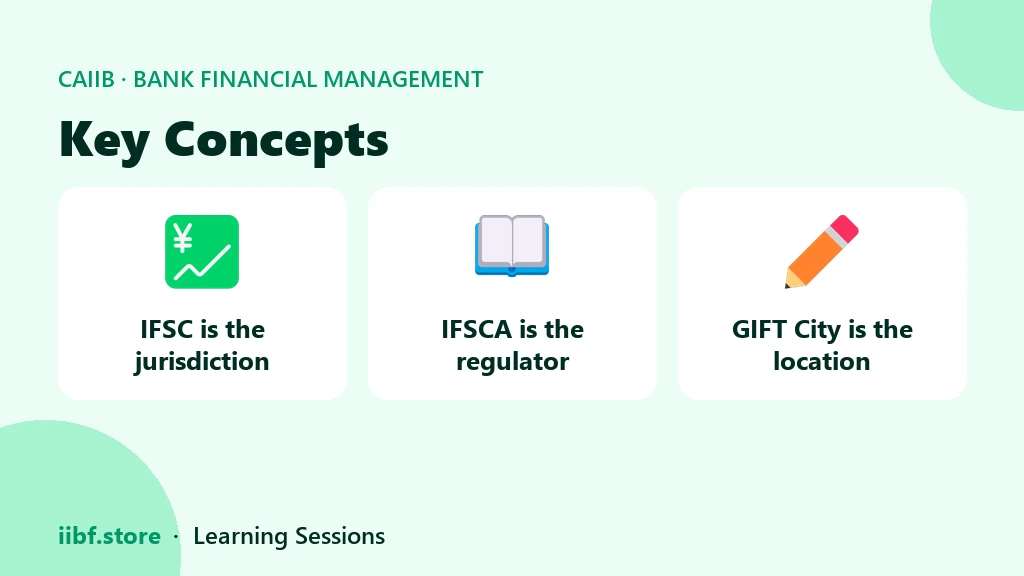
An International Financial Services Centre is a jurisdiction carved out inside India where cross-border financial products and services are offered. Legally it is set up under Section 18 of the Special Economic Zones Act, 2005. Geographically it sits on Indian soil. Financially, however, it is treated as offshore — the money that flows in and out is foreign currency moving across borders, and a unit inside the centre is generally treated as a person resident outside India for exchange-control purposes.
India has exactly one operational IFSC today: GIFT IFSC, inside Gujarat International Finance Tec-City at Gandhinagar. That single fact is worth memorising, because a favourite objective question is simply "How many IFSCs are operational in India?"
Why did the country need one at all? Take the example from the video. An Indian company wants a foreign-currency loan. It wants to raise funds from overseas investors. It wants to list a bond on an international exchange. Before GIFT IFSC, that business was routed through Singapore, Dubai, Mauritius or London — Indian borrowers, Indian assets, Indian risk, but the fees, the jobs and the tax all landed abroad. An IFSC brings that activity home without forcing it through the domestic rulebook that was never designed for dollar-denominated wholesale business.
IFSCA is the referee, not the ground
Once you accept that an IFSC is a territory, the next question answers itself: somebody has to police the banks, brokers, insurers and fund managers operating inside it. That somebody is the International Financial Services Centres Authority. IFSCA was established on 27 April 2020 under the International Financial Services Centres Authority Act, 2019, and it is headquartered at GIFT City, Gandhinagar.
The word that carries the marks is unified. Outside the centre, Indian finance is policed sector by sector — the RBI for banking, SEBI for capital markets, IRDAI for insurance, PFRDA for pension funds. Inside it, those four sets of powers are consolidated into one authority. A bank branch, a stock exchange, an insurance office and a fund house standing on the same street in GIFT City all answer to IFSCA. You can confirm the mandate directly on the regulator's own site at ifsca.gov.in.
Note carefully what this does not mean. RBI has not been replaced. Step one metre outside the boundary and the RBI, SEBI, IRDAI and PFRDA are back in charge exactly as before. The unification is geographic, not national. Candidates who write "IFSCA replaced RBI" in a descriptive answer lose the mark cleanly.
| Point of difference | IFSC | IFSCA |
|---|---|---|
| What it is | A jurisdiction / financial centre | A statutory regulator |
| Governing law | Section 18, SEZ Act, 2005 | IFSCA Act, 2019 |
| Came into being | GIFT IFSC, India's first and only operational centre | Established 27 April 2020 |
| Location | GIFT City, Gandhinagar, Gujarat | Head office at GIFT City, Gandhinagar |
| Role | Hosts cross-border financial activity | Develops and regulates that activity |
| Analogy | The stadium | The referee |
Where a banker actually meets the centre: the IBU
For a CAIIB candidate the practical entry point is the IFSC Banking Unit. An IBU is a banking unit that an Indian bank or a foreign bank sets up inside the centre. It is not a separate company; it is a unit of the parent bank, but it books international business and operates in foreign currency.
Two numbers are worth carrying into the hall. First, the parent bank must provide and maintain a minimum capital of USD 20 million for the IBU's operations at all times, as laid down in the IFSCA Banking Handbook. Second, authorisation, supervision and day-to-day regulation of that IBU sit with IFSCA — banking, market conduct, insurance and fund management alike. That single sentence is the practical payoff of understanding IFSC and IFSCA as two different things: the IBU sits in the centre, and it answers to the Authority.
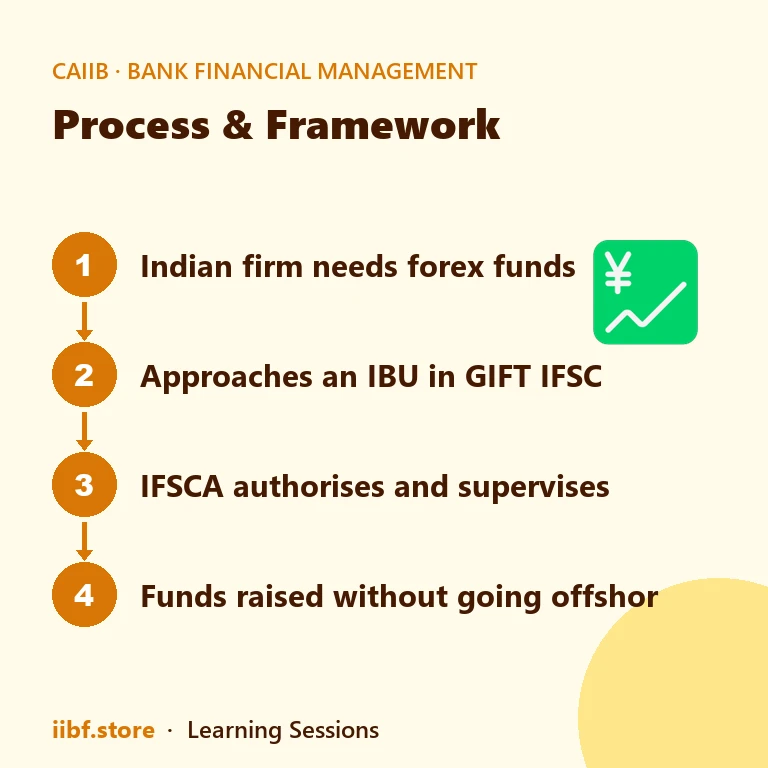
Walk one transaction through it. Suppose an Indian manufacturer needs a USD 40 million term loan. It approaches the IBU of a large Indian bank inside GIFT IFSC. The IBU lends in dollars, funds itself in dollars, and books the exposure on its own balance sheet. The Authority has licensed that IBU, sets its prudential norms and receives its returns. The borrower gets offshore pricing without leaving India, and the fee income stays in the domestic banking system. That is the entire policy argument for GIFT IFSC in one paragraph, and it is exactly the kind of applied question BFM likes to set.
How BFM turns this into marks
The traps are predictable once you have seen them. The first is the abbreviation itself — the centre versus the eleven-character bank branch code you use for NEFT. The exam will not clarify which one it means; context will. If the sentence is about cross-border transactions, it is the centre. If it is about routing a payment, it is the code.
The second trap is the date pairing. The Act is of 2019; the Authority came into existence on 27 April 2020. Options routinely swap them. The third is the regulator list — four regulators consolidated, not three, and PFRDA is the one candidates forget. The fourth is the SEZ linkage; the centre is created under the SEZ Act, 2005, not under the Banking Regulation Act or FEMA, even though FEMA governs how residents transact with it.
A clean revision loop helps here. Watch the short once, write the six-row comparison table above from memory, then attempt a mixed set on iibf.store mock tests so the recall is tested under time pressure rather than in a comfortable armchair. If your BFM module plan is still loose, the study planner will slot forex and international banking into a realistic weekly schedule, and the full CAIIB course material carries the surrounding chapters — correspondent banking, FEMA residential status, LRS and ECB — that the examiner tends to bundle with this topic. Keep an eye on the current RBI rates page too, because BFM questions love a live number.
Sum it up in one line you can carry into the hall: IFSC and IFSCA are place and police. The centre is the offshore-style jurisdiction on Indian soil at GIFT City; the Authority is the single unified regulator that licences and supervises everything inside it. Once that distinction between IFSC and IFSCA sticks, every follow-up question about IBUs, foreign-currency lending or international listings has an obvious home.
Frequently asked questions
Is IFSC in CAIIB BFM the same as the IFSC code on my cheque book?
No. In BFM it stands for International Financial Services Centre — a jurisdiction set up under Section 18 of the SEZ Act, 2005. The eleven-character code on a cheque book is the Indian Financial System Code used to route NEFT, RTGS and IMPS payments. Same letters, unrelated concepts.
When was IFSCA established and under which Act?
IFSCA was established on 27 April 2020 under the International Financial Services Centres Authority Act, 2019. Its head office is at GIFT City, Gandhinagar, Gujarat. Remember the pairing: Act of 2019, Authority from 2020.
Which regulators' powers does IFSCA exercise inside the centre?
Four — the RBI, SEBI, IRDAI and PFRDA. Within the centre, IFSCA acts as a unified regulator across banking, capital markets, insurance and pension funds. Outside it, those four regulators continue to operate normally in their own domains.
What is the minimum capital a bank must provide for an IFSC Banking Unit?
The parent bank must provide and maintain a minimum of USD 20 million of capital for the IBU's operations at all times, as specified in the IFSCA Banking Handbook, unless the Authority specifies another level.
More short revision reads for CAIIB and JAIIB are collected on the iibf.store blog, and every one of them is built around a five-minute clip like this one.
Prefer revising from a printed book?
Chapter-wise books with MCQs after every chapter — minimal pages, complete coverage, delivered anywhere in India. Every book has a free sample to read first.









Quick quiz on this topic
5 exam-style questions from our free test bank — check yourself before you move on.
Practice this topic
Take a free mock test, download chapter PDFs, or watch a video class — all included on iibf.store.