Inside the CISB Exam Preparation Book: 20 Chapters, 8 Modules
It is 10 pm. The branch is finally quiet, you have eaten late, and the Certified Information System Banker syllabus is open in front of you. Technology, security, audit, legal framework, business continuity. None of it looks small, and you have maybe an hour of real concentration left. If you have postponed an IIBF certificate before because the material felt shapeless, you are not alone.
The fix is rarely more hours. It is a clear picture of what you are walking into. So this article is a guided tour of the CISB exam preparation book we publish: how it is organised, what a single chapter looks like, and what else is bundled with it. You can use the tour as a map even if you never buy anything.
Why a map matters more than motivation
Most tired candidates do not fail because they cannot understand networks or audit trails. They fail because they study in the order the material happens to arrive, give three weeks to the first module, and meet the last modules in the final weekend. A map fixes that. Once you know there are eight modules and twenty chapters, you can divide your available weeks honestly.
Here is a method that costs nothing:
- Count your realistic study hours per week, not your hopeful ones.
- List every chapter on one sheet of paper and tick it only after you have attempted questions on it.
- Give lighter weight to short modules and more time to the module with the most chapters.
- Keep one buffer week at the end for revision and timed practice.
Nothing in that list needs a CISB exam preparation book. But a book whose structure is already laid out makes the sheet of paper easy to fill, which is why we start the tour with the structure.
How the CISB exam preparation book is organised
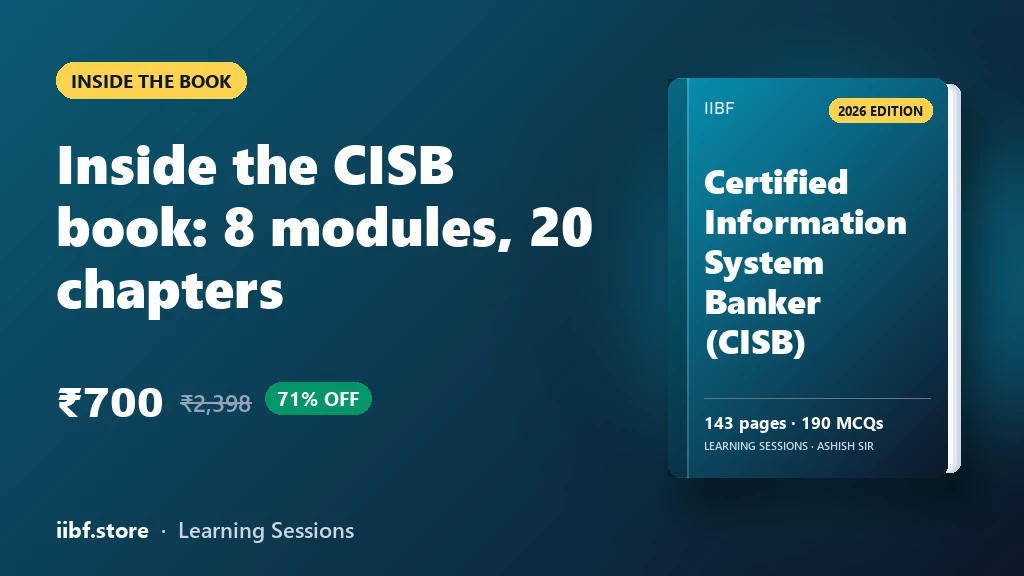
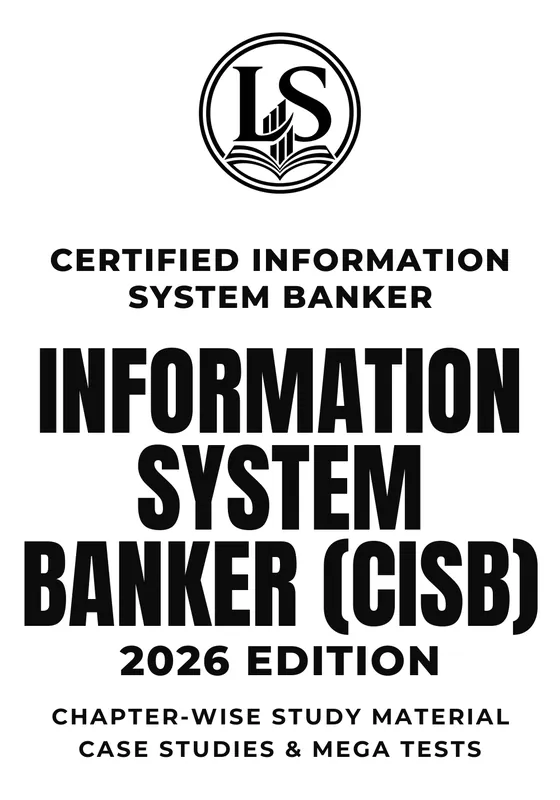
The CISB printed book is a 2026 edition running to 143 pages. It is split into 20 chapters across eight modules, labelled A to H, and carries 190 multiple-choice questions. Those are compact numbers on purpose: it is meant to be finished, not admired on a shelf.
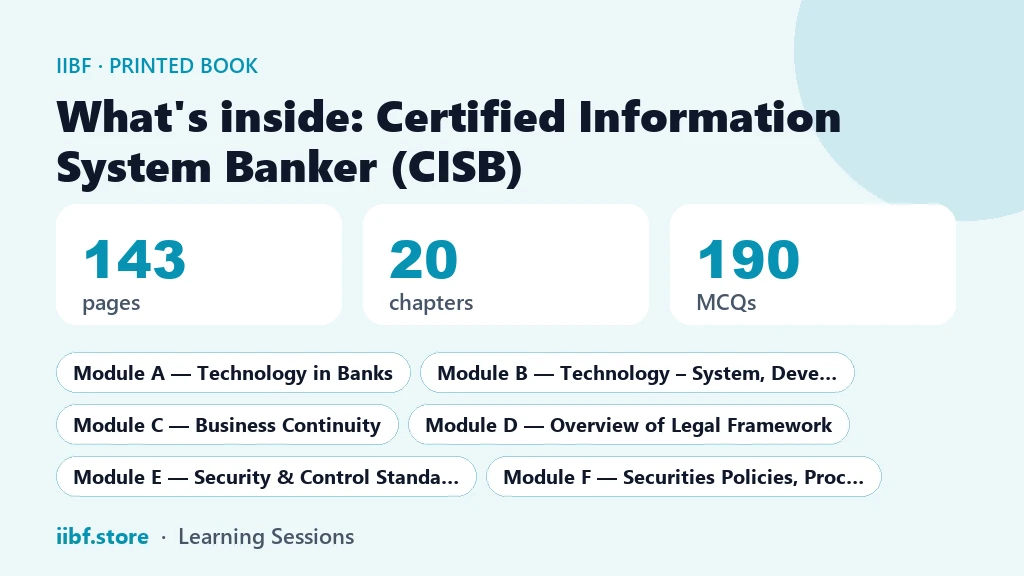
The modules follow a sensible arc, from how technology sits inside a bank, to how systems are built, to how they are protected, audited and kept running.
Module A to D: technology, systems and the legal backdrop
Module A, Technology in Banks, is the largest, with six chapters: Banking Environment and Technology, Overview of Processing Infrastructure, Accounting Information System, Information Organization and Management, Risk Associated with Technology in Banking, and Audit Function and Technology. If you work in a branch, much of this will feel familiar in practice, only now with proper vocabulary.
Module B covers the technology itself in four chapters: Hardware Architecture, Software Platforms, System Development Life Cycle and Computer Networks. Module C is a single chapter on Business Continuity and Disaster Recovery Planning. Module D is a single chapter titled Online Transactions: Concepts, Trends and Legal Implications, your overview of the legal framework.
Module E to H: security, audit and updates
Module E, Security and Control Standard in Banking, has two chapters: Security: Risk, Architecture and Management, and Controls and Quality, Security and Continuity Standards. Module F, Securities Policies, Procedure and Controls, has three: Developing and Reviewing Security Policies and Control Standards, Compliance and Incident Management, and Network Security.
Module G pairs Information Security Administration and Operational Procedures with Information Systems Audit. Module H is a one-chapter section, Post-Cutoff Dated Updates, for regulatory and standards changes that arrived after the main material was fixed.
The module map at a glance
If you like seeing it in one place, this table shows how the twenty chapters are spread. Use it as your planning sheet while you read the CISB exam preparation book.
| Module | Theme | Chapters |
|---|---|---|
| A | Technology in Banks | 6 |
| B | Systems, Development, Process, Implementation | 4 |
| C | Business Continuity | 1 |
| D | Overview of Legal Framework | 1 |
| E | Security and Control Standard in Banking | 2 |
| F | Security Policies, Procedure and Controls | 3 |
| G | Information Security and IS Audit | 2 |
| H | Regulatory and Standards Updates | 1 |
Notice how uneven it is. Modules A and B hold ten of the twenty chapters, so half your reading effort sits in the first two modules. Modules C, D and H are one chapter each, which means they can be finished in a single sitting. That alone changes how you schedule your weeks.
What one chapter looks like
A tour is only useful if you can picture the actual reading. Every chapter in the book follows the same shape, so you learn the rhythm once and it holds for all twenty.
- Concise notes. The concept in plain language, trimmed to what is exam-relevant. No padding, no pages of history.
- Key points. The lines you should be able to repeat without looking: definitions, lists, distinctions between similar terms.
- MCQs. Practice questions that test the same chapter, so you know within minutes whether the notes actually stayed.
Take Information Systems Audit as an example. You read the notes once, mark the key points, then go straight to the questions. The ones you get wrong tell you exactly which paragraph to reread. That loop, notes then key points then questions, is far better than reading five chapters and hoping.
One honest limit: a book alone will not give you exam-hall speed. Reading builds understanding; only timed practice builds pace. That is why the free mock tests at iibf.store/tests are worth using alongside any book you choose.
The extras that come with the CISB exam preparation book
Beyond the 190 chapter questions, the book lists two additional practice resources.
30 case studies
The case studies carry 120 questions between them. Case-style questions ask you to apply a concept to a scenario, such as a security incident or an audit finding, instead of recalling a definition. They are the best test of whether you understand a topic or have merely memorised it.
5 mega tests
The five mega tests total 500 questions. Save these for the last stretch. Attempt one under a timer, review every wrong answer, and only then attempt the next. Doing all five in one weekend wastes them.
A four-step way to work through it
You do not need an elaborate plan. Four steps cover the whole book and fit around a branch job.
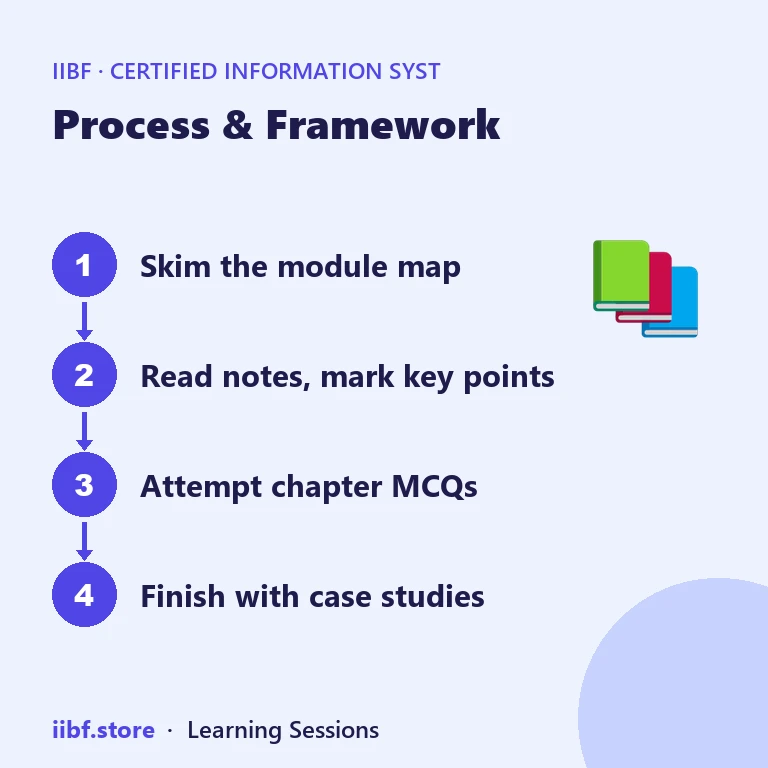
- Skim the module map. Spend one evening reading only the module and chapter titles. You are building a skeleton, not learning yet.
- Read the notes and mark key points. One chapter per sitting is a fair target for most working candidates. Stop when the chapter ends, not when your energy does.
- Attempt the chapter MCQs the same day. Same-day recall is when mistakes are cheapest to fix.
- Finish with case studies and mega tests. Use these in the last weeks to check application and speed.
If you follow this with the CISB exam preparation book in hand, a chapter a day on weekdays would cover all twenty in a little over a month, with room for revision. Adjust to your own shifts and be kind to yourself on heavy branch days.
Free material to pair with it
Before you spend anything, look at what is free. The free material library has PDFs you can read today, and the free mock tests let you gauge your starting level. You can also browse the full books catalogue to compare. And for the exam schedule, syllabus notices and eligibility, always check the official IIBF website, because that is the only source that is current for the upcoming exam cycle.
Who gets the most out of this CISB exam preparation book
Based on its structure, the book suits a few kinds of candidates best:
- Branch staff new to IT topics. If networks, SDLC and IS audit feel like another language, the plain-language notes and short chapters lower the entry barrier.
- Candidates short on time. At 143 pages and 20 chapters, it can realistically be finished alongside a full-time job.
- People who learn by testing themselves. With 190 chapter MCQs, 30 case studies and 5 mega tests, practice is built in rather than an afterthought.
- Anyone who has felt buried by large reference volumes. A compact book gives you one complete pass, which beats a half-read big one.
It will suit you less if you want deep technical engineering detail. This is a certification-oriented book and aims at exam-ready understanding. If that is what you need, the CISB book page has the full details and a free sample, so you can judge the writing before you decide. It is priced at ₹700 against an MRP of ₹2,398, but prices may change, so treat the book page as the current source.
Frequently asked questions
How many chapters and questions does the book have?
It has 20 chapters across eight modules (A to H), 143 pages in the 2026 edition, and 190 multiple-choice questions. The extras listed are 30 case studies with 120 questions and 5 mega tests with 500 questions.
Can I preview it before ordering?
Yes. A free sample is available on the book page, so you can read a few pages and judge the style first.
Is one book enough to clear the exam?
A book gives you understanding and a structured pass through the syllabus. Exam-hall speed comes from timed mock tests, so pair it with practice. Check the official IIBF website for the latest exam details.
What does Module H cover?
Module H is a single chapter, Post-Cutoff Dated Updates, which collects regulatory and standards updates that came after the main content was fixed.
Prefer revising from a printed book?
Chapter-wise books with MCQs after every chapter — minimal pages, complete coverage, delivered anywhere in India. Every book has a free sample to read first.








Practice this topic
Take a free mock test, download chapter PDFs, or watch a video class — all included on iibf.store.