PCCFM Study Book: A Chapter-by-Chapter Look Inside
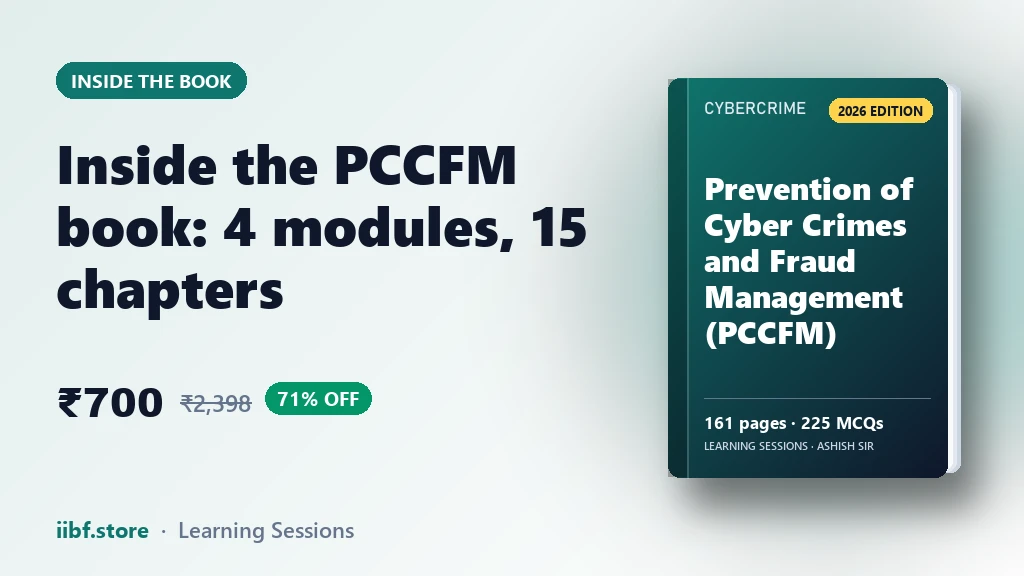
It is 9:40 at night. The branch closed hours ago, the day's cash and complaints are behind you, and you have promised yourself half an hour of study before sleep. The Prevention of Cyber Crimes and Fraud Management certificate looks important, but the topic list feels scattered: hackers, cards, payment systems, laws, institutions. Where do you even begin? A good PCCFM study book should answer that before you open the first page, by showing you a clear order of reading.
This article is a guided tour. We will look at how the book is organised, what one chapter looks like, what the extras are, and how you can use all of it in thirty-minute slots. Even if you never buy anything, the section on planning and the module table will help you organise your own preparation.
Why the layout of a certificate book matters more than its size
When you study after a full day at work, your enemy is not difficulty. It is friction. Every time you open a book and have to figure out where you stopped, which topics belong together and what to revise first, you lose ten of your thirty minutes. A well-organised book removes that friction.
Cyber crime is also a subject where topics blur into each other. A phishing question can touch channels, modus operandi, card fraud and the IT Act in a single paragraph. If you read chapters in random order, everything feels like one big pile of terms. If you read them in a sensible order, each chapter gives you a hook for the next.
So before you judge any book, ask three questions:
- Can I see the whole syllabus in one glance, grouped into a few big blocks?
- Is each chapter small enough to finish in one or two sittings?
- Does each chapter end with practice, so I know whether it stayed in my head?
Keep these three questions in mind as we go through the PCCFM study book and see how it answers them.
How the PCCFM study book is organised: four modules, fifteen chapters
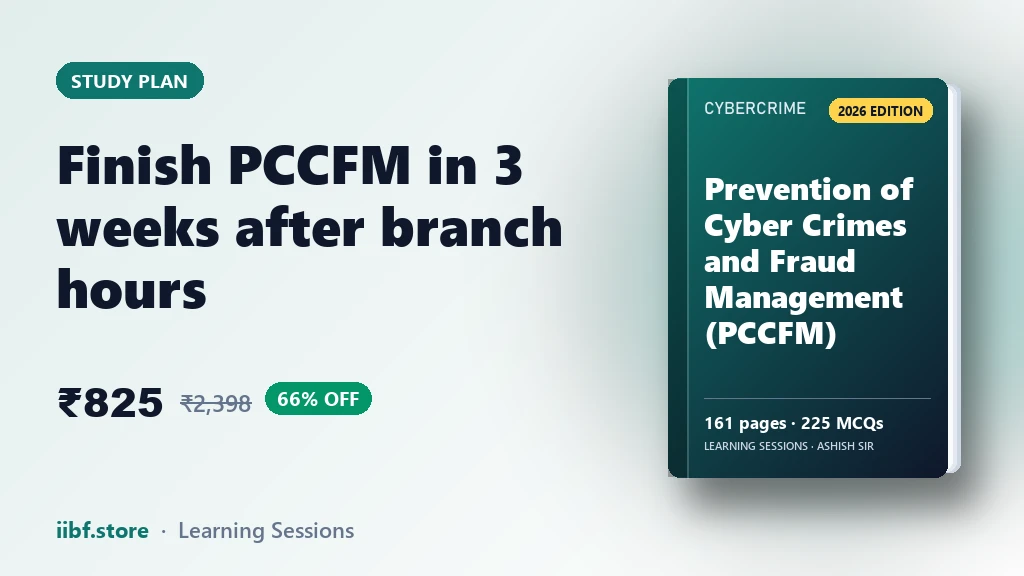
The book runs to 161 pages across 15 chapters, grouped into four modules. That is a deliberately compact size. The 2026 edition is meant to be read, not just kept on a shelf. Here is the full map, so you can picture where each topic sits.
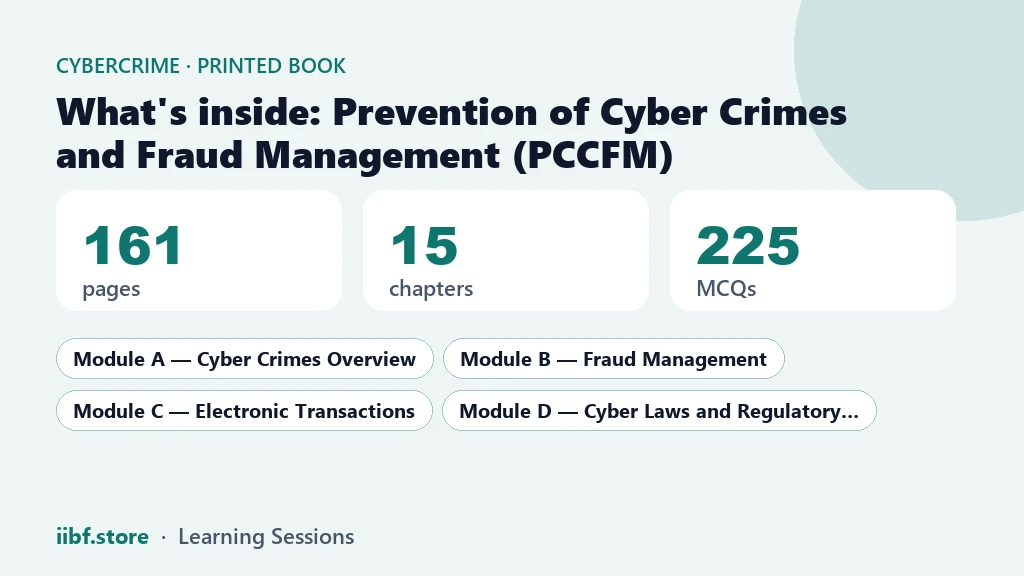
| Module | Chapters | What it covers |
|---|---|---|
| Module A: Cyber Crimes Overview | 5 | Concepts and techniques, channels, modus operandi, digital vulnerabilities, computer hackers |
| Module B: Fraud Management | 2 | Computer fraud protection, incident management of cyber crimes |
| Module C: Electronic Transactions | 3 | Online transactions, global payment processing, electronic card frauds |
| Module D: Cyber Laws and Regulatory Compliance | 5 | Cyber laws in India, taxation issues, human traits, regulatory compliance, national and international institutions |
Module A: first understand the enemy
Module A is the largest block, with five chapters: Introduction to Cyber Crime (concepts and techniques), Channels of Cyber Crimes, Modus Operandi of Cyber Crimes, Digital Vulnerabilities and Computer Hackers. Read it as a story. What is cyber crime, through which doors does it enter, how do criminals actually operate, what weaknesses do they exploit, and who are the people doing it.
For a banker, this module is the vocabulary. Once these terms are clear, the rest of the syllabus stops sounding like jargon.
Module B: what you do about it
Module B has just two chapters, Computer Fraud Protection and Incident Management of Cyber Crimes. It is short but very practical. Protection is what you do before something goes wrong; incident management is what you do after. Many working bankers find this the module they relate to most, because it mirrors what happens when a customer walks in and says money has gone from their account.
Module C: where the money actually moves
Module C covers Online Transactions, Global Payment Processing and Electronic Card Frauds. This is where your day-to-day banking knowledge helps you most. If you already handle cards, UPI or internet banking complaints, you will move faster here and can spend the saved time on the other modules.
Module D: laws, compliance and institutions
Module D is the other five-chapter block: Cyber Laws in India, Electronic Transactions and Taxation Issues, Human Traits, Regulatory Compliance, and National and International Institutions. This is the module most candidates postpone because it feels like memorisation. We will come back to how to handle it in the plan below.
What a single chapter looks like when you sit down with it
A tour of modules is useful, but what you really want to know is what happens when you open page one of a chapter. The PCCFM study book follows a simple rhythm inside every chapter: concise notes first, then the key points to remember, then multiple-choice questions to test yourself.
Here is how that rhythm helps a tired reader.
- Concise notes. The chapter is written as notes, not as a textbook essay. You read the idea, see the terms, and move on. There is no need to wade through long paragraphs to find the one line that matters.
- Key points. After the notes, the important points are pulled together. This is the part you will return to the night before the exam. If you underline here and not in the notes, your revision becomes a ten-minute job per chapter.
- MCQs. Each chapter ends with questions. Across the book there are 225 of them. Attempting these right after reading is the single best way to find out whether you understood or only recognised the words.
A practical tip: do not read the MCQs after a week. Read the notes, then attempt the questions the same evening, even if you are sleepy. The mistakes you make while tired are the ones the exam will find again.
An example evening with one chapter
Suppose tonight is Channels of Cyber Crimes from Module A. You spend about fifteen minutes reading the notes, five minutes on the key points, and ten minutes on the questions. Mark every question you got wrong or guessed. Tomorrow, before you start the next chapter, spend three minutes on only those marked items. That small habit does more than any extra hour on Sunday.
The extras: case studies and mega tests
Beyond the chapters, the book includes two extras listed on its page: 20 Case Studies carrying 80 questions, and 5 Mega Tests carrying 500 questions.
Why do these matter? Because cyber crime and fraud questions are rarely pure theory. They are often scenarios. A customer receives a call, a link, an OTP request, a card transaction from another country. What is the right response, and which provision or process applies? Case studies train exactly that way of thinking, and the mega tests let you check the whole syllabus in one go after you have finished all four modules.
When to use each extra
- Use the case studies after each module, to join the chapters together.
- Keep the mega tests for the last stretch, once you have completed every chapter at least once.
- Do not treat any single mega test as a prediction. Treat it as a mirror that shows your weak chapters.
For more free practice before you decide anything, you can try the free mock tests and browse the free study material that are already on the site.
A plan to use the PCCFM study book around a full-time job
Here is a simple method that works for people with limited hours. It does not depend on the book, though the book fits it well.
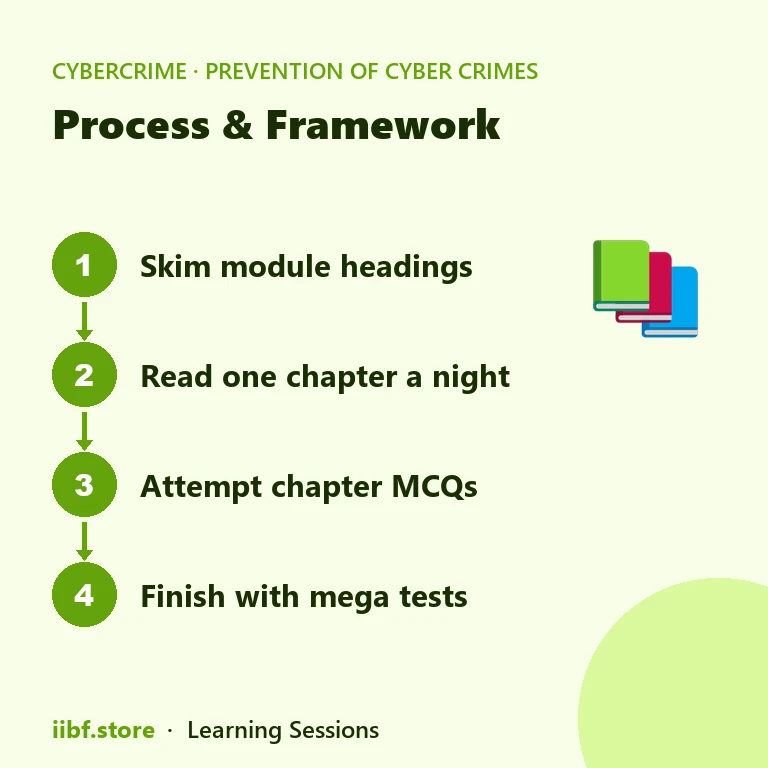
- Skim the module headings first (one evening). Read only the module names and chapter titles. You are building a map in your head, nothing more.
- One chapter per night. With 15 chapters, that is roughly three weeks of weekday evenings, and you can double up on weekends. Do not aim to finish a module in one sitting.
- Attempt the chapter MCQs the same night. Mark the wrong ones. Revisit them the next day.
- Finish with the mega tests. Once all four modules are done, use the mega tests to find weak chapters, then reread only those.
How to handle Module D without losing heart
The laws and institutions chapters feel dry. Try this: for each law or institution, write one line answering three things, what it is, who it applies to and what a banker does with it. If you cannot write that line, the chapter is not finished. Short, personal notes are far easier to revise than the original text.
One honest limit
A book gives you structure and practice questions. It does not give you exam-hall speed. For that, you need timed practice, so pair the book with mock tests, and always check the latest syllabus and notices on the official IIBF website, including the schedule for the upcoming exam cycle.
Who gets the most out of this book
No book suits everyone, so here is a fair view of who benefits most from the PCCFM printed book.
- Branch and operations staff who handle customer complaints about fraud and want a structured way to learn the framework behind them.
- Candidates with little time who prefer one compact book of 161 pages over a stack of scattered notes.
- People who learn by testing themselves, since the book is built around MCQs, case studies and mega tests.
- Anyone who likes to read on paper after a day of screens.
It may suit you less if you want video lectures, or if you only study on a phone. In that case, start with the free resources on the site and see how far they take you. You can also explore other titles on the books page.
Price and how to decide
At the time of writing, the book is listed at ₹700 against an MRP of ₹2,398. Prices may change, so please treat the book page as the current source. If you want to judge the writing style first, the page offers a free sample, and reading a few pages is the best test of whether the notes style suits you.
Whatever you choose, the point of this article stands: pick a clear order, read one chapter at a time, test yourself the same evening, and revise from the key points. That method is what turns a PCCFM study book into a passed certificate. For more preparation guides, visit the iibf.store blog.
Frequently asked questions
How many modules and chapters does the book have?
The book has four modules and 15 chapters in 161 pages. Module A has five chapters, Module B two, Module C three and Module D five.
Does the book include practice questions?
Yes. The book carries 225 MCQs across its chapters, and its extras include 20 case studies with 80 questions and 5 mega tests with 500 questions.
Can I see a sample before ordering?
Yes, the book page has a free sample you can read before you decide. Prices may change, so check the book page for the current price.
Is the book enough on its own?
It gives you structured notes and a lot of practice, but exam-hall speed comes from timed mocks. Pair it with free mock tests and check the official IIBF website for the latest syllabus and exam schedule.
Prefer revising from a printed book?
Chapter-wise books with MCQs after every chapter — minimal pages, complete coverage, delivered anywhere in India. Every book has a free sample to read first.











Practice this topic
Take a free mock test, download chapter PDFs, or watch a video class — all included on iibf.store.