Inside the CWMP Exam Preparation Book: 71 Chapters Tour
It is 10 pm. You have been at the counter, or in a review meeting, since morning, and the CWMP syllabus is open on your phone. Three papers, wealth management, tax, insurance, retirement, estate planning. Where do you even start? Most candidates do not fail because the subject is too hard. They fail because they never found a way to cut it into pieces small enough to finish on a tired weeknight. This article is a plain tour of one tool for that job, the CWMP exam preparation book, so you can picture exactly how you would use it before you decide anything.
Even if you never buy it, the way we break the syllabus down below will work with any material. Read it as a method first and a book review second.
First, how a CWMP syllabus is shaped
The Certified Wealth Management Professional (CWMP) is an IIBF certification, and the content is organised as three papers, each split into modules. That structure is your friend. A module is the right unit of study, because it is big enough to feel like progress and small enough to finish in one to two weeks of evenings.
The mistake most people make is treating the syllabus as one long river. They start at Chapter 1, get stuck in the economics and the time value of money, and run out of steam before they ever reach insurance or estate planning, which are often the topics that quietly decide a result. Think in modules, not in a single wall of 71 chapters.
For the official syllabus, eligibility and the upcoming exam cycle schedule, always check the IIBF website. We do not quote dates here because they change.
How the book is organised: 3 volumes, 8 modules, 71 chapters
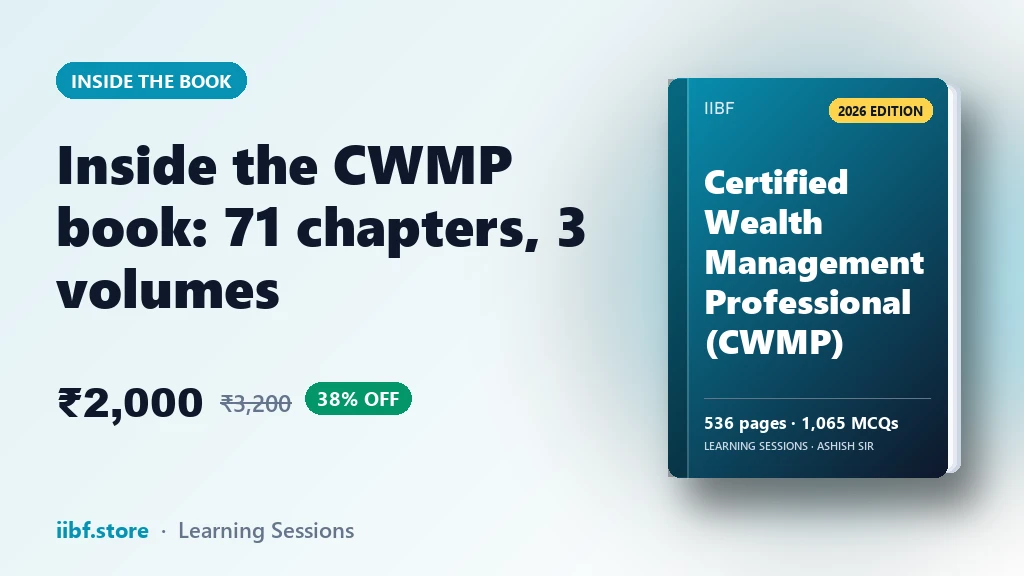
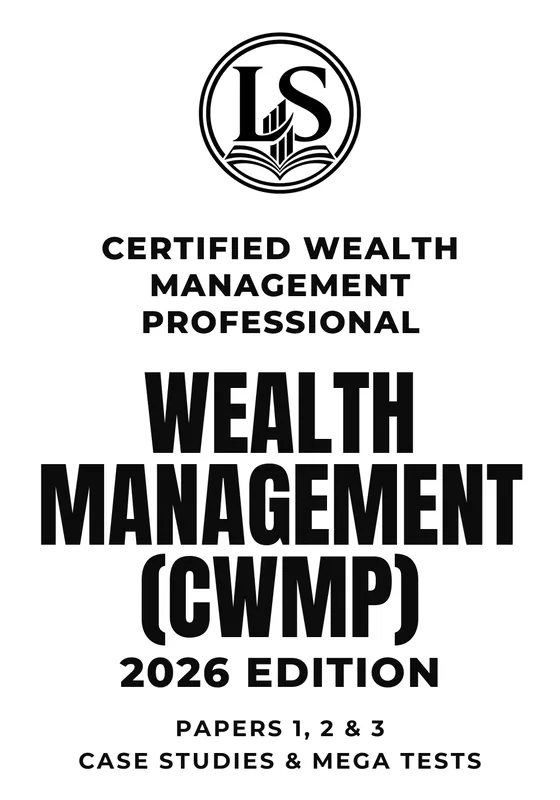
The CWMP printed book (2026 edition) runs to 536 pages and comes as three volumes, one for each paper. Inside them sit 8 modules and 71 chapters, followed by 1,065 practice questions. Here is the map.
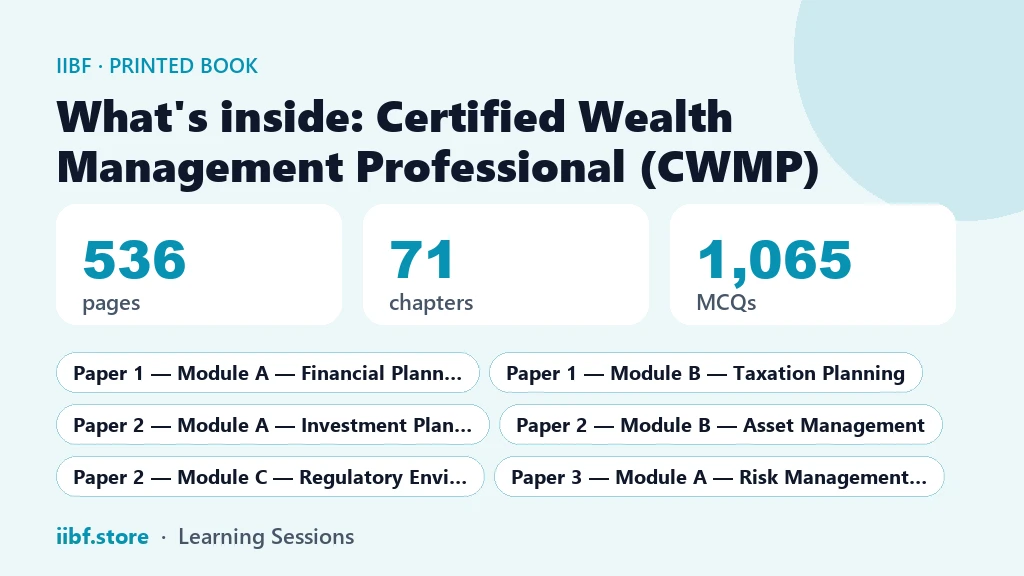
| Volume / Paper | Module | Chapters |
|---|---|---|
| Paper 1 | Module A: Financial Planning | 10 |
| Paper 1 | Module B: Taxation Planning | 13 |
| Paper 2 | Module A: Investment Planning | 17 |
| Paper 2 | Module B: Asset Management | 3 |
| Paper 2 | Module C: Regulatory Environment, Compliance and Law | 6 |
| Paper 3 | Module A: Risk Management and Insurance | 10 |
| Paper 3 | Module B: Retirement Planning | 6 |
| Paper 3 | Module C: Estate Planning | 6 |
Add the last column and you get 71. The weight is not even, and that is useful information. Investment Planning alone holds 17 chapters, and Taxation Planning holds 13. If you are short of time, you now know where the bulk of your reading sits. Asset Management is only three chapters, so it is a quick win once the rest is in place.
Paper 1: Financial Planning and Taxation Planning
Volume one starts with the Indian economic environment and financial markets, moves through the financial planning process, communication with clients, marketing of financial products and behavioural finance, and then covers the statistical tools (time value of money, annuities, IRR and NPV) that everything later depends on. The taxation module then walks through residency, salary, house property, capital gains, other sources, exemptions, deductions, business income, computation and filing, taxation of other products and an introduction to international taxation.
Paper 2: Investment, Asset Management and Regulation
Volume two is the heaviest. Investment Planning runs from objectives, constraints and suitability through risk, equity, fixed income, derivatives, mutual funds, performance measurement, portfolio theory, asset allocation and alternative investments. Asset Management covers cash and credit management, financial modelling with ESG factors, and Portfolio Management Services. The regulatory module closes it with the regulatory environment, relevant Acts, customer service, grievance redressal and ethics.
Paper 3: Insurance, Retirement and Estate Planning
Volume three covers risk management, life, general and health insurance, the regulator and intermediaries, then retirement needs, cash flow sources, withdrawal strategies, pension reforms and gratuity, and finally estate planning: succession law, wills, administration of estate, will substitutes, gifts, trusts and family arrangements.
What one chapter looks like on the page
Every chapter follows the same rhythm: concise notes first, then key points, then MCQs. That sameness matters more than it sounds. When you are tired, you do not want to decode a new layout each evening. You open the chapter, you know what comes next, and you start.
- Concise notes. The chapter content trimmed to what you need to read, not a full textbook rewrite. This is the part you read once, slowly, with a pen.
- Key points. The compact revision layer. This is what you reread the night before a mock and on the morning of the exam.
- MCQs. Questions on the same chapter, so you test yourself while the reading is still fresh. Across the book there are 1,065 of them.
A chapter such as "Basics of Financial Planning" or "Health Insurance" is meant to fit into a single evening sitting, with the MCQs done the same night or the next. If a chapter is long, such as the multi-part ones on asset classes or life insurance, the book already splits it into parts, so you never face an intimidating block.
The extras: case studies and mega tests
Besides the chapters, the book lists two extras that change how you can use it in the last weeks.
- 90 Case Studies (360 questions). Wealth management is applied work. You are given a client situation and asked what to do. Practising on case studies trains you to read a scenario, pick out the numbers and the constraint, and answer calmly.
- 15 Mega Tests (1500 questions). Full-length practice for when the chapters are done. This is where you check stamina and timing, not just knowledge.
Be honest with yourself about one limit. A book gives you coverage and practice, but exam-hall speed only comes from timed attempts. Pair the reading with free mock tests at iibf.store/tests and keep the mega tests for the final stretch.
A four-step routine to use this CWMP exam preparation book
Here is a routine you can run on weeknights of 60 to 90 minutes. It works with any CWMP exam preparation book, but the fixed chapter layout makes it especially easy to follow with this one.
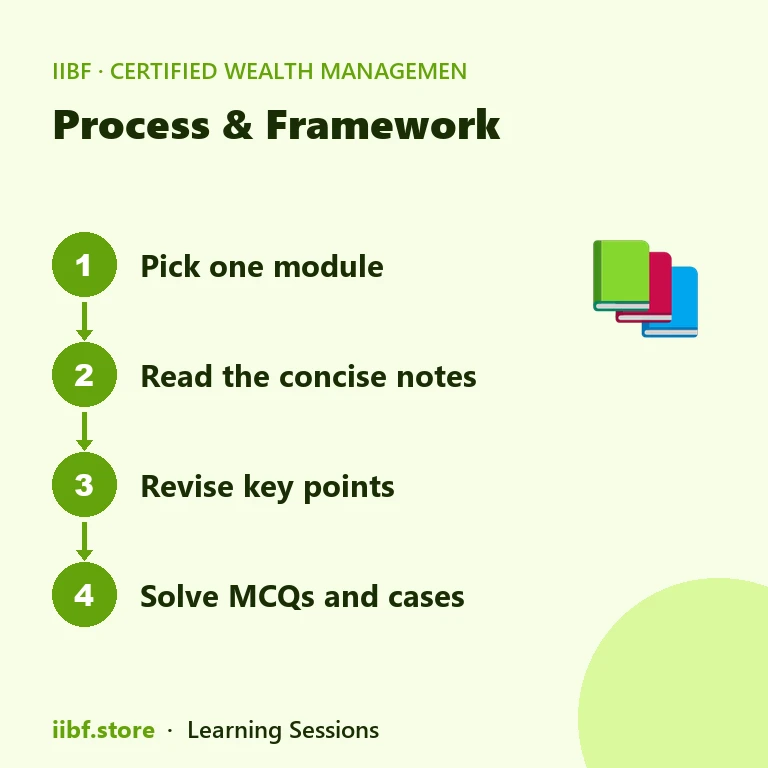
- Pick one module and fix a finish date. Do not start Chapter 1 and hope. Choose a module, count its chapters, and divide by the evenings you actually have free. Be realistic about branch overtime.
- Read the concise notes, once, with a pen. Underline only what you could not have guessed. If you underline everything, you have underlined nothing.
- Revise the key points the next evening. Five to ten minutes at the start of the next session, before opening the new chapter. This is the cheapest memory work you can do.
- Solve the MCQs, then log your errors. A one-line note per wrong answer: what you assumed, and what was true. Review that log every weekend.
A sensible module order
You are free to read in book order, but many candidates do better by starting with the module they already half-know from their job. If you work in a branch, Insurance or Investment products may feel familiar. Take an early win, build the habit, then tackle the heavier unfamiliar ones such as Taxation Planning or Estate Planning. Leave the statistical tools chapters until you can give them a full, rested evening, because time value of money, IRR and NPV are used again later.
Who gets the most out of it
The book is a good fit if you:
- prefer reading on paper, underlining and flipping back, rather than scrolling on a phone at midnight;
- want one structured source across all three papers instead of stitching together scattered notes;
- learn by doing questions, and want volume to practise on: 1,065 MCQs, 360 case-study questions and 1500 mega-test questions;
- are working full time and need each chapter to be short enough to finish in one sitting.
It is a weaker fit if you want a long classroom-style explanation of every concept from zero, or if you only read on screen. In that case, start with the free PDFs at iibf.store/free-material and see what suits you.
Prices can change, so the book page is always the current source. At the time of writing, the CWMP book page lists it at ₹2,000 against an MRP of ₹3,200, which is 38% off. There is a free sample you can read before you order. If you want to compare it with other titles first, browse all our books.
The bottom line
Whatever you use, the principle is the same: break CWMP into modules, give each module a finish date, read once, revise the key points, and test on MCQs and cases. A CWMP exam preparation book earns its place only if it makes that routine easier, and a fixed notes, key points and questions layout across 71 chapters does exactly that. Read the free sample, check the module list against your own weak areas, and decide calmly. For more preparation guides, see the iibf.store blog.
Frequently asked questions
How many chapters and questions are in the CWMP book?
The 2026 edition has 536 pages, 71 chapters across 8 modules, and 1,065 questions. It also lists 90 case studies (360 questions) and 15 mega tests (1500 questions) as extras.
Is the book one volume or several?
It comes as three volumes: Papers 1, 2 and 3. That makes it easier to carry and to plan, since each volume matches one paper of the certification.
Can I read a sample before buying?
Yes. The book page has a free sample. Read a chapter, see whether the notes, key points and MCQs layout works for you, and then decide.
Is the book enough on its own to clear the exam?
No single book guarantees a result. Use it for coverage and practice, add timed mock tests for exam-hall speed, and check the official syllabus and schedule on the IIBF website.
Prefer revising from a printed book?
Chapter-wise books with MCQs after every chapter — minimal pages, complete coverage, delivered anywhere in India. Every book has a free sample to read first.















Practice this topic
Take a free mock test, download chapter PDFs, or watch a video class — all included on iibf.store.
Keep reading