Inside the CCFE foreign exchange book: modules, chapters and MCQs
It is 9:40 pm. The branch closed hours ago, the day's pending items are finally off your desk, and you open the foreign exchange syllabus. Forward contracts, FEMA remittances, UCP 600, ECGC, Foreign Trade Policy. It feels like five different subjects glued together, and you have perhaps an hour of usable energy. If that is your situation, you are exactly who we had in mind while describing the CCFE foreign exchange book below.
This is a guided tour, not a sales pitch. Even if you never buy anything, the way we break the paper into modules, and the way a single chapter is meant to be used, should help you plan your own preparation. For the official syllabus and exam schedule, always check the IIBF website; the upcoming exam cycle details change and we do not want you relying on a blog for dates.
Why forex feels harder than it is
Most candidates who struggle with foreign exchange are not weak. They are studying it in the wrong order. They begin with a thick regulation text, meet a dozen unfamiliar terms in the first page, and close the book. Foreign exchange is really a ladder: you need the vocabulary before the rates, the rates before the contracts, and the contracts before the regulations make sense.
So the first thing to fix is sequence. Whatever material you use, ask whether it builds the ladder in order. A good CCFE foreign exchange book should let you climb one rung per sitting, with a clear stopping point each night. That matters more than total hours, because a tired mind retains a finished small unit far better than half of a large one.
- Study one chapter-sized unit per sitting, not one "topic" that has no end.
- Finish each sitting with questions, not just reading. Recall is what the exam tests.
- Keep a one-line note of what you got wrong. That note becomes your revision list.
The map: six modules, 48 chapters
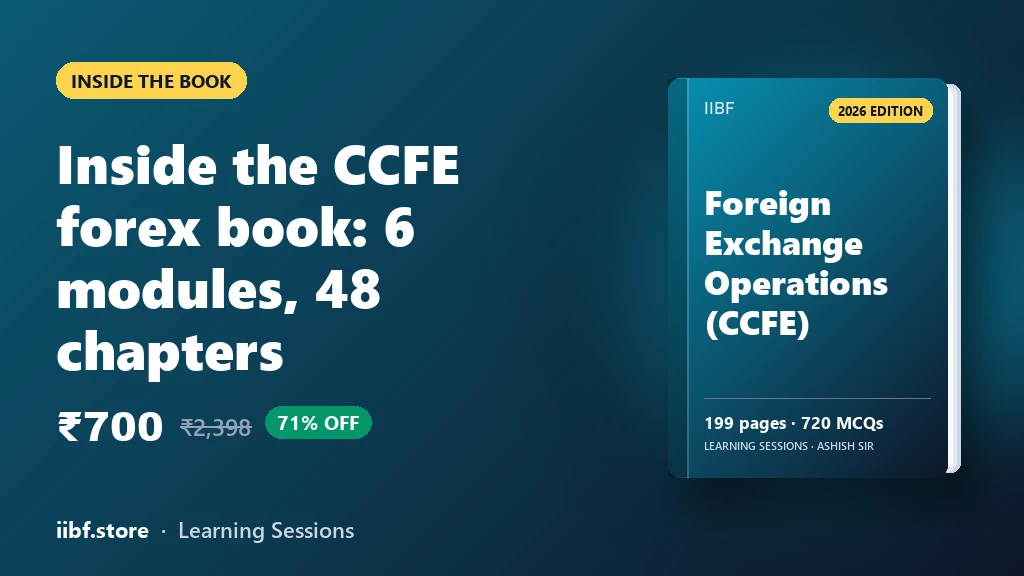
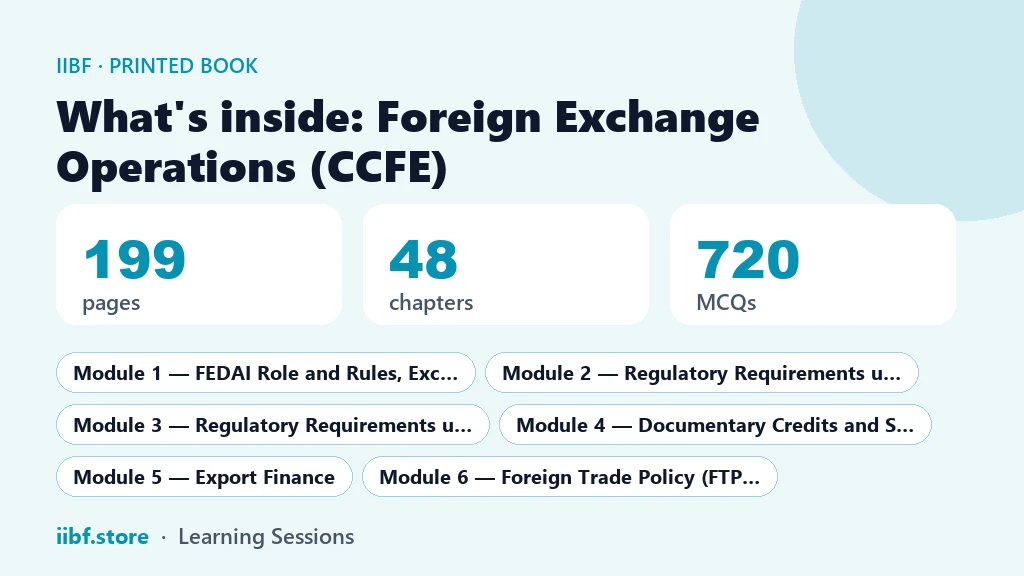
The book is organised into six modules, with 48 chapters across 199 pages in the 2026 edition. The short chapter lengths are deliberate: a chapter you can finish in a weeknight is a chapter you will actually start. Here is how the modules sit.
Module 1: rates, FEDAI, risk and conduct (7 chapters)
This is your foundation. It starts with basic ideas, participants and terminology, then moves to the roles of RBI, Authorised Dealers and FEDAI. After that come quotations (direct, indirect, bid, offer, spread), customer rates (TT, bills, cross-rates), cash, TOM, spot and forward exchange, forward contracts including cancellation, extension and hedging, and finally conduct, compliance and controls. If you are weak at calculation, spend your extra time here; the rate chapters repay practice.
Module 2: FEMA for individuals (8 chapters)
Residence, current and capital account transactions, the Liberalised Remittance Scheme, personal remittances for travel, education and medical needs, foreign-currency accounts, overseas assets, inheritance and repatriation, then NRE, NRO and FCNR(B) accounts and NRI investments. Branch staff meet these questions at the counter every week, so this module often feels familiar quickly.
Module 3: FEMA for entities (11 chapters)
The largest regulatory block: imports, services remittances, IDPMS and reconciliation, trade credit and merchanting, the 2026 framework for external commercial borrowings, exports, export of services and EDPMS, advances, extensions and write-off, overseas investment, foreign investment in India, and liaison, branch and project offices. Work through it in the book's order; import and export chapters mirror each other.
Modules 4, 5 and 6: credits, finance and policy
Module 4 (12 chapters) covers trade documents, documentary credits, UCP 600, document examination, discrepancies, eUCP, collections under URC 522, standby credits, demand guarantees and URDG 758, URBPO 750, DOCDEX 872 and Incoterms. Module 5 (5 chapters) is export finance: packing credit, PCFC, post-shipment finance, factoring and forfaiting, and ECGC cover. Module 6 (5 chapters) is Foreign Trade Policy 2023, from DGFT and IEC through Advance Authorisation and EPCG to combined FTP-FEMA cases.
| Module | Focus | Chapters |
|---|---|---|
| 1 | FEDAI, exchange rates, risk, conduct | 7 |
| 2 | FEMA for individuals | 8 |
| 3 | FEMA for entities | 11 |
| 4 | Documentary and standby credits | 12 |
| 5 | Export finance | 5 |
| 6 | Foreign Trade Policy 2023 | 5 |
What one chapter looks like
Every chapter follows the same rhythm: concise notes first, then key points, then MCQs. Take the chapter on UCP 600 as an example. You read the practical examination framework in the notes, you pull out the handful of rules you must be able to recall, and then you test yourself on questions that use those rules.
That fixed pattern is a gift when you are tired, because you never have to decide what to do next. Open the chapter, read, tick the key points, attempt the questions. If you score poorly, you know the notes need a second pass; if you score well, you move on without guilt.
The extras: case studies and mega tests
Beyond the chapters, the book carries 80 case studies, which bring 320 questions, and 5 mega tests, which bring 500 questions. In total the book holds 720 questions. We state those numbers as listed on the book page, and the page is the place to confirm the latest details.
Why do case studies matter in forex? Because the paper rarely asks "define a forward contract". It hands you a small scenario, an exporter, a remittance, a discrepant document set, and asks what the bank should do. Combined FTP-FEMA cases in Module 6 are the clearest example: the answer depends on reading the facts, not on memory alone.
Use the mega tests as checkpoints, not as daily homework. Attempt one after you finish Modules 1 and 2, another after Module 4, and keep the rest for the final fortnight. Treat the score as information about where to revise, not as a verdict.
- Chapter MCQs: same night, to lock in what you just read.
- Case studies: weekend work, when you have a longer stretch.
- Mega tests: spaced checkpoints, attempted in one go and reviewed the next day.
A study method that fits a branch job
Here is a simple plan you can run with any serious material, and it fits neatly around the CCFE foreign exchange book. It assumes 45 to 60 minutes on weekdays and a longer block on Sunday.
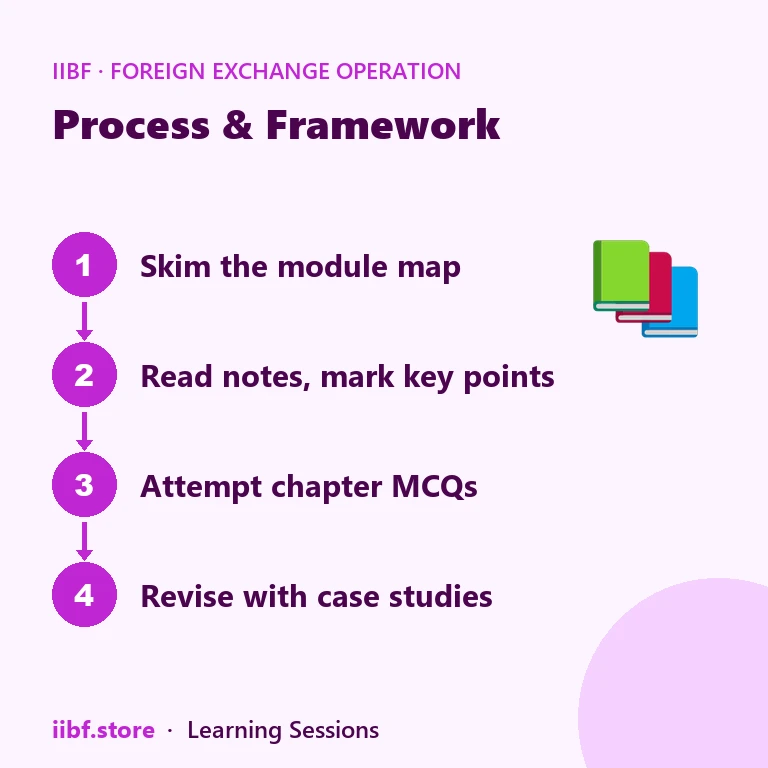
Step 1: skim the module map first
Spend one evening reading only the chapter titles of all six modules. You are not learning anything yet; you are building a mental table of contents so that later chapters feel like known territory.
Step 2: read the notes, mark the key points
One chapter per weekday. Read the concise notes once, slowly, and mark the key points in pencil. If a chapter has a calculation, redo the worked numbers with the book closed.
Step 3: attempt the MCQs before you sleep
Do the chapter questions the same evening. Write down each wrong answer in one line. By Sunday you will have a short list of your own weak spots, which is worth more than any generic summary.
Step 4: revise through case studies and free practice
On Sunday, redo the wrong-answer list, then attempt a few case studies. Add free practice from the free mock tests and browse the free study material for anything you want explained in another way. A book alone will not give you exam-hall speed; timed mocks are what build it.
Who gets the most out of this book
Be honest with yourself about fit. The CCFE foreign exchange book is most useful for you if:
- You work in a branch, treasury or trade-finance desk and want exam-focused revision rather than a full textbook.
- You prefer a printed book you can mark up on the commute or at the weekend.
- You learn best by testing yourself, and want plenty of questions tied to each chapter.
- You are new to foreign exchange and need the vocabulary built step by step, from Module 1 upward.
It is less suited if you want live classroom teaching, or if you already work daily with letters of credit and FEMA and only need a quick mock-test sprint. In that case, the free mock tests on the site may be enough to start with. You can also compare other titles on the books page.
The book is listed at ₹700 against an MRP of ₹2,398, which the page shows as 71 percent off. Prices may change, so treat the book page as the current source, and use the free sample there to judge the writing style before you decide.
Your next step
Whatever you choose, do one small thing tonight: write the six module names on a sheet, and next to each, write how confident you feel from one to five. That ten-minute exercise tells you where your first week goes. If the CCFE foreign exchange book fits your plan, you now know exactly how its modules, chapters and questions will slot into your evenings. If not, take the method anyway and apply it to whatever you already own.
Frequently asked questions
How many chapters and pages does the book have?
The 2026 edition has 199 pages and 48 chapters, grouped into six modules, along with 720 questions in total.
Can I see a sample before ordering?
Yes. The book page has a free sample, so you can check the notes style and the MCQ format first.
Is the book enough on its own to clear the exam?
It gives you structured notes, key points and plenty of questions, but exam-hall speed comes from timed practice. Pair it with mock tests and check the official IIBF site for the current syllabus and schedule.
Where do I start if I am new to forex?
Start at Module 1, chapter one, and follow the order. The modules are arranged so that vocabulary and rates come before regulations and documentary credits.
Prefer revising from a printed book?
Chapter-wise books with MCQs after every chapter — minimal pages, complete coverage, delivered anywhere in India. Every book has a free sample to read first.







Practice this topic
Take a free mock test, download chapter PDFs, or watch a video class — all included on iibf.store.
Keep reading