Inside the CTP Exam Preparation Book: Modules, Chapters, MCQs
It is 9:40 at night. You have closed the branch, finished the day's reconciliations, eaten something quick, and now there is a treasury syllabus waiting for you. Forex, derivatives, bond duration, dealing-room ethics. None of it looks like what you handle at the counter or the credit desk. Most people in this position do not fail for lack of intelligence. They fail because the material feels endless and they never know where tonight's hour should go.
This article is a guided tour of one specific CTP exam preparation book, so you can picture exactly how it is organised and how a single study session with it would look. Even if you never buy it, the method in the middle of this piece works with any material you already have.
Why a treasury certificate feels harder than it is
The Certified Treasury Professional paper from IIBF sits in the certification stream, and it asks you to move between very different kinds of knowledge in one syllabus. One chapter is pure market vocabulary. The next is arithmetic on bond prices. A third is a code of conduct. Your brain changes gear every few days, and if your notes are scattered across PDFs, circulars and lecture recordings, every change of gear costs you ten minutes of just finding the right page.
That is the real problem a good CTP exam preparation book should solve. Not magic shortcuts, but a fixed order, a fixed size of study unit, and one place where everything lives. When the unit is small, you can finish it on a Tuesday night. When you finish it, you feel progress, and that feeling is what keeps a working person studying for eight or ten weeks.
What tired learners usually get wrong
- They start with the hardest chapter (usually derivatives) because it is "the scoring one", and quit within a week.
- They read for two hours on Sunday and nothing on weekdays, so Monday's content is gone by Saturday.
- They collect more material instead of finishing one source.
- They never attempt questions until the very end, so they discover their gaps too late.
Keep these four mistakes in mind. The rest of this guide is built to avoid them.
How the book is organised: seven modules, thirty chapters
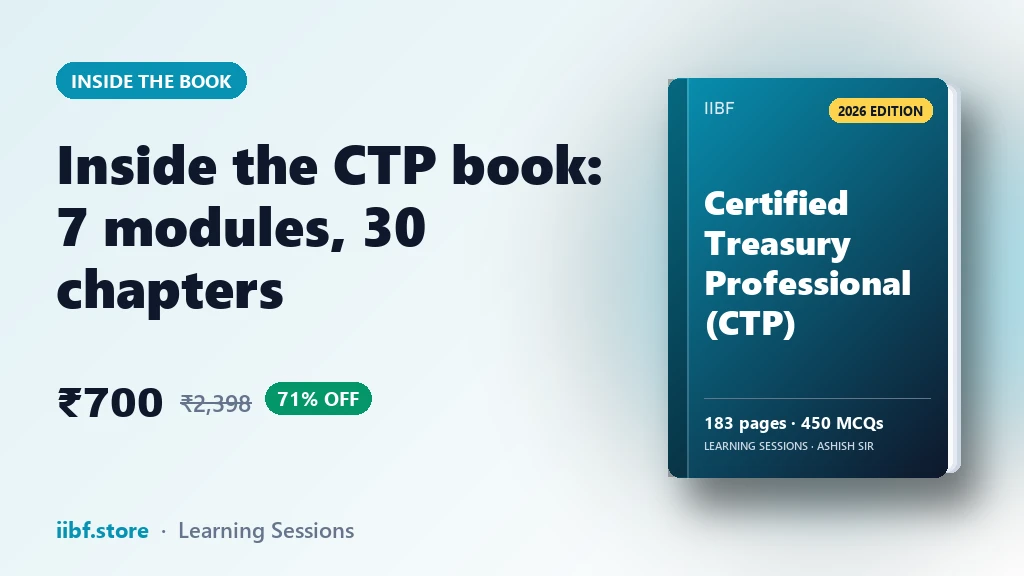
The Certified Treasury Professional book is a 183-page printed volume, 2026 edition, divided into seven modules with 30 chapters in total. Here is the actual structure, so you can see where the weight sits.
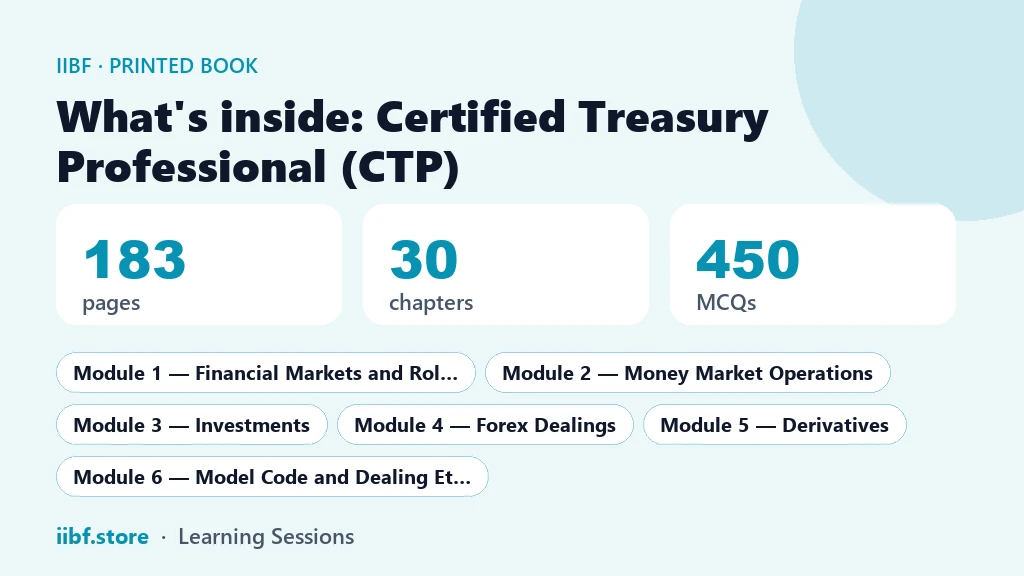
| Module | Chapters | What you cover |
|---|---|---|
| 1. Financial Markets and Role of Treasury | 3 | Financial Markets; Treasury; Scope and Functions of Treasury Management |
| 2. Money Market Operations | 3 | Liquidity Management; Integrated Treasury; Treasury Instruments |
| 3. Investments | 13 | Interest rate quotations, fixed income, bond pricing, duration and convexity, portfolio management, accounting, exposure norms, audit, IT, regulation |
| 4. Forex Dealings | 5 | Foreign exchange market, exchange rate mechanism, valuation, risk control, multi-currency balance sheets |
| 5. Derivatives | 4 | Derivative market, swaps, options, interest rate futures, caps, floors, credit derivatives |
| 6. Model Code and Dealing Ethics | 1 | Ethics, morals and code of conduct for the dealing room |
| 7. Time Value of Money and Interest Rate Calculations | 1 | Time value of money and interest rate calculations |
Notice something useful straight away. Module 3 alone holds 13 of the 30 chapters. That is not a reason to panic; it is a reason to plan. It means close to half your chapter count is the investments block, and within it, the bond chapters (pricing and yield, duration and convexity, portfolio management) build on each other. Studying them in the printed order is genuinely better than jumping around.
The small modules are not small in importance
Modules 6 and 7 are a single chapter each. They are short, which makes them perfect for a weekday evening when you have only 45 minutes. Time value of money in particular is the arithmetic underneath bond pricing, so many candidates are happier if they do it early, before they meet yield and duration.
One chapter, start to finish
The book is built so that every chapter follows the same rhythm: concise notes first, then the key points you should be able to say from memory, then MCQs on that chapter. Because the pattern never changes, you stop wasting energy on "how do I study this one?" and just begin.
Take a chapter like "Fixed Income Securities – Duration and Convexity". In a long textbook you might meet it as twenty pages of derivation. Here you read the notes, close the book, and try to state the key points aloud: what duration measures, why it changes when yields change, what convexity corrects. Then you open the questions. If you stumble on a question, you know exactly which sentence in the notes to return to.
The four-step method
This is the loop to follow for every one of the 30 chapters. It works for any CTP exam preparation book, but it fits especially well with a notes-plus-MCQs layout.
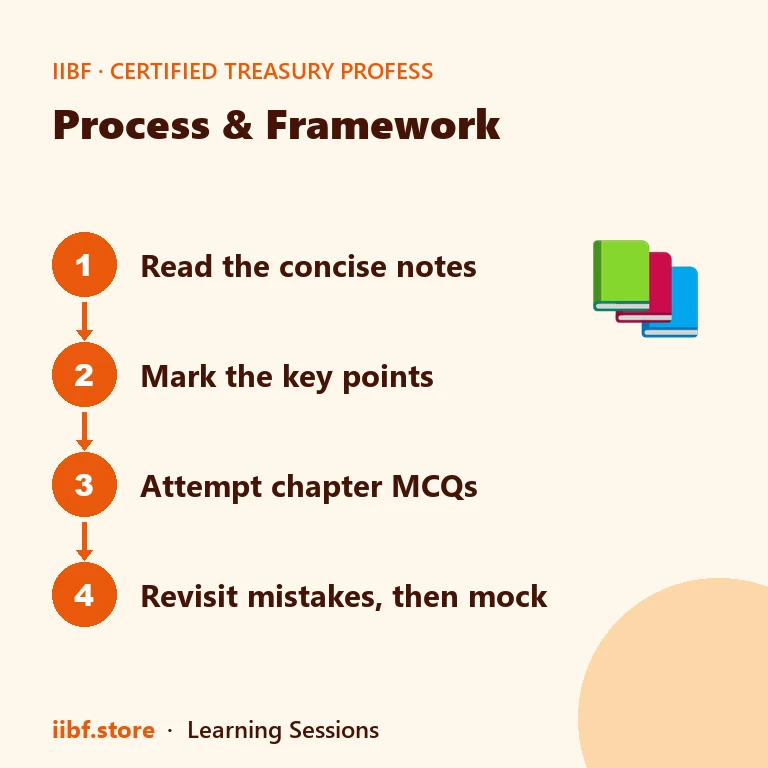
- Read the concise notes once, without highlighting. Your only job is to understand. Thirty to forty minutes is plenty for most chapters.
- Close the book and recall the key points. Say them or write them in five lines. Whatever you cannot recall is your real study list.
- Attempt the chapter's MCQs the same day. The book carries 450 MCQs across its chapters. Do them while the notes are fresh.
- Revisit only the questions you got wrong, two days later. Not the whole chapter. Just the mistakes.
Done properly, a chapter takes about an hour and a half spread over two evenings. At that pace, 30 chapters are well within reach for someone studying five evenings a week.
Planning your weeks around the modules
A simple way to organise the CTP exam preparation book is by module, not by date. Give each module a block and let the block take as long as it needs. A rough sequence that tired working learners find comfortable:
- Warm-up (Modules 1, 2 and 7): seven chapters that build vocabulary and the time value arithmetic. These are approachable and give you early momentum.
- The long middle (Module 3): thirteen chapters. Split them into three sub-blocks: market terminology and fixed income basics, pricing, yield, duration and portfolio management, and finally the operations and compliance chapters (accounting, exposure norms, audit, IT, regulation).
- Forex (Module 4): five chapters. If your branch does any foreign exchange work, you already have a head start.
- Derivatives (Module 5): four chapters. By now you have the bond and rate maths behind you, which makes swaps and options far less intimidating.
- Ethics (Module 6): one chapter, best read again in the last week because it is mostly judgement and wording.
Treasury questions often mix topics, so do not treat modules as sealed boxes. When you reach options, glance back at the pricing chapters. When you read about the dealing room, connect it to the regulation chapter in Module 3. Small cross-references like this are what turn memory into understanding.
Using spare minutes
A printed book has one quiet advantage for people with jobs: no notifications. Fifteen minutes in a local train, or at lunch, is enough to reread a chapter's key points. Keep the MCQs for the longer evening sitting, when you can concentrate.
The extras: case studies and mega tests
Beyond the chapters, the book lists two extras. There are 60 case studies carrying 240 questions, and 5 mega tests carrying 500 questions. Case-style questions matter in a treasury paper because they ask you to apply a concept to a situation instead of recalling a definition. Practising them after you finish a module is more useful than leaving them for the last weekend.
The mega tests are best treated as checkpoints. Take one after you have finished roughly half the modules, review it properly, and take the next after a few more. Sitting a full test teaches you things reading cannot: how long you spend on calculation questions, where you rush, and where you second-guess a correct answer.
For additional free practice, the free mock tests and the free study material library are worth using alongside any book. Browse the wider range on the IIBF books page if you are preparing for more than one paper.
Honest limits of any book
A book gives you structure and content. It does not give you exam-hall speed. That comes only from timed practice, so pair the book with full mock tests in the last few weeks. Also remember that regulations and market conventions move. For the upcoming exam cycle, the syllabus, schedule and eligibility details are published by IIBF, so check the official IIBF website before you finalise your plan.
And be realistic about your own time. A 183-page book is compact, but compact is not the same as effortless. Treasury concepts need repetition, and the people who do well are usually those who showed up for thirty or forty small sessions rather than five heroic ones.
Who gets the most out of this book
Based on its structure, this CTP exam preparation book suits a few kinds of readers especially well:
- Working bankers with fragmented time who need one chapter to equal one clear session.
- Candidates without a treasury background in operations, credit or branch banking who want the market from the ground up.
- People who learn by testing themselves, since each chapter ends with questions and the extras add heavy practice volume.
- Anyone who has postponed before because the syllabus felt shapeless. Seven modules with named chapters make the whole thing visible.
If you would rather see the style before deciding, the book page has a free sample you can read. The current price on the page is ₹700 against an MRP of ₹2,398, a 71 percent saving, but prices can change, so treat the book page as the final word. If you are also thinking about a longer course path, see the IIBF.store blog for more planning guides.
Your first week, in practice
Do not wait for a perfect schedule. Tonight, open Module 1 and read the first chapter, "Financial Markets". Tomorrow, recall its key points and attempt its questions. By the end of the week you should have two or three chapters behind you, a feel for the rhythm, and an honest sense of how many evenings you actually have. That sense is worth more than any plan made on a Sunday full of optimism.
Frequently asked questions
How many chapters and questions does the CTP book have?
The book has 30 chapters across seven modules, 183 pages in the 2026 edition, and 450 MCQs. It also lists 60 case studies with 240 questions and 5 mega tests with 500 questions as extras.
Which module should I start with?
Most candidates do well starting with Modules 1 and 2 for vocabulary, and Module 7 for the time value arithmetic, before moving to the 13-chapter investments module.
Is a book enough to clear the exam?
A book gives structure and content, but timed practice builds speed. Pair the chapters with the mega tests and free mock tests, and check the official IIBF website for the current syllabus and schedule.
Can I see the book before ordering?
Yes. The book page offers a free sample, so you can judge the notes and question style first. Prices on that page are the current ones and may change.
Prefer revising from a printed book?
Chapter-wise books with MCQs after every chapter — minimal pages, complete coverage, delivered anywhere in India. Every book has a free sample to read first.



















Practice this topic
Take a free mock test, download chapter PDFs, or watch a video class — all included on iibf.store.
Keep reading