Inside the IIBF Risk Management Book: Modules, Chapters and MCQs
It is 10 pm. The branch is finally quiet, you have eaten late, and the Risk Management syllabus is open in front of you: Basel, ICAAP, duration, Value at Risk, options and swaps. Every topic looks like its own small subject. If that is your evening, the problem is rarely intelligence. It is that nobody has shown you the shape of the paper.
This article is a guided tour of the IIBF Risk Management book: how it is organised, what a single chapter looks like when you sit down with it, and what the extras are. Even if you never buy it, the map of the subject below is yours to use.
The shape of the Risk Management paper
Before opening any book, split the paper into four blocks in your head. Risk Management is not 26 unrelated topics. It is four connected ideas:
- What risk management is and how a bank frames it (the overview).
- What the regulator demands in return (the Basel framework and supervision).
- How market risk is measured (fixed income, interest rate measurement, Value at Risk).
- How risk is transferred or hedged (derivatives).
Once you see these four blocks, a chapter on Operational Risk capital stops feeling random. It belongs to the regulator block, and you know what question it answers. This is exactly how the book is arranged, which is why it is easy to plan around.
How the book is organised: four modules, 26 chapters
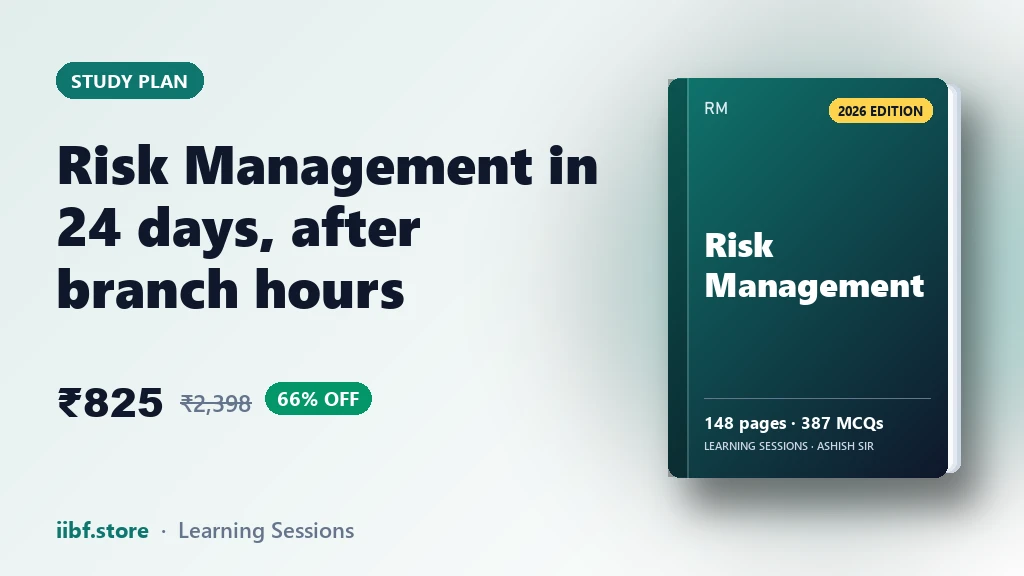
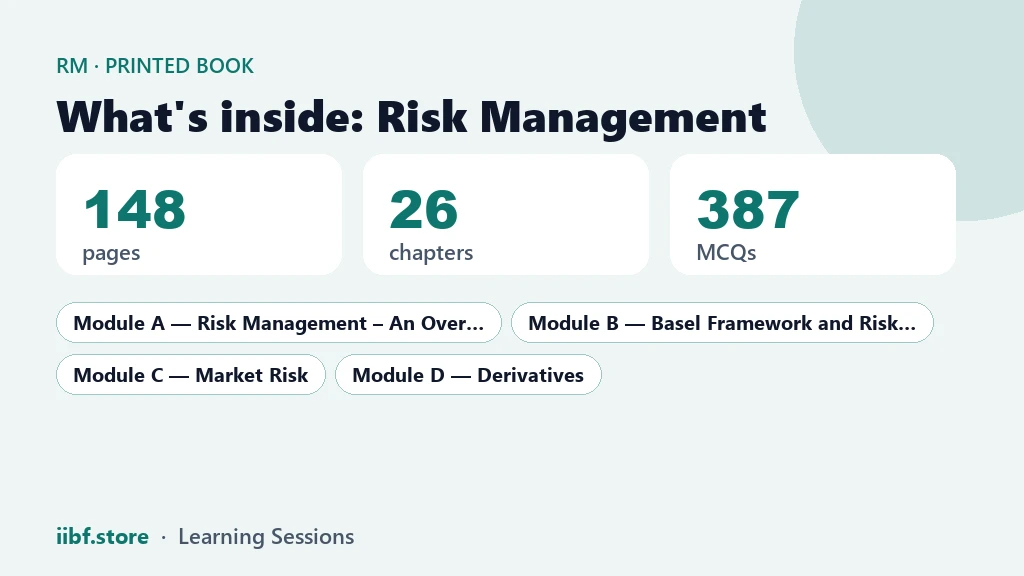
The printed edition runs to 148 pages across 26 chapters, split into four modules. Here is the full layout.
| Module | Chapters | What it covers |
|---|---|---|
| Module A: Risk Management, An Overview | 5 | Why banks are special, the risk framework, ALM and IRRBB, liquidity risk |
| Module B: Basel Framework and Risk Regulation | 12 | Basel III, capital adequacy, credit, market and operational risk capital, ICAAP, stress testing, market discipline, buffers, supervision, audit |
| Module C: Market Risk | 4 | Market risk, fixed income, interest rate measurement, Value at Risk |
| Module D: Derivatives | 5 | Derivatives, forwards, futures, options, swaps |
Notice the weight. Module B alone carries twelve of the 26 chapters. If you are short on time, that tells you where your hours will be spent, though you should check the official syllabus at iibf.org.in for how the paper itself is structured.
Module A: the overview
This is the gentlest module and the right place to start on a tired evening. It opens with Why Banks Are Special, moves through Introduction to Risk Management and the Risk Management Framework, and then reaches Asset Liability Management and IRRBB and Liquidity Risk. These last two are where bankers with a branch background suddenly find the vocabulary new: gaps, repricing, time buckets. Read them slowly.
Module B: Basel and regulation
This is the heart of the paper. It starts with why banks need regulation, then the Global Financial Crisis and Basel III, then regulatory capital and capital adequacy. After that come the three capital charges (credit risk, market risk and operational risk), followed by the Supervisory Review Process and ICAAP, Stress Testing and the PCA Framework, Market Discipline, Basel III Buffers, Liquidity Ratios and the Leverage Ratio, Risk Based Supervision and Risk Based Internal Audit.
Modules C and D: numbers and instruments
Module C builds the toolkit: market risk, fixed income, interest rate measurement and Value at Risk. Module D then uses that toolkit on derivatives: forwards, futures, options and swaps. If numbers make you nervous, this is where you want worked examples and repetition, not more theory.
What one chapter looks like
Every chapter follows the same rhythm, so you stop wasting energy figuring out how to read it. Take Value at Risk as an example.
- Concise notes. The concept is explained in short, exam-focused paragraphs rather than a textbook essay.
- Key points. The definitions, ratios and distinctions an examiner is likely to test are pulled together so that you can revise them in minutes.
- MCQs. You close the chapter by attempting questions on exactly what you just read.
That last step matters most. Reading feels productive, but it is the questions that tell you whether a chapter has actually stayed. Across the book there are 387 questions, so you get this check after every chapter and not only at the end of the syllabus.
The extras: case studies and mega tests
Beyond the chapters, the IIBF Risk Management book carries two extras. There are 36 case studies, with 144 questions built on them, and 5 mega tests with 500 questions in total.
Why do these matter? Because chapter-wise practice and exam-hall practice are different skills. After a chapter, you know the topic is fresh in your mind. A case study asks you to read a situation, pick out the relevant concept and apply it, which is closer to what the paper demands of you. A mega test then mixes all four modules, so you also learn to switch gears between, say, Basel buffers and option pricing.
One honest limit: no printed book gives you exam-hall speed on its own. Pair the mega tests with timed practice on the free mock tests, and use the free study material for quick revision of weaker chapters.
A simple plan for using the IIBF Risk Management book
Here is a method that works for people with a job to do all day. Treat each module of the IIBF Risk Management book as a mini-project and each chapter as one sitting of 30 to 45 minutes.
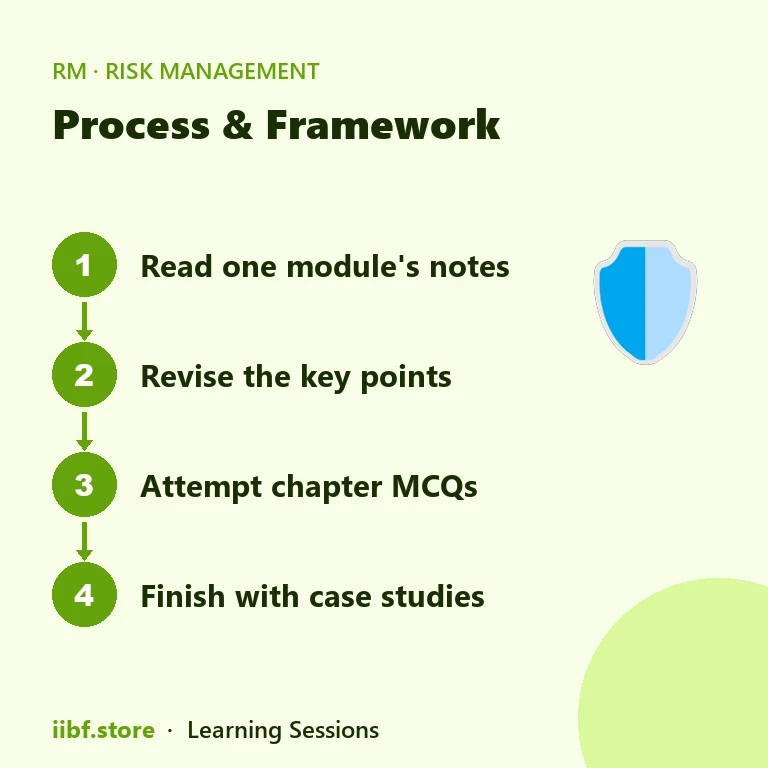
Step 1: read one chapter of notes
Do not read ahead. One chapter, one sitting. On a weekday evening, pick a short one such as Market Discipline. Keep the long ones, such as Capital Charge for Credit Risk, for a weekend.
Step 2: revise the key points the next day
Spend ten minutes the following morning with the key points only. This single habit does more for retention than a second full read.
Step 3: attempt the MCQs without looking
Mark the ones you got wrong and the ones you guessed. Both go on your revision list. When you finish a module, return to those questions before moving on.
Step 4: finish with case studies and a mega test
Once the four modules are done, work through the case studies, and then take the mega tests one at a time with a timer. Review every wrong answer against the relevant chapter.
Who gets the most out of this book
The IIBF Risk Management book suits a few kinds of reader especially well:
- Bankers returning to study after a long gap who want a structured path instead of scattered PDFs.
- Candidates who have attempted before and need to find which modules cost them marks, using the chapter-wise MCQs as a diagnostic.
- People who prefer paper and find that a printed copy lets them underline, flag and revise on a commute without a screen.
- Anyone who learns by testing themselves, since the questions, case studies and mega tests make up most of the practice material.
It will matter less to you if you already have strong, current notes and only need mock tests. In that case, the free tests may be all you need. You can also look at the whole books range to compare options, or read more preparation guides on the iibf.store blog.
Price and sample
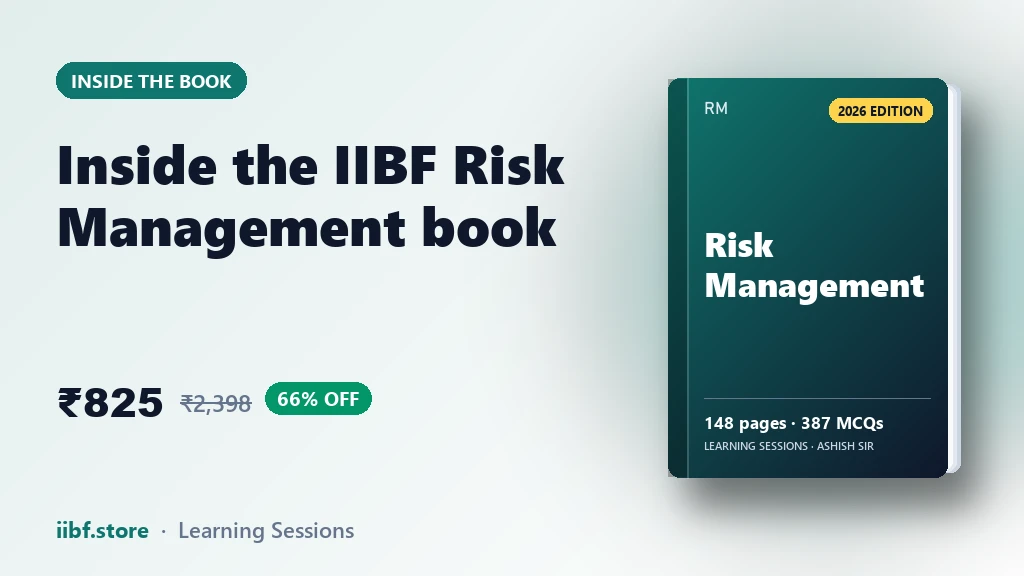
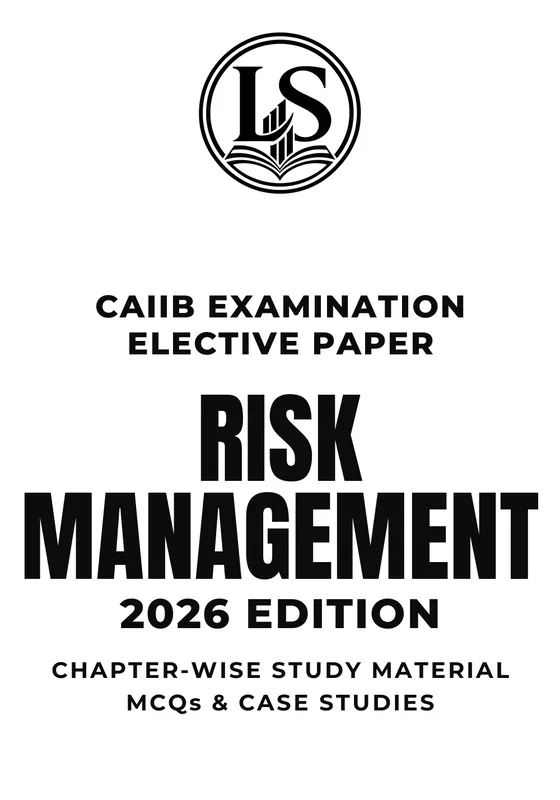
The 2026 edition of the IIBF Risk Management book is listed at ₹825 against an MRP of ₹2,398, which is 66% off. Prices can change, so the Risk Management book page is always the current reference. A free sample is available there, and it is worth reading one chapter before you decide. If the way the notes are written suits your brain, that is a better reason to buy than any discount.
Frequently asked questions
How many chapters and pages does the Risk Management book have?
The 2026 edition has 148 pages and 26 chapters, divided into four modules: the overview, the Basel framework and regulation, market risk, and derivatives.
How many practice questions are included?
The book carries 387 questions in total. In addition, there are 36 case studies with 144 questions and 5 mega tests with 500 questions.
Is there a free sample of the book?
Yes. A sample is available on the book page, so you can judge the style of the notes, key points and MCQs before ordering.
Will the book alone be enough to pass?
No book can promise that. Use it to learn and revise the syllabus, then add timed mock tests for speed, and check the official IIBF website for the latest syllabus and exam schedule for the upcoming cycle.
Prefer revising from a printed book?
Chapter-wise books with MCQs after every chapter — minimal pages, complete coverage, delivered anywhere in India. Every book has a free sample to read first.











Practice this topic
Take a free mock test, download chapter PDFs, or watch a video class — all included on iibf.store.
Keep reading