Inside the CAAP Exam Preparation Book: Modules, Chapters, MCQs
This guide tours the CAAP exam preparation book for tired bankers. It is 9 pm. You have closed the branch, answered the last call from the regional office, and reached home with just enough energy for one hour of study. You open the CAAP material and the syllabus looks endless: balance sheets, Ind AS, tax, risk-based audit, long form audit reports. Where do you even begin?
Most people in this position do not fail because the subject is too hard. They fail because they never see the whole map, so every evening starts with confusion instead of reading. This article gives you that map. We will walk through the CAAP exam preparation book chapter by chapter, so you can picture exactly how a study session with it will feel, and decide for yourself whether it suits you.
Even if you never buy it, the method in the later sections works with any material you already have.
Why a map of the syllabus matters before the first chapter
The Certified Accounting and Audit Professional certificate covers two very different skills under one roof: preparing and understanding accounts, and auditing them. A working banker usually has strength in one and gaps in the other. A credit officer may be comfortable with advances and asset classification, but have never touched a cash flow statement. An inspection or concurrent audit person may know audit procedure well and still struggle with Ind AS consolidation.
So the first job is not reading. It is sorting. Write down the modules, tick the ones you already handle daily, and mark the ones that feel foreign. The foreign ones deserve your fresh early-evening hours; the familiar ones can be revised on weekends.
- Familiar from daily work: banking operations, advances, bank reconciliation, treasury and forex basics.
- Usually unfamiliar: Ind AS, consolidation, tax planning, data analytics, remote auditing.
- Needs both reading and practice: financial statement preparation, long form audit reports.
Once you have this sorting done, the structure of the book below will make immediate sense. For official syllabus details and the current exam schedule, always check the notices on the IIBF website.
How the book is organised: two volumes, eight modules
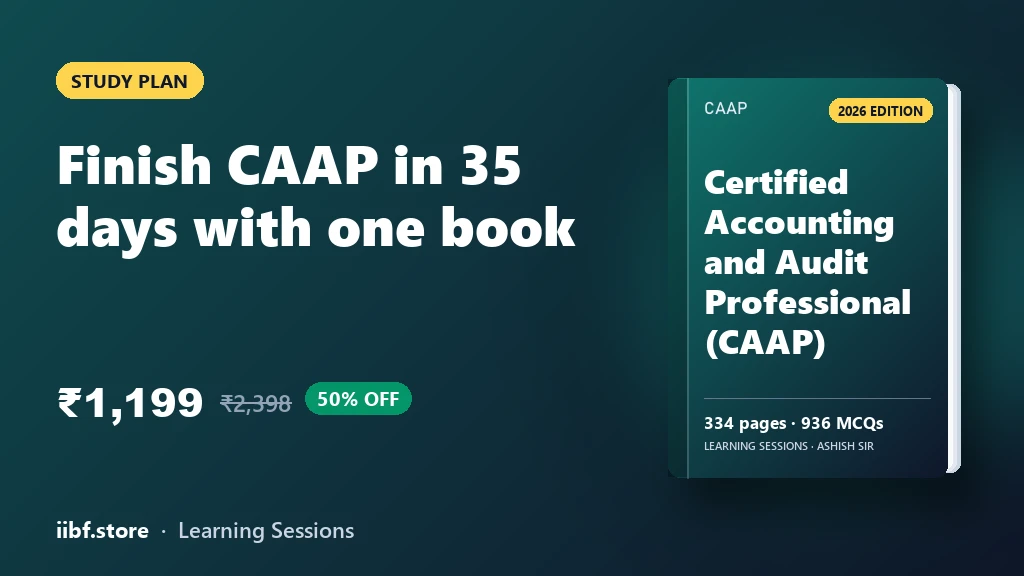
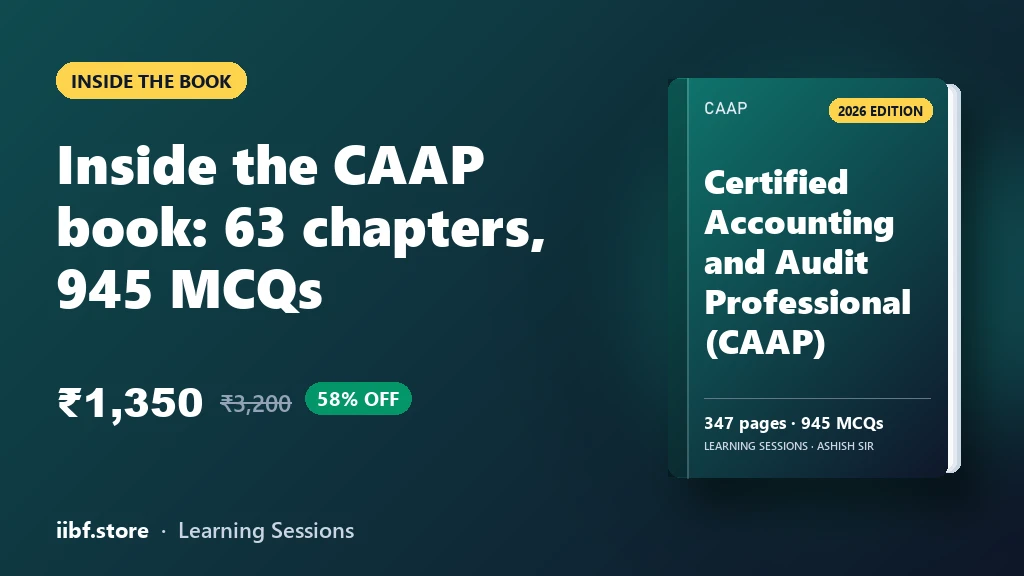
The CAAP exam preparation book is a 347-page printed set, 2026 edition, split into two volumes: Accounting and Auditing. Together they hold 63 chapters and 945 questions. Each volume has four modules, labelled A to D.
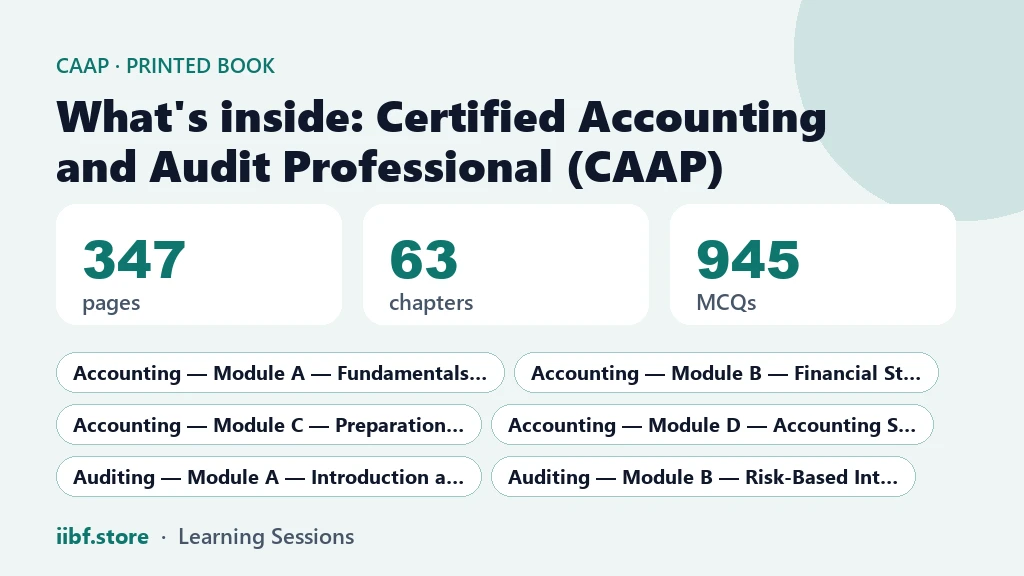
Volume 1: Accounting (38 chapters)
Module A, Fundamentals of Accounting (8 chapters). This is the foundation: accounting basics, the manual and computerised accounting process, definitions, vouchers and journals in computerised banking accounting, bank reconciliation, depreciation, capital and revenue expenditure, and banking operations. If your accounting is rusty, start here and do not skip it.
Module B, Financial Statements of Banks and Taxation (15 chapters). The heaviest module in the accounting volume. It goes line by line through a bank balance sheet: advances, asset classification, income recognition and provisioning, cash balances with RBI, fixed assets, borrowings and deposits, capital and reserves, other liabilities, contingent liabilities, investments, the profit and loss account, disclosure requirements, consolidation, branch account consolidation and inter-office transactions.
Module C, Preparation of Financial Statements of Banks and Taxation (8 chapters). Here you move from reading statements to preparing them: final accounts, cash flow and funds flow statements, MIS and financial reporting, accounting in a computerised environment, direct and indirect tax, filing of returns, income tax and GST provisions, and deferred tax with tax planning.
Module D, Accounting Standards (Ind AS) (7 chapters). Scope and statutory provisions, applicability to banks, financial institutions and corporates, consolidated financial statements, consolidation procedures, standalone statements, jointly controlled entities and associates, and disclosures with technical issues.
Volume 2: Auditing (25 chapters)
Module A, Introduction and Types of Audit (5 chapters). Auditing and its types, bank audit, risk-based supervision, the role of internal audit in governance, and risk-based internal audit in banks.
Module B, Risk-Based Internal Audit, Risk Management and Data Analytics (3 chapters). Audit procedures under the risk-based approach, risk management, and data analytics with continuous controls monitoring.
Module C, Audit in a Computerised Information System Environment (2 chapters). An introduction to CIS audit and audit in a computerised environment. Short, but a topic many branch staff have never studied formally.
Module D, Bank Audit and Special Audit Areas (15 chapters). Audit aspects of advances, of the asset side, of capital, borrowings and deposits, of liabilities and contingent liabilities, of treasury operations including forex and derivatives, and of the profit and loss account. It then covers disclosure, consolidation, inter-office transactions, the long form audit report for branches and for head office, Basel III regulations and disclosures, database security audit and remote auditing.
Notice the pattern: the Auditing volume mirrors the Accounting volume. Module B of Accounting teaches you what a bank's financial statements contain; Module D of Auditing teaches you how to check each of those items. Reading them as pairs is one of the smartest ways to use this structure.
What a single chapter looks like
A syllabus map is useful, but what you really want to know is what happens when you open page one of a chapter. The book follows a consistent three-part rhythm, so after the first chapter you stop wondering how to read and simply read.
- Concise notes. The concept is explained in compact exam-oriented language rather than textbook sprawl. The idea is that a tired reader can finish a chapter in one sitting.
- Key points. The takeaways you will want to revisit in the last week, written so that you can scan them in minutes.
- MCQs. Practice questions to check whether the idea actually stuck, because understanding a paragraph and recalling it under exam pressure are two different things.
Across all 63 chapters this adds up to 945 MCQs, or roughly 15 per chapter on average. That is a healthy number for a chapter-end check without turning the book into a question bank.
The extras: case studies and mega tests
Beyond the chapters, the set includes two practice components that deserve their own place in your plan.
- 120 case studies with 480 questions. Case-based questions test whether you can apply a concept to a situation, which is how auditing and accounting are really tested. Attempt these after you finish a module, not before.
- 10 mega tests with 1000 questions. Full-length practice for the final stretch. Treat these as dress rehearsals: timed, no phone, no peeking at notes.
These two extras are what separate reading from preparing. Reading a chapter once gives you familiarity; solving questions on it gives you recall. If you want even more practice at no cost, the free mock tests and the free study material on iibf.store are worth using alongside any book.
A four-step routine for one chapter after a long day
Here is a routine you can run in about an hour, whether you use this CAAP exam preparation book or any other. It is deliberately simple, because complicated plans are the first thing to break in a week of month-end closing.
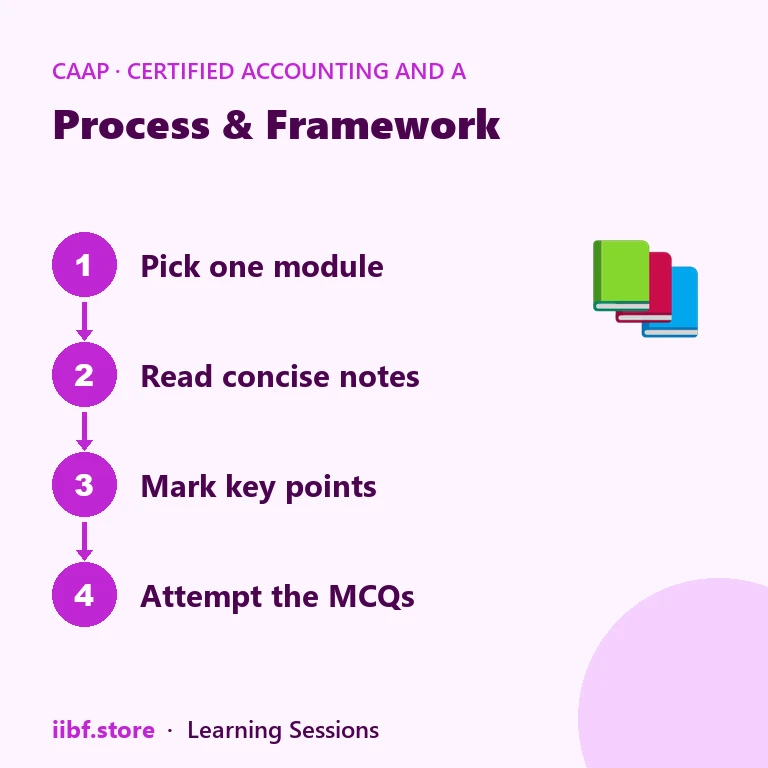
Step 1: pick one module for the week
Do not hop between volumes. Choose one module, look at its chapter list, and decide how many chapters you can realistically finish. For a short module such as Auditing Module C, that may be a single weekend. For Accounting Module B, plan several weeks.
Step 2: read the concise notes without highlighting
On the first pass, just read. Highlighting too early turns every line yellow and teaches you nothing. Twenty to thirty minutes of uninterrupted reading is enough.
Step 3: mark your own key points
After reading, close the book and write down three to five points from memory. Then compare them with the key points in the chapter. The gaps tell you what to re-read.
Step 4: attempt the MCQs the same night
Do the chapter MCQs while the material is fresh. Note every wrong answer in a small notebook with the reason you got it wrong. That notebook becomes your last-week revision sheet.
| Day | Time | What to do |
|---|---|---|
| Mon to Thu | 45 to 60 min | One chapter: notes, key points, MCQs |
| Friday | 30 min | Re-attempt the wrong MCQs from the week |
| Saturday | 2 hours | Case studies for the module just finished |
| Sunday | 1 hour | Rest, or a light read of the next module list |
Adjust the table to your own branch rhythm. The point is repeatability: a modest routine you keep for ten weeks beats an ambitious one you abandon in ten days.
Who gets the most out of this book
A book is a tool, and every tool has a user it suits best. Based on its structure, the CAAP exam preparation book is most useful for:
- Bankers who like paper. If screens tire you after a full day, a printed set you can mark, fold and carry is a real advantage.
- People weak in one volume. Strong in accounting, shaky in audit, or the other way round? The two-volume split lets you spend your hours where they are needed.
- Candidates who want structure. Eight modules with fixed chapter lists are easy to turn into a checklist.
- Those who revise by practice. With 945 chapter MCQs, 120 case studies and 10 mega tests, you will not run out of questions.
One honest limit: a book alone will not give you exam-hall speed. Pair it with timed mocks, and keep an eye on regulatory changes by reading the latest circulars, because banking rules move faster than any printed edition. If you are still choosing what to buy, compare options on the books page and read the study blog for free guidance.
Price, sample and what to do next
The set is listed at ₹1,350 against an MRP of ₹3,200, which is 58 percent off at the time of writing. Prices may change, so treat the book page as the current source. There is also a free sample, which is the most sensible way to judge the writing style before you spend anything: read a few pages, see whether the notes feel clear to you, and then decide.
Whatever you decide about the CAAP exam preparation book, do one thing today: write the eight module names on a sheet of paper, tick what you already know, and pick the first module for this week. That small act of structure is worth more than another evening of staring at an endless syllabus.
Frequently asked questions
How many chapters and questions are there in the CAAP book?
The set has 63 chapters over 347 pages, with 945 questions, plus 120 case studies (480 questions) and 10 mega tests (1000 questions).
Is the book split by subject?
Yes. It comes in two volumes, Accounting and Auditing, each divided into four modules labelled A to D.
Can I check the style before buying?
Yes, a free sample is available on the book page, so you can read a few pages and judge whether the notes suit you.
Is a book enough to clear the exam?
A book gives you structured notes and practice, but exam-hall speed comes from timed mocks and revision. Use the free mock tests on iibf.store and check the official IIBF site for the latest exam cycle details.
Prefer revising from a printed book?
Chapter-wise books with MCQs after every chapter — minimal pages, complete coverage, delivered anywhere in India. Every book has a free sample to read first.









Practice this topic
Take a free mock test, download chapter PDFs, or watch a video class — all included on iibf.store.