Inside the International Trade Finance Book: A Chapter Tour
It is 9:40 at night. The branch closed hours ago, the last customer queries are still in your head, and you have promised yourself that today you will finally start on trade finance. You open a big reference text, see letters of credit, Incoterms, URC, URDG, FEDAI, ECGC, and close it again. If that sounds familiar, the problem is rarely your ability. It is that the subject arrives as one huge cloud instead of a sequence you can finish.
This article is a guided tour of the International Trade Finance book from iibf.store: how it is laid out, what a single chapter looks like when you sit down with it, and what the extras at the back are for. Even if you never buy it, the tour will show you how to break the subject down yourself, because the shape of the content is the real lesson here.
Why trade finance feels harder than it is
Trade finance sits in a strange place for a working banker. You may have handled a few bank guarantees or an export bill at your branch, but the exam wants you to see the whole chain: who buys, who ships, who pays, which document moves where, which rule governs it, and which regulator watches over it. Branch work usually shows you one link of that chain. The exam asks about all of them.
Three things make it feel heavy:
- Too many rulebooks with similar names. URC, UCPDC, URR, ISBP, URDG and ISP98 all sound alike until you know which one applies to which instrument.
- Documents everywhere. Bill of lading, invoice, packing list, insurance certificate, certificate of origin. Each has a purpose, and questions test that purpose.
- Institutions and policy. DGFT, RBI, FEDAI, ECGC, EXIM Bank, SEZ and STPI each get a short chapter, and they blur together if you read them in one sitting.
The fix is not more hours. It is a map. Once you know there are six clear modules and you are only ever standing in one of them, the cloud turns into a checklist. That is exactly how this book is organised.
How the International Trade Finance book is organised
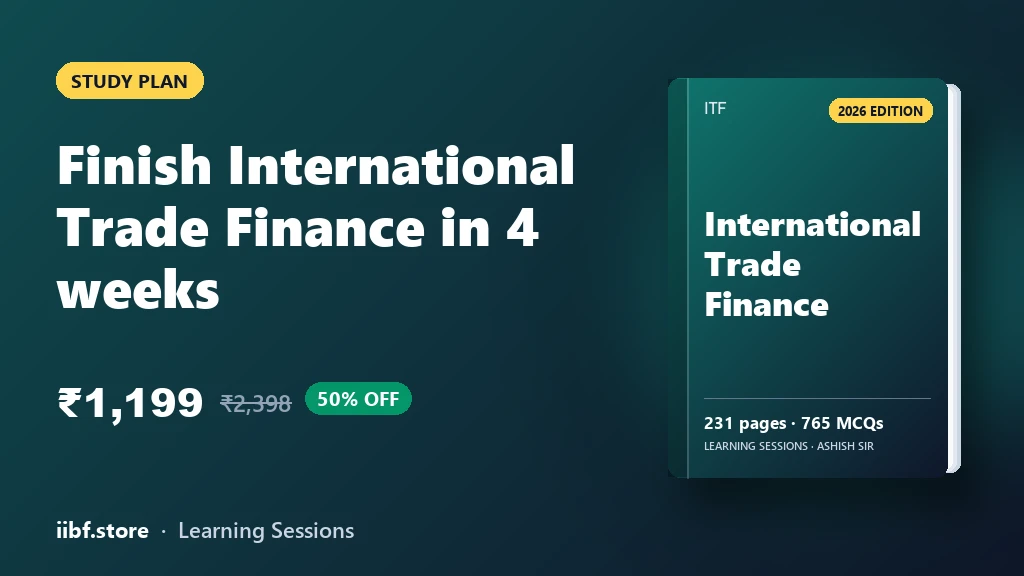
The book runs to 231 pages and is divided into six modules holding 51 chapters in all. The edition is 2026. It follows the natural flow of a trade transaction, so each module answers one question a banker should be able to answer.
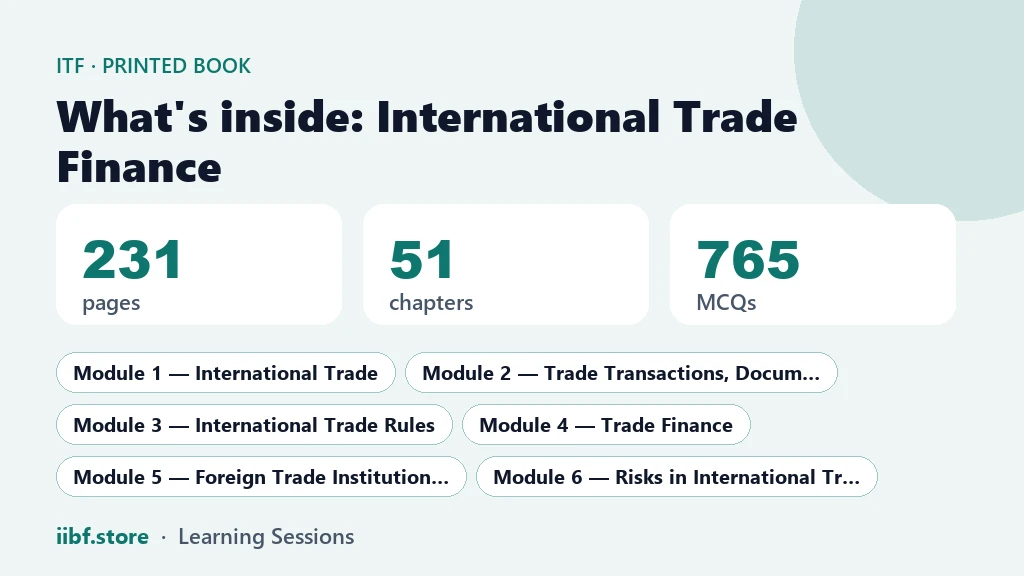
| Module | Chapters | The question it answers |
|---|---|---|
| Module 1 - International Trade | 4 | Why and how do countries trade, and what limits them? |
| Module 2 - Trade Transactions, Documents and Digitisation | 9 | How does a deal move, and how is it paid and documented? |
| Module 3 - International Trade Rules | 7 | Which international rule governs which instrument? |
| Module 4 - Trade Finance | 9 | How do banks fund exporters and importers? |
| Module 5 - Foreign Trade Institutions and Regulations | 12 | Who regulates and supports foreign trade? |
| Module 6 - Risks in International Trade | 10 | What can go wrong, and how is it managed? |
Notice that Module 5 is the largest by chapter count. Many learners skip regulations because they feel dry, and then lose easy marks. Knowing the weight of each module helps you plan your evenings sensibly.
A walk through the six modules
Module 1: the foundation (4 chapters)
The first module covers the meaning and definitions of international trade, theories of international trade, the WTO and trade blocs, and trade barriers along with ICC and exchange controls. It is short, and it is the ideal first week because nothing here needs prior knowledge. Read it for vocabulary. Later chapters assume you are comfortable with these terms.
Module 2: how a transaction actually moves (9 chapters)
This is where the subject becomes practical. Chapters cover the components of a trade transaction, understanding trade transactions, trade documents, methods of payment, payment systems and blockchain, documentary credits, SWIFT communication between banks, logistics, and trade digitisation. If you work in a branch that handles remittances or bills, you will recognise much of it, and that recognition makes it a good confidence builder.
Module 3: the rulebooks (7 chapters)
Incoterms, URC, UCPDC, URR, ISBP, URDG, and international standby practices with DOCDEX each get their own chapter. This is the module most learners confuse, so the separation matters. One rule, one chapter, one set of MCQs. Keep a single-page sheet where you note, for each rule, what it governs. You will thank yourself later.
Module 4: the money side (9 chapters)
Basics of trade finance, pre-shipment credit, post-shipment credit, factoring and forfaiting, letters of credit, bank guarantees and standby letters of credit, domestic trade finance, LIBOR and alternate reference rates, and imports with import finance methods. This module is closest to what a bank officer is expected to know cold.
Module 5: institutions and regulation (12 chapters)
Regulators of foreign trade, DGFT, Foreign Trade Policy 2023, FEMA and RBI guidelines, customs, FEDAI, ECGC, EXIM Bank, STPI, SEZ, free trade warehousing zones and export promotion bodies. Twelve short chapters. The trick here is to study two a night and not more, because the names run together if you rush.
Module 6: risk (10 chapters)
Risk elements in trade, country and political risk, credit risk, currency risk, shipment and transportation risk, legal and compliance risk, risk management policy, maritime frauds, trade based money laundering, and ethical practices. It closes the loop: after learning how trade works, you learn how it fails.
Regulations and policy change over time, so always cross-check the latest circulars and the official schedule at the IIBF website before the upcoming exam cycle.
What one chapter looks like on the table
Every chapter follows the same rhythm, which is what makes a 51-chapter book manageable. You get concise notes first, then the key points pulled out for quick revision, then multiple-choice questions on that chapter. Same order, every time.
Why does the sameness matter? Because tired minds love predictability. You do not spend the first ten minutes working out how to read the page. You open the chapter, read the notes, tick through the key points, and test yourself. When the structure is automatic, a 45-minute evening session is enough to close one chapter.
Here is a sensible way to use a single chapter:
- Read the notes once, without a pen. Aim only to follow the story.
- Read the key points slowly and underline the two or three that surprised you.
- Attempt the MCQs closed-book. Mark what you got wrong, not just the score.
- Next evening, revisit only the wrong ones before starting the new chapter.
The plan: using the International Trade Finance book without burning out
Here is a four-step loop that suits a full-time job. It works with any good material, and it fits this book's layout neatly.
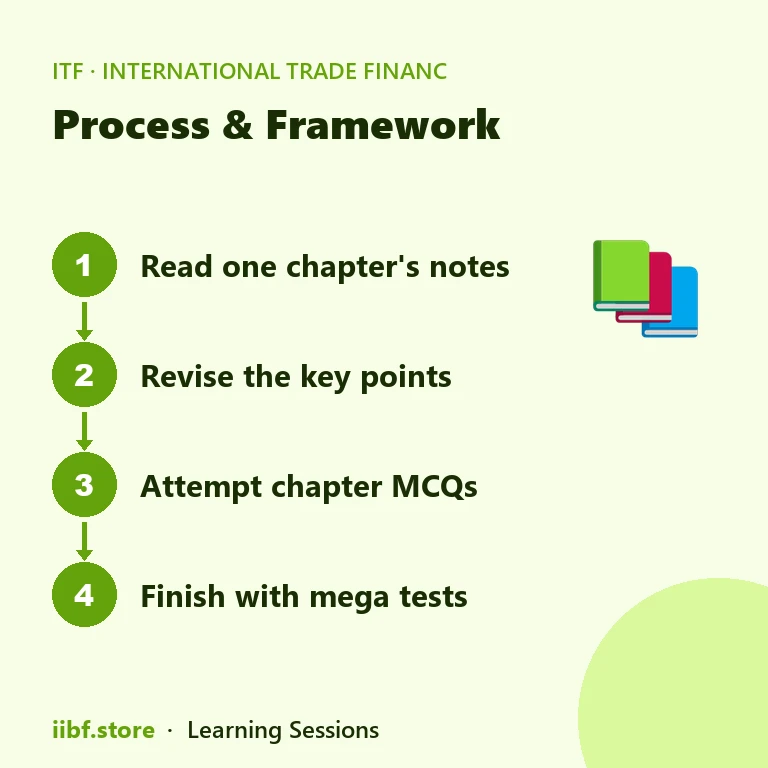
Step 1 and 2: notes, then key points
Do not try to memorise on the first pass. Read to understand. The key points that follow the notes are your revision list, so treat them as the thing you will re-read before the exam, not the notes.
Step 3: chapter MCQs
The book carries 765 questions in all. Attempting them chapter by chapter, immediately after reading, shows you at once whether you actually understood or merely recognised the words. A wrong answer straight after reading is cheap. A wrong answer in the exam hall is not.
Step 4: case studies and mega tests
At the back you will find 12 case studies carrying 48 questions, and 4 mega tests carrying 400 questions. Save these for after you have finished a module or two. Case studies train you to apply a rule to a messy situation, which is what trade finance questions often do. Mega tests give you stamina and a first honest look at your score across the full syllabus.
A realistic pace for most working learners is one chapter on weekdays and two on a weekend day. At that pace, 51 chapters take roughly eight to ten weeks, with the last two weeks left for case studies and mega tests. Adjust to your own shift pattern, and do not be harsh on yourself if a month-end week eats your evenings.
What the book will not do for you
An honest limit: a printed book builds understanding and recall, but it cannot give you exam-hall speed on its own. For that you need timed practice. Use the free mock tests at iibf.store/tests alongside the book, and browse the free material section for extra PDFs when a topic needs a second explanation.
Also remember that rules such as Incoterms and the uniform rules are revised from time to time, and regulatory chapters need a quick check against current circulars. Treat the book as your base layer and stay alert to official updates.
Who gets the most out of this book
Based on its layout, the International Trade Finance book suits three kinds of readers:
- The branch officer who touches only part of the chain. If you handle remittances but never see a letter of credit, the module-by-module flow fills the gaps without assuming prior knowledge.
- The repeat candidate. If long reference texts have worn you out before, short chapters with a fixed notes, key points and MCQs rhythm give you something finishable.
- The person who prefers paper. After a day on screens, many learners simply retain more from a printed page they can annotate.
It is less ideal if you want a deep academic treatment of every theory. This is exam-focused material at 231 pages, designed to be completed, not admired.
On price: at the time of writing the book is listed at ₹825 against an MRP of ₹2,398, a 66% reduction. Prices can change, so the book page is always the current reference. You can compare it with other titles on the books page, and read more preparation guidance on the iibf.store blog.
Conclusion
Trade finance becomes manageable the moment you stop seeing it as one subject and start seeing it as six modules and 51 short chapters. The International Trade Finance book is built around exactly that idea: notes, key points, MCQs, then case studies and mega tests to test the whole picture. Start with Module 1 this week, protect two or three evenings, and let the repetition do the work. If you want to see the writing style first, the book page has a free sample.
Frequently asked questions
How many chapters and questions does the book have?
It has 6 modules, 51 chapters and 765 questions in total, including 12 case studies (48 questions) and 4 mega tests (400 questions). It runs to 231 pages in the 2026 edition.
Where should a beginner start?
Start with Module 1, which covers the meaning, theories and barriers of international trade. It builds the vocabulary that Modules 2 to 4 rely on, so it is a gentle first week.
Is the book enough on its own?
It is a strong base for understanding and revision, but pair it with timed mock tests for exam-hall speed, and check the official IIBF website for the exam schedule and any updates.
Can I see a sample before ordering?
Yes, a free sample is available on the book page. Prices may change, so check the book page for the current price.
Prefer revising from a printed book?
Chapter-wise books with MCQs after every chapter — minimal pages, complete coverage, delivered anywhere in India. Every book has a free sample to read first.






Practice this topic
Take a free mock test, download chapter PDFs, or watch a video class — all included on iibf.store.