Inside the KYC AML CFT Book: Modules, Chapters and MCQs
You reach home after a long day at the branch. Customers, cash, a pending audit query, maybe a target call. Now you have to open a certificate syllabus that talks about layering, correspondent banking, FATF and suspicious transaction reports. It feels endless, and the first question is always the same: where do I even start?
This article is a guided tour of the KYC AML CFT book, so you can picture exactly how it is organised and how a single evening with it looks. Even if you never buy it, the method below will help you attack any compliance-heavy paper in small, finishable pieces.
Why KYC, AML and CFT feels heavy when you are working full time
Most candidates do not struggle with the idea of money laundering. They struggle with the volume. International standards, Indian legislation, the organisation structure, risk categories, reporting rules, plus the day-to-day KYC procedures you already follow at the counter but have never studied as a subject.
Three things usually go wrong:
- No map. You start at chapter one, read for two hours, and have no idea how much is left or how the topics connect.
- Reading without testing. The pages feel familiar, so you assume you know them. The exam question then changes one word and you are stuck.
- Uneven energy. Weekday evenings give you forty minutes, Sundays give you three hours. A plan built for "two hours daily" collapses in a week.
So the first job is not reading. The first job is to get a map of the whole subject. That is what the next section gives you.
The map: two modules, sixteen chapters
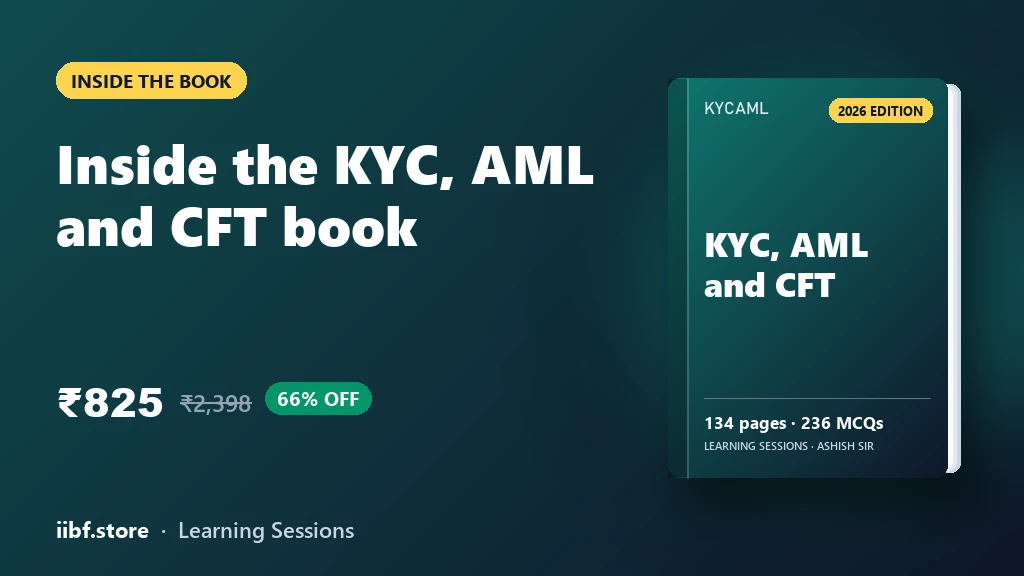
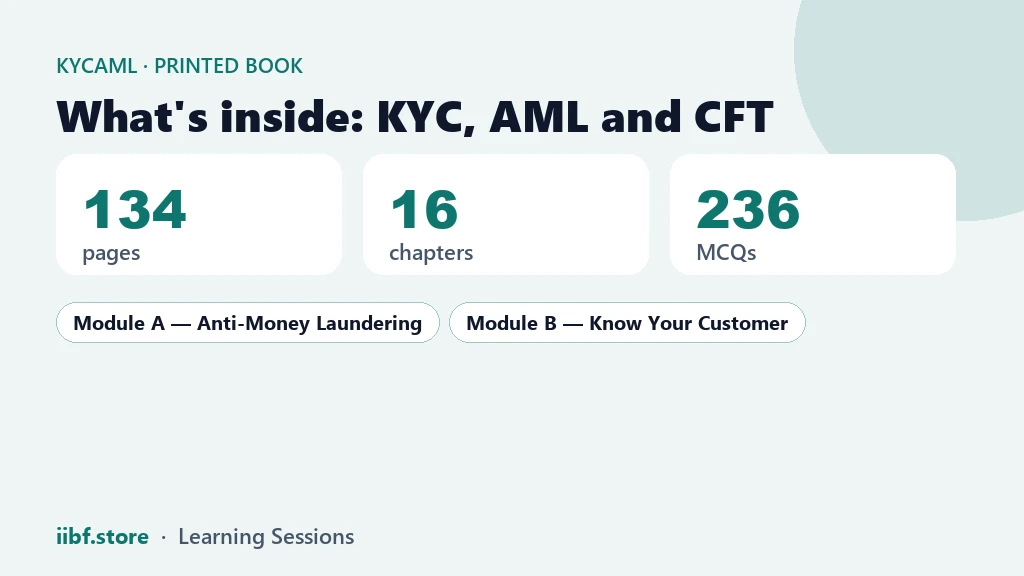
The book is 134 pages and is divided into two modules with 16 chapters in all. Here is the layout, so you can see the shape of the subject before you read a line.
Module A: Anti-Money Laundering (10 chapters)
This module starts with the concept and builds outward to the global and Indian framework:
- Money Laundering and Terrorism Financing
- Money Laundering - Some Methods
- Money Laundering - Global Measures
- International Guidelines and Standards
- AML/CFT Legislation in Major Countries and Regions
- AML CFT Legislation in India
- AML/CFT Organisation Structure in India
- Money Laundering and Correspondent Banking
- Country Risk
- Transaction Monitoring and Reporting
Module B: Know Your Customer (6 chapters)
This module is closer to your daily work, which makes it a good confidence builder:
- KYC Policy and Customer Acceptance Policy
- Customer Identification Procedure and Risk Management
- KYC Specific Requirements
- Organisational Set Up for KYC AML
- Topical Issues Related to KYC AML
- Training and Awareness
Notice the logic. Module A answers "what is the crime and who fights it". Module B answers "what must a bank do about it at the customer level". Once you see that split, the 16 chapters stop looking like 16 unrelated topics.
What one chapter looks like
A book is only useful if you can finish a chapter on a tired weeknight. Each chapter in the KYC, AML and CFT printed book follows the same rhythm, so you stop wasting energy on figuring out the layout:
- Concise notes. The chapter content is condensed, not copied from a bulky text. You read the idea, the terms and the structure.
- Key points. The points most likely to be asked are pulled together, so a last-day revision does not mean re-reading everything.
- MCQs. Questions at the end of the chapter let you check yourself while the material is still fresh.
Across the book there are 236 MCQs. That works out to roughly fifteen per chapter on average, which is a sensible number for one evening: read the notes, scan the key points, then attempt the questions without looking back.
A realistic evening with Chapter 6, AML CFT Legislation in India
Say tonight is the Indian legislation chapter. First ten minutes: read the notes slowly and underline every defined term. Next ten: go through the key points and say each one aloud in your own words. Then fifteen minutes on the MCQs. Mark every question you got wrong or guessed, and note why. Total, about forty minutes. That is a single finished unit, and a finished unit is what keeps motivation alive.
The extras: case studies and mega tests
Besides the chapters, the book lists two extras:
- 40 Case Studies (160 questions). Case-based questions train you to apply a rule to a situation, which is how many compliance questions are framed.
- 5 Mega Tests (500 questions). Longer practice sets for the final stretch, once you have covered both modules.
Use them in that order. Case studies belong in the middle of your preparation, after you finish a module, because they force you to connect chapters. Mega tests belong at the end, under a timer, when you want to see how you hold up over a long paper.
You can also add free practice from the free mock tests on the site, and pick up supporting PDFs from the free study material section. There is no need to depend on one source.
A simple plan to use the book alongside a full-time job
Here is a four-step method that works for any KYC AML CFT book, and fits a weekday schedule where you only have thirty to forty minutes.
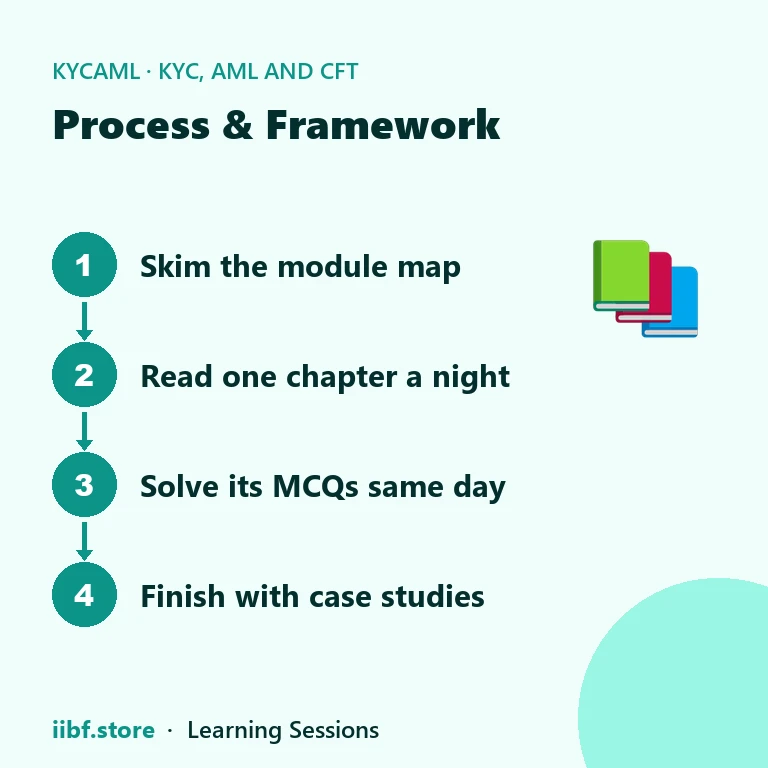
Step 1: Skim the module map (one evening)
Do not read in detail. Flip through both modules, read only chapter headings and the first few lines of each. The aim is to know where each topic lives.
Step 2: One chapter a night (Module B first if you are short of confidence)
Many bankers find Module B easier because it mirrors branch practice. Starting there gives you early wins. Then move to Module A, where the global material needs more patience.
Step 3: Solve the MCQs the same day
The memory of a chapter fades within days. Attempting its questions the same night is the cheapest revision you will ever do. Keep a small notebook of wrong answers and review it every weekend.
Step 4: Case studies, then mega tests
When both modules are covered, switch to the case studies, then finish with the mega tests under timed conditions.
| Day | Time | What to do |
|---|---|---|
| Mon to Thu | 40 minutes | One chapter: notes, key points, MCQs |
| Friday | 20 minutes | Review the wrong-answer notebook |
| Saturday | Rest | Nothing. Protect your energy. |
| Sunday | 2 to 3 hours | Case studies or a mock test, then a short summary of the week |
At four chapters a week, 16 chapters take about four weeks. Add a week or two for case studies and mega tests, and you have a realistic six-week path without giving up your weekends entirely.
Who gets the most out of this book
The book is built for a specific reader, and it helps to be honest about who that is:
- Working bankers preparing for the certificate. Clerks, officers and managers who need a compact, structured route through the syllabus rather than a library.
- People who learn by testing themselves. If you remember better after attempting questions, the chapter-end MCQs, case studies and mega tests suit you.
- Those who prefer paper. A printed book can travel in your bag, be marked up, and does not ping you with notifications at ten at night.
One honest limit: a book alone will not give you exam-hall speed. Pair it with timed practice, use the other books on the store only if you actually need them, and check the official IIBF website for the latest exam schedule and syllabus before you plan your dates.
Price, edition and the free sample
This is the 2026 edition. At the time of writing, the KYC AML CFT book is listed at ₹825 against an MRP of ₹2,398, which is about 66 percent off. Prices can change, so treat the book page as the current source of truth. A free sample is available there, and I would strongly suggest reading it first. If the style of the notes does not suit you, you have lost nothing.
If you are also thinking about the wider certificate route, the blog has more preparation guides written for people in your position.
Conclusion
A syllabus becomes manageable the moment you can see its shape. Two modules, 16 chapters, 236 MCQs, 40 case studies and 5 mega tests are a finite list, and a finite list can be finished one evening at a time. Whether you use this KYC AML CFT book or another source, build the map first, test yourself daily, and protect your rest days. That is how working bankers actually clear these papers.
Frequently asked questions
How many chapters and questions does the book have?
The book has 134 pages and 16 chapters across two modules, with 236 MCQs. It also lists 40 case studies (160 questions) and 5 mega tests (500 questions) as extras.
Which module should I start with?
Many candidates start with Module B, Know Your Customer, because it mirrors branch work and builds confidence. Then they move to Module A, Anti-Money Laundering, which covers global and Indian frameworks.
Can I see a sample before buying?
Yes. A free sample is available on the book page. Read it to check whether the notes and MCQ style suit the way you study.
Is the book enough on its own?
It gives you structured notes and a lot of practice, but speed and exam temperament come from timed mocks. Combine it with the free tests on the store and check the official IIBF site for the current exam cycle.
Prefer revising from a printed book?
Chapter-wise books with MCQs after every chapter — minimal pages, complete coverage, delivered anywhere in India. Every book has a free sample to read first.





Quick quiz on this topic
5 exam-style questions from our free test bank — check yourself before you move on.
Practice this topic
Take a free mock test, download chapter PDFs, or watch a video class — all included on iibf.store.