International Trade Finance Study Plan for Working Bankers
It is 9:30 at night. The branch closed hours ago, the last customer escalation is finally behind you, and the syllabus for the IIBF paper is open on the table. Letters of credit, Incoterms, FEMA, ECGC, TBML. It all looks like one endless pile. If this is you, a good International Trade Finance study plan matters more than another set of notes.
This article gives you a plan you can follow with a full-time job: four weeks, about 90 minutes on weekdays and a longer block on weekends. You can use the plan with any material. We also show where our printed book fits in, so you can decide for yourself.
Why the International Trade Finance paper feels bigger than it is
Most bankers who postpone this paper do so for one reason. The subject touches everything: documents, rules, regulation, risk, foreign exchange. Each topic has its own jargon, and without a map you keep jumping between them.
The map is simple. The paper is really six blocks of work:
- What trade is - theories, WTO, trade barriers.
- How a trade transaction runs - documents, payment methods, documentary credits, SWIFT, logistics, digitisation.
- The rule books - Incoterms, URC, UCPDC, URR, ISBP, URDG, standby practices.
- How the bank finances it - pre-shipment, post-shipment, factoring, forfaiting, guarantees.
- Who regulates it - DGFT, FEMA and RBI, customs, FEDAI, ECGC, EXIM Bank, SEZ.
- What can go wrong - country, credit, currency and shipment risk, frauds, TBML, ethics.
Once you see the paper as six blocks, the fear drops. You are not studying one giant subject. You are finishing six smaller ones in order. Everything below is built on that idea.
Three rules for tired learners
- Read in the same order every day. Switching between topics costs you the first 20 minutes of a short session.
- Test while the chapter is fresh. Ten questions the same night teach you more than one extra hour of re-reading.
- Protect one day a week. Missing two evenings should not break the plan. Keep a buffer day.
The book behind this plan
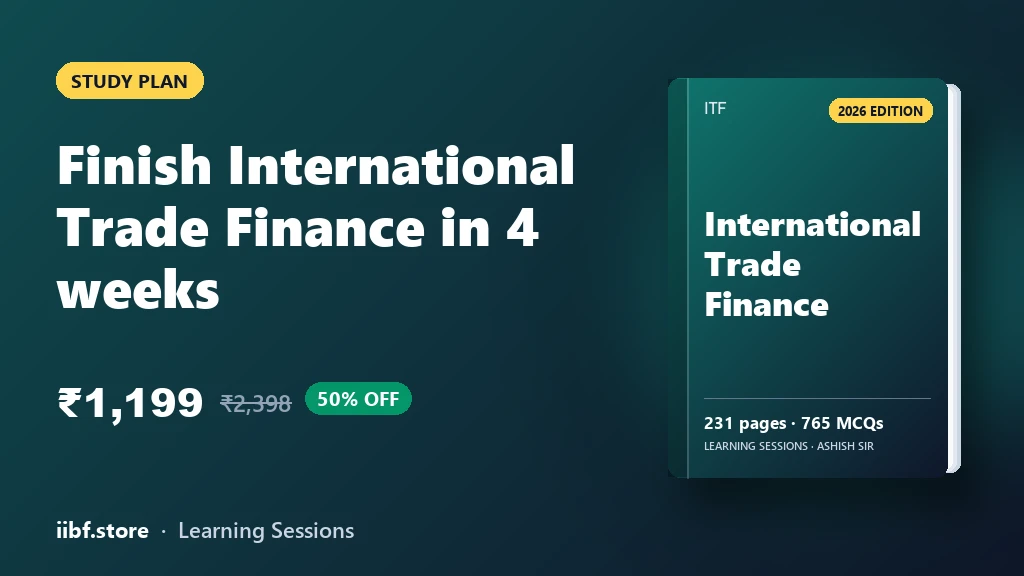
We built the plan around the International Trade Finance book because its chapter order already matches the six blocks above. It runs to 231 pages across 51 chapters in six modules, with 765 questions in the 2026 edition. It also carries 12 case studies (48 questions) and 4 mega tests (400 questions).
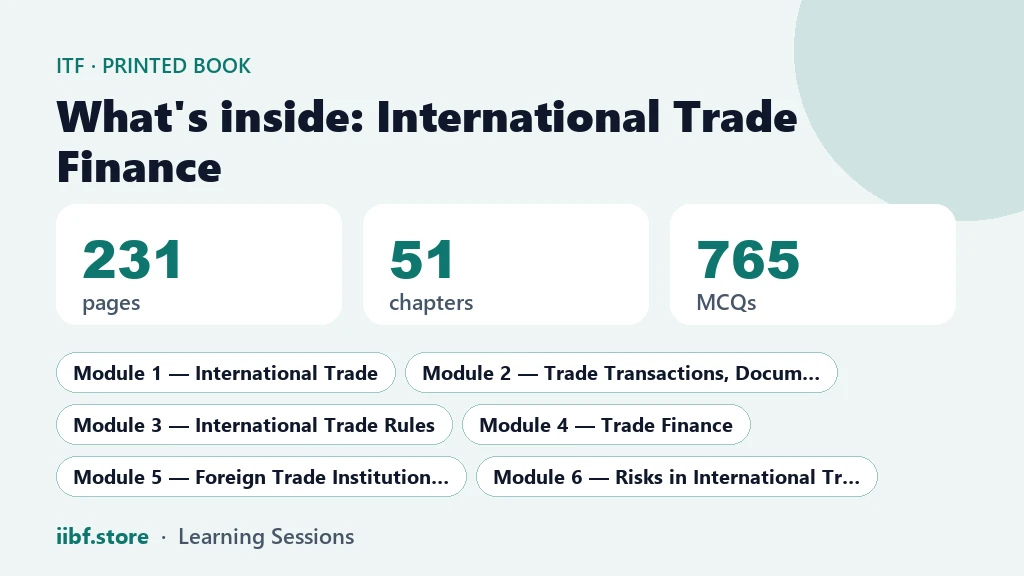
At 231 pages for 51 chapters, most chapters are short. That is useful for you. A short chapter fits inside one weekday evening, so you can finish something every day. Finishing something is what keeps a tired person coming back.
The six modules, in the order the book follows:
- Module 1 - International Trade (4 chapters)
- Module 2 - Trade Transactions, Documents and Digitisation (9 chapters)
- Module 3 - International Trade Rules (7 chapters)
- Module 4 - Trade Finance (9 chapters)
- Module 5 - Foreign Trade Institutions and Regulations (12 chapters)
- Module 6 - Risks in International Trade (10 chapters)
The International Trade Finance study plan, day by day
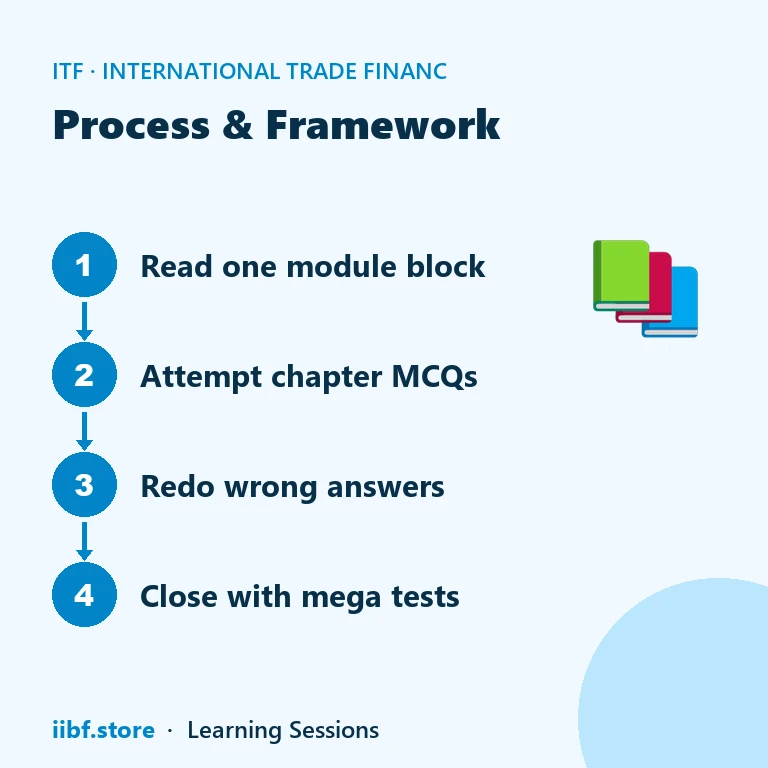
Here is the table. Weekday sessions are about 90 minutes: 60 minutes of reading and 30 minutes of MCQs. Weekend sessions can be double that. The MCQ counts are targets we suggest, not numbers fixed by the book. Adjust them to your pace.
| Days | What to read | MCQ target |
|---|---|---|
| Day 1-3 | Module 1 (4 chapters): meaning of trade, theories, WTO and trade blocs, barriers and exchange controls | All end-of-chapter MCQs, 10 minutes after each chapter |
| Day 4-8 | Module 2 (9 chapters): trade documents, methods of payment, documentary credits, SWIFT, logistics, digitisation | Chapter MCQs daily; redo the wrong ones on Day 8 |
| Day 9-12 | Module 3 (7 chapters): Incoterms, URC, UCPDC, URR, ISBP, URDG, standby practices and DOCDEX | Chapter MCQs daily; make a one-page rule-book comparison |
| Day 13-17 | Module 4 (9 chapters): pre- and post-shipment credit, factoring, forfaiting, LC, guarantees, LIBOR and alternate rates | Chapter MCQs daily; one case study on Day 17 |
| Day 18-23 | Module 5 (12 chapters): DGFT, Foreign Trade Policy, FEMA and RBI, customs, FEDAI, ECGC, EXIM Bank, SEZ and more | Chapter MCQs daily; two chapters per weekday |
| Day 24-26 | Module 6 (10 chapters): country, credit, currency and shipment risk, maritime frauds, TBML, ethics | Chapter MCQs daily; remaining case studies |
| Day 27-28 | Revision: wrong-answer list, then the mega tests | Timed mega test, then review every miss |
Notice the shape. Module 5 is the longest, with 12 chapters, so it gets six days and two chapters an evening. Module 1 is the lightest, so it is a gentle start. Do not skip Module 1 because it feels theoretical. The theory chapters are quick marks if you read them once properly.
What a weekday evening looks like
- 0-10 minutes: skim yesterday's wrong answers.
- 10-60 minutes: read one or two chapters. Underline only definitions, forms and names of rules.
- 60-90 minutes: attempt the chapter MCQs. Write down every wrong answer with the reason in one line.
That wrong-answer notebook is your best revision material. By Day 27 it will hold the exact points you personally forget.
How to study each module in this International Trade Finance study plan
Modules 1 and 2: understand the flow first
Draw one export transaction on paper: exporter, importer, two banks, shipping line, customs. Then add documents and payment methods to it. When you reach documentary credits and SWIFT, you will already know why they exist.
Module 3: do not memorise rule books one by one
URC, UCPDC, URR, ISBP, URDG: five sets of rules feel like five fresh subjects. Build one comparison page instead. For each rule set, write what it covers, who uses it and which instrument it applies to. Revise that single page every few days.
Module 4: connect it to your branch
If you have handled pre-shipment credit or an LC, link the chapter to a file you have seen. If you have not, imagine one. Finance methods stick when attached to a real customer.
Module 5: institutions are a names game
DGFT, ECGC, EXIM Bank, FEDAI, STPI, SEZ. Make a simple table: institution, what it does, one fact. Twelve chapters sounds heavy, but the questions here are mostly direct, so reading plus MCQs works well.
Module 6: think like a risk manager
Country, credit, currency and shipment risk each have a typical cause and a typical safeguard. Learn them as pairs. TBML and maritime fraud chapters reward you if you can describe a red flag in your own words.
Using the free tools alongside the book
You do not need to spend money to follow this International Trade Finance study plan. Our free mock tests are good for a first self-check after Module 3 and again after Module 5. The free material library has PDFs you can read on your phone during a commute. For other papers and certificates, browse the full books list and the blog.
One honest limit: a book gives you understanding and practice, but not exam-hall speed. Pair the plan with timed mocks in the last week. That is why Days 27-28 are reserved for mega tests.
If you fall behind on your International Trade Finance study plan
You will. Everyone does, especially around month-end and audit time. Do not restart the plan. Use these rules:
- Missed one day: merge it into the weekend block.
- Missed three or more days: drop the case studies, never the chapter MCQs.
- Short on time before the exam: finish Modules 4 and 5 first, then revise your wrong-answer notebook.
Check the official schedule and exam rules at the IIBF website before you fix your dates. We do not quote dates here because they change from cycle to cycle, and the upcoming exam cycle is what counts for you.
Final word
A good International Trade Finance study plan is boring on purpose: same order, same time, same routine. Six modules, 28 days, a notebook of wrong answers and a mega test at the end. If you want the structure ready-made, the International Trade Finance book is listed at ₹1,199 against an MRP of ₹2,398 right now. Prices may change, so the book page always has the current figure. Start tonight with Module 1, Chapter 1. Ten questions, then sleep.
FAQ
Can I finish this paper in less than four weeks?
Yes, if you can give more than 90 minutes a day. Compress each module's days, but keep the daily chapter MCQs and the final mega tests. Skipping practice is the usual reason people feel unprepared.
Is the book enough on its own?
It covers all six modules and carries 765 questions, so it is a complete base. For exam-hall speed, add timed mock tests in the final week.
Is there a free sample before I buy?
Yes. The book page has a free sample you can read first, so you can check the style and level before ordering.
Which module should I never skip?
None, but Modules 4 and 5 carry the most chapters between them, so protect those days first if time runs short.
Prefer revising from a printed book?
Chapter-wise books with MCQs after every chapter — minimal pages, complete coverage, delivered anywhere in India. Every book has a free sample to read first.








Practice this topic
Take a free mock test, download chapter PDFs, or watch a video class — all included on iibf.store.