SFB Exam Preparation Book: A Guided Tour Inside, Chapter by Chapter
It is nine at night. You have been at the counter, the desk or the loan file since morning, and now the syllabus for the Small Finance Bank certificate is open in front of you. Thirty topics, from the financial system to soft skills. You are tired, and the honest question is not "is this exam hard?" but "where do I even begin?"
This article is a guided tour of one tool for that problem: the SFB exam preparation book. We will look at how it is organised, what a single chapter looks like when you sit down with it, and what the extras are. Whether or not you buy it, you will also leave with a method for reading any large syllabus in small, tired-evening bites.
Why a big syllabus feels heavier than it is
Most working bankers do not fail a certificate because the material is beyond them. They fail, or postpone, because the syllabus has no visible shape. When everything looks like one long list, every evening begins with the same dread: "Where was I?"
Three things usually go wrong:
- No map. You read a chapter on Know Your Customer one day and a chapter on pricing the next, with no sense of how they connect.
- Too much source material. Circulars, master directions and thick reference books are written for reference, not for a Tuesday night after a long shift.
- Practice left to the end. Questions get attempted only in the last week, when it is too late to find the weak chapters.
A well-organised book fixes the first two. Discipline fixes the third. So we will start with the map, because a map is the single most useful thing a tired reader can have.
The map: how the SFB exam preparation book is organised
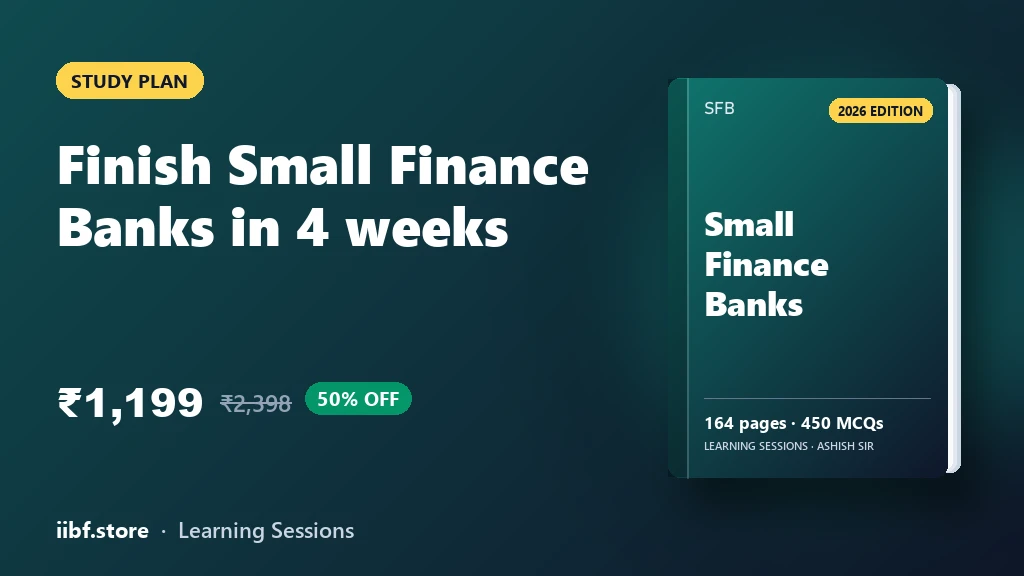
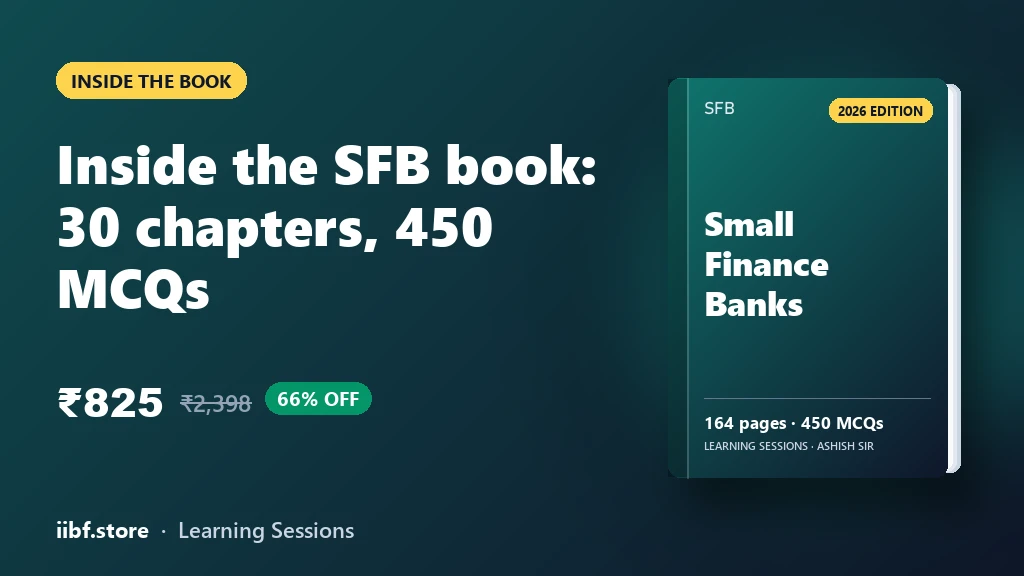
Here is the layout of the book. It runs to 164 pages in the 2026 edition, and the 30 chapters sit inside four modules. Think of the modules as four rooms. You finish a room before moving to the next.
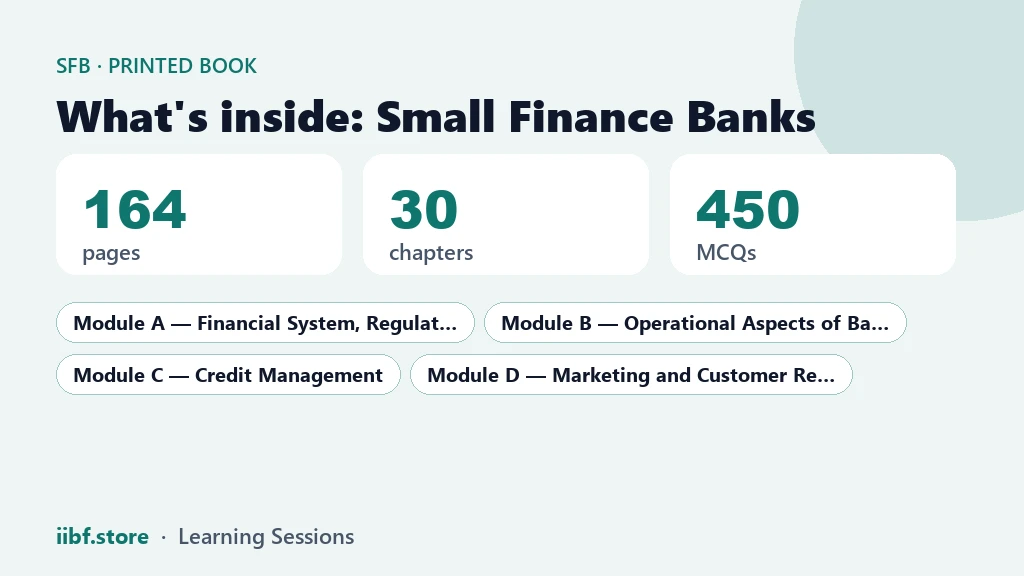
Module A: Financial System, Regulation and SFB Framework (6 chapters)
This is the foundation. It covers the Financial System, Banking Regulations, Setting Up of a Small Finance Bank, Financial Inclusion and Financial Literacy, Government Sponsored Credit-Linked Schemes, and Risk Management. If the paper is about small finance banks specifically, this is the module that explains why they exist and how they are meant to work.
Module B: Operational Aspects of Banking (5 chapters)
The everyday machinery: Operations of Banks, Maintenance of Accounts, Know Your Customer and Anti-Money Laundering, Banker Special Relationship, and Negotiable Instrument. Many branch staff already know a good part of this from work, so it is a good module to pick up momentum.
Module C: Credit Management (9 chapters)
The largest module. It includes Principles of Lending, Working Capital Assessment and Credit Monitoring, Documentation, Different Modes of Charges, Priority Sector Advances, Non-Performing Assets, Agricultural Advances, Recovery of Loans, Credit Guarantee Schemes and Foreign Exchange. If you work outside credit, plan extra evenings here.
Module D: Marketing and Customer Relationship Management (10 chapters)
Marketing, Consumer Behaviour, Pricing and Distribution, Channel Management, Para Banking Activities, Data Communication, Customer Service, Payment Systems and Electronic Banking, Consumer Protection, and Soft Skills and Leadership Skills. These chapters read lighter, which makes them handy for the days when you have only thirty minutes.
| Module | Theme | Chapters |
|---|---|---|
| A | Financial system, regulation, SFB framework | 6 |
| B | Operational aspects of banking | 5 |
| C | Credit management | 9 |
| D | Marketing and customer relationship management | 10 |
| Total | 30 |
Notice something useful even if you never open the book: 6, 5, 9 and 10 chapters. Module A and Module B together are 11 chapters, so you can finish a full "room" in the first couple of weeks and feel real progress. Visible progress is what keeps tired people studying.
What one chapter of the SFB exam preparation book looks like
A book can have thirty chapters and still be unusable if each one is a wall of text. The pattern to look for is a repeating shape, so that your brain learns where things are. In this book each chapter follows the same flow: concise notes first, then key points to fix the idea, then MCQs to test it.
1. Concise notes
These are short, exam-oriented notes, not a textbook. The aim is to give you the idea in a few minutes so that you can decide whether you understand it or need to slow down.
2. Key points
After the notes come the points worth memorising: definitions, lists, and the things an examiner likes to turn into a question. This is the part you will return to in the last week before the exam, so mark it as you go.
3. MCQs
Across the book there are 450 multiple-choice questions. Do them while the chapter is fresh. A wrong answer on the same night you read the chapter is cheap to fix. The same wrong answer discovered a month later, in a mock test, is expensive.
A practical way to read one chapter in a single sitting of about forty-five minutes:
- Spend ten minutes on the notes, with a pencil in hand.
- Spend ten minutes on the key points, writing two or three of them on a sticky note.
- Spend twenty minutes on that chapter's MCQs, and circle every one you got wrong or guessed.
- Spend the last five minutes re-reading only the circled items.
That is the whole routine. It is deliberately boring, and boring is what survives a hard week at work.
The extras: case studies and mega tests
Beyond the 30 chapters, the book lists two additions: 30 case studies (120 questions) and 5 mega tests (500 questions). These matter because chapter-wise practice and exam-hall practice are different skills.
Chapter MCQs tell you whether you understood a topic. Case studies ask you to apply several ideas to one situation, which is closer to how a working banker actually thinks. Mega tests mix everything together, so you cannot rely on the fact that "this was in the credit chapter, so the answer must be about lending".
A fair word on limits: a book alone will not give you exam-hall speed. Reading builds understanding, but speed comes from timed practice. Pair the book with the free mock tests at iibf.store/tests and keep the mega tests for your final fortnight.
A four-step plan for using the book while you work full time
Here is the method in one picture, followed by the reasoning. The approach holds for any large certificate paper, not only this one.
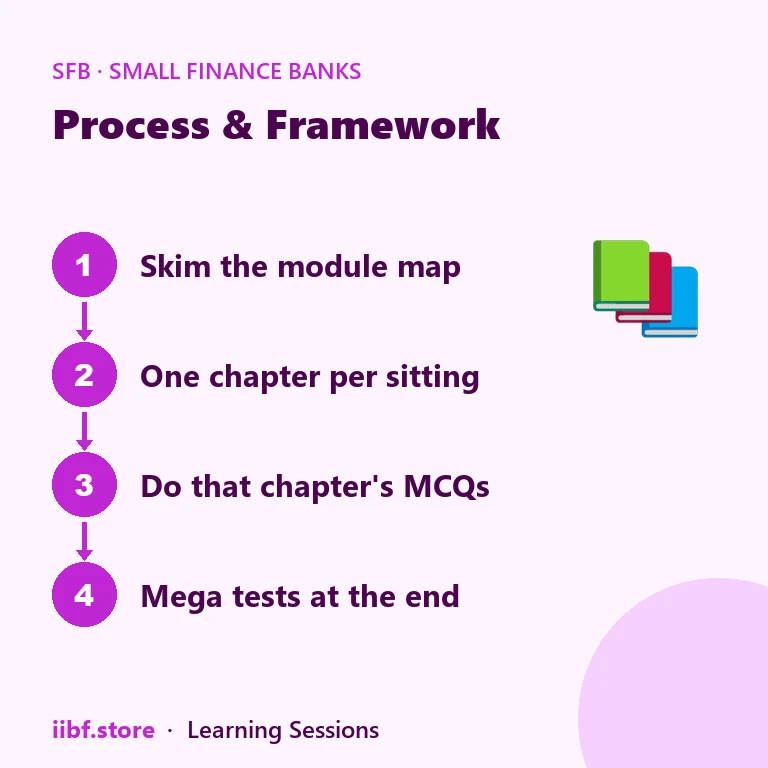
- Skim the module map first. Spend one evening reading only the chapter titles and the first page of each module. You are not learning yet. You are building the map.
- One chapter per sitting. Resist the urge to read three chapters on Sunday and none on weekdays. Consistency beats volume.
- Do that chapter's MCQs the same day. Keep a running list of weak topics.
- Keep mega tests for the end. Attempt them under timed conditions once you have finished all four modules.
If you can study on only four evenings a week, one chapter per evening finishes thirty chapters in about eight weeks, with a little slack for missed days. That is an illustration of the arithmetic, not a promise: your own pace depends on your job, your background and how much of the material is new to you.
With the SFB exam preparation book or any other source, whatever pace you set, check the official schedule and syllabus notices on the IIBF website for the upcoming exam cycle, and plan backwards from there.
Who gets the most out of this book
Every book suits some readers better than others. Here is an honest sorting.
It is a good fit if you
- work in or near a small finance bank, or plan to, and want one organised source instead of scattered notes;
- are a branch employee with only an hour or so on weekdays;
- have been postponing because the syllabus looks shapeless;
- learn best by reading a short note and testing yourself straight away.
Look elsewhere, or add to it, if you
- want deep legal commentary on every regulation, since this is exam-oriented, concise material;
- need live classes or a teacher to explain concepts from scratch;
- plan to rely on reading alone with no timed practice.
If you are comparing options, you can see the full range on the IIBF books page, and the free PDFs at iibf.store/free-material are a sensible way to test how you take to this style of study before spending anything.
Price, sample and what to do next
The printed Small Finance Banks book is listed at ₹825 against an MRP of ₹2,398 (about 66% off). Prices can change, so treat the book page as the current source. There is also a free sample on the book page, and reading it is the best way to judge the style of the notes yourself, which is better than trusting any description, including this one.
To close, the method matters more than the book. Get a map of the syllabus, take one chapter per sitting, test yourself the same night, and save the full-length practice for the end. The SFB exam preparation book is built around exactly that rhythm, which is why a tired reader can actually keep it up. Start tonight with just the module map. That is ten minutes, and it is the hardest step already done.
Frequently asked questions
How many pages and chapters does the book have?
The 2026 edition runs to 164 pages and 30 chapters, arranged in four modules (A to D), with 450 MCQs.
Does it include practice beyond chapter MCQs?
Yes. The extras listed are 30 case studies (120 questions) and 5 mega tests (500 questions), which help you move from topic-wise revision to full-paper practice.
Can I read a sample before ordering?
Yes, a free sample is available on the book page. It is worth reading one sitting's worth to see whether the notes suit your style.
Is a book enough to pass on its own?
For most people, no. Reading gives understanding, but you also need timed practice. Pair the book with mock tests, and confirm the exam schedule on the IIBF website.
Prefer revising from a printed book?
Chapter-wise books with MCQs after every chapter — minimal pages, complete coverage, delivered anywhere in India. Every book has a free sample to read first.











Practice this topic
Take a free mock test, download chapter PDFs, or watch a video class — all included on iibf.store.