Small Finance Banks Study Plan for Working Bankers
It is 9:40 pm. The branch closed hours ago, but the last reconciliation, the audit query and the pending loan file kept you back. You open the syllabus for the Small Finance Bank paper and it looks endless: financial system, regulations, KYC, lending, NPAs, payment systems, soft skills. You close the laptop and tell yourself you will start on Saturday.
If that sounds familiar, this article is for you. A workable Small Finance Banks study plan does not need six free hours a day. It needs a fixed order, a small nightly target and a way to test yourself so that you know what has actually stayed in your head. Below is the plan I would follow if I were preparing again while working a full branch day.
Why most plans fail for working bankers
Most people who postpone an IIBF certificate do not fail because the content is too hard. They fail because the plan was written for a full-time student. It assumed three hours every evening, and the first month-end closing or inspection broke it. After two missed days, the whole schedule feels lost and the book goes back on the shelf.
A plan that survives a bank job has three features:
- Small blocks. One chapter, not one module, per sitting. Forty-five to sixty minutes is enough.
- Slack days. Built-in catch-up days so that one bad week does not collapse everything.
- Testing early. Questions after every chapter, not only at the end. Reading feels productive, but only questions show what you have really retained.
Keep this in mind as you read the rest. The numbers below are a suggestion, not a rule. Move days around to fit your branch rhythm.
Know the shape of the paper before you start
Before you plan the days, you need to see the whole paper in one glance. The Small Finance Banks book follows four modules, and the 30 chapters sit inside them like this:
Module A: Financial System, Regulation and SFB Framework (6 chapters)
Financial System, Banking Regulations, Setting Up of a Small Finance Bank, Financial Inclusion and Financial Literacy, Government Sponsored Credit-Linked Schemes, and Risk Management. This is the module that explains why small finance banks exist, so it is a good place to begin.
Module B: Operational Aspects of Banking (5 chapters)
Operations of Banks, Maintenance of Accounts, Know Your Customer and Anti-Money Laundering, Banker Special Relationship, and Negotiable Instrument. If you work in a branch, much of this will feel like revision, which makes it a comfortable second week.
Module C: Credit Management (9 chapters)
Principles of Lending, Working Capital Assessment and Credit Monitoring, Documentation, Different Modes of Charges, Priority Sector Advances, Non-Performing Assets, Agricultural Advances, Recovery of Loans, Credit Guarantee Schemes, and Foreign Exchange. This is the heaviest module by chapter count, so it gets the most days.
Module D: Marketing and Customer Relationship Management (10 chapters)
Marketing, Consumer Behaviour, Pricing and Distribution, Channel Management, Para Banking Activities, Data Communication, Customer Service, Payment Systems and Electronic Banking, Consumer Protection, and Soft Skills and Leadership Skills. Many chapters here are short and descriptive, so they move faster than credit.
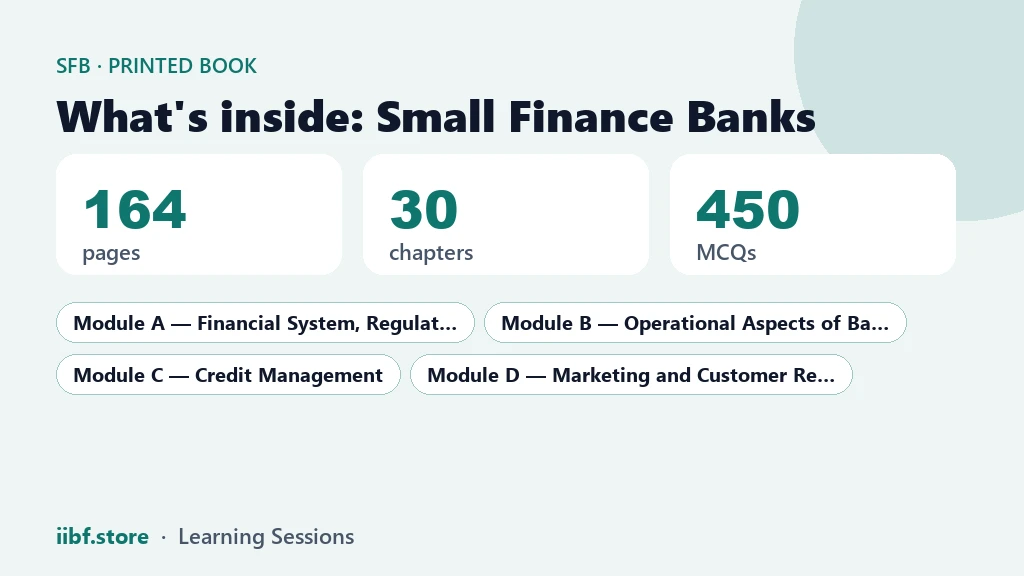
The printed book is 164 pages long, with 30 chapters and 450 MCQs placed at the end of the chapters. That works out to about 15 questions per chapter on average, which is a sensible daily dose. Besides the chapters, it carries 30 Case Studies (120 questions) and 5 Mega Tests (500 questions). Those extras matter for the last week of this Small Finance Banks study plan.
The four-week Small Finance Banks study plan, day by day
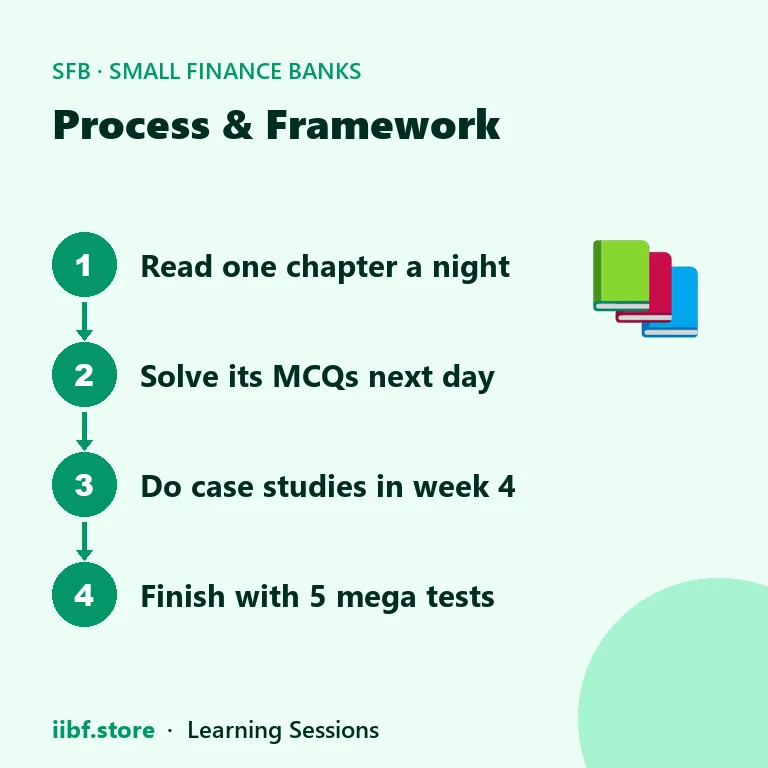
The table below spreads the 30 chapters over about three weeks, then uses the final week for case studies and mega tests. Weekday sessions assume 45 to 60 minutes after branch hours. Use Sundays for the catch-up and for the heavier credit chapters. MCQ counts are approximate, using the average of roughly 15 per chapter.
| Days | What to read | MCQ target |
|---|---|---|
| Days 1 to 5 | Module A, 6 chapters (about one a day, one chapter shared with a catch-up) | About 90 chapter MCQs |
| Days 6 to 8 | Module B, 5 chapters (two light nights, one slightly longer) | About 75 chapter MCQs |
| Days 9 to 15 | Module C, 9 chapters (credit needs the extra days; use Sunday for NPAs and charges) | About 135 chapter MCQs |
| Days 16 to 21 | Module D, 10 chapters (pair two short chapters on some nights) | About 150 chapter MCQs |
| Days 22 to 24 | The 30 Case Studies, ten a day | 120 case-study questions |
| Days 25 to 28 | The 5 Mega Tests, then revise only the weak chapters | 500 mega-test questions |
If your month is heavier than this, stretch each row by a few days. The order stays the same, and that order is what protects you from panic.
How to use one evening, minute by minute
A table of days is useless if the evening itself is unstructured. Here is a simple routine for a 60-minute session.
- First 5 minutes: skim the chapter headings and the boxed points. Decide what you want to know by the end.
- Next 35 minutes: read actively. Underline the numbers, limits, definitions and names of schemes. Do not highlight everything, because then nothing stands out.
- Next 15 minutes: attempt the chapter MCQs without looking back. If you are too tired, do half now and half the next evening.
- Last 5 minutes: mark every wrong answer and write one line on why you missed it.
That last step is where marks are won. A wrong answer you explain in your own words is a wrong answer you will rarely repeat.
What to do when a day is lost
It will happen. A late meeting, a transfer, a sick child. Do not try to read two chapters the next day to compensate. Simply push the plan forward by one day, or use the Sunday catch-up slot. The aim is steady progress, not a perfect streak.
Where the book fits inside this plan
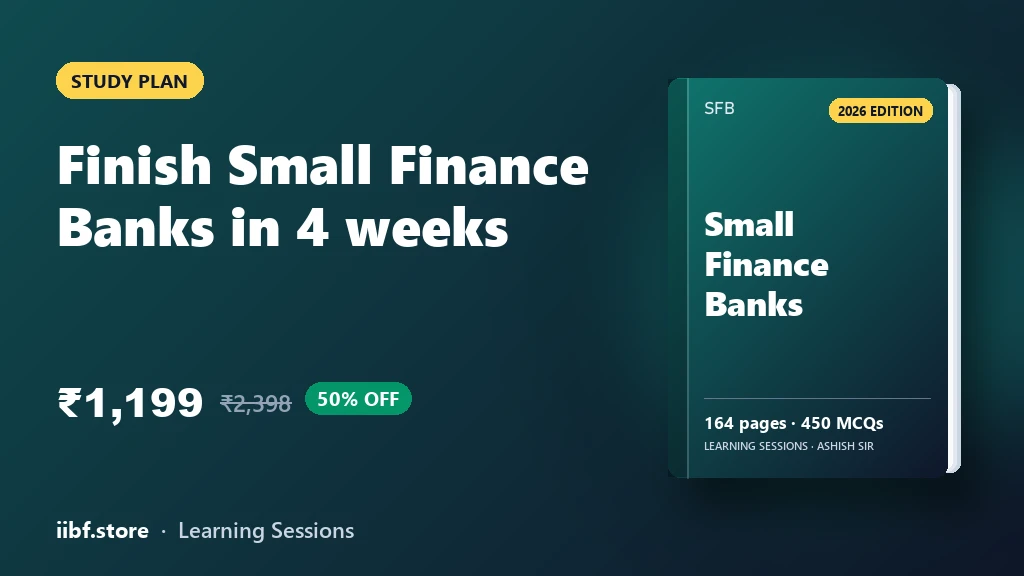
You can follow the structure above with any reliable material, but a book built to the same shape saves effort. The Small Finance Banks paper book keeps the four-module order, puts the MCQs at the end of each chapter and carries the case studies and mega tests in the same volume, so you are not hunting for practice material at 10 pm. As on the book page, the 2026 edition is listed at ₹1,199 against an MRP of ₹2,398 (50% off); prices can change, so check the book page for the current figure. There is also a free sample you can read before deciding.
One honest limit: a book alone will not give you exam-hall speed. Reading and chapter questions build knowledge, but timing comes from sitting full mocks. Pair the printed material with the free mock tests at iibf.store/tests and keep the official notices handy at iibf.org.in.
The last week: case studies and mega tests
Case studies feel different from plain MCQs. You read a short situation, such as a borrower account turning irregular or a customer complaint, and choose the best response. They test whether you can apply a rule, not only recall it. That is why the plan keeps them for after the chapters, when the rules are fresh.
When you start the five mega tests, treat them like the real paper. Sit at a table, set a timer, and do not pause. After each test, spend as long reviewing as you spent attempting. Group your errors by module. If most of them fall in Module C, go back to the credit chapters for two evenings rather than rereading everything.
Do not take all five mega tests in five days if you are exhausted. One test every alternate day, with a review day between, will teach you more than a rushed marathon.
A short checklist before you begin
- Check the official schedule for the upcoming exam cycle on the IIBF website and pick your target window.
- Mark the four-week block on a wall calendar and note your known busy days.
- Keep a notebook only for mistakes, not for copying the book.
- Fix one study spot and one time slot, even if it is only 45 minutes.
- Browse the free PDFs at iibf.store/free-material for extra revision on the weaker chapters.
That is the whole method. Choose a start date, begin with Module A tonight and let the routine do the heavy lifting. A calm, repeatable Small Finance Banks study plan will carry you further than a burst of effort that fades in ten days.
Frequently asked questions
Can I finish the Small Finance Banks paper in four weeks while working full time?
Many working bankers can, if they hold to about 45 to 60 minutes on weekdays and use Sundays for catch-up. If your branch load is heavy, stretch the plan to five or six weeks and keep the same order.
Should I read all chapters before attempting any MCQs?
No. Attempt the chapter questions the same night or the next evening. Early testing shows what you have retained while the chapter is fresh, and it makes revision much shorter.
How many questions does the book give me to practise?
The printed book has 450 chapter MCQs, plus 30 case studies with 120 questions and 5 mega tests with 500 questions. Check the book page for the current details and edition.
Where do I find the exam date and rules?
This article does not quote dates or rules because they can change. Please check the official IIBF website at iibf.org.in for the schedule and eligibility of the upcoming exam cycle.
You can also browse more books at iibf.store/books and other preparation guides on the iibf.store blog.
Prefer revising from a printed book?
Chapter-wise books with MCQs after every chapter — minimal pages, complete coverage, delivered anywhere in India. Every book has a free sample to read first.












Practice this topic
Take a free mock test, download chapter PDFs, or watch a video class — all included on iibf.store.
Keep reading