Inside the CAIIB Risk Management Book: A Chapter Tour
It is 9:40 pm. You have closed the branch, settled the cash, answered the last customer call, and now you are supposed to open a Risk Management elective with Basel, VaR, ICAAP and swaps in it. Most people in your position do not fail because the subject is impossible. They fail because the material feels endless and they cannot see where one session ends and the next begins.
This article is a guided tour of the CAIIB Risk Management book so you can picture, before anything else, what a single evening with it looks like. Even if you never buy it, the module map and the chapter routine below will help you plan any risk management preparation.
Why a map matters more than motivation
When the syllabus is a fog, every session starts with the same wasted question: what should I study today? A tired mind answers that question badly. It picks the chapter it likes, usually the easy one, and avoids Basel buffers or probability until the last fortnight.
The fix is boring and effective. Break the subject into modules, break the modules into chapters, and give each chapter a fixed routine. Then your only decision each evening is which chapter number comes next. The rest is execution.
- Decide your module order once, not every night.
- Keep each session to one chapter, or half a chapter on a heavy day.
- End every session by writing down what you could not recall without looking.
The structure of the book is built around exactly this idea, so let us walk through it.
The module map: six modules, 40 chapters
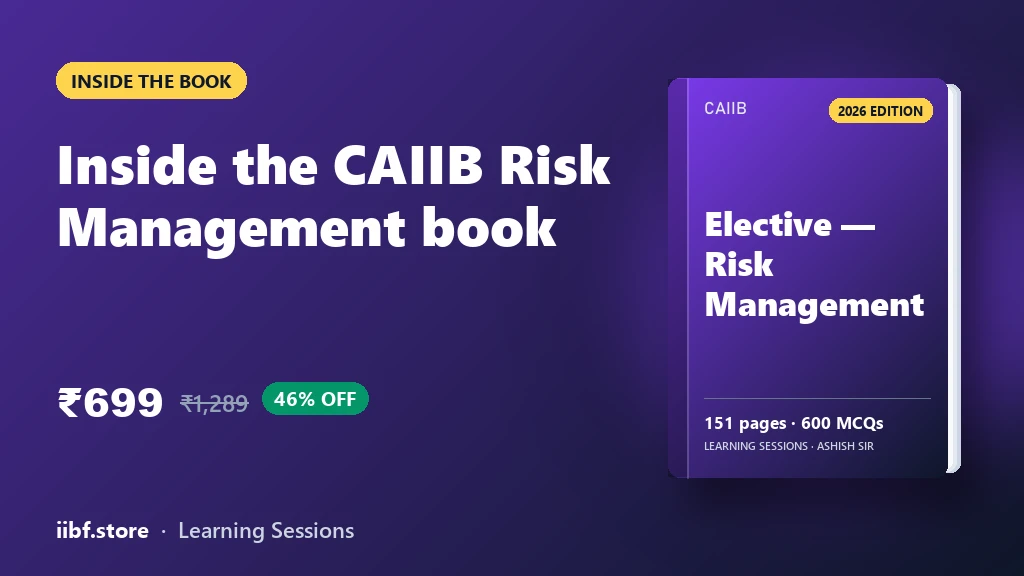
The book is 151 pages in the 2026 edition and divides Risk Management into six modules. Here is the whole layout of the CAIIB Risk Management book in one view.
| Module | Chapters | What it covers |
|---|---|---|
| A - An Overview | 5 | Why banks are special, risk framework, ALM, liquidity risk |
| B - Credit Risk Management | 7 | Framework, obligor risk, rating, portfolio, models, derivatives |
| C - Market Risk | 4 | Market risk, fixed income, interest rate risk, Value at Risk |
| D - Operational Risk | 6 | Loss data, RCSA and KRI, technology risk, governance, climate risk |
| E - Risk Regulation and Basel Framework | 11 | Basel III, capital adequacy, ICAAP, stress testing, supervision |
| F - Derivatives and Quantitative Techniques | 7 | Forwards, futures, options, swaps, statistics, probability |
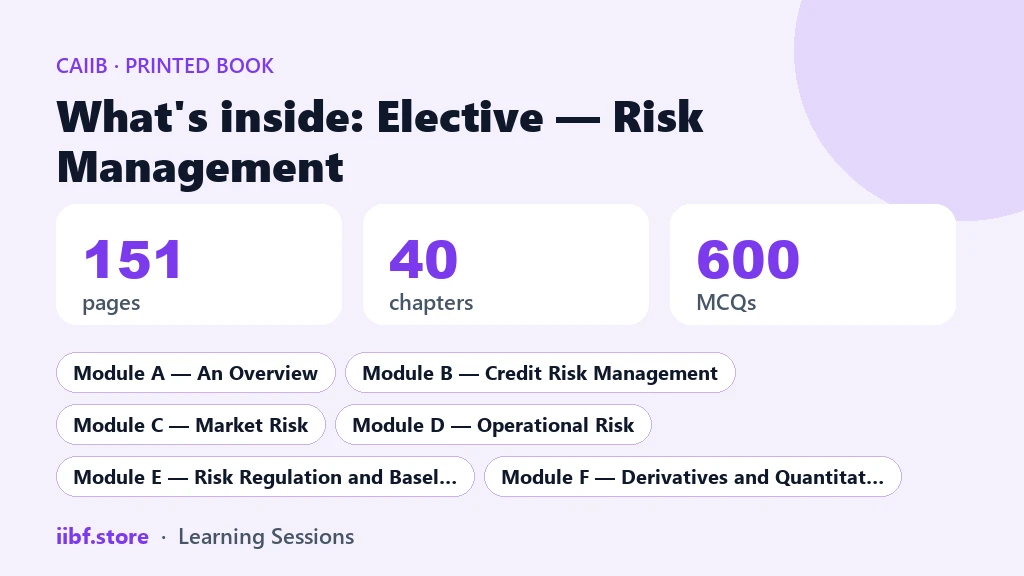
Notice the weight. Module E alone has eleven chapters, more than a quarter of the book. If you are short of time, that is where a regulation-heavy paper like this rewards steady effort. Module C is small at four chapters, but it carries Value at Risk and interest rate measurement, which feel numerical to many candidates and need practice rather than reading.
Module A: the on-ramp
The first five chapters, from "Why Banks are Special" to "Liquidity Risk Management", set the vocabulary. Treat them as your warm-up. If you already work in credit or treasury, you will move quickly; if you are in a branch role, they give you the language that the later modules assume.
Modules B, C and D: the three risk families
Credit, market and operational risk each get their own module. Credit runs from the framework and obligor risk through rating systems, portfolio risk, models, measurement and credit derivatives. Operational risk moves from the framework and loss data to RCSA and KRI, technology risk, corporate governance, and climate risk with sustainable finance.
One chapter, three layers
The real question when you hold a book like this is not how many chapters it has but what happens inside one. Each chapter follows the same pattern, which is what makes it possible to plan a tired evening around it.
- Concise notes. The concept explained briefly, without padding. This is the part you read once, slowly.
- Key points. The short list you will revisit the night before the paper. Reading this layer is revision, not first learning.
- MCQs. Questions that test whether the notes actually stuck. Across the book there are 600 of them.
This order matters. Many candidates go straight to questions, get a wrong answer, and feel discouraged. Others read notes forever and never test themselves. Notes, then key points, then questions keeps you honest in the right sequence.
A realistic evening: forty minutes on the notes, ten minutes writing the key points from memory in your own words, then fifteen minutes on that chapter's MCQs. About an hour. On a Sunday you can do two chapters.
The extras that change how you revise
Beyond the chapters, the book carries 60 case studies, listed as 240 questions. Case-style questions are where a Risk Management paper separates people who memorised definitions from those who can apply them: reading a short scenario about a loan portfolio or a capital calculation and picking the right response.
Do not leave the cases to the last week. Attempt a few at the end of each module, so that when you reach Module E you are already used to reading a scenario and answering from the framework you just learned.
You can see for yourself how a chapter reads before spending anything. The free sample for this elective is on the book page, and the current price and availability are shown there too, since prices may change.
A four-step plan for using the CAIIB Risk Management book
Here is the routine that matches the three layers above, stretched into a plan you can run across several weeks.
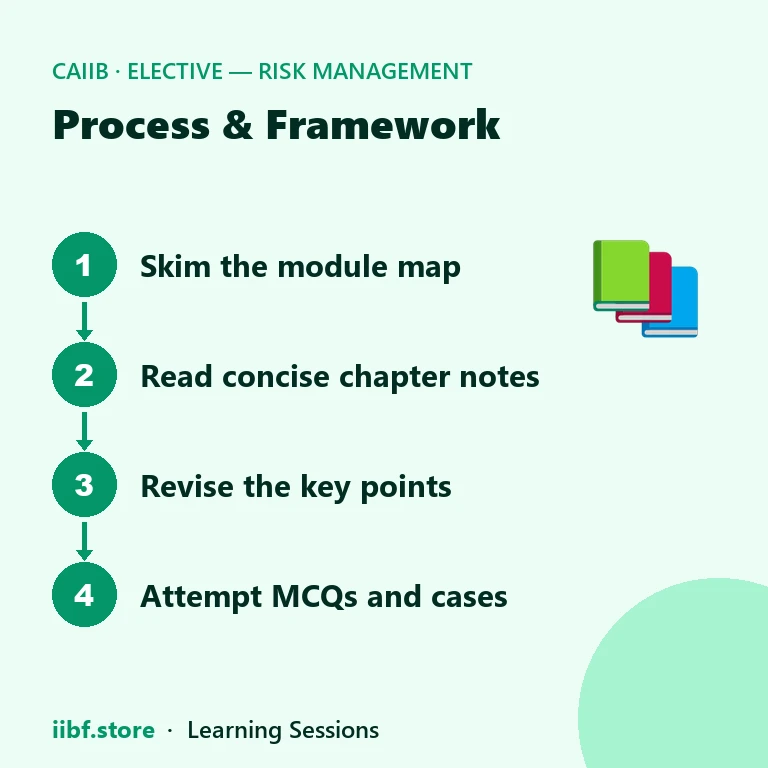
Step 1: skim the module map
Before starting a module, spend five minutes reading just the chapter titles. Your brain gets a frame to hang details on. This costs almost nothing and saves confusion later.
Step 2: read the concise notes
One chapter per sitting. Do not highlight everything. Mark only the formula, the definition or the rule you would struggle to reconstruct.
Step 3: revise the key points
Close the book and write them out from memory. Whatever you cannot write goes onto a short list. That list is your personal revision sheet, and it is far more useful than the full book in the final week.
Step 4: attempt MCQs and cases
Do the chapter's questions straight after the notes while the material is fresh. Log wrong answers by module. After a month the pattern will tell you honestly where to spend your remaining hours.
Using the book alongside free material
A printed book is one tool, not a complete system. For exam-hall speed you also need timed practice, and that is not something any book can give you by itself.
- Take timed papers on the free mock tests once you finish each module.
- Browse the free PDFs for quick revision on topics you keep missing.
- See the CAIIB course page for how the electives fit with the compulsory papers.
- Check the official schedule and notices at the IIBF website for the upcoming exam cycle.
If you are comparing options, the full range is on the books page, and more preparation guides are in the blog.
Who gets the most out of it
Being honest, the CAIIB Risk Management book at 151 pages will not suit everyone. It suits you if:
- You work full time and need compact chapters that fit one evening.
- You prefer a printed copy you can carry, mark up and revise on a commute.
- You have studied the syllabus before and need a structured way to finish it, not a fresh encyclopedia.
- You want questions attached to every chapter rather than hunting for practice elsewhere.
It suits you less if you want a deep academic treatment of every derivative pricing model. A concise book trades depth for completeness and speed, and for most working bankers that is the right trade.
The takeaway
Picture the whole thing as six modules, forty chapters and one repeating routine. That is what the CAIIB Risk Management book gives you: a way to turn an endless syllabus into a sequence of one-hour sessions. Pair it with timed mocks, keep your wrong-answer log, and let the routine do the work on the nights when motivation is low. The book page lists the current price against the printed MRP, so you can decide for yourself.
FAQ
How many chapters and questions does the book have?
It has 40 chapters across six modules, 151 pages in the 2026 edition, and 600 MCQs, plus 60 case studies listed as 240 questions.
Is there a sample I can read first?
Yes. A free sample is available on the book page, so you can see the notes, key points and question style before ordering.
Can this book alone get me through the paper?
It gives you structured notes and practice, but exam-hall speed comes from timed mock tests. Use the book for learning and mocks for pace.
Where do I check exam dates and rules?
Always use the official IIBF website for the schedule, eligibility and syllabus notices for the upcoming exam cycle.
Prefer revising from a printed book?
Chapter-wise books with MCQs after every chapter — minimal pages, complete coverage, delivered anywhere in India. Every book has a free sample to read first.
151 pages · 600 MCQs
Learning Sessions · Ashish Sir
148 pages · 478 MCQs
Learning Sessions · Ashish Sir
151 pages · 465 MCQs
Learning Sessions · Ashish Sir
148 pages · 375 MCQs
Learning Sessions · Ashish Sir
216 pages · 895 MCQs
Learning Sessions · Ashish Sir
109 pages · 300 MCQs
Learning Sessions · Ashish Sir
104 pages · 360 MCQs
Learning Sessions · Ashish Sir
82 pages · 297 MCQs
Learning Sessions · Ashish Sir
98 pages · 282 MCQs
Learning Sessions · Ashish Sir
131 pages · 672 MCQs
Learning Sessions · Ashish Sir
221 pages · 831 MCQs
Learning Sessions · Ashish Sir
128 pages · 524 MCQs
Learning Sessions · Ashish Sir
107 pages · 445 MCQs
Learning Sessions · Ashish Sir
132 pages · 225 MCQs
Learning Sessions · Ashish Sir
188 pages · 435 MCQs
Learning Sessions · Ashish Sir
117 pages · 236 MCQs
Learning Sessions · Ashish Sir
Learning Sessions · Ashish Sir
118 pages · 299 MCQs
Learning Sessions · Ashish Sir
Learning Sessions · Ashish Sir
Learning Sessions · Ashish Sir
Learning Sessions · Ashish Sir
115 pages · 255 MCQs
Learning Sessions · Ashish Sir
Learning Sessions · Ashish Sir
334 pages · 936 MCQs
Learning Sessions · Ashish Sir
Learning Sessions · Ashish Sir
115 pages · 344 MCQs
Learning Sessions · Ashish Sir
107 pages · 240 MCQs
Learning Sessions · Ashish Sir
90 pages · 150 MCQs
Learning Sessions · Ashish Sir
Learning Sessions · Ashish Sir
Quick quiz on this topic
5 exam-style questions from our free test bank — check yourself before you move on.
Practice this topic
Take a free mock test, download chapter PDFs, or watch a video class — all included on iibf.store.