Inside the CAIIB ITDB Book: Modules, Chapters and MCQs
It is 10 pm. The branch closed late, the audit queries are still in your head, and you have a CAIIB elective waiting. Information Technology and Digital Banking looks friendly on the surface, but then you open the syllabus and see networking, databases, data mining, clearing systems, the IT Act and RBI cyber security guidelines all in one paper. Where do you even begin? This article is a guided tour of the CAIIB ITDB book, so you can picture exactly how a late-night session with it would go, and decide calmly whether it suits you.
Even if you never buy anything from us, the tour below should help you plan. A paper like this is easier once you see its shape.
Why ITDB feels harder than it really is
Most bank employees do not come from a computer background. You use core banking software every day, but you may never have thought about how a database stores a record or what a firewall actually filters. When a paper suddenly asks about data warehousing or business continuity planning, it feels like a different language.
The good news is that the paper is broad but shallow in most places. It tests whether you know the concept, the terminology and where it applies in a bank. It rarely asks you to build anything. That means a clean, organised set of notes plus regular practice usually works better than reading a thick reference text from cover to cover.
- Vocabulary is half the battle. Terms such as RTGS, NEFT, SLA, RFP, DR site, data mart and PKI keep recurring. Learn them as a glossary first.
- Chapters are independent. You can study them in any order, which suits a broken study schedule.
- Regulatory chapters carry real weight. The IT Act and the RBI cyber security material reward careful reading.
How the CAIIB ITDB book is organised
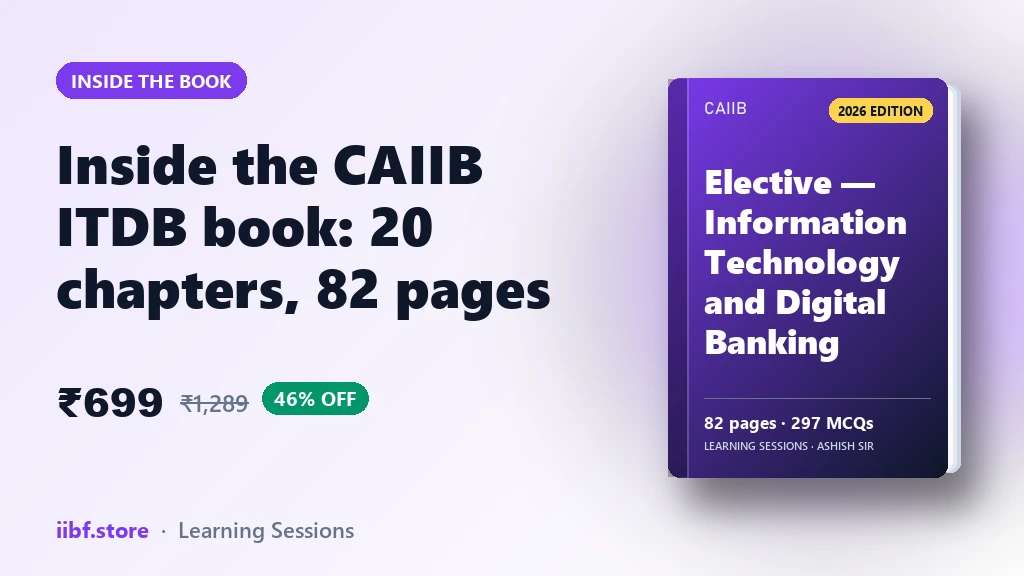
The CAIIB Elective Information Technology and Digital Banking printed book (2026 edition) runs to 82 pages across 20 chapters, grouped into four modules. It also carries 297 questions. Eighty-two pages is deliberately compact: the idea is notes you can finish and revise, not a library you carry around and never open.
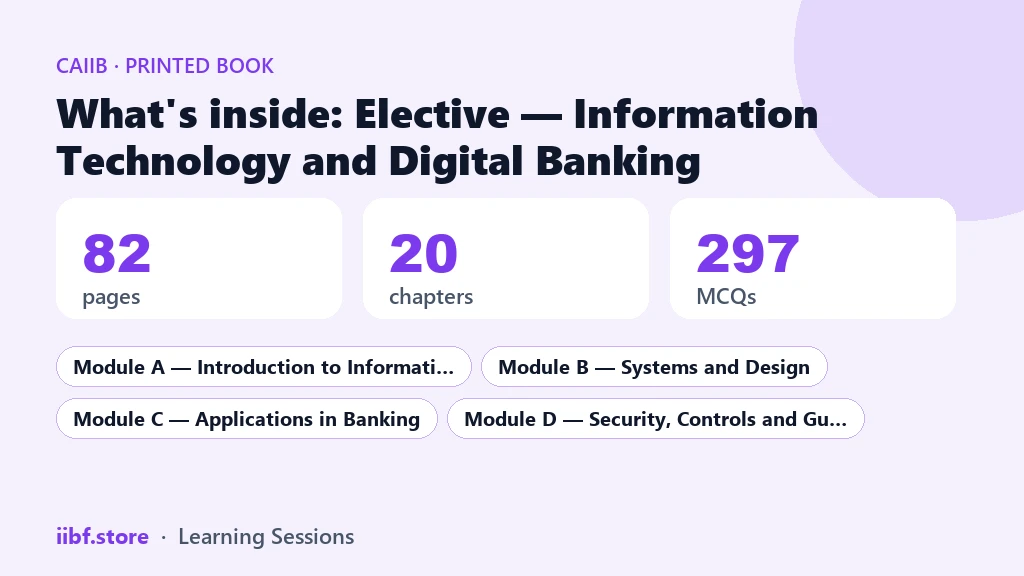
Module A: Introduction to Information Technology
This is the foundation, four chapters: Information Technology and its Implications, Introduction to Computing, Introduction to Software, and Networking Systems. If you are the person in the branch who always calls the IT helpdesk, start here. Do not skip it, because later modules lean on these basics.
Module B: Systems and Design
Three chapters: Introduction to Information Systems, Database Management Systems, and Data Warehousing and Data Mining. These are the most "technical" pages in the paper, but they are also the most self-contained. Learn the definitions and the differences between similar-sounding terms.
Module C: Applications in Banking
Seven chapters, and the one most bankers find comfortable because it is about things you see at work: E-Learning Environment, Banking Software, Electronic Clearing and Settlement Systems, Plastic Money, Electronic Commerce and Banking, IT Act 2000 and 2008, and Emerging Technologies. Read this module when you are too tired for abstract concepts.
Module D: Security, Controls and Guidelines
Six chapters: Computer Security, Communication Security, Business Continuity and Disaster Recovery planning, Information System Audit, Competitive Bid Process (RFP and SLA), and RBI Guidelines on Cyber Security (2016) and Digital Payment Security (2021). For an officer who will one day sit on a vendor committee or face an IS audit, this module is useful well beyond the exam.
What one chapter looks like
A book is only useful if the rhythm of a chapter works for you. Each chapter in the CAIIB ITDB book follows the same simple pattern, so after the first one you know what to expect.
- Concise notes. The topic in short, plain paragraphs and lists, trimmed to what an exam-oriented reader needs.
- Key points. The facts, definitions and distinctions you should be able to recall without looking.
- MCQs. Questions on that chapter, so you test yourself while the material is still fresh.
Take the chapter on Electronic Clearing and Settlement Systems as an example of how you might use it. First read the notes once, without highlighting anything. Then close the book and say aloud the three or four things you remember. Open the key points and compare. Only then attempt the questions. Wrong answers tell you exactly which paragraph to reread, which is far more efficient than rereading everything.
The extras: case studies
Apart from chapter questions, the book lists 60 case studies carrying 240 questions. Case studies train a different skill: reading a short banking situation and picking the right response. Treat them as your second pass, once you have finished the chapters of a module, not as a starting point.
A practical way to work through it
Twenty chapters sounds like a lot until you divide it. If you can manage even five or six short sessions a week, the whole book is within reach well before the upcoming exam cycle. Check the official schedule at the IIBF website and work backwards from your date.
Here is a sample split that respects a tired brain. It is only a suggestion, so adjust it to your branch hours.
| Slot | What to do | Why it works |
|---|---|---|
| Weekday evening (short) | One chapter's notes and key points | Low effort, builds the habit |
| Next evening | The MCQs for that chapter | Recall while it is fresh |
| Weekend morning | Redo wrong questions, then a module revision | Fixes weak spots |
| Weekend later | A set of case studies | Applies the theory |
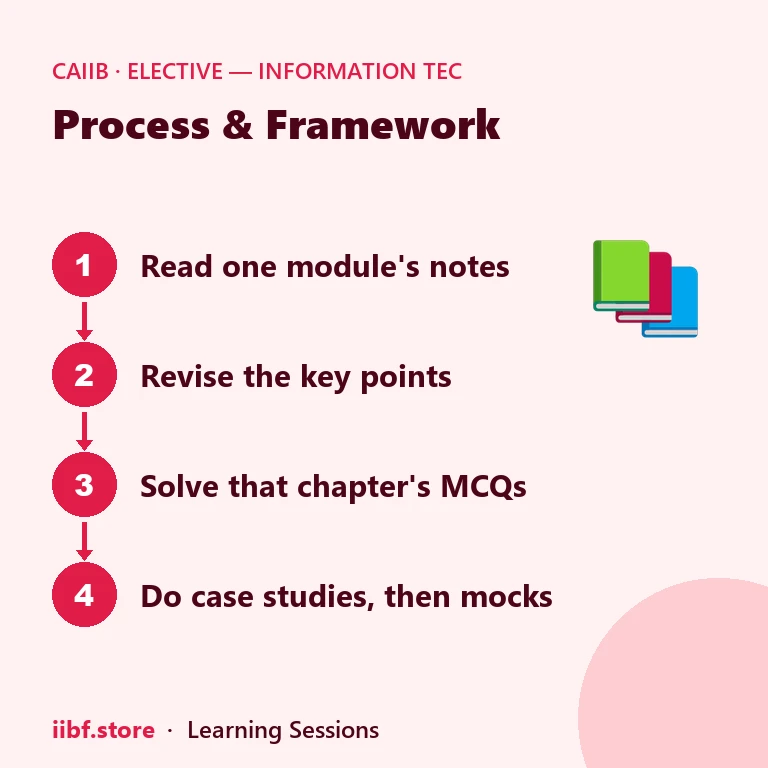
Notice the loop: read, recall, practise, apply. It matters more than the exact days. If a week goes wrong because of a rush at the branch, do not try to double up. Pick the loop up again at the next chapter.
Pairing the book with free practice
No book alone will give you exam-hall speed. Reading builds understanding, but timed practice builds the ability to finish a paper. Use the free mock tests once you have covered a module, and browse the free study material for extra revision PDFs. If you are still deciding on your overall CAIIB approach, the CAIIB course page and the blog carry more guidance.
A printed book has one advantage that matters to many people: it does not buzz with notifications. If your phone pulls you away every few minutes, a physical copy of the CAIIB ITDB book can protect your forty focused minutes. If you prefer screens, that is fine too. Pick the format you will really open.
Who gets the most out of it
Be honest with yourself. This book is likely to help you most if:
- You are a working banker without an IT background and want a compact, structured start.
- You have limited evenings and need to finish the syllabus once, then revise it more than once.
- You learn by testing yourself, and want questions placed right after the notes.
- You have been through a bulky reference text before and abandoned it halfway.
It may be less suitable if you want deep technical detail on networking or databases beyond what the exam asks, or if you already hold a technology qualification and only need practice papers. In that case the free tests may be all you need.
As for the price, the CAIIB ITDB book is listed at ₹699 against an MRP of ₹1,289, which is 46% off. Prices can change, so the books page is always the current word. There is also a free sample, so you can judge the style of the notes yourself before ordering.
Final thoughts
ITDB rewards steady, organised effort more than raw brilliance. Four modules, twenty chapters, one simple loop. If you take only one idea from this tour, take the loop: notes, key points, questions, then application. With that habit, even a tired Tuesday evening can add one more chapter to your tally. Whether you use our CAIIB ITDB book or another resource, start with Module A this week and keep moving.
Frequently asked questions
How many chapters and questions does the CAIIB ITDB book have?
It has 20 chapters in four modules, 82 pages in the 2026 edition, and 297 questions. It also lists 60 case studies with 240 questions.
Which modules does it cover?
Module A (Introduction to Information Technology), Module B (Systems and Design), Module C (Applications in Banking) and Module D (Security, Controls and Guidelines).
Is there a free sample before I buy?
Yes. The book page offers a free sample so you can check the notes and question style first.
Is the book enough on its own to clear the paper?
It gives you organised notes and practice, but timed mock tests build exam speed. Pair it with the free tests and check the official IIBF site for the upcoming exam schedule.
Prefer revising from a printed book?
Chapter-wise books with MCQs after every chapter — minimal pages, complete coverage, delivered anywhere in India. Every book has a free sample to read first.
82 pages · 297 MCQs
Learning Sessions · Ashish Sir
148 pages · 478 MCQs
Learning Sessions · Ashish Sir
151 pages · 465 MCQs
Learning Sessions · Ashish Sir
148 pages · 375 MCQs
Learning Sessions · Ashish Sir
216 pages · 895 MCQs
Learning Sessions · Ashish Sir
109 pages · 300 MCQs
Learning Sessions · Ashish Sir
104 pages · 360 MCQs
Learning Sessions · Ashish Sir
151 pages · 600 MCQs
Learning Sessions · Ashish Sir
98 pages · 282 MCQs
Learning Sessions · Ashish Sir
131 pages · 672 MCQs
Learning Sessions · Ashish Sir
221 pages · 831 MCQs
Learning Sessions · Ashish Sir
128 pages · 524 MCQs
Learning Sessions · Ashish Sir
107 pages · 445 MCQs
Learning Sessions · Ashish Sir
132 pages · 225 MCQs
Learning Sessions · Ashish Sir
188 pages · 435 MCQs
Learning Sessions · Ashish Sir
117 pages · 236 MCQs
Learning Sessions · Ashish Sir
Learning Sessions · Ashish Sir
118 pages · 299 MCQs
Learning Sessions · Ashish Sir
Learning Sessions · Ashish Sir
Learning Sessions · Ashish Sir
Learning Sessions · Ashish Sir
115 pages · 255 MCQs
Learning Sessions · Ashish Sir
Learning Sessions · Ashish Sir
334 pages · 936 MCQs
Learning Sessions · Ashish Sir
Learning Sessions · Ashish Sir
115 pages · 344 MCQs
Learning Sessions · Ashish Sir
107 pages · 240 MCQs
Learning Sessions · Ashish Sir
90 pages · 150 MCQs
Learning Sessions · Ashish Sir
Learning Sessions · Ashish Sir
Quick quiz on this topic
5 exam-style questions from our free test bank — check yourself before you move on.
Practice this topic
Take a free mock test, download chapter PDFs, or watch a video class — all included on iibf.store.