Inside the CAIIB Central Banking Book: Modules, Chapters, MCQs
It is nine at night. You have closed the branch, finished the pending reports, eaten something quickly, and now you have maybe ninety minutes before your eyes give up. On the table is a CAIIB elective that sounds enormous: central banking, monetary policy, financial stability, regulation of banks, co-operatives, NBFCs and primary dealers. The syllabus feels endless, and you are not sure where to start.
This article is a guided tour of the CAIIB Central Banking book we publish: how it is organised, what one chapter looks like when you sit down with it, and what the extras are. Even if you never buy it, the tour should help you see how to cut this elective into pieces small enough to finish on a weeknight.
Why central banking feels harder than it is
Most candidates find an elective intimidating for one reason: they treat it as a single block. Central Banking is not one subject, it is six smaller subjects sitting under one name. Once you see the six, the fear drops.
- Time is the real constraint. You do not have six free hours. You have forty-five minutes on a Tuesday and a long Sunday.
- The paper rewards recall of institutions and policy, not long essays. That favours short, repeated passes over one heroic marathon.
- Everything connects. Monetary policy links to liquidity, liquidity links to financial stability, and stability links to regulation. If you learn them as a chain, each topic helps you remember the next.
So the first job is not to read faster. It is to break the paper into units you can finish and tick off. That is exactly how a well-organised CAIIB Central Banking book should be built, so let us look at the structure.
How the book is organised: six modules, eighteen chapters
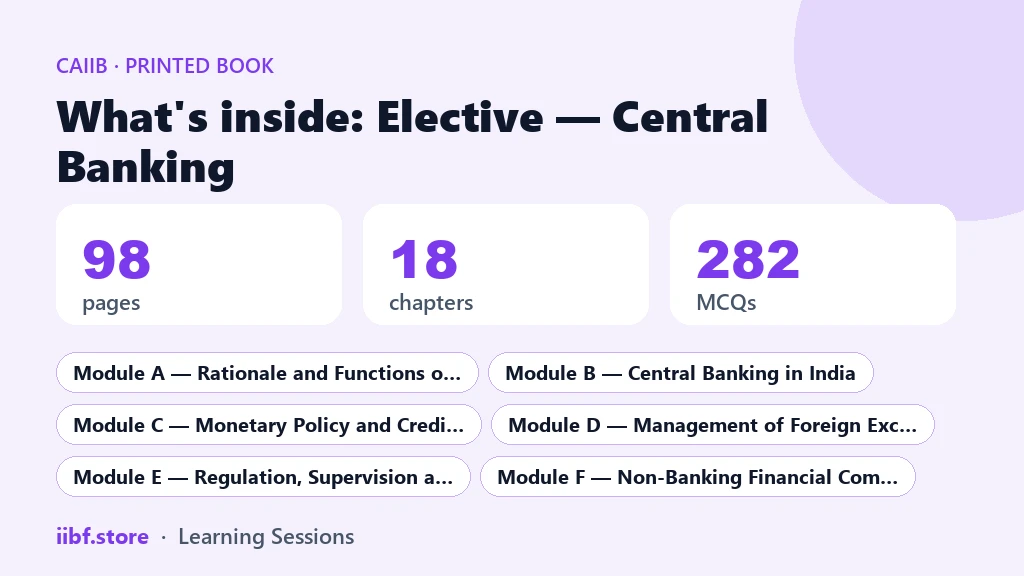
The CAIIB Elective Central Banking book follows the paper's six modules, A to F. Here is the full map, so you can see the shape before you open a page.
| Module | Chapters inside |
|---|---|
| A. Rationale and Functions of Central Bank | Theory and Practice of Central Banking (Evolution); Functions of Central Banks; Contemporary Issues in Central Banking |
| B. Central Banking in India | Reserve Bank of India; Central Banking - Indian Specific Issues; Financial Inclusion and Development |
| C. Monetary Policy and Credit Policy | Monetary Policy; Credit Policy; Fiscal-Monetary Relations; Liquidity Management |
| D. Foreign Exchange Reserves and the Indian Financial Market | Management of Foreign Exchange Reserves; Constituents of Indian Financial System Structure |
| E. Regulation, Supervision and Financial Stability | Evolution of Regulation and Supervision; Scheduled Commercial Banks; Co-Operative Banks; Financial Stability |
| F. NBFCs and Primary Dealers | Non-Banking Financial Institutions; Role of Primary Dealers in the Government Securities Market |
Notice that the modules are uneven. Modules C and E carry four chapters each, while D and F carry two. That tells you where to spend more of your evenings, and it tells you that Module D or F can be finished in a single weekend sitting.
What the numbers look like
The book is 98 pages across 18 chapters, with 282 questions in the 2026 edition. That is a compact book, which matters: a short book you finish twice is worth more than a long one you finish once.
What one chapter looks like
Take a chapter such as Monetary Policy or Liquidity Management. The idea of the book is simple, and you can judge it for yourself in the free sample: concise notes first, then the key points you must carry into the exam hall, then MCQs to test whether the chapter actually stuck.
Concise notes
The notes are meant to be read in one sitting. They give you the concept, the institution, and the policy tool, without making you wade through pages of background. When you are tired, a short chapter is the difference between opening the book and avoiding it.
Key points
Key points are your revision layer. A week later you should be able to read only these and recall the whole chapter. If you cannot, go back to the notes for that chapter alone, not the entire module.
MCQs
The questions close each chapter so you find your gaps while the chapter is fresh. A wrong answer is useful information: it tells you which paragraph to reread. Keep a small note of every question you miss and attempt those again after a few days.
You can see this layout before you pay anything. The Central Banking book page has a free sample of the book, so check whether the style suits how you read.
The extras: case studies and an appendix
Beyond the chapters, the book carries two extras listed on the book page:
- 60 case studies (240 questions). These move you from remembering a fact to applying it. A short scenario, a few questions, and you have to pick the right regulatory or policy response.
- An appendix on Central Banking. A handy place for quick reference when you want to confirm something without hunting through chapters.
Case studies are where most candidates lose marks, because they study notes but never practise reading a scenario under time pressure. Keep them for the second pass, once you have finished the modules once.
A four-step routine for every chapter
Here is a routine you can repeat on any chapter of the CAIIB Central Banking book, and on any other elective too.
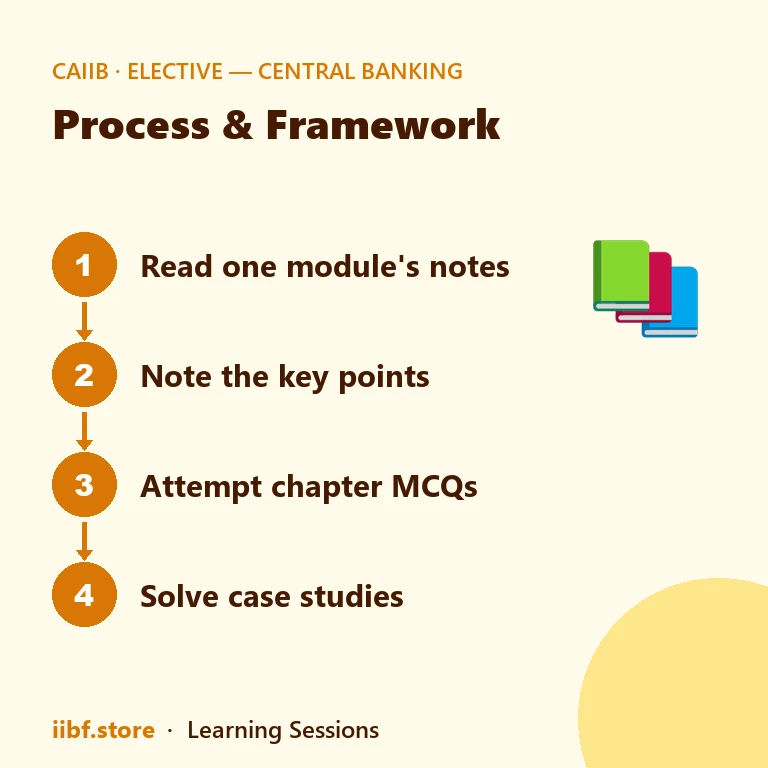
- Read one chapter's notes. Forty minutes, no phone. Do not underline everything.
- Write down the key points. Five to eight lines in your own words. This is what you will revise later.
- Attempt the chapter MCQs. Do them closed-book. Mark the ones you guessed, not only the ones you got wrong.
- Move to case studies in your second pass. After a full round of modules, start applying what you know.
A sample week
| Day | Task |
|---|---|
| Mon, Tue | One chapter of Module A, notes plus key points |
| Wed | MCQs of that chapter, then recheck wrong answers |
| Thu | Next chapter, notes plus key points |
| Fri | Rest or light revision of key points |
| Sat | One longer chapter from Module C or E, with MCQs |
| Sun | Weekly recap, then a free mock test |
At this pace, eighteen chapters take several weeks, not several months. Adjust the speed to your own job and your exam date, which you should confirm on the official IIBF website for the upcoming exam cycle.
Who gets the most out of this book
The book suits you best if:
- you have chosen Central Banking as your CAIIB elective and want a compact, structured text;
- you are working full time and need chapter-sized units you can finish in one evening;
- you learn by attempting questions rather than rereading;
- you want case studies to practise application, not only definitions.
It is a poor fit if you want to read the original policy documents in depth, or if you plan to rely on one book alone. Be honest with yourself here: a book will not give you exam-hall speed by itself. Pair it with timed practice. The free mock tests are a good place to start, and the free study material section has PDFs that complement your reading. You can also browse the full books collection if you are comparing electives.
The current price of the Central Banking book is ₹699 against an MRP of ₹1,289, which is 46 percent off. Prices may change, so the book page is always the current source.
Conclusion: pick one module and start tonight
You do not need a perfect plan. You need the first chapter finished. Open Module A, read the first chapter, write five key points, and attempt its questions. If the style works for you, continue with the CAIIB Central Banking book through the other five modules. If it does not, you have still learned how to break an elective into pieces, and that skill carries to every paper you will write.
Frequently asked questions
How many chapters and questions are in the book?
The 2026 edition has 98 pages, 18 chapters in six modules, and 282 questions. It also lists 60 case studies (240 questions) and an appendix on Central Banking as extras.
Can I see a sample before ordering?
Yes. The book page has a free sample, so you can check the layout and writing style first.
Is one book enough to pass the elective?
A book gives you structure and practice questions, but exam-hall speed comes from timed mocks. Use it together with free mock tests and revision of your key points.
Where do I find the official exam schedule?
Check the official IIBF website at iibf.org.in for the schedule and rules of the upcoming exam cycle, since these can change.
Prefer revising from a printed book?
Chapter-wise books with MCQs after every chapter — minimal pages, complete coverage, delivered anywhere in India. Every book has a free sample to read first.
98 pages · 282 MCQs
Learning Sessions · Ashish Sir
148 pages · 478 MCQs
Learning Sessions · Ashish Sir
151 pages · 465 MCQs
Learning Sessions · Ashish Sir
148 pages · 375 MCQs
Learning Sessions · Ashish Sir
216 pages · 895 MCQs
Learning Sessions · Ashish Sir
109 pages · 300 MCQs
Learning Sessions · Ashish Sir
104 pages · 360 MCQs
Learning Sessions · Ashish Sir
82 pages · 297 MCQs
Learning Sessions · Ashish Sir
151 pages · 600 MCQs
Learning Sessions · Ashish Sir
131 pages · 672 MCQs
Learning Sessions · Ashish Sir
221 pages · 831 MCQs
Learning Sessions · Ashish Sir
128 pages · 524 MCQs
Learning Sessions · Ashish Sir
107 pages · 445 MCQs
Learning Sessions · Ashish Sir
132 pages · 225 MCQs
Learning Sessions · Ashish Sir
188 pages · 435 MCQs
Learning Sessions · Ashish Sir
117 pages · 236 MCQs
Learning Sessions · Ashish Sir
Learning Sessions · Ashish Sir
118 pages · 299 MCQs
Learning Sessions · Ashish Sir
Learning Sessions · Ashish Sir
Learning Sessions · Ashish Sir
Learning Sessions · Ashish Sir
115 pages · 255 MCQs
Learning Sessions · Ashish Sir
Learning Sessions · Ashish Sir
334 pages · 936 MCQs
Learning Sessions · Ashish Sir
Learning Sessions · Ashish Sir
115 pages · 344 MCQs
Learning Sessions · Ashish Sir
107 pages · 240 MCQs
Learning Sessions · Ashish Sir
90 pages · 150 MCQs
Learning Sessions · Ashish Sir
Learning Sessions · Ashish Sir
Quick quiz on this topic
5 exam-style questions from our free test bank — check yourself before you move on.
Practice this topic
Take a free mock test, download chapter PDFs, or watch a video class — all included on iibf.store.