IT security threats in banks: A Complete IIBF ITSEC Guide
IT security threats in banks are the starting point of every control, standard and incident-response procedure tested under the IIBF IT Security (ITSEC) certificate exam. Before a candidate can evaluate a firewall rule, a DLP policy or a SIEM alert, the syllabus expects a working map of the threat actors and attack techniques those controls exist to stop. This article builds that map — malware and ransomware, phishing and social engineering, distributed denial-of-service (DDoS) attacks, insider threats and advanced persistent threats (APTs) — and ties each one to the specific IIBF module that examiners draw questions from, plus the regulatory reporting timelines candidates most often get wrong.
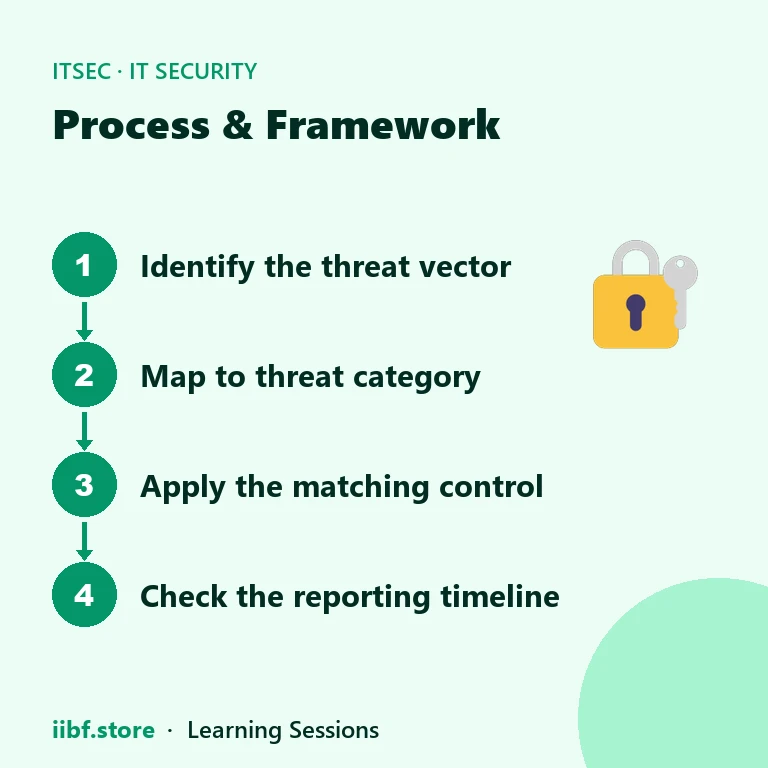
Most ITSEC papers do not ask you to name a threat in isolation; they ask you to match a scenario — a teller clicking a link, a vendor laptop plugged into the branch LAN, a spike in outbound traffic at 2 a.m. — to the correct threat category and the correct first-line control. That mapping skill is what this piece is built to sharpen.
🦠 Malware, Ransomware and the Insider Threat
Malware remains the broadest threat category in the IIBF syllabus and covers viruses, worms, trojans, spyware and ransomware. In a banking context, ransomware is the highest-impact variant because it can encrypt core banking data stores or ATM switch components, forcing a choice between paying a ransom (against RBI and law-enforcement guidance) and restoring from backup, which is why immutable, air-gapped backups are treated as a primary control rather than a nice-to-have. Trojans that masquerade as legitimate utilities are the usual delivery mechanism for banking credential theft, often bundled with keyloggers that harvest login details for internet banking or SWIFT terminals.
Insider threats sit in a different category because the actor already has legitimate access. The IIBF syllabus splits this into malicious insiders (a disgruntled employee exfiltrating customer data) and negligent insiders (a staff member misconfiguring an S3-style bucket or emailing a spreadsheet to a personal address). Both are addressed through the same control family — least-privilege access, segregation of duties, and activity logging — which is covered in depth in the Asset Classification And Controls chapter. A bank that classifies its data correctly can apply tighter monitoring to the accounts that actually touch crown-jewel systems, instead of spreading detection effort evenly and missing the accounts that matter.
💡 Exam Tip: If a question describes an attack that used a legitimate, already-issued credential, the answer is almost always "insider threat" or "compromised credential," not malware — read the vector carefully before picking a control.
🎣 Phishing, Social Engineering and Advanced Persistent Threats
Phishing is still the most common initial-access technique against Indian banks, and the ITSEC syllabus expects candidates to distinguish its variants: mass phishing (broad, low-effort emails), spear phishing (targeted at a named employee), whaling (targeted at a CXO), vishing (voice-based, often impersonating an RBI or bank official demanding "KYC verification") and smishing (SMS-based, frequently used against retail customers with fake loan or refund links). Each variant defeats a different control layer — spam filters catch mass phishing, but spear phishing and whaling typically require security-awareness training plus out-of-band verification for any high-value payment instruction.
Social engineering broadens this further to pretexting, baiting and tailgating into physical premises, which is why the ITSEC syllabus deliberately pairs cyber controls with the physical layer covered in Physical And Environmental Security Controls. An attacker who tailgates into a data centre bypasses every network control a bank has built.
Advanced persistent threats (APTs) are the exam's hardest category because they combine several techniques over a long dwell time: initial phishing access, lateral movement across the network, privilege escalation, and slow, low-volume data exfiltration designed to avoid triggering volume-based alerts. APT groups targeting the financial sector — the kind referenced in SWIFT and CERT-In advisories — typically aim at payment-switch or SWIFT-adjacent infrastructure rather than customer-facing apps, because that is where a single successful intrusion yields the largest payout.
🌐 DDoS, Network-Level Threats and Where Each Control Sits
Distributed denial-of-service attacks target availability rather than confidentiality, flooding a bank's internet banking gateway, mobile API layer or DNS infrastructure until legitimate customers cannot transact. Volumetric DDoS is countered with upstream scrubbing and ISP-level rate limiting; application-layer DDoS (a flood of legitimate-looking login requests) needs bot-management and CAPTCHA-style controls closer to the application. The Network Controls chapter is the anchor reference here, covering firewalls, IDS/IPS placement and DMZ design as the layered response to network-level threats.
The table below maps the threat categories covered in this article to their typical vector, the primary control family the ITSEC syllabus expects, and whether that threat generally triggers mandatory regulatory escalation.
| Threat Category | Typical Vector | Primary Control Family | Usually Reportable to Regulator |
|---|---|---|---|
| Ransomware / malware | Malicious attachment, drive-by download | Endpoint protection, immutable backup | ✅ |
| Phishing / vishing / smishing | Email, voice call, SMS | Awareness training, out-of-band verification | ✅ (if credentials/funds compromised) |
| Insider threat (malicious) | Misused legitimate access | Least privilege, DLP, activity logging | ✅ |
| Insider threat (negligent) | Misconfiguration, accidental exposure | Change control, asset classification | ❌ (unless data exposed) |
| DDoS (volumetric) | Botnet traffic flood | ISP scrubbing, rate limiting | ✅ (if service outage) |
| Advanced persistent threat | Multi-stage, long dwell time | Network segmentation, SIEM correlation | ✅ |
⚠️ Common Mistake: Candidates often assume every threat category carries the same regulatory reporting clock. It does not — the applicable framework and timeline depend on which regulator and which circular governs the incident.
📋 Regulatory Reporting: Reading the RBI and CERT-In Timelines Correctly
This is the section where ITSEC candidates lose the most marks, because two separate reporting regimes get merged into one imaginary rule. CERT-In's 2022 cybersecurity directions impose a hard, mandatory six-hour window for reporting specified categories of cyber incidents to CERT-In, and this six-hour figure is the one most study material quotes verbatim. RBI's expectation is different and older: RBI's 2016 Cyber Security Framework circular for banks set out a general expectation that unusual cyber incidents be reported to RBI within a window of roughly two to six hours of detection, alongside root-cause and remedial-action follow-up reports. RBI's more recent IT Governance, Risk, Controls and Assurance Practices Directions, 2023 require banks to have a board-approved incident-reporting policy and to report incidents promptly, but the 2023 Directions themselves do not prescribe a fixed hour limit — the specific 2-6 hour figure traces back to the 2016 circular, not the 2023 Directions. Treating these as one rule is the single most common error the exam is designed to catch.
Software-level threats — vulnerabilities introduced during development, insecure deserialization, or unpatched third-party libraries — are handled through the controls discussed in Controls In Software Development And Maintenance, which candidates should read alongside this article rather than treating threat identification and secure development as separate topics; the exam frequently blends the two into a single scenario question.
🧩 Building a Threat-to-Control Study Map
The fastest way to retain this material is to build a two-column revision sheet: threat category on the left, the exact control family and IIBF module reference on the right. Candidates preparing full chapters on this pattern should also work through types of security controls in banks, which classifies the control side (preventive, detective, corrective, compensating) that every threat in this article eventually maps back to. Pair that with secure coding practices in banks for the software-development threat surface, and security operations centre in banks for how a bank actually detects and triages the incidents this article describes once they hit the network. Threats do not exist only in IT security either — a related pattern shows up in conduct risk in financial services, where poor internal controls create a different but analogous category of exposure for a bank.
Security standards give this map its structure. Reviewing Security Standards And Best Practices alongside the IT Security Threats chapter itself closes the loop between "what can go wrong" and "which standard tells us how to prevent, detect or respond to it." For the full library of scenario-based practice across every IT Security module, browse the IT Security tag hub on the blog.
📌 Remember: A scenario question is really two questions in disguise — first identify the threat category from the vector described, then pick the control or reporting rule that applies to that specific category.
🧠 Practice MCQs: IT Security Threats in Banks
Q1. A bank employee with legitimate database access copies customer PAN and account data to a personal cloud drive before resigning. This is best classified as: (a) Volumetric DDoS (b) Malicious insider threat (c) Advanced persistent threat (d) Vishing
Answer: (b) — The actor used already-legitimate access for unauthorised purposes, the defining feature of a malicious insider threat.
Q2. Which control is most effective against ransomware that has already encrypted a production database? (a) Spam filtering (b) Immutable, air-gapped backups (c) CAPTCHA on the login page (d) Vendor risk assessment
Answer: (b) — Once encryption has occurred, recovery depends on backups the ransomware could not reach or alter.
Q3. A fraudulent SMS with a fake loan-approval link sent to retail customers is an example of: (a) Whaling (b) Smishing (c) Tailgating (d) Baiting
Answer: (b) — SMS-based phishing aimed at customers or staff is termed smishing.
Q4. Under CERT-In's 2022 directions, specified categories of cyber incidents must be reported within: (a) 24 hours (b) 6 hours (c) 72 hours (d) No fixed timeline
Answer: (b) — CERT-In mandates a strict six-hour reporting window for specified incident categories; this is distinct from RBI's separate expectations.
Q5. An advanced persistent threat is primarily distinguished from ordinary malware by its: (a) Use of email as a vector (b) Multi-stage, long-dwell-time approach with slow exfiltration (c) Reliance on physical tailgating only (d) Exclusive targeting of ATM hardware
Answer: (b) — APTs combine phased access, lateral movement and low-and-slow exfiltration to avoid detection over an extended period.
Want chapter-wise mock tests with 100+ MCQs? Start practising free →
❓ Frequently Asked Questions
What is the difference between a threat and a vulnerability in IT security?
A vulnerability is a weakness — an unpatched server, a weak password policy — while a threat is the actor or event, such as a phishing campaign or ransomware group, that can exploit that weakness to cause harm.
Are all IT security threats in banks reportable to RBI within a fixed number of hours?
No. RBI's IT Governance, Risk, Controls and Assurance Practices Directions, 2023 require prompt, board-policy-driven reporting without a fixed hour limit; the widely quoted 2-6 hour expectation comes from RBI's earlier 2016 Cyber Security Framework circular, and CERT-In separately mandates a strict six-hour window for specified incident categories under its own 2022 directions.
Why do banks treat insider threats separately from external malware?
Because the actor already holds legitimate credentials, perimeter controls like firewalls and email filters are ineffective; insider threats are instead addressed through least-privilege access, segregation of duties and behaviour-based monitoring.
How should I prepare the IT Security Threats module for the IIBF exam?
Build a threat-to-control mapping table, work through the physical, network and software security chapters alongside it, and practise scenario-based MCQs so you can identify the correct threat category from a described vector rather than a named term.
🎯 Final Word
Every control the ITSEC syllabus tests — physical, network, software, or standards-based — exists because of a specific threat category described in this article. Candidates who memorise controls without anchoring them to the threat they defend against tend to freeze on scenario questions, because the exam rarely names a threat outright; it describes a vector and expects you to identify both the threat and the control in one step. Revise the threat map, cross-check it against the RBI and CERT-In reporting timelines above, and reinforce it with timed practice. For source-verified detail on the reporting framework itself, see the Reserve Bank of India's cyber security circulars at rbi.org.in. To convert this reading into exam-ready recall, take a full-length IT Security mock test today.
Practice this topic
Take a free mock test, download chapter PDFs, or watch a video class — all included on iibf.store.