JAIIB 30-Day Study Plan: A Working Banker's Last-Mile Guide
A focused JAIIB 30-day study plan is the single most reliable way for a working banker to clear the exam on the first attempt — not because the syllabus is small, but because thirty disciplined days beat six months of scattered, guilt-ridden reading. If your branch shutters at 6, your reconciliation drags past 7, and a JAIIB chapter is glaring at you from the kitchen table by 9, this guide is built for your real life: two focused hours a night, no 4 AM heroics, and a week-by-week roadmap that respects the fact that you already have a full-time job.
This is the plan I wish someone had handed me before I sat the exam. It is organised around the four current JAIIB papers and the way a banker actually finds time to study — a daily ritual that sticks, and a mock-test method that separates pass-on-attempt-one candidates from the re-attempt crowd.
- A structured JAIIB 30-day study plan needs about 15-16 hours a week — roughly two hours each weeknight plus longer weekend blocks.
- Devote one week to each of the four papers: IEIFS, PPB, AFM and RBWM, with rolling revision baked in.
- Mocks are the highest-yield activity in your last mile — the score is the receipt, the debrief is the learning.
- The final seven days are for revision and sleep, not new chapters.
- JAIIB has no negative marking, so never leave a question blank.
- Always confirm exam dates and admit-card windows on the official IIBF notification.
Before you begin, anchor the calendar correctly. Count backwards from your registered exam date and open Day 1 exactly thirty days before your first paper. The 30-day window is your last mile, not your only mile — if you have already done a few months of light reading, this plan locks it in; if you are starting cold, thirty days is still enough, provided you start tonight. The exact session dates shift each cycle, so verify them against the latest released IIBF schedule on the official IIBF site.
Why a structured JAIIB 30-day study plan beats six months of drift
Here is an uncomfortable truth: most candidates who miss JAIIB do not fail because the syllabus defeated them. They fail because they kept starting again — three weeks of half-hearted reading, then a month off, then a panic push five days before the exam. The brain simply does not retain knowledge delivered in that stop-start pattern.
A tight, time-boxed plan fixes three things that an open-ended approach never can:
- It creates urgency without panic. Thirty days is long enough to genuinely cover four papers, yet short enough that you can see the finish line every single day.
- It compounds. Each evening's two hours builds on yesterday's chapter. The macro concepts in IEIFS reinforce the products you study in PPB, which feed the ratios in AFM, which finally land as real-world cases in RBWM.
- It eliminates decision fatigue. You never burn twenty minutes deciding what to study. The plan tells you; you open the file, read, attempt the chapter test, and log off.
Think of these thirty days as a project with a fixed deadline rather than a hobby you will get to "someday." The deadline is what does the heavy lifting.
The week-by-week JAIIB syllabus breakdown
Each week is anchored to one paper plus light revision of the previous week. A realistic load is two hours per weeknight, around four hours on Saturday and three on Sunday — roughly 15-16 hours a week, or about sixty hours across the month. That is comfortably enough to read every chapter, watch the lectures, and clear two mock tests per paper. Browse the full structure on the JAIIB course hub before you start so nothing surprises you.
Week 1 — Indian Economy and Indian Financial System (IEIFS)
Start here, because IEIFS is the macro foundation the other three papers quietly lean on. Its four modules — Indian Economic Architecture, Economic Concepts Related to Banking, Indian Financial Architecture, and Financial Products and Services — span GDP, monetary and fiscal policy, the RBI's role, money market versus capital market, mutual funds, insurance and more. Read for understanding rather than memorising figures, and keep current policy rates in view so the numbers you revise are live, not last year's. Reinforce the toughest macro chapters with the IEIFS module guide.
Week 2 — Principles and Practices of Banking (PPB)
This is the bread-and-butter paper and the easiest to absorb, because most of it is your day job. Its four modules — General Banking Operations, Functions of Banks, Banking Technology, and Ethics in Banks and Financial Institutions — cover KYC, AML, types of customers, deposit products, NEFT/RTGS/UPI, NPA classification and ethical dilemmas. Read these the way you would read your own branch SOP file, then close each session with a short chapter test. The PPB module guide mirrors the exact module order.
Week 3 — Accounting and Financial Management for Bankers (AFM)
This is the paper most working bankers fear, and the one where a focused week pays the highest dividend. Its modules — Accounting Principles and Processes, Financial Statements and Core Banking Systems, Financial Management, and Taxation and Costing Fundamentals — demand daily numerical practice: depreciation methods, ratio analysis, bank reconciliation, partnership accounts and working-capital sums. The discipline that works is simple: attempt first, fail, then read the solution. Your brain needs to feel the wrong answer to remember the right method.
Week 4 — Retail Banking and Wealth Management (RBWM) plus revision
The newest paper since the syllabus revision is also the most relatable: housing and personal loans, mutual funds, insurance, NPS, tax-saving instruments and customer-relationship management. Its four modules are Retail Banking, Retail Products and Recovery, Support Services and Marketing of Banking Services, and Wealth Management. Reserve the final two days of the week to revise whichever paper from Weeks 1-3 felt weakest.
JAIIB study plan at a glance
Print this table and stick it next to your study spot. Crossing off a week is more motivating than any app notification.
| Week | Paper | Focus areas | Mocks |
|---|---|---|---|
| Week 1 | IEIFS | Macro architecture, monetary & fiscal policy, financial markets & products | 2 |
| Week 2 | PPB | KYC/AML, deposit products, payment systems, NPA, banking ethics | 2 |
| Week 3 | AFM | Accounting processes, financial statements, ratios, costing & taxation | 2 |
| Week 4 | RBWM + revision | Retail products, recovery, marketing, wealth management, weak-paper revision | 2 + 1 mixed |
That adds up to roughly a dozen mocks across the month — two per paper plus a full-length mixed paper in the closing days. Anything materially less than that is under-preparing.

Daily study rituals that actually stick for working bankers
The roadmap only works if you open the book every night. These are the habits I have seen separate the bankers who pass from the ones who keep deferring:
- Anchor it to an existing habit. Do not say "I'll study at 9 PM" — that is wishful. Say "after my evening tea, I open the JAIIB folder." Your brain links the two and stops negotiating.
- Phone face-down, on charge, in another room. Two undisturbed hours beat four distracted ones. The message that lands at 10:30 PM can wait until morning.
- One chapter, one chapter test. Read it, watch the relevant video class, then take the test. The auto-graded JAIIB mock tests show you exactly where you went wrong — use them.
- A five-minute end-of-day note. Before you shut the laptop, jot two lines: what you learnt, and what still confuses you. Tomorrow, start with the confusion. By Week 3 that "still confused" list should be nearly empty.
- Sunday is for mocks, not new chapters. Treat it as a dress rehearsal — full-length, timed, no breaks — then debrief honestly about which topics you guessed on.
If you can spare twenty minutes at lunch, play a quick JAIIB matching game. Active recall of definitions in game mode sticks far better than another tired read-through at midnight.
Mock-test strategy — when to attempt and how to debrief
Mocks are the highest-yield activity in your final thirty days, yet most candidates use them wrong: they sit a test, see 60%, feel deflated, and move on. The score is just the receipt; the debrief is where the learning happens. Here is how to extract everything from each attempt:
- Time it strictly. Sit each mock to the official paper duration with no pauses and no peeking at the book. If you finish far too early, you are guessing on too many questions.
- Sort, do not celebrate or sulk. After submitting, split a page into four boxes: got it right and knew why; got it right but guessed; got it wrong but recognised the topic; did not recognise the topic at all. Boxes two and four are next week's action items.
- Re-attempt only your "didn't know" questions. Redoing the whole mock is just patting yourself on the back. Redo the ones you missed — chapter open if needed — until you can answer them cold.
- Spread mocks across the month. Two per paper through Weeks 1-4, plus one full-length mixed paper in the closing days.
Most working bankers I have coached pass on attempt one once they cross roughly 65% in two consecutive mocks per paper. If you are not there by Week 3, slow down and revise rather than sprinting to the end on a shaky foundation. You can build that streak using the free mock test library.
The last seven days — revision, sleep and exam-day routine
The final stretch is sacred, and the rule is blunt: stop touching new material. Every minute spent learning a fresh concept now is a minute stolen from cementing the 90% you already know. A clean closing week looks like this:
- Days 24-26: Re-read your end-of-day notebook and speed-revise the chapters you flagged as "still confused" in earlier weeks.
- Day 27: Sit a full mixed-paper mock, time it, debrief it, and identify your bottom three weak areas.
- Day 28: Revise only those three weak areas — formulas for AFM, key concepts for IEIFS, product features for RBWM and PPB.
- Day 29: Books closed by evening. Confirm the centre location, print the admit card, and pack your stationery. Sleep early — rest is the highest-return revision tool in your last 24 hours.
- Exam day: Eat a normal breakfast, leave earlier than you think you need to, and read each question twice before marking. Clear the easy ones first and return to the hard ones in a second pass. With no negative marking, leave nothing blank.
IIBF posts admit-card windows, centre rules and last-minute changes on its official site. Check the IIBF announcements page in your final week so a late notice never catches you out.
Common mistakes that quietly sink JAIIB attempts
Even diligent candidates trip over a handful of avoidable errors. Watch for these:
- Reading the solution before attempting. Especially fatal in AFM — passive reading builds false confidence that collapses under exam timing.
- Hoarding study material instead of finishing chapters. One clean pass with tests beats three half-read PDFs from different sources.
- Treating mocks as a scoreboard. Without a structured debrief, a mock teaches you almost nothing.
- Cramming new topics in the last week. It destabilises the material you have already secured.
- Relying on videos alone. Watch them after reading the chapter, not instead of it. Compare your own plan against the deeper context in our JAIIB PPB guide.
- Ignoring why the credential matters. The motivation that powers thirty hard days is real — read up on JAIIB increments and career benefits when your energy dips.
For deeper dives on the trickier RBWM and AFM topics, our mutual funds advisor's guide and the ratio analysis walkthrough are excellent companions to this plan, and the full set lives on the JAIIB guides hub.
Frequently Asked Questions
Is 30 days really enough for JAIIB if I'm starting from scratch?
Yes, provided you can genuinely commit 15-16 hours a week. The four JAIIB papers are wide but not deep, and they reward consistent daily contact far more than occasional weekend marathons. The real risk is not syllabus volume — it is missing two or three weeknights in a row and losing momentum. Treat the daily two-hour slot as non-negotiable.
Which paper should I attempt first on exam day?
IIBF schedules the four papers on separate sittings, so you do not choose the running order across papers. Within any single paper, begin with the questions you are certain about — usually the conceptual MCQs — to build a comfort buffer, then tackle the numerical and case-based questions in a second pass. Because there is no negative marking, attempt every question even if the last few are educated guesses.
How important are the latest RBI rates for JAIIB?
Very important. Policy rates such as repo, CRR, SLR, MSF and reverse repo recur across the economic-concepts and general-banking modules almost every cycle. Always memorise the current values rather than last year's, and keep a live rates reference open while you revise the monetary policy chapter. When in doubt, cross-check the latest figures against the official IIBF and RBI releases.
Can I clear JAIIB just from YouTube videos?
Watching videos passively will not get you across the line, but using them after you have read the chapter is genuinely powerful. The Learning Sessions video classes are designed this way — a downloadable chapter, a video that unpacks the tricky parts, and a chapter test. That read-watch-test combination beats any single format on its own.
How many mock tests should I take before the JAIIB exam?
Aim for roughly a dozen across the thirty days — two per paper plus a full-length mixed mock near the end. More than the raw count, what matters is the debrief: re-attempt every question you got wrong until you can answer it cold. Quality of review, not sheer quantity, is what moves your score.
What is the ideal daily study schedule for a working banker?
Two undisturbed hours on weeknights, anchored to an existing habit such as your evening tea, with longer four- and three-hour blocks on Saturday and Sunday. End each session with a chapter test and a two-line note on what still confuses you. This rhythm fits around branch hours without demanding pre-dawn starts.
Final Word
Thirty days is enough. Two hours a night is enough. Your branch's daily chaos is not a reason to defer — it is the exact reason this credential will matter when promotions open up. Open the file tonight, do tomorrow's chapter, take the test, log the result, and then do it again. Start with one free JAIIB mock test right now; even a 35% will tell you precisely which module to open first. Always confirm your session dates and admit-card window on the official IIBF notification, and see you in the hall.
Related Guides
📚 Free Learning Sessions resources — connect & crack your exam
- 📝 Free mock tests — chapter-wise, exam-pattern, with instant solutions
- 🎮 Matching games — gamified revision of key terms & concepts
- 📄 Study notes & PDFs — downloadable chapter material
- 🎥 Video classes on YouTube — subscribe to @learningsessions
💬 Want the full course? WhatsApp your course name to 8360944207 and our team will set you up.
📱 Study on the go — get our iOS & Android app at iibf.store/app.
Prefer revising from a printed book?
Chapter-wise books with MCQs after every chapter — minimal pages, complete coverage, delivered anywhere in India. Every book has a free sample to read first.
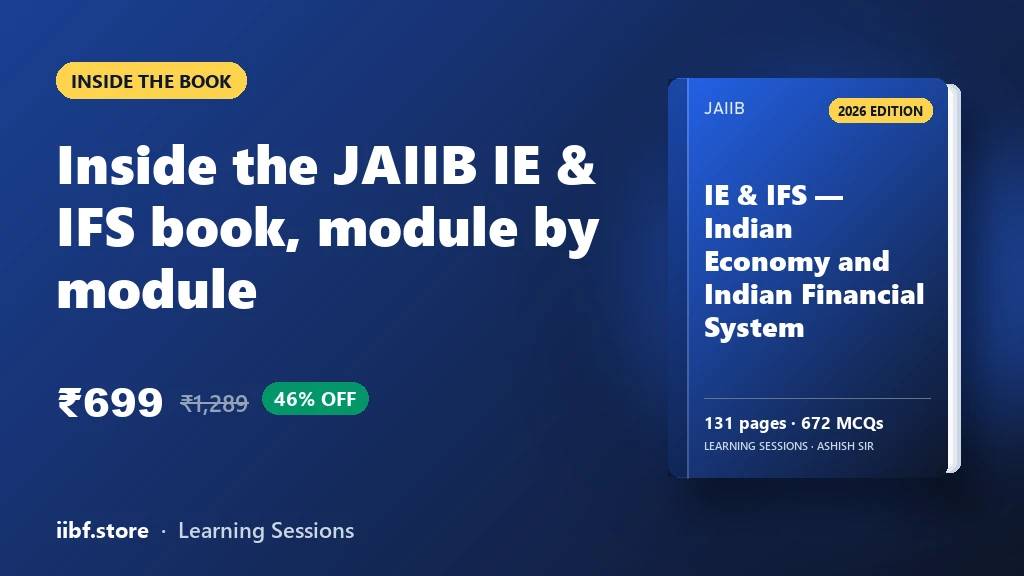
131 pages · 672 MCQs
Learning Sessions · Ashish Sir
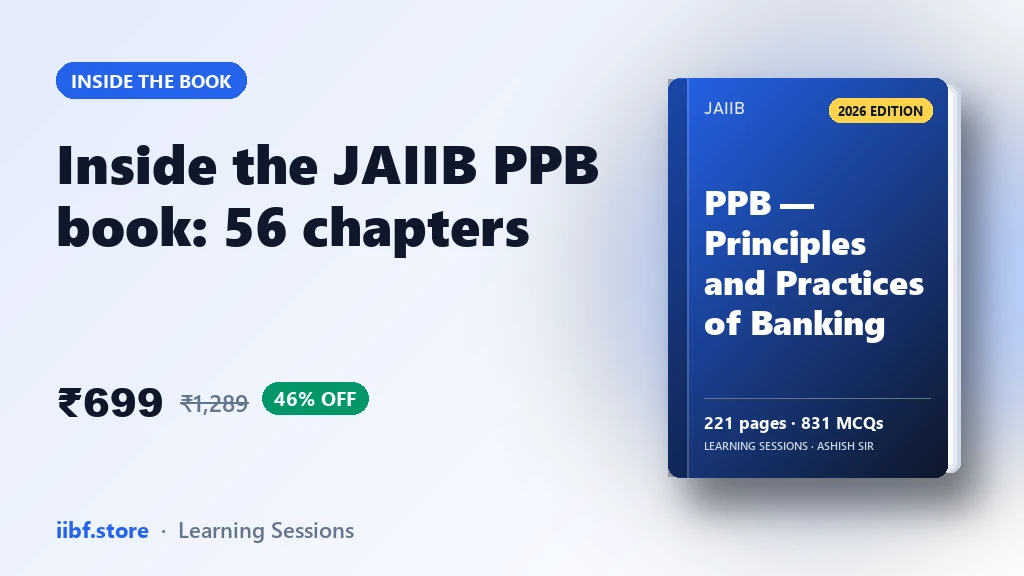
221 pages · 831 MCQs
Learning Sessions · Ashish Sir
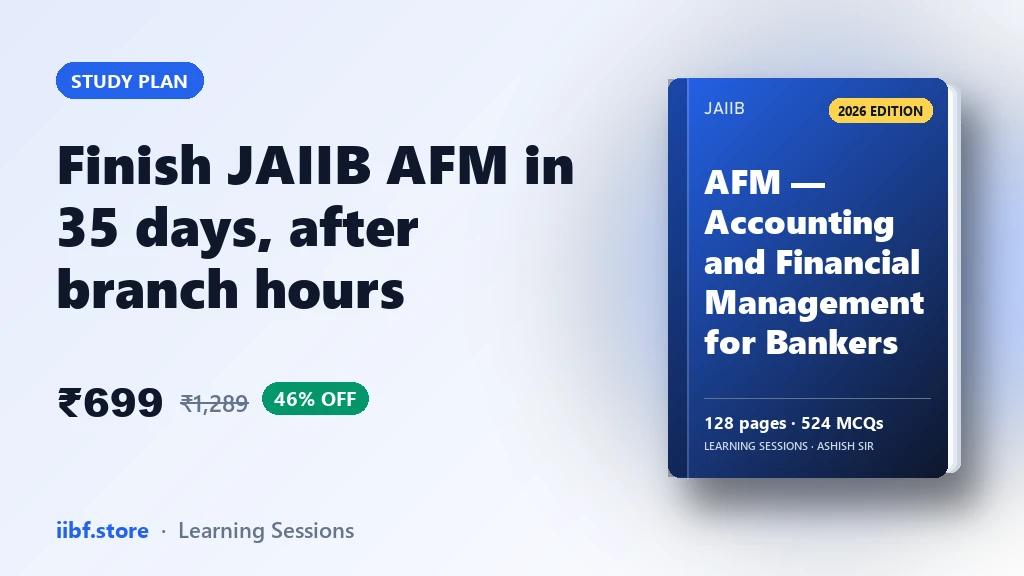
128 pages · 524 MCQs
Learning Sessions · Ashish Sir
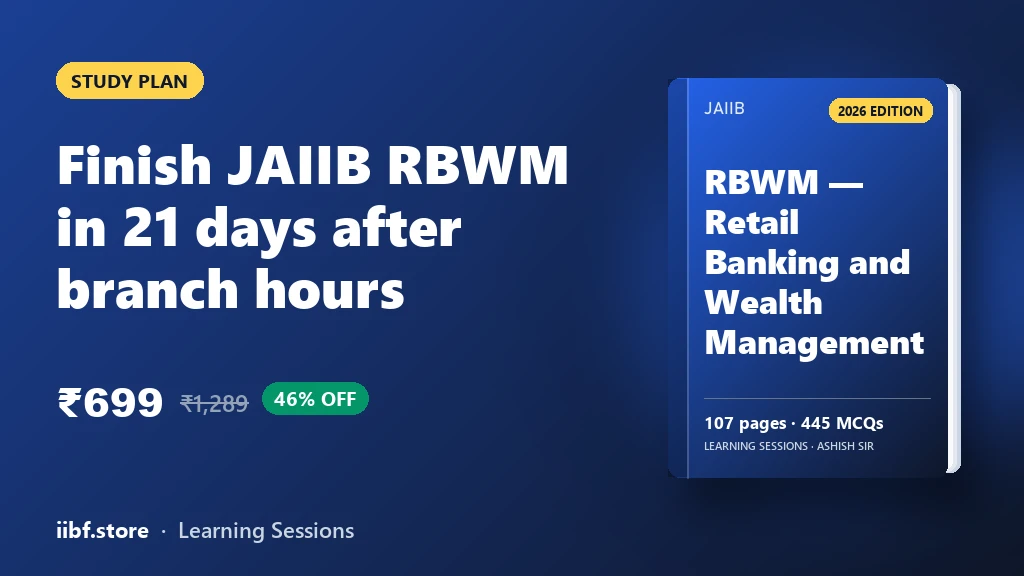
107 pages · 445 MCQs
Learning Sessions · Ashish Sir
148 pages · 478 MCQs
Learning Sessions · Ashish Sir
151 pages · 465 MCQs
Learning Sessions · Ashish Sir
148 pages · 375 MCQs
Learning Sessions · Ashish Sir
216 pages · 895 MCQs
Learning Sessions · Ashish Sir
109 pages · 300 MCQs
Learning Sessions · Ashish Sir
104 pages · 360 MCQs
Learning Sessions · Ashish Sir
82 pages · 297 MCQs
Learning Sessions · Ashish Sir
151 pages · 600 MCQs
Learning Sessions · Ashish Sir
98 pages · 282 MCQs
Learning Sessions · Ashish Sir
132 pages · 225 MCQs
Learning Sessions · Ashish Sir
188 pages · 435 MCQs
Learning Sessions · Ashish Sir
117 pages · 236 MCQs
Learning Sessions · Ashish Sir
Learning Sessions · Ashish Sir
118 pages · 299 MCQs
Learning Sessions · Ashish Sir
Learning Sessions · Ashish Sir
Learning Sessions · Ashish Sir
Learning Sessions · Ashish Sir
115 pages · 255 MCQs
Learning Sessions · Ashish Sir
Learning Sessions · Ashish Sir
334 pages · 936 MCQs
Learning Sessions · Ashish Sir
Learning Sessions · Ashish Sir
115 pages · 344 MCQs
Learning Sessions · Ashish Sir
107 pages · 240 MCQs
Learning Sessions · Ashish Sir
90 pages · 150 MCQs
Learning Sessions · Ashish Sir
Learning Sessions · Ashish Sir
Quick quiz on this topic
5 exam-style questions from our free test bank — check yourself before you move on.
Practice this topic
Take a free mock test, download chapter PDFs, or watch a video class — all included on iibf.store.