Mis-selling of Financial Products: IIBF Ethics Guide 2026
Mis-selling of Financial Products is one of the most heavily tested ethical failures in the IIBF Ethics in Banking paper, because it sits exactly where commercial pressure meets customer trust. A bank employee who persuades a retired pensioner to switch a safe deposit into a long-tenure unit-linked policy has not committed forgery or theft, yet the harm to the customer is real and the reputational damage to the bank is lasting. That is precisely why examiners like this topic: it forces you to reason with principles rather than recall a section number.
In this guide we define the concept precisely, separate it from honest sales, map the regulatory scaffolding around it, and work through the controls and exam-style questions you are likely to face.
🎯 What Exactly Counts as Mis-selling
Mis-selling occurs when a financial product is sold to a customer who did not need it, could not understand it, or was induced to buy it through incomplete, exaggerated or misleading information. The defining test is not whether the product was defective — most mis-sold products are perfectly legitimate instruments — but whether the match between product and customer was honest.
Four recurring patterns appear in supervisory findings and in exam cases. The first is suppression of material facts: lock-in periods, surrender charges, market risk, or the fact that returns are not guaranteed. The second is misrepresentation, such as describing an insurance policy as a "deposit scheme with bonus". The third is unsuitability, where the product's risk, tenure or liquidity profile plainly conflicts with the customer's stated circumstances. The fourth is coercive bundling — implying that a loan, locker or account will be sanctioned only if an insurance or investment product is also purchased.
Ethically, mis-selling breaches three duties at once: the duty of truthfulness (the customer was misinformed), the duty of fidelity (the banker's own incentive was placed above the customer's interest), and the duty of fairness (the customer's inexperience was exploited). This overlap is why the topic connects so naturally to the wider study of ethical dilemmas in banking, where competing loyalties to employer, customer and self must be ranked.
💡 Exam Tip: Mis-selling is judged by the process of the sale, not by the eventual outcome. A product that later loses value was not necessarily mis-sold; a product that later gains value may still have been mis-sold.
⚖️ Aggressive Selling vs Mis-selling: The Line
Banks are commercial entities and selling is legitimate. The examiner expects you to draw the line rather than condemn all salesmanship, so it helps to hold a clear comparison in mind.
| Aspect | Legitimate Selling | Mis-selling |
|---|---|---|
| Disclosure of risk and charges | ✅ Full, in writing, before signature | ❌ Vague, verbal or after signature |
| Need and suitability assessment | ✅ Documented and matched to profile | ❌ Skipped or back-filled |
| Customer's freedom to decline | ✅ Preserved; no linkage to other services | ❌ Sanction or service implicitly tied |
| Language and comprehension | ✅ Explained in a language the customer follows | ❌ Relies on unread English fine print |
| Driver of the recommendation | ✅ Customer objective | ❌ Branch target or personal commission |
| Record of the interaction | ✅ Auditable trail retained | ❌ No trail; deniability by design |
Notice that every "legitimate" cell is something a bank can evidence after the fact. That is the practical heart of the subject: ethical selling is documentable selling. Where documentation is systematically thin, mis-selling tends to be systemic rather than individual, which shifts the blame upward to the culture and control environment described in Building an Ethical Organization.
🏛️ The Regulatory and Code Framework
India does not regulate mis-selling through a single statute; it is addressed through overlapping conduct obligations across regulators. The Reserve Bank of India approaches it primarily through customer-protection instruments: the Fair Practices Code that banks adopt, the Charter of Customer Rights — which includes an explicit right to suitability — and the requirement that banks distribute third-party products only under a board-approved policy with clear disclosure of the bank's role as distributor and of the commission it earns.
Where insurance is sold through bank branches, IRDAI's corporate-agency and bancassurance rules apply, including prescribed need-analysis documentation and free-look rights. Where mutual funds or securities are involved, SEBI's intermediary conduct norms and distributor registration requirements govern the sale. Grievances that survive the bank's internal machinery move to the Internal Ombudsman and then to the RBI Ombudsman mechanism, under which mis-selling of third-party products is a recognised ground of complaint.
Two structural safeguards recur across all three regimes. First, role transparency: the customer must know the bank is acting as a distributor earning a commission, not as a neutral adviser. Second, cooling-off: a defined window in which the customer may exit without penalty, which converts a pressured decision into a reversible one. For the exam, remember the principle behind each safeguard rather than trying to memorise circular numbers, and read them alongside the fair practices code for banks.
📌 Remember: Selling a third-party product without disclosing that the bank earns a commission is a conflict-of-interest failure even if every other disclosure was accurate.
🔍 Why Good Bankers Mis-sell: Incentives and Pressure
Most mis-selling is not done by dishonest people. It is produced by ordinary employees inside a badly designed incentive system, which is why the topic belongs to organisational ethics rather than individual morality alone.
The dominant driver is target architecture. When a large share of an officer's appraisal, incentive or transfer prospects depends on third-party product volume, and no part of it depends on persistency, complaint ratios or surrender rates, the system has silently instructed staff to close sales at any cost. A second driver is information asymmetry: the branch officer understands the product, the walk-in customer usually does not, and asymmetry without accountability reliably degrades into exploitation.
A third driver is diffusion of responsibility. When the product is manufactured by an insurer, sold by a bank employee, approved by a regional target-setter and serviced by a call centre, every participant can plausibly say the harm was somebody else's doing. A fourth is normalisation — the "everyone does it in March" effect, where a quarter-end practice becomes an accepted routine that nobody re-examines. These behavioural dynamics mirror the discussion of workplace pressure in Work Ethics and the Workplace, and they explain why enforcement alone rarely fixes the problem.
⚠️ Common Mistake: Candidates answer mis-selling questions by blaming the individual seller. Higher marks go to answers that identify the incentive design, supervisory tone and absent controls that made the conduct rational.
🛡️ Controls That Actually Prevent It
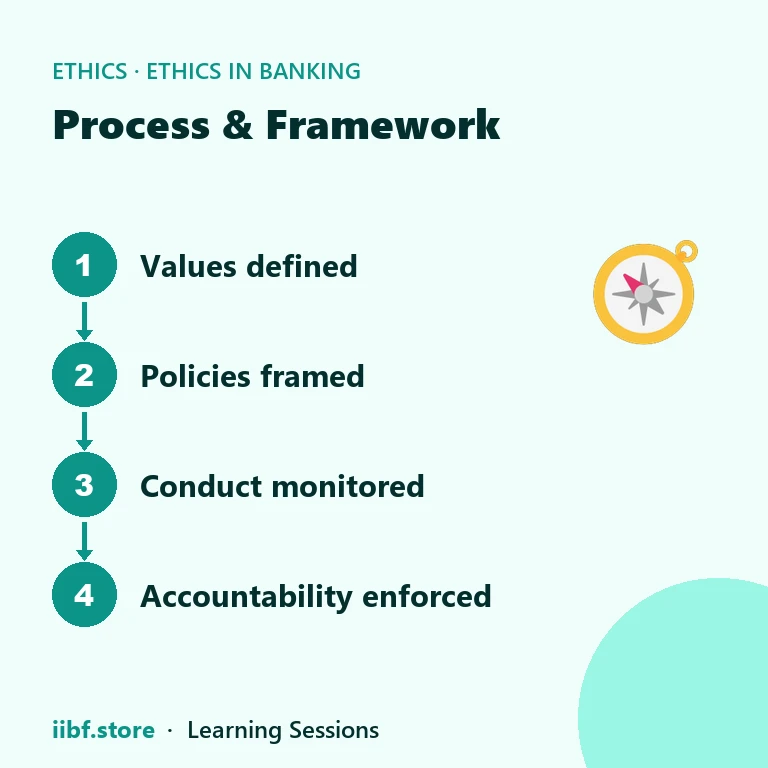
A workable prevention framework operates at four levels, and the exam rewards answers that move through all four rather than listing slogans.
At the product level, boards approve which third-party products may be distributed at all, and define customer segments for which a product is presumptively unsuitable — for example, long-lock-in market-linked products for very elderly first-time investors. At the process level, a documented need-and-suitability assessment precedes the sale, key features are given in a short vernacular summary, and a welcome or verification call independently confirms the customer understood tenure, charges and risk. Voice or digital records of that confirmation are the single most effective control in practice.
At the people level, staff must be certified for the products they sell, incentives must be balanced by persistency and complaint metrics, and clawback should apply where a policy lapses early or a complaint is upheld. At the oversight level, root-cause analysis of complaints, mystery shopping, surrender-rate monitoring by branch, and a functioning whistle-blower route close the loop. Handling of customer information gathered during profiling must also respect data-protection duties, discussed further in our note on the DPDP Act in banking. Since mis-selling is a textbook manifestation of conduct risk in banking, these controls are increasingly reported to the board as a risk category, not merely as a customer-service statistic.
📝 How This Topic Appears in the IIBF Exam
Questions come in three shapes. Definition questions ask you to identify which of four described sales is mis-selling — the answer is almost always the option where a material fact was withheld or suitability was ignored. Case-study questions give a branch scenario with a target-pressured officer and ask for the correct course of action; the expected answer prioritises the customer's interest, escalation through proper channels and documentation, never silent compliance or unilateral rule-breaking. Framework questions ask which control or which right applies, testing whether you can connect suitability, disclosure and cooling-off to the correct regulator.
A reliable answering method is to state the ethical breach, name the affected stakeholder, identify the control that failed, and then propose the remedy. This structure works even when you cannot recall the exact circular, because it demonstrates the reasoning the syllabus is actually testing. It also pairs well with the treatment of gain-driven misconduct in Ethical Issues of Corruption, Bribery and White-Collar Crime. For more topic-wise preparation, browse the full Ethics in Banking article hub.
🧠 Practice MCQs: Mis-selling of Financial Products
Q1. The defining test of mis-selling is whether — (a) the product later lost value (b) the product was legally permitted (c) the match between product and customer was honestly made (d) the customer signed the form
Answer: (c) — Mis-selling is judged by the honesty and suitability of the sale process, not by later outcomes.
Q2. A branch officer tells a customer that a loan will be sanctioned faster if a life insurance policy is also bought. This is best described as — (a) cross-selling (b) coercive bundling amounting to mis-selling (c) relationship banking (d) permitted incentive selling
Answer: (b) — Linking sanction of a credit facility to purchase of another product removes the customer's freedom to decline.
Q3. Under the Charter of Customer Rights, the right most directly breached by mis-selling is the right to — (a) privacy (b) suitability (c) grievance redress (d) fair treatment only
Answer: (b) — The right to suitability requires that products offered match the customer's assessed need and risk profile.
Q4. Which control most effectively detects mis-selling after the sale has been completed? (a) A larger disclosure booklet (b) Higher sales targets (c) Independent verification calls plus surrender and persistency monitoring (d) Longer product training
Answer: (c) — Post-sale verification and lapse or surrender analytics reveal patterns that pre-sale paperwork cannot.
Q5. When a bank distributes a third-party investment product, ethical transparency requires disclosure of — (a) only the product's returns (b) the bank's role as distributor and the commission earned (c) the manufacturer's balance sheet (d) nothing beyond the application form
Answer: (b) — The customer must know the bank is a commission-earning distributor, not a neutral adviser.
Want chapter-wise mock tests with 100+ MCQs? Start practising free →
❓ Frequently Asked Questions
Is every unprofitable investment sold by a bank a case of mis-selling?
No. Market-linked products can lose value without any wrongdoing. Mis-selling arises only where risk, charges or tenure were misrepresented or concealed, or where the product was clearly unsuitable for the customer's profile.
Who can a customer approach if a product was mis-sold?
The customer should first use the bank's internal grievance channel, which escalates to the Internal Ombudsman. If still unresolved, the complaint may be taken to the RBI Ombudsman mechanism, and to IRDAI or SEBI channels depending on the product involved.
Can a bank employee be held personally responsible?
Yes. Staff accountability policies allow disciplinary action, incentive clawback and adverse appraisal entries, especially where suppression of material facts or forged suitability records is established.
How much weight does this topic carry in the Ethics in Banking exam?
It is not a standalone module, but it recurs across customer-relationship, conflict-of-interest and corporate-governance questions, so it is worth preparing thoroughly as a cross-cutting theme rather than a single chapter.
✅ Conclusion
Mis-selling endures because it is profitable in the short run and invisible in the short run. The ethical answer is not to stop selling but to make every sale defensible: assess the need, disclose the risk, record the conversation, and reward persistency rather than volume alone. For the IIBF exam, carry one sentence into the hall — a sale is ethical when the customer, fully informed, would still have said yes.
Ready to test yourself on Ethics in Banking and the rest of your syllabus? Take a free chapter-wise mock test on iibf.store →
Prefer revising from a printed book?
Chapter-wise books with MCQs after every chapter — minimal pages, complete coverage, delivered anywhere in India. Every book has a free sample to read first.
132 pages · 225 MCQs
Learning Sessions · Ashish Sir
188 pages · 435 MCQs
Learning Sessions · Ashish Sir
117 pages · 236 MCQs
Learning Sessions · Ashish Sir
Learning Sessions · Ashish Sir
118 pages · 299 MCQs
Learning Sessions · Ashish Sir
Learning Sessions · Ashish Sir
Learning Sessions · Ashish Sir
Learning Sessions · Ashish Sir
115 pages · 255 MCQs
Learning Sessions · Ashish Sir
Learning Sessions · Ashish Sir
334 pages · 936 MCQs
Learning Sessions · Ashish Sir
Learning Sessions · Ashish Sir
115 pages · 344 MCQs
Learning Sessions · Ashish Sir
107 pages · 240 MCQs
Learning Sessions · Ashish Sir
90 pages · 150 MCQs
Learning Sessions · Ashish Sir
Learning Sessions · Ashish Sir
131 pages · 672 MCQs
Learning Sessions · Ashish Sir
221 pages · 831 MCQs
Learning Sessions · Ashish Sir
128 pages · 524 MCQs
Learning Sessions · Ashish Sir
107 pages · 445 MCQs
Learning Sessions · Ashish Sir
148 pages · 478 MCQs
Learning Sessions · Ashish Sir
151 pages · 465 MCQs
Learning Sessions · Ashish Sir
148 pages · 375 MCQs
Learning Sessions · Ashish Sir
216 pages · 895 MCQs
Learning Sessions · Ashish Sir
109 pages · 300 MCQs
Learning Sessions · Ashish Sir
104 pages · 360 MCQs
Learning Sessions · Ashish Sir
82 pages · 297 MCQs
Learning Sessions · Ashish Sir
151 pages · 600 MCQs
Learning Sessions · Ashish Sir
98 pages · 282 MCQs
Learning Sessions · Ashish Sir
Quick quiz on this topic
5 exam-style questions from our free test bank — check yourself before you move on.
Practice this topic
Take a free mock test, download chapter PDFs, or watch a video class — all included on iibf.store.