Trial Balance and Final Accounts for JAIIB AFM: Complete Guide
If one topic quietly decides whether you clear JAIIB Paper 3, it is Trial Balance and Final Accounts. Almost every numerical in Accounting and Financial Management for Bankers ends with either a balanced trial balance or a correctly closed Profit & Loss Account and Balance Sheet. Examiners love this area because it is objective: either your debits equal your credits, or they do not. This guide walks you through the logic, the standard format, the adjustment entries that trip up most candidates, the bank-specific formats prescribed under the Banking Regulation Act, 1949, and five exam-style MCQs with explanations.
📘 What a Trial Balance Actually Proves
A trial balance is a statement — not an account — listing the closing debit or credit balance of every ledger account on a particular date. Its single arithmetical purpose is to test whether the double-entry system has been applied consistently: for every debit posted, a corresponding credit must exist somewhere. When the two columns agree, the books are said to be "in agreement".
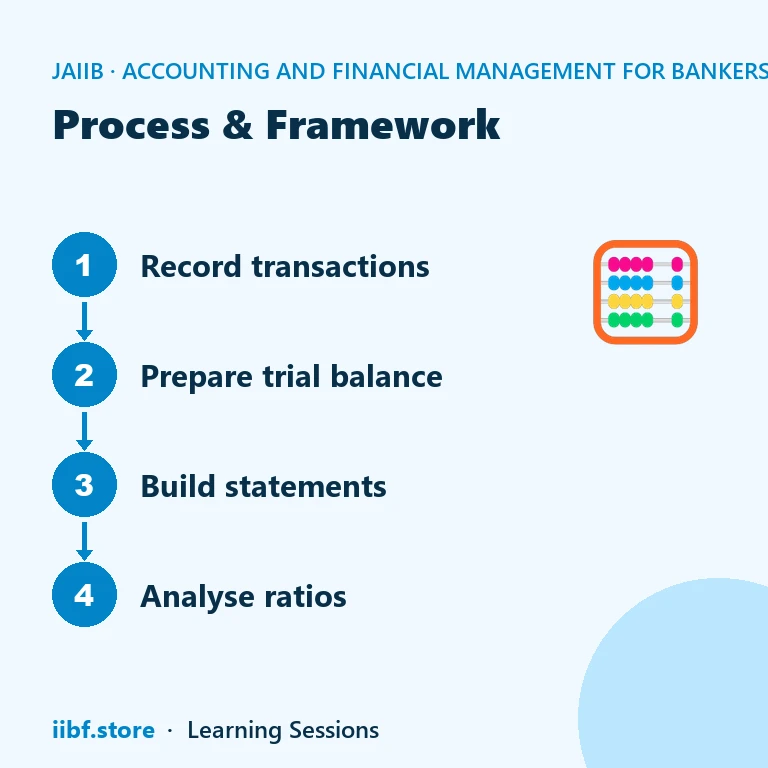
Understand the sequence, because JAIIB frequently asks it directly. Transactions are first recorded in the journal or subsidiary books, posted to the ledger, balanced off, and only then extracted into the trial balance. The trial balance is therefore a summary of the ledger, and the ledger is a classification of the journal. If you are shaky on this chain, revise the basic accountancy procedures chapter before attempting adjustment problems.
Three methods of preparation appear in the syllabus. The balance method lists only the net balance of each ledger account and is the one used in practice and in exams. The totals method lists the debit and credit totals of every account without balancing. The totals-cum-balance method combines both in four columns. Banks, working on core banking systems, generate the balance-method trial balance automatically at end-of-day, which is why branch staff see it as a control report rather than a manual exercise.
What the trial balance does not do is prove that the accounts are correct. It only proves arithmetical equality. A payment to a wrong supplier, an entry omitted entirely, or a rent expense wrongly debited to a building account will all leave the trial balance perfectly balanced — and the final accounts perfectly wrong.
💡 Exam Tip: A trial balance is prepared on a specific date, while the Profit & Loss Account is prepared for a period. Question stems often swap these two phrases to test whether you are reading carefully.
🧮 Building the Statement Without Losing Marks
The mechanical rule is short: all assets, expenses, losses, drawings and purchases carry debit balances; all liabilities, capital, incomes, gains, sales and provisions carry credit balances. Memorise that split and roughly seventy per cent of a trial balance question answers itself.
The traps live in the remaining thirty per cent. Bank overdraft is a liability and therefore credited, even though "bank" instinctively feels like an asset. Purchase returns (returns outward) reduce purchases and sit on the credit side; sales returns (returns inward) reduce sales and sit on the debit side. Provision for doubtful debts and accumulated depreciation are credit balances despite relating to assets, because they are contra accounts. Closing stock generally does not appear in the trial balance at all — it is given as an adjustment outside it, since it was never posted to the ledger during the year.
When the two columns refuse to agree, follow a disciplined search rather than re-adding blindly. First, compute the difference. If it is divisible by 9, suspect a transposition error such as ₹5,940 written as ₹5,490. If the difference is an even number, halve it and look for an item of that exact value posted on the wrong side. If the difference equals a round figure, suspect a casting or carry-forward mistake. If no cause is found before the accounts must be finalised, the gap is parked in a Suspense Account, which is later cleared through rectification entries. A suspense balance still standing at year-end is shown in the balance sheet — as an asset if it is a debit balance and as a liability if it is a credit balance.
For a fuller drill on posting and balancing discipline, work through the chapter on maintenance of cash, subsidiary books and ledger.
⚖️ Errors the Trial Balance Catches — and Errors It Hides
This distinction is the single most examined idea in the topic, and it is almost always asked as a one-line MCQ. Errors are classified into those that disclose themselves by unbalancing the trial balance and those that do not.
| Type of error | Illustration | Trial balance still agrees? |
|---|---|---|
| Error of omission (complete) | A credit sale never recorded anywhere | ✅ Yes — undetected |
| Error of commission (wrong account, same side) | ₹10,000 credited to Ramesh instead of Rakesh | ✅ Yes — undetected |
| Error of principle | Machinery repairs debited to Machinery A/c | ✅ Yes — undetected |
| Compensating error | Two ₹500 mistakes on opposite sides cancelling out | ✅ Yes — undetected |
| Partial omission (one-sided posting) | Debited in ledger, credit side missed | ❌ No — disclosed |
| Wrong amount posted to one account only | ₹4,500 posted as ₹5,400 on the debit side | ❌ No — disclosed |
| Casting or carry-forward error | Purchases book undercast by ₹1,000 | ❌ No — disclosed |
Notice the pattern: any error that affects both the debit and the credit by an equal amount keeps the statement balanced, while any one-sided or unequal error breaks it. Errors of principle are especially dangerous in banking because capitalising a revenue expense inflates both assets and profit, distorting capital adequacy and the profitability picture. If you want to see how misstated profit ripples into every ratio, read our note on profitability ratios.
⚠️ Common Mistake: Candidates assume a balanced trial balance means audited-quality books. It only means the arithmetic is consistent. Four whole categories of error survive a perfectly agreed trial balance.
📊 From Trial Balance to Final Accounts: The Adjustments
Final accounts comprise the Trading Account, the Profit & Loss Account and the Balance Sheet. The trial balance supplies the raw figures; adjustments convert them from cash-basis leftovers into accrual-basis truth, satisfying the matching concept. The golden rule to carry into the exam hall: every adjustment given below the trial balance is posted twice — once in the Trading or P&L Account and once in the Balance Sheet.
Apply it item by item. Closing stock is credited to the Trading Account and shown as a current asset. Outstanding expenses are added to the relevant expense and shown as a current liability. Prepaid expenses are deducted from the expense and shown as a current asset. Accrued income is added to income and shown as an asset; income received in advance is deducted from income and shown as a liability. Depreciation is charged to the P&L Account and deducted from the asset — the choice between straight-line and written-down-value methods is covered in the depreciation chapter. A new provision for doubtful debts is debited to P&L and deducted from debtors, while bad debts already written off inside the trial balance need no second entry.
Two exceptions are worth memorising because they break the twice-posted rule. An item already appearing inside the trial balance is posted only once, since its double entry is complete. And goods withdrawn by the proprietor for personal use are deducted from purchases and added to drawings, never treated as sales. Once the accounts are closed, the same figures feed straight into ratio work — see how the closing balance sheet drives leverage in our guide to the debt-equity ratio.
🏦 Why Bank Final Accounts Look Different
A trading company's final accounts begin with a Trading Account, because it buys and sells goods. A bank has no trading stock; its "raw material" is money. Consequently, banks in India prepare their final accounts in the statutory formats prescribed by Section 29 and the Third Schedule of the Banking Regulation Act, 1949: Form A for the Balance Sheet and Form B for the Profit & Loss Account.
Form A carries twelve schedules. Schedules 1 to 5 detail capital, reserves and surplus, deposits, borrowings, and other liabilities and provisions. Schedules 6 to 11 detail cash and balances with the RBI, balances with banks and money at call, investments, advances, fixed assets and other assets. Schedule 12 lists contingent liabilities, which for a bank includes guarantees, letters of credit and forward exchange contracts — off-balance-sheet exposures that carry very real risk. Form B uses Schedules 13 to 16: interest earned, other income, interest expended, and operating expenses.
The structural insight to carry into the exam is that a bank's balance sheet is inverted relative to a manufacturer's. Deposits, which feel like the bank's money, are liabilities repayable to customers. Advances, which feel like money gone out, are the bank's largest asset. Interest earned on advances and investments is the principal revenue line, and interest expended on deposits is the principal cost — their difference is net interest income. Provisions for non-performing assets are charged before arriving at net profit, which is why asset quality directly compresses reported earnings. Statutory audit of these formats is examined further in the Bank Audit & Inspection chapter, and the formats themselves are notified by the Reserve Bank of India through its master directions on financial statements.
📌 Remember: Banks prepare a Profit & Loss Account and a Balance Sheet, but no Trading Account. Any option claiming a bank prepares a Trading Account is wrong by definition.
Practice across papers helps here too — the deposit and advance products that populate these schedules are described in JAIIB PPB Module B, and more AFM revision notes are collected on the Accounting and Financial Management for Bankers tag hub.
🧠 Practice MCQs: Trial Balance and Final Accounts
Q1. Which of the following errors will NOT be disclosed by a trial balance? (a) Purchases book undercast by ₹1,000 (b) A sale of ₹5,000 completely omitted from the books (c) Debit posting made without the corresponding credit (d) ₹2,300 posted as ₹3,200 in one account only
Answer: (b) — A complete omission misses both the debit and the credit, so the columns still agree.
Q2. Repairs to machinery of ₹8,000 were debited to the Machinery Account. This is an error of: (a) omission (b) commission (c) principle (d) compensation
Answer: (c) — Treating a revenue expense as capital expenditure violates an accounting principle, not just a posting rule.
Q3. Closing stock appearing INSIDE the trial balance should be: (a) credited to Trading A/c and shown as an asset (b) shown only in the Balance Sheet (c) debited to Trading A/c only (d) ignored entirely
Answer: (b) — Its double entry is already complete, so it is posted once, on the assets side.
Q4. A bank's Balance Sheet is prepared in which format under the Banking Regulation Act, 1949? (a) Form A (b) Form B (c) Schedule VI (d) Form C
Answer: (a) — Form A of the Third Schedule is the Balance Sheet; Form B is the Profit & Loss Account.
Q5. The difference in a trial balance is ₹450 and is divisible by 9. The most likely cause is: (a) an omitted entry (b) a transposition of digits (c) a compensating error (d) an error of principle
Answer: (b) — Differences divisible by 9 almost always signal transposed digits, such as ₹850 written as ₹580.
Want chapter-wise mock tests with 100+ MCQs? Start practising free →
Is a trial balance part of the final accounts?
No. It is a working statement prepared before the final accounts to verify arithmetical accuracy. Final accounts consist of the Trading Account, Profit & Loss Account and Balance Sheet.
What happens to a Suspense Account that is not cleared by year-end?
It is carried into the Balance Sheet — as an asset if it carries a debit balance and as a liability if it carries a credit balance — until the underlying errors are located and rectified.
Why do banks not prepare a Trading Account?
A Trading Account computes gross profit on the purchase and sale of goods. Banks deal in funds rather than goods, so income begins directly with interest earned in Form B of the Third Schedule.
How many marks does this topic carry in JAIIB AFM?
IIBF does not publish a fixed mark-wise split, but trial balance, rectification and final accounts are core Module A areas and typically generate several direct and case-based questions in every attempt.
🎯 Final Word Before Your Attempt
Treat this topic as a pipeline rather than a list of formats. Journal to ledger, ledger to trial balance, trial balance plus adjustments to final accounts — and for a bank, final accounts in Form A and Form B. If you can explain where a single ₹1,000 entry surfaces at each stage, you can solve almost any variation the paper throws at you. Drill the error-classification table until it is reflexive, then move to numericals under timed conditions. Ready to test yourself chapter by chapter? Explore the full JAIIB course →
Prefer revising from a printed book?
Chapter-wise books with MCQs after every chapter — minimal pages, complete coverage, delivered anywhere in India. Every book has a free sample to read first.
128 pages · 524 MCQs
Learning Sessions · Ashish Sir
131 pages · 672 MCQs
Learning Sessions · Ashish Sir
221 pages · 831 MCQs
Learning Sessions · Ashish Sir
107 pages · 445 MCQs
Learning Sessions · Ashish Sir
148 pages · 478 MCQs
Learning Sessions · Ashish Sir
151 pages · 465 MCQs
Learning Sessions · Ashish Sir
148 pages · 375 MCQs
Learning Sessions · Ashish Sir
216 pages · 895 MCQs
Learning Sessions · Ashish Sir
109 pages · 300 MCQs
Learning Sessions · Ashish Sir
104 pages · 360 MCQs
Learning Sessions · Ashish Sir
82 pages · 297 MCQs
Learning Sessions · Ashish Sir
151 pages · 600 MCQs
Learning Sessions · Ashish Sir
98 pages · 282 MCQs
Learning Sessions · Ashish Sir
132 pages · 225 MCQs
Learning Sessions · Ashish Sir
188 pages · 435 MCQs
Learning Sessions · Ashish Sir
117 pages · 236 MCQs
Learning Sessions · Ashish Sir
Learning Sessions · Ashish Sir
118 pages · 299 MCQs
Learning Sessions · Ashish Sir
Learning Sessions · Ashish Sir
Learning Sessions · Ashish Sir
Learning Sessions · Ashish Sir
115 pages · 255 MCQs
Learning Sessions · Ashish Sir
Learning Sessions · Ashish Sir
334 pages · 936 MCQs
Learning Sessions · Ashish Sir
Learning Sessions · Ashish Sir
115 pages · 344 MCQs
Learning Sessions · Ashish Sir
107 pages · 240 MCQs
Learning Sessions · Ashish Sir
90 pages · 150 MCQs
Learning Sessions · Ashish Sir
Learning Sessions · Ashish Sir
Quick quiz on this topic
5 exam-style questions from our free test bank — check yourself before you move on.
Practice this topic
Take a free mock test, download chapter PDFs, or watch a video class — all included on iibf.store.