Cyber Crime and Fraud Management study material: IIBF Certificate Guide 2026
Search for Cyber Crime and Fraud Management study material and most results push a "free book PDF" download rather than a plan you can actually study from. This guide does the opposite. It walks through what the IIBF Certificate in Prevention of Cyber Crimes and Fraud Management really asks of you, breaks the course into study blocks, tells you what to read in each block, and gives you a six-week routine. Every resource pointed to here is legitimate: the official IIBF courseware and regulator sources, plus chapter-wise notes and mock tests on iibf.store. No pirated files, no dead Telegram links.
This is a working banker's certificate, not a theory paper. The questions lean towards recognising a fraud pattern, knowing who is liable, and knowing what the bank is obliged to do next. Keep that lens on while you read.
📚 What This Course Actually Tests
The certificate sits at the intersection of three things a branch or operations officer deals with weekly: how cyber attacks are technically carried out, how frauds move through banking channels, and what the legal and regulatory response has to be. If you read only the technical half you will struggle, because a large share of questions are about process — reporting, liability, evidence, customer communication.
Start with the foundation chapter on Introduction to Cyber Crimes, which fixes the vocabulary the rest of the course reuses — what counts as a computer-related offence, who the actors are, and how motive shapes the attack. Follow it with Channels of Cyber Crimes, which maps the delivery routes: email, SMS, voice calls, mobile apps, cards, ATMs, internet banking and UPI.
The recurring exam trap is confusing an attack technique with an attack channel. Phishing is a technique; email is a channel. The same technique appears across channels, and questions often shift the channel to see whether you actually understood the mechanism. Our companion guide on social engineering tactics in banking is the fastest way to lock that distinction in, because social engineering is precisely the technique that survives every change of channel.
💡 Exam Tip: When a question describes a scenario, first name the channel, then name the technique, then name the control that would have stopped it. Three-step reading turns most scenario questions into one obvious answer.
🗂️ Module-Wise Reading Order
The official courseware is organised into modules, and the current module list and exam pattern should always be confirmed on the IIBF official website before you plan, since IIBF revises syllabi and editions periodically. That said, the subject matter reliably falls into four study blocks, and reading them in this order stops you doubling back.
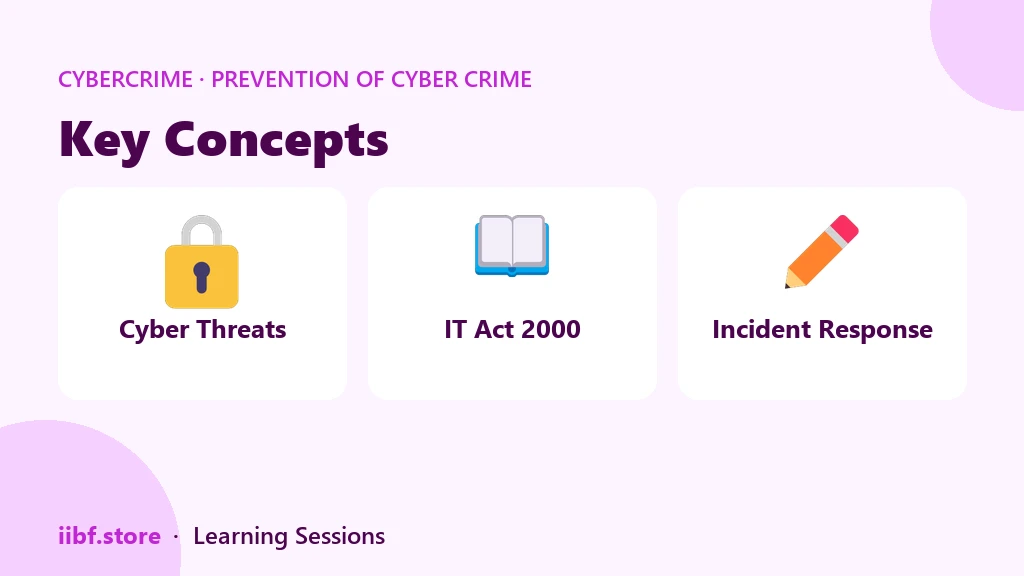
Block 1 — Foundations. Cyber crime definitions, actors and motives, channels, and the idea of computer insecurity: why systems are vulnerable by design and by configuration. Light on marks individually, but everything else assumes it.
Block 2 — Attack methods. The cyber crime methods and computer hackers chapters. Malware families, ransomware, denial of service, hacking classifications, and the phishing–vishing–smishing family. This block is definition-dense and rewards flashcards over re-reading.
Block 3 — Banking fraud in practice. Electronic card frauds, internet and mobile banking fraud, and computer fraud protection controls. This is the heaviest scoring block for most candidates, and it overlaps directly with the wider discipline covered in our guide to fraud management in banking.
Block 4 — Law, regulation and response. The IT Act framework, evidence, RBI's cyber security expectations, and incident management. Leave it last but never leave it out.
📖 Choosing Study Material Without Getting Burned
The single biggest mistake candidates make is studying from a circulated PDF of an old edition. Cyber regulation moves faster than almost any other banking subject — reporting windows, liability rules and framework names have all been revised in recent years. An outdated file will teach you answers that are now wrong, and downloading pirated courseware is both an infringement and a malware risk in a subject that is literally about malware.
| Source | Current with latest rules | Aligned to IIBF syllabus | Legitimate to use |
|---|---|---|---|
| Official IIBF courseware (bought via IIBF / listed publishers) | ✅ | ✅ | ✅ |
| RBI and IIBF websites, master directions and circulars | ✅ | ❌ (not exam-shaped) | ✅ |
| iibf.store chapter notes and mock tests | ✅ | ✅ | ✅ |
| Forwarded "free book PDF" from chat groups | ❌ | ❌ | ❌ |
A workable stack is: the official book as your spine, the regulator's own pages for anything involving numbers or timelines, and chapter-wise notes plus MCQs to convert reading into recall. Browse everything we publish for this paper on the Prevention of Cyber Crime tag hub, where guides are grouped by module rather than by date.
⚠️ Common Mistake: Memorising a timeline or a liability rule from a coaching handout without checking the primary circular. If a question hinges on a number, verify it at the source before you commit it to memory.
⚖️ The Legal and Regulatory Half You Cannot Skip
Candidates from technical backgrounds routinely under-prepare this block and lose easy marks. The regulatory portion is finite, highly structured and very testable, which makes it the best return on study time in the whole course.
Cover the Information Technology Act framework first: what constitutes an offence, the treatment of electronic records and digital signatures, and the concept of intermediary obligations. Then move to the supervisory layer — the RBI's expectations of banks on cyber security governance, board oversight, security operations, and customer protection. Read the actual text on the Reserve Bank of India website rather than a summary, because the phrasing of a master direction is often reused almost verbatim in questions.
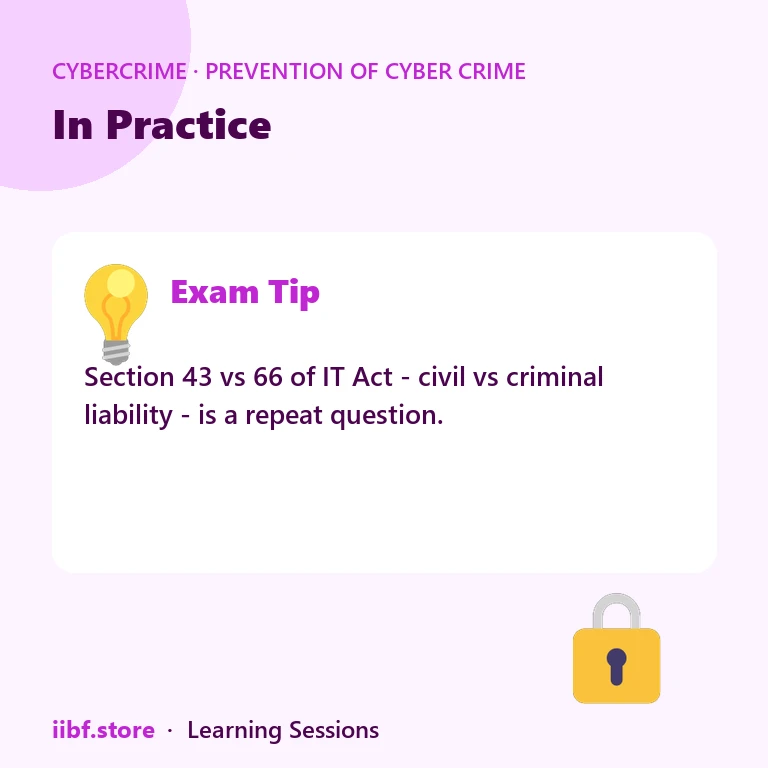
Two areas deserve dedicated revision because they generate a disproportionate number of questions. The first is customer liability in unauthorised electronic transactions — the zero, limited and full liability outcomes, and how the customer's reporting delay determines which applies. The second is incident reporting: who must be told, and within what window. Our detailed walkthrough of cyber incident reporting timelines covers the second in exam-ready form.
If you are also preparing CAIIB or a technology paper, note the overlap with detection tooling — our guide to data analytics for fraud detection explains how rule engines and anomaly models actually flag the frauds this course describes.
🗓️ A Six-Week Study Routine
Roughly sixty to seventy focused hours is enough for most working bankers. Spread across six weeks that is about ten hours a week, or ninety minutes on weekdays with a longer weekend block.
Weeks 1–2: Blocks 1 and 2. Read one chapter per sitting and end each sitting by writing five definitions from memory. Do not highlight; recall instead. Attempt a short topic quiz after every two chapters so gaps surface early rather than in week six.
Weeks 3–4: Block 3, the banking fraud core. Work scenario-first here: read a fraud type, then immediately list the preventive control, the detective control and the customer-communication step. Card fraud, UPI fraud and account takeover deserve one full sitting each.
Week 5: Block 4 — law, regulation, incident response and liability. Build a single one-page sheet of every timeline and liability threshold and revise it daily thereafter.
Week 6: Full-length mock tests only. Take at least three timed papers, and after each one classify every wrong answer as a knowledge gap, a misreading, or a guess. Fix knowledge gaps by re-reading the chapter; fix misreadings by slowing down on the first read of the question stem.
📌 Remember: In the last week, revise your one-page timeline sheet and your list of wrong answers. Do not start new chapters in week six — breadth added late crowds out recall you already built.
🧠 Practice MCQs: Cyber Crime and Fraud Management
Q1. A caller posing as a bank official persuades a customer to reveal an OTP over the phone. The technique is best classified as: (a) Skimming (b) Vishing (c) Ransomware (d) SQL injection
Answer: (b) — Voice-based social engineering to extract credentials is vishing; the telephone is the channel, deception is the technique.
Q2. Which of the following is a detective control rather than a preventive control? (a) Two-factor authentication (b) Transaction monitoring alerts (c) Card tokenisation (d) Access rights restriction
Answer: (b) — Monitoring alerts identify suspicious activity after it occurs; the other three stop it happening in the first place.
Q3. In an unauthorised electronic transaction, the customer's liability depends primarily on: (a) The transaction amount (b) The channel used (c) The delay in reporting to the bank (d) The customer's account type
Answer: (c) — The regulatory framework grades liability by how quickly the customer notifies the bank after the unauthorised transaction.
Q4. Skimming is most directly associated with which of the following? (a) Payment cards at ATMs and POS terminals (b) Distributed denial of service attacks (c) Email spoofing (d) Software licence piracy
Answer: (a) — Skimming captures magnetic stripe or card data at the point of use through a covert reading device.
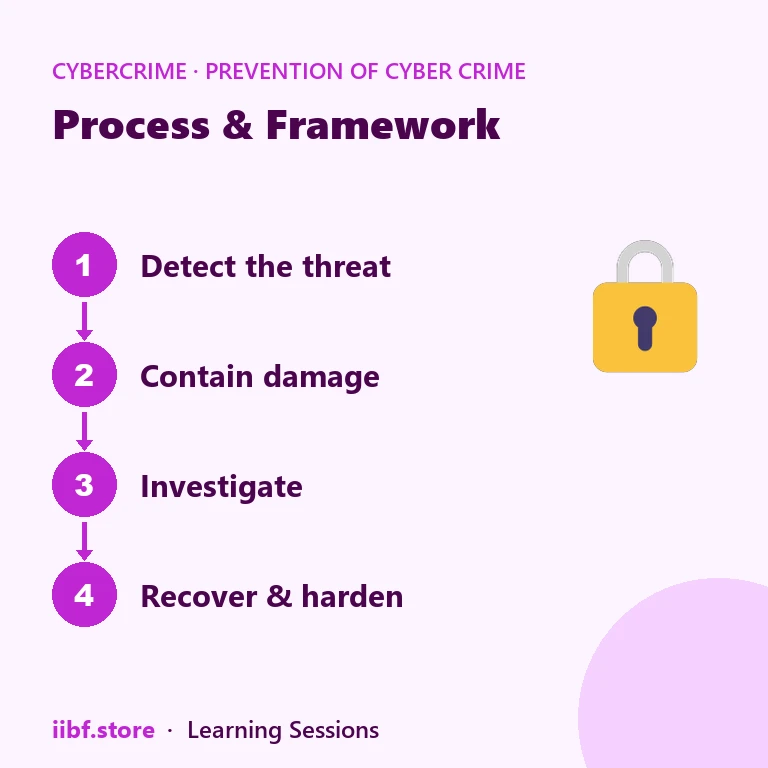
Q5. The first step in a bank's incident management process on detecting a cyber incident is normally to: (a) Issue a press release (b) Identify and contain the incident (c) Recover deleted logs (d) Close all customer accounts
Answer: (b) — Identification and containment come first so the damage stops spreading; eradication, recovery and reporting follow.
Want chapter-wise mock tests with 100+ MCQs? Start practising free →
❓ Frequently Asked Questions
Is there a free official PDF of the IIBF courseware?
No. IIBF courseware is a paid publication and copies circulating as free downloads are unauthorised and frequently out of date. Buy the current edition through IIBF or its listed publishers, and use free chapter notes and mock tests on iibf.store alongside it.
How long does this certificate take to prepare for?
Most working bankers need roughly sixty to seventy focused hours. Six weeks at about ten hours a week is a comfortable pace, with the final week reserved entirely for full-length mock tests and revision.
Which block carries the most weight?
The banking fraud block — card, internet, mobile and UPI frauds together with the controls that counter them — is usually the largest single source of questions, closely followed by the legal and regulatory portion. Always confirm the current pattern on iibf.org.in.
Do I need a technical background to pass?
No. The technical content is conceptual rather than hands-on, and no coding or system administration experience is expected. A banker with branch or operations experience often has an advantage on the fraud and process questions.
🎯 Where to Go From Here
Treat this course as three habits rather than one syllabus: name the technique behind every fraud you read about, verify every timeline and liability rule at its source, and convert reading into recall with questions rather than re-reading. Do that consistently for six weeks and the paper stops feeling like memorisation.
Start with the foundation chapters linked above, keep the tag hub open for module-wise guides, and finish every session with a short quiz. Take a free chapter-wise mock test on iibf.store → and turn your reading into marks.
Prefer revising from a printed book?
Chapter-wise books with MCQs after every chapter — minimal pages, complete coverage, delivered anywhere in India. Every book has a free sample to read first.
132 pages · 225 MCQs
Learning Sessions · Ashish Sir
188 pages · 435 MCQs
Learning Sessions · Ashish Sir
117 pages · 236 MCQs
Learning Sessions · Ashish Sir
Learning Sessions · Ashish Sir
118 pages · 299 MCQs
Learning Sessions · Ashish Sir
Learning Sessions · Ashish Sir
Learning Sessions · Ashish Sir
Learning Sessions · Ashish Sir
115 pages · 255 MCQs
Learning Sessions · Ashish Sir
Learning Sessions · Ashish Sir
334 pages · 936 MCQs
Learning Sessions · Ashish Sir
Learning Sessions · Ashish Sir
115 pages · 344 MCQs
Learning Sessions · Ashish Sir
107 pages · 240 MCQs
Learning Sessions · Ashish Sir
90 pages · 150 MCQs
Learning Sessions · Ashish Sir
Learning Sessions · Ashish Sir
131 pages · 672 MCQs
Learning Sessions · Ashish Sir
221 pages · 831 MCQs
Learning Sessions · Ashish Sir
128 pages · 524 MCQs
Learning Sessions · Ashish Sir
107 pages · 445 MCQs
Learning Sessions · Ashish Sir
148 pages · 478 MCQs
Learning Sessions · Ashish Sir
151 pages · 465 MCQs
Learning Sessions · Ashish Sir
148 pages · 375 MCQs
Learning Sessions · Ashish Sir
216 pages · 895 MCQs
Learning Sessions · Ashish Sir
109 pages · 300 MCQs
Learning Sessions · Ashish Sir
104 pages · 360 MCQs
Learning Sessions · Ashish Sir
82 pages · 297 MCQs
Learning Sessions · Ashish Sir
151 pages · 600 MCQs
Learning Sessions · Ashish Sir
98 pages · 282 MCQs
Learning Sessions · Ashish Sir
Practice this topic
Take a free mock test, download chapter PDFs, or watch a video class — all included on iibf.store.