JAIIB AFM Capital Investment Decisions & Term Loans: Full Guide
Every long-term commitment a bank-financed firm makes — a new plant, a capacity expansion, a machinery replacement, a fresh product line — is one of the capital investment decisions that JAIIB AFM Module C, Chapter 25 puts under the microscope. Such commitments tie up funds for years and carry time-value implications, so the banker appraising a term loan reaches for exactly the same toolkit the borrower used to justify the spend: NPV, IRR, Payback Period and ARR.
This guide follows the chapter in sequence: the four core capital-budgeting techniques with the book's own worked numbers, then term loans and Deferred Payment Guarantees (DPG), and finally the pillars of project appraisal. The chapter also flags loan syndication, the Harmonised Master List of infrastructure categories and the RBI Project Finance Directions that now govern project lending, so keep the RBI website open beside your notes when you revise the regulatory layer.
Download the full chapter PDF
JAIIB AFM Module C Chapter 25 — Capital Investment Decisions & Term Loans — the complete Learning Sessions study chapter, exam-ready with latest updates, key terms, exam traps and revision tables. Free to download, print and share.
1. What Capital Investment Decisions Actually Ask
Investment appraisal exists to answer a single question: is the future stream of cash inflows worth the money invested today? Every technique in this chapter is a different way of testing that one proposition, and capital investment decisions are classified by whether the technique respects the time value of money.
- Discounted Cash Flow (DCF) methods recognise the time value of money: Net Present Value (NPV) and Internal Rate of Return (IRR).
- Non-DCF methods ignore the time value of money: Payback Period and Accounting Rate of Return (ARR).
Exam trap. If the question mentions a discount rate, present value or cost of capital, the answer lies with NPV or IRR. If it asks only how fast the money comes back, it is Payback. If it divides average profit by average investment, it is ARR. Train that reflex on the JAIIB mock tests until the classification takes you two seconds, not twenty.
2. Net Present Value: Formula, Worked Numbers and Limits
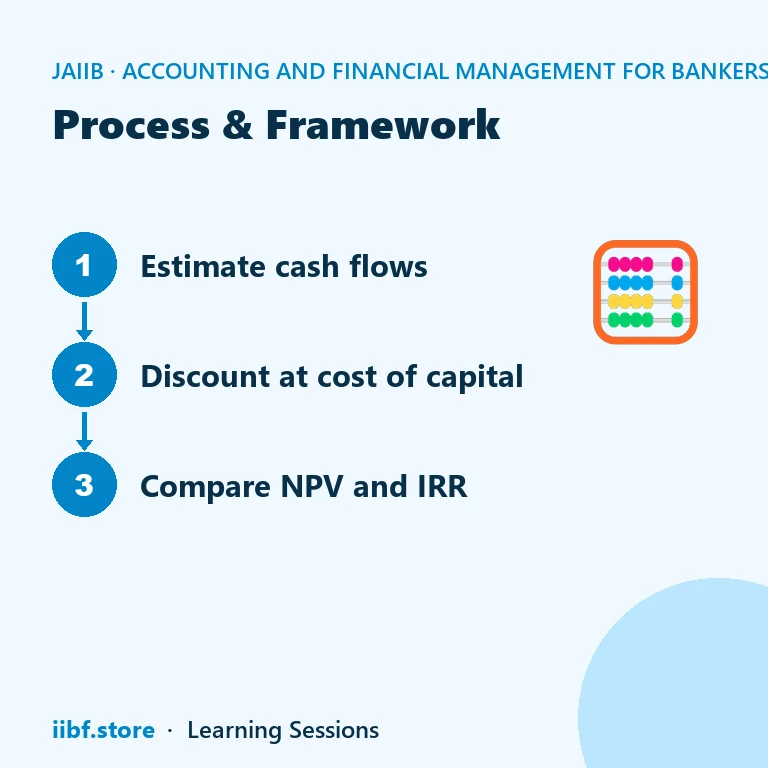
NPV measures the rupee surplus a project creates — the present value of future net cash inflows minus the initial outlay. The chapter builds it in four steps: estimate all future net cash flows over the project's life; discount each flow at the appropriate rate, usually the cost of capital; sum those present values; and subtract the initial investment. Whatever remains is the NPV.
NPV = Σ [ CFt ÷ (1 + r)t ] − CF0, where CFt is the net cash flow in year t, r is the discount rate, n is the project life and CF0 is the initial outlay.
The decision rule is blunt: a positive NPV means accept, a negative NPV means reject, and among mutually exclusive projects the highest positive NPV wins.
Worked example with uniform inflows. Outlay ₹10,00,000, inflows of ₹3,00,000 a year for five years, discount rate 10%. The present value of inflows is 3,00,000 × (0.909 + 0.826 + 0.751 + 0.683 + 0.621) = ₹11,37,000. NPV = 11,37,000 − 10,00,000 = ₹1,37,000. Positive, so the project is accepted.
The chapter then sets two mutually exclusive projects against each other at a 10% cost of capital:
| Year | PVF @10% | A: inflow (₹) | A: PV (₹) | B: inflow (₹) | B: PV (₹) |
|---|---|---|---|---|---|
| 0 | 1.000 | (25,000) | — | (20,000) | — |
| 1 | 0.909 | 4,500 | 4,090.50 | 3,000 | 2,727.00 |
| 2 | 0.826 | 6,000 | 4,956.00 | 4,000 | 3,304.00 |
| 3 | 0.751 | 7,500 | 5,632.50 | 5,500 | 4,130.50 |
| 4 | 0.683 | 9,000 | 6,147.00 | 6,500 | 4,439.50 |
| 5 | 0.621 | 11,000 | 6,831.00 | 7,000 | 4,347.00 |
| Total PV | — | — | 27,657.00 | — | 18,948.00 |
| NPV | — | — | +₹2,657 | — | (₹1,052) |
Project A returns a surplus of ₹2,657 while Project B destroys ₹1,052 of value, so A is accepted and B rejected. Had both been positive, the higher NPV would still have taken the mutually exclusive slot.
Limitations of NPV. The choice of discount rate is decisive, because a small change in r can swing the NPV across zero. Ordinary NPV also struggles to rank repeatable, mutually exclusive projects of unequal lives performing the same function — the Equivalent Annual Annuity or replacement-chain method is used there. And estimation risk never disappears: inflow and outflow assumptions stay fragile until the project actually runs.
3. Internal Rate of Return and the NPV vs IRR Verdict
IRR is the discount rate at which NPV equals zero — the rate at which discounted inflows exactly match discounted outflows. For independent projects the rule is simple: accept when IRR exceeds the cost of capital. For mutually exclusive projects the primary rule remains the highest positive NPV at the appropriate cost of capital, because a higher-IRR project can still carry a lower NPV owing to differences in size, timing, life or reinvestment. Incremental IRR may supplement the analysis, but it does not replace the NPV ranking.
In the exam you will normally be asked to find IRR by linear interpolation:
IRR ≈ L + [ NPV(L) ÷ ( NPV(L) − NPV(H) ) ] × (H − L), where L and H are the lower and higher trial rates that bracket the sign change.
Worked example. NPV at 15% is +₹2,400 and NPV at 20% is −₹1,600. IRR ≈ 15 + [2,400 ÷ (2,400 + 1,600)] × 5 = 15 + 0.60 × 5 = 18.00% p.a. Applying the same narrowing to Projects A and B, both turn positive at 15% and negative at 20%, so both IRRs sit inside the 15–20% band — roughly 18.1% for A and 16.8% for B. Both clear the 10% cost of capital, and here the IRR and NPV rankings happen to agree; where they conflict, NPV rules.
Limitations of IRR. Scale, timing and life differences can make IRR rank projects incorrectly, because it is a percentage and therefore blind to rupee scale; committing funds longer at a high IRR may not suit a bank's liquidity needs. Note the precision point the chapter insists on: IRR is computed from all dated cash flows, so it does not literally ignore duration — the defect is in ranking, not in arithmetic. Under the textbook reinvestment convention, IRR assumes intermediate cash flows are reinvested at the IRR itself, which often overstates true profitability. Finally, with n sign changes in the cash-flow sequence there can be up to n positive IRRs, while NPV always produces a single figure — one reason it is academically preferred when capital investment decisions are compared side by side.
| Basis | NPV | IRR |
|---|---|---|
| Meaning | Algebraic sum of the present values of all cash flows | Discount rate at which NPV = 0 |
| Expressed in | Absolute rupees | Percentage |
| Represents | Surplus generated | Break-even discount rate |
| Reinvestment (textbook convention) | At the cost of capital | At the IRR |
| Decision | NPV > 0 → accept | IRR > cost of capital → accept; for mutually exclusive projects defer to the NPV ranking |
Precision note. Reinvestment is a textbook convention. Strictly, NPV is a present-value rule and needs no separate reinvestment assumption to establish value, so quote the convention when the exam compares the two methods — never as a property of the mathematics itself.
4. Non-DCF Methods: Payback Period and ARR
The Payback Period is the time required for cumulative net cash inflows to recover the initial cash investment. It is a cash-flow measure and never an accounting-earnings measure. With uniform inflows, Payback = initial investment ÷ annual net cash inflow; with uneven inflows you simply accumulate year by year until the outlay is recovered.
Worked example. Two projects each cost ₹50,000. Project A returns 10,000 / 12,500 / 15,000 / 12,500 / 3,000 and Project B returns 10,000 every year for five years. A's cumulative flow runs 10,000 → 22,500 → 37,500 → 50,000, hitting the outlay at the end of Year 4. B reaches only 40,000 by Year 4 and 50,000 at the end of Year 5. Payback is therefore 4 years for A and 5 years for B, so A is chosen for its shorter recovery.
Payback ignores the time value of money, ignores every cash flow arriving after the payback point and therefore total profitability, and judges nothing but recovery speed. Two projects with identical paybacks can hide wildly different lifetime returns.
ARR measures profitability using accounting profits after tax rather than cash flows, expressed as a percentage of average investment: ARR = (Average annual PAT ÷ Average investment) × 100. Average investment is taken as (initial investment + scrap value) ÷ 2, an approximation that assumes straight-line depreciation and an even decline in carrying value; where recoverable working capital exists, add it as (fixed cost + scrap)/2 + WC. Always follow the method the question specifies.
Worked example. Initial investment ₹8,00,000, scrap ₹2,00,000, PAT over four years of 1.2, 1.4, 1.6 and 1.8 lakh. Average PAT = 6,00,000 ÷ 4 = ₹1,50,000. Average investment = (8,00,000 + 2,00,000) ÷ 2 = ₹5,00,000. ARR = 1,50,000 ÷ 5,00,000 × 100 = 30% p.a., accepted if it clears the management hurdle rate. Among mutually exclusive projects prefer the highest ARR — while remembering it ignores the time value of money entirely.
5. Term Loans, WCTL and Deferred Payment Guarantees
Term loans are the funding side of capital investment decisions. A term loan is a funded credit facility with a specified maturity and an agreed repayment schedule, financing fixed assets such as land, building, plant and machinery, and infrastructure. Repayment may run through equal instalments, unequal instalments, balloon payments, bullet repayment, step-up instalments or any other cash-flow-linked structure — there is no uniform schedule across a bank's portfolio. Repayment follows the sanction terms, matched to the borrower's cash-surplus profile, and moratoriums are common.
Working-capital facilities behave differently. Cash-credit and overdraft limits are commonly reviewed annually, though their repayment character and renewal terms flow from the sanction documents. Working capital may also be financed by demand loans, short-term loans, bills, packing credit and Working Capital Term Loans. A WCTL is not only a stressed-account product: it may fund the permanent or core component of working capital, structure a working-capital gap, convert an irregular portion during restructuring, or implement a cash-flow-based arrangement under the bank's policy.
A Deferred Payment Guarantee arises where the buyer of a fixed asset pays the supplier on an agreed deferred schedule and the bank guarantees those payments. The bank carries term-loan-like credit risk on the buyer, yet the instrument is a non-fund-based, off-balance-sheet exposure until invocation. The bank steps in only on default; on invocation or devolvement the exposure becomes funded. For capital treatment the guarantee converts to a credit equivalent using the prescribed Credit Conversion Factor — as a direct credit substitute a 100% CCF generally applies, followed by the counterparty risk weight. The bank charges commission and the DPG should ordinarily be backed by adequate tangible security or counter-guarantees per policy.
Exam trap. Write it precisely: a DPG exposes the bank to term-loan-like credit risk but remains an off-balance-sheet contingent exposure until invocation. It is not a term loan in the bank's books from the date of issuance.
6. Project Appraisal: Managerial, Technical and Economic Pillars
Project appraisal is where capital investment decisions meet credit risk. It structures the case for a project — its viability — before the term loan is sanctioned, and the classical syllabus pillars run in sequence.
Managerial appraisal tests the credentials of the promoters (track record, competence, integrity), their financial stake (the higher the promoters' margin, the greater the commitment), the form of organisation (proprietorship, partnership, LLP or company, each with its own governance and liability implications) and the key persons — the depth of the second line, succession and operational expertise.
Technical appraisal covers location (proximity to raw material, markets, labour, power and transport), products and process (technology choice, plant capacity, layout), infrastructure availability, the technology provider's track record and know-how transfer, construction details and the implementation schedule, the EPC contractor's credentials and financial strength, waste disposal and pollution control including environmental clearances, raw-material availability and supply tie-ups, and marketing arrangements such as off-take agreements and distribution.
Economic appraisal applies return-on-investment measures — NPV, IRR, Payback, cost-benefit ratio and ARR — to the project's own numbers, adds break-even analysis (a high break-even point means more risk before profitability arrives) and sensitivity analysis, which tests viability under moves in key variables such as raw material up 10%, sale price down 5% or utilisation down 8%.
Modern practice. Lender appraisal today runs wider than the three pillars: promoter and managerial, then market and commercial, technical, legal and regulatory, environmental, financial and economic, and finally risk, sensitivity and security assessment. That covers legal due diligence, approvals, environmental and social and climate risk, group exposure, security enforceability, DSCR and scenario analysis. Banks conduct scenario and sensitivity testing under their Board-approved policies — the number and severity of scenarios follow project size and risk, not a universal regulator-mandated minimum.
7. Rapid Revision Table, Exam Traps and FAQs
Use this grid the night before the paper. It compresses every method the chapter tests on capital investment decisions into one screen.
| Method | Time value? | Core formula | Accept when |
|---|---|---|---|
| NPV | Yes | Σ [CFt ÷ (1+r)t] − CF0 | NPV > 0; highest NPV if mutually exclusive |
| IRR | Yes | Rate where NPV = 0; interpolate between L and H | IRR > cost of capital |
| Payback | No | Initial investment ÷ annual net cash inflow | Shorter than the target period |
| ARR | No | (Average PAT ÷ Average investment) × 100 | Above the hurdle rate |
Three traps sink most candidates. First, reading "profit" as "cash flow" — only ARR uses accounting profit after tax; Payback, NPV and IRR all use cash flows. Second, ranking mutually exclusive projects by IRR when NPV disagrees. Third, calling a DPG a term loan from the date of issuance. Reinforce all three with the structured chapter notes in the JAIIB course, revise formulas quickly through the match-the-pair game, and read the companion write-ups on the IIBF blog.
Are capital investment decisions tested numerically in JAIIB AFM?
Yes. Expect direct calculation questions on NPV using given present value factors, IRR by linear interpolation between two trial rates, cumulative payback with uneven inflows, and ARR using average PAT over average investment. Memorise the four formulas and practise with the chapter's own figures.
If IRR and NPV rank two projects differently, which one do I follow?
NPV. For mutually exclusive projects the primary rule is the highest positive NPV at the appropriate cost of capital. A higher-IRR project can carry a lower NPV because of differences in size, timing, life or the reinvestment convention. Incremental IRR may supplement the analysis but never overrides the NPV ranking.
Why can a project have more than one IRR?
Because IRR solves a polynomial. With n sign changes in the cash-flow sequence there can be up to n positive IRRs, although the actual number may be lower. NPV always produces a single figure, which is one reason it is academically preferred.
How is a Deferred Payment Guarantee treated on the bank's balance sheet?
It stays a non-fund-based, off-balance-sheet contingent exposure until invocation. For capital adequacy the guarantee converts to a credit equivalent through the prescribed Credit Conversion Factor — as a direct credit substitute a 100% CCF generally applies — and the counterparty risk weight is then applied. Only on invocation or devolvement does the exposure become funded.
Master these four techniques and the term-loan vocabulary around them, and the capital investment decisions block of Module C turns from a formula-hunt into easy marks. Pair the notes with the free PDF above, then attempt a timed set on iibf.store tests to see which trap still catches you.
Prefer revising from a printed book?
Chapter-wise books with MCQs after every chapter — minimal pages, complete coverage, delivered anywhere in India. Every book has a free sample to read first.



































Quick quiz on this topic
5 exam-style questions from our free test bank — check yourself before you move on.
Practice this topic
Take a free mock test, download chapter PDFs, or watch a video class — all included on iibf.store.