Bancassurance in Retail Banking: JAIIB RBWM Exam Guide
Bancassurance in retail banking is the arrangement under which a bank distributes the insurance products of one or more insurers to its own customer base, earning fee income while the insurer continues to carry the underwriting risk. The bank never becomes an insurer. It becomes a regulated distribution channel that monetises the trust, the footfall and the transaction history it already owns.
For a JAIIB candidate, one idea decides most of the marks in this chapter: the bank is a distributor, not a risk carrier. The premium belongs to the insurer, the policy contract runs between the customer and the insurer, and the bank's income is a commission or fee capped by IRDAI. Every tricky question on this topic is built on that single distinction.
🏦 What Bancassurance in Retail Banking Actually Is
The commercial logic is easy to see from a branch manager's chair. A branch that has already completed KYC, holds the salary account and can read the customer's cash flows sells a term plan at a fraction of the acquisition cost an insurer's own agency force would incur. The insurer buys reach; the bank sells access. Study this alongside the introduction of retail banking chapter, because insurance sits inside the retail product bundle rather than beside it.
Indian practice runs on four delivery models, and RBWM expects you to tell them apart cold:
- Corporate agency — the bank registers with IRDAI as a corporate agent and solicits business for a limited number of insurers. It represents the insurer.
- Insurance broking — the bank or a group entity registers as a broker, represents the customer, and can place business with any insurer in the market.
- Referral — the bank shares qualified leads with the insurer, whose own certified staff complete the sale. The bank does not solicit.
- Joint venture / promoted insurer — the bank promotes an insurance company and holds equity in it, which requires prior RBI approval and minimum eligibility on net worth, capital adequacy and NPA levels.
The first three are fee-based, non-risk activities. Only the fourth puts the bank's capital at risk, and that is why the approval bar for it is set so much higher. Candidates routinely lose a mark by treating a corporate agency tie-up as though it needed the same RBI clearance as a joint venture. It does not.
📜 The Regulatory Chain: BR Act, RBI and IRDAI
Three layers of permission stack up before a branch counter can legally hand over a proposal form, and exam questions love to test the order.
The first layer is the enabling statute. A banking company can only carry on the forms of business listed in Section 6 of the Banking Regulation Act, 1949, which is why insurance agency business needed express enablement before banks could touch it. Nothing a bank does in this space is an inherent banking activity; it is a permitted add-on.
The second layer is RBI. Distribution of insurance and other third-party products is para-banking, governed by RBI's Master Directions on financial services provided by banks, available on the RBI Master Directions page. The standing conditions are consistently examinable: the bank needs a board-approved policy for third-party distribution, the sale must be entirely voluntary, it can never be made a pre-condition for sanctioning a loan or opening an account, risk must not migrate to the bank's balance sheet, and a proper grievance mechanism must exist at the branch.
The third layer is IRDAI. The bank must hold a valid registration in the chosen capacity, appoint a principal officer, and ensure that only certified specified persons solicit business. An uncertified teller cannot fill a proposal form, however well he knows the customer.
⚠️ Common Mistake: Candidates write that RBI licenses banks to sell insurance. It does not. RBI permits the activity as para-banking and sets conduct conditions; the actual registration as corporate agent or broker is granted by IRDAI.
📊 Corporate Agency vs Broking vs Referral
The 2015 shift to open architecture is the reform most often examined. Before it, a bank was effectively locked to a single insurer per line of business. Under the corporate agency framework that followed, a corporate agent may tie up with up to three insurers in each line — life, general and health — which gave customers genuine choice at the counter and forced insurers to compete on product rather than on exclusivity.
| Aspect | Corporate agency | Insurance broking |
|---|---|---|
| Whom the bank represents | The insurer | The customer |
| Can place business with any insurer | ❌ No — capped tie-ups per line of business | ✅ Yes — open market access |
| Registration granted by | IRDAI, as corporate agent | IRDAI, as insurance broker |
| Who solicits the business | Certified specified persons | Qualified persons of the broking entity |
| Remuneration | Commission from the insurer, within IRDAI limits | Brokerage from the insurer, within IRDAI limits |
| Advice on comparative suitability | Limited to the tied insurers | Expected across the market |
The referral model sits below both. The bank supplies a lead and a database; it does not solicit, does not fill proposal forms and does not earn a solicitation commission. Because the bank's staff never advise, the compliance burden is lightest — and so is the income. Most large Indian banks therefore run corporate agency at the branch and reserve broking for a separate group entity, since a single legal entity cannot comfortably be both the insurer's agent and the customer's broker at the same counter.
💰 Fee Income, Branch Profitability and the Sales Funnel
Bancassurance income is attractive because it is capital-light. Commission carries no risk weight, consumes no deposit funding and does not enter the loan book, so it flows almost straight to the bottom line. In a rate cycle that compresses net interest margin, a stable non-interest income line is what keeps a branch viable — the exact argument developed in the branch profitability chapter.
Compare the two engines. A 3% margin on a Rs 1 crore advance books roughly Rs 3 lakh a year and locks up capital to do it, while a modest book of protection policies can earn comparable fee income with no capital charge at all. That is why insurance targets appear in almost every retail branch scorecard, and why the applicability of retail banking concepts and branch profitability chapter treats third-party distribution as a core profitability lever rather than a side activity.
Insurance also rarely travels alone. It is the anchor of the cross-sell chain that runs through systematic investment plan for retail customers, retirement products such as atal pension yojana full form and, at the top of the wealth pyramid, discretionary mandates covered under portfolio management services. Each additional product raises the cost of switching banks, which is the real strategic prize.
💡 Exam Tip: If a question asks why banks favour third-party distribution, the marking scheme wants two words — fee income and customer stickiness — not a list of product names. Add "no capital charge" and you have a full-mark answer.
Two caveats matter. Commission income is cyclical, and it is far more sensitive to a persistency slump than interest income. More on this is collected on the Retail Banking and Wealth Management topic hub.
⚖️ Mis-selling, Suitability and Customer Redress
The risk that regulators care about is mis-selling, and the classic pattern is depressingly consistent: a single-premium unit-linked plan sold to an elderly depositor as though it were a fixed deposit with a bonus. The customer signs because the person across the counter is the bank, not because the product suits the need. The bank keeps the commission; the customer discovers the surrender penalty three years later.
Two safeguards are examinable. First, suitability — the product must be matched to the customer's need, horizon and risk appetite, and the need analysis must be documented. Second, disclosure — the customer must be told, in writing, that the product is an insurance contract underwritten by a named insurer, that the bank is only the distributor and that returns on market-linked plans are not guaranteed. A tie-in sale, where any credit facility is conditioned on buying a policy, is prohibited outright.
Redress runs on two tracks and candidates mix them up. A dispute about the policy itself — a repudiated claim, a surrender value calculation — goes to the Insurance Ombudsman. But a complaint about the bank's conduct in selling it, such as a forced or unsuitable sale, is a deficiency in banking service and is covered by the RBI Integrated Ombudsman Scheme (RB-IOS) 2026, which replaced the 2021 scheme with effect from 1 July 2026. Under RB-IOS 2026 the complaint must ordinarily be filed within 90 days of the bank's reply or the lapse of the reply period, the award ceiling is Rs 30 lakh, and compensation for consequential loss is capped at Rs 3 lakh. Prudence in cross-border and macro topics matters too — see how external flows are read in balance of payments in India.
🧠 Practice MCQs: Bancassurance in Retail Banking
Q1. Under the corporate agency framework, a bank registered as a corporate agent may tie up with a maximum of how many life insurers? (a) One (b) Two (c) Three (d) No limit
Answer: (c) — Open architecture permits a corporate agent up to three insurers in each line of business: life, general and health.
Q2. In a bancassurance arrangement, the underwriting risk on a policy sold across a bank counter is borne by: (a) The distributing bank (b) The bank and the insurer equally (c) The customer (d) The insurer
Answer: (d) — The bank is only a distributor; the contract of insurance and its risk sit entirely with the insurer.
Q3. A bank entity that wishes to represent the customer and place business with any insurer in the market must be registered with IRDAI as a: (a) Corporate agent (b) Insurance broker (c) Referral partner (d) Specified person
Answer: (b) — Only a broker acts for the customer and enjoys open market access; a corporate agent acts for the insurer.
Q4. Which condition governs a bank's distribution of third-party insurance products? (a) The sale must be voluntary and never a pre-condition for a credit facility (b) The premium must be routed through the bank's profit and loss account (c) The branch manager must personally hold an IRDAI licence (d) The bank must guarantee the maturity value
Answer: (a) — Tie-in sales are prohibited, and risk must not migrate to the bank's books; solicitation is done by certified specified persons, not by every branch official.
Q5. Under RB-IOS 2026, a complaint about deficiency in banking service must ordinarily be filed within: (a) 30 days (b) 60 days (c) 90 days (d) One year of the bank's reply
Answer: (c) — The 2026 scheme, effective 1 July 2026, prescribes a 90-day window, an award ceiling of Rs 30 lakh and Rs 3 lakh for consequential loss.
Want chapter-wise mock tests with 100+ MCQs? Start practising free →
❓ Frequently Asked Questions
Does a bank need RBI approval to start bancassurance?
For pure distribution as a corporate agent, broker or referral partner, the bank needs a board-approved policy and must comply with RBI's para-banking conditions, plus IRDAI registration. Prior RBI approval is specifically required when the bank wants to promote or hold equity in an insurance company.
Can a branch make a home loan conditional on buying a policy?
No. A tie-in sale is prohibited. The bank may offer credit-linked cover, but the customer must be free to decline it or to buy the cover elsewhere without affecting the loan sanction.
Who can actually solicit an insurance product inside a branch?
Only a certified specified person of the corporate agent, working under the designated principal officer. Ordinary branch staff may explain that the facility exists, but they cannot solicit business or complete a proposal form.
Where does a mis-selling complaint go?
A dispute about the policy or the claim goes to the Insurance Ombudsman. A complaint about how the bank sold it is a deficiency in banking service and falls under RB-IOS 2026, after first exhausting the bank's own grievance channel.
🎯 Key Takeaways and Next Step
Hold on to three anchors and this chapter becomes predictable. The bank distributes and never underwrites. Permission is layered — the Banking Regulation Act enables, RBI conditions the conduct as para-banking, IRDAI registers the entity. And the model chosen, corporate agency or broking, decides whom the bank legally represents and therefore how far its advice may go.
Practise the numbers you can defend rather than memorising commission tables that move. Then convert the reading into marks with full-length papers on the JAIIB course page.
Prefer revising from a printed book?
Chapter-wise books with MCQs after every chapter — minimal pages, complete coverage, delivered anywhere in India. Every book has a free sample to read first.
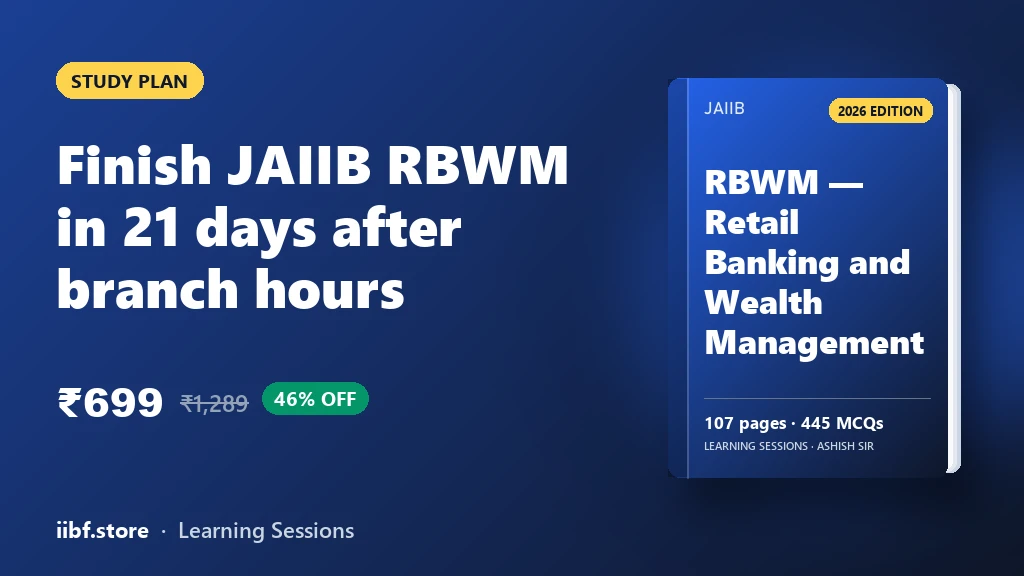
107 pages · 445 MCQs
Learning Sessions · Ashish Sir
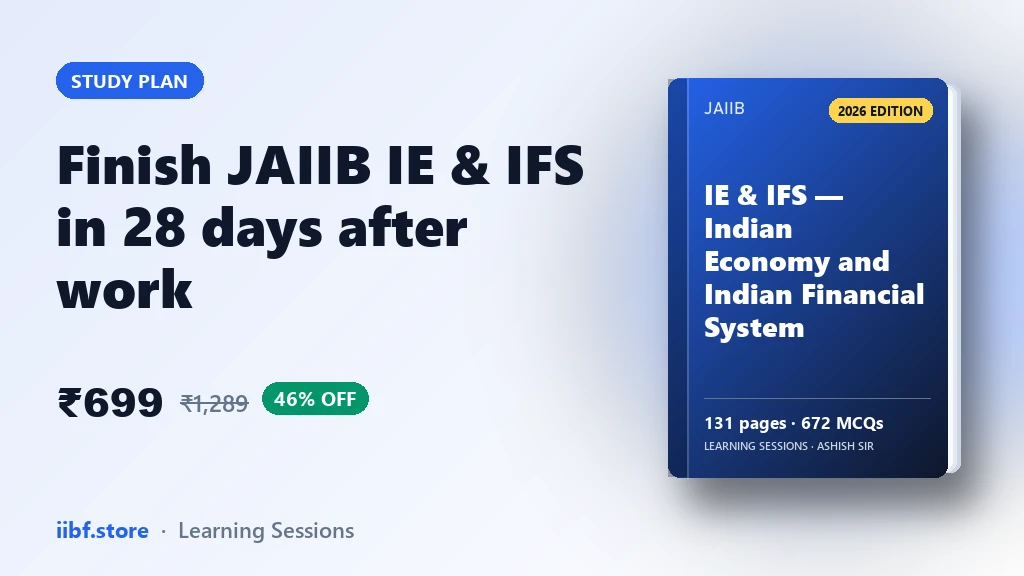
131 pages · 672 MCQs
Learning Sessions · Ashish Sir
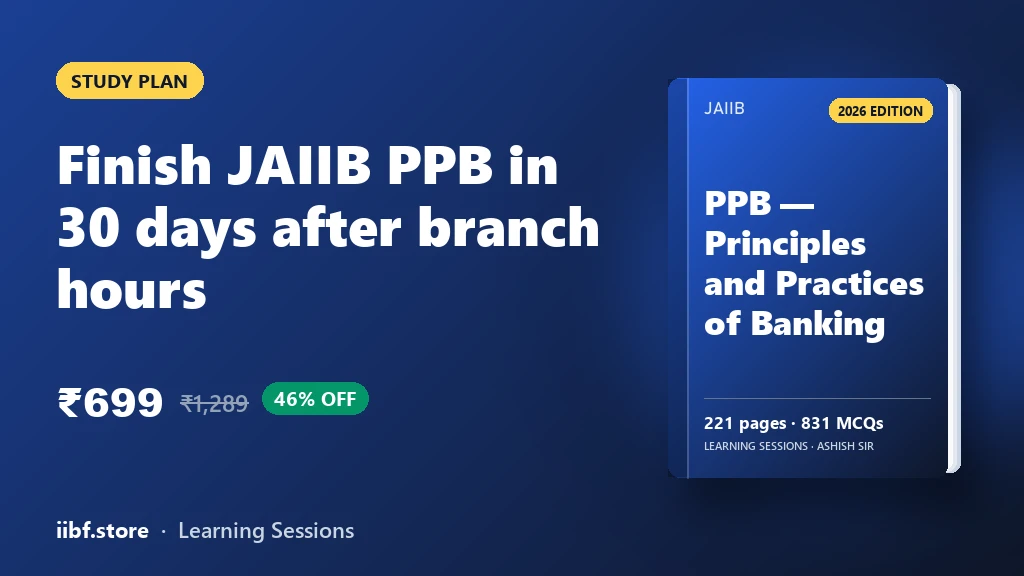
221 pages · 831 MCQs
Learning Sessions · Ashish Sir
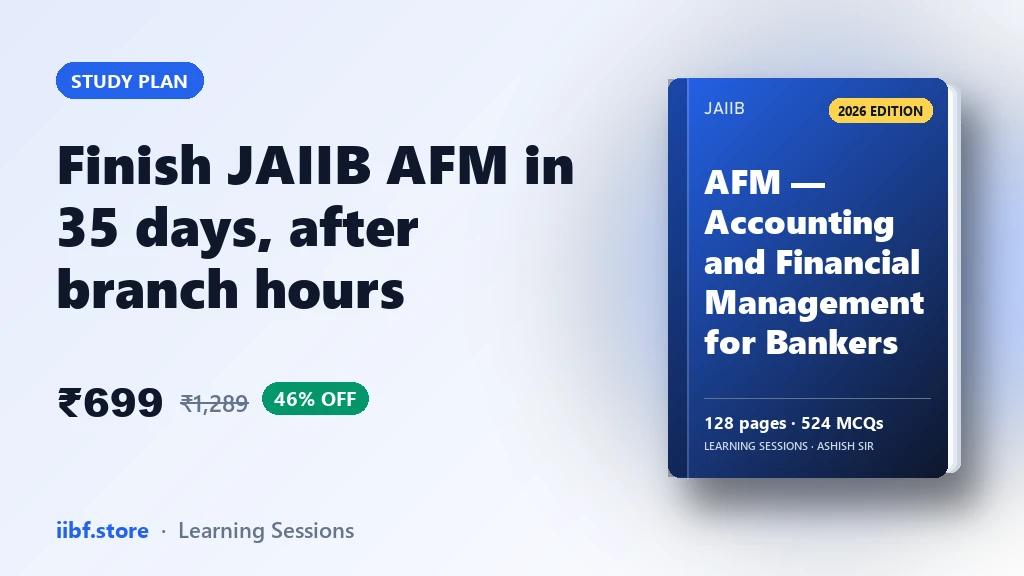
128 pages · 524 MCQs
Learning Sessions · Ashish Sir
148 pages · 478 MCQs
Learning Sessions · Ashish Sir
151 pages · 465 MCQs
Learning Sessions · Ashish Sir
148 pages · 375 MCQs
Learning Sessions · Ashish Sir
216 pages · 895 MCQs
Learning Sessions · Ashish Sir
109 pages · 300 MCQs
Learning Sessions · Ashish Sir
104 pages · 360 MCQs
Learning Sessions · Ashish Sir
82 pages · 297 MCQs
Learning Sessions · Ashish Sir
151 pages · 600 MCQs
Learning Sessions · Ashish Sir
98 pages · 282 MCQs
Learning Sessions · Ashish Sir
132 pages · 225 MCQs
Learning Sessions · Ashish Sir
188 pages · 435 MCQs
Learning Sessions · Ashish Sir
117 pages · 236 MCQs
Learning Sessions · Ashish Sir
Learning Sessions · Ashish Sir
118 pages · 299 MCQs
Learning Sessions · Ashish Sir
Learning Sessions · Ashish Sir
Learning Sessions · Ashish Sir
Learning Sessions · Ashish Sir
115 pages · 255 MCQs
Learning Sessions · Ashish Sir
Learning Sessions · Ashish Sir
334 pages · 936 MCQs
Learning Sessions · Ashish Sir
Learning Sessions · Ashish Sir
115 pages · 344 MCQs
Learning Sessions · Ashish Sir
107 pages · 240 MCQs
Learning Sessions · Ashish Sir
90 pages · 150 MCQs
Learning Sessions · Ashish Sir
Learning Sessions · Ashish Sir
Quick quiz on this topic
5 exam-style questions from our free test bank — check yourself before you move on.
Practice this topic
Take a free mock test, download chapter PDFs, or watch a video class — all included on iibf.store.