JAIIB AFM Numerical Tricks: Solve Ratio Problems Fast

JAIIB AFM numerical tricks are what separate a candidate who clears Accounting and Financial Management for Bankers on the first attempt from one who runs out of time with ten ratio questions still untouched. The knowledge gap between a 48 and a 55 is usually tiny. The speed gap is enormous. This guide hands you the exact shortcuts, formula families, and timing rhythm that let a working banker solve ratio, depreciation, partnership, and reconciliation problems on reflex rather than from first principles.
Treat this article as a cheat sheet you return to the night before the exam. Read it once, attempt twenty questions on a timed AFM mock test, and watch your time-per-question drop by a third. The aim is not to learn new accounting theory. It is to convert the theory you already half-know into muscle memory that fires in under sixty seconds.
Key takeaways
- Memorise formulas in families, not in isolation — liquidity, profitability, solvency, and activity each follow one predictable pattern.
- Ratio analysis is the highest-yield bucket in AFM Module C; master five families and you cover the bulk of the numerical questions.
- Read only the two numbers a question actually needs. Most marks are lost to over-computation, not to ignorance.
- Sign conventions (sacrificing vs gaining ratio, Cash Book vs Pass Book direction) catch out more candidates than any formula.
- Timing is the single biggest score lift — a three-pass strategy beats any extra chapter you might cram.

Why AFM punishes knowledge and rewards speed
Among the four JAIIB papers, AFM is the one most candidates lose sleep over, and the reason is structural. The numerical density is high, the clock is unforgiving, and a single twisted question can swallow three minutes if you let it. You typically face roughly a hundred questions in around two hours — a little over a minute per question on average — yet AFM is front-loaded with calculations that tempt you to spend ninety seconds each.
The bankers who clear it are not the ones who read the most. They are the ones who drilled the common patterns until recognition replaced reasoning. When you see "Net Profit and Total Assets, find ROA," your hand should move before your brain finishes the sentence. That reflex is built, not born — and the rest of this guide shows you exactly how to build it.
JAIIB AFM numerical tricks for ratio analysis — the highest-yield bucket
Ratio analysis dominates the Financial Management module. Expect a healthy cluster of numerical questions spread across profitability, liquidity, solvency, and activity ratios. The core trick is simple: never memorise a formula in isolation. Memorise each one inside its family, because every family follows a logical progression you can reconstruct under pressure even if a specific formula slips your mind. For a deeper conceptual treatment, pair this section with our Ratio Analysis of Financial Statements JAIIB AFM guide.
Liquidity family
- Current Ratio = Current Assets ÷ Current Liabilities. A commonly cited healthy range is 1.5 to 2.0.
- Quick (Acid-Test) Ratio = (Current Assets − Inventory − Prepaid Expenses) ÷ Current Liabilities. Generally considered comfortable at 1.0 or above.
- Cash Ratio = (Cash + Marketable Securities) ÷ Current Liabilities — the most conservative liquidity test of the three.
Notice the pattern: each ratio strips out one more less-liquid asset. If a question hands you Current Assets, Inventory, and Current Liabilities and asks for the Quick Ratio, subtract Inventory from Current Assets and divide. There is nothing more to do. Candidates routinely overthink this and lose an easy mark.
Profitability family
- Gross Profit Margin = Gross Profit ÷ Sales × 100
- Operating Margin = Operating Profit ÷ Sales × 100
- Net Profit Margin = Net Profit ÷ Sales × 100
- Return on Assets (ROA) = Net Profit ÷ Total Assets × 100
- Return on Equity (ROE) = Net Profit ÷ Shareholders’ Equity × 100
The favourite trap here: a stem reads "Net Profit ₹50,000, Total Assets ₹5,00,000, find ROA." The answer is a clean 10%. Do not average the numerator with anything; the figure given stays as given. Many candidates manufacture an extra step that does not exist and talk themselves out of a correct answer.
Solvency family
- Debt-Equity Ratio = Long-term Debt ÷ Shareholders’ Equity. A reading above 2:1 is generally viewed as leverage-heavy.
- Interest Coverage Ratio = EBIT ÷ Interest Expense. A value below roughly 1.5 signals stress.
- Debt Service Coverage Ratio (DSCR) = (Net Profit + Depreciation + Interest) ÷ (Interest + Principal). This is the banker’s favourite — it sits inside every loan appraisal you handle at the branch.
DSCR is worth extra attention precisely because it mirrors your day job. The numerator adds back the non-cash charge (depreciation) and the financing cost (interest) to approximate cash available to service debt. Internalise why each item sits where it does and you will never fumble the formula.
Activity / Turnover family
- Inventory Turnover = Cost of Goods Sold ÷ Average Inventory
- Debtors Turnover = Net Credit Sales ÷ Average Debtors; convert to Days = 365 ÷ Debtors Turnover.
- Creditors Turnover = Net Credit Purchases ÷ Average Creditors; convert to Days the same way.
- Operating Cycle = Inventory Days + Debtor Days − Creditor Days.
The operating cycle is a recurring favourite. Lock in the rhythm "stock holding days plus debtor collection days minus creditor payment days." Drill five of these and the structure sticks for life. The minus sign in front of creditor days is the only thing that trips people up — creditors fund your cycle, so they shorten it.
Ratio families at a glance
Keep this comparison table in your peripheral vision while you practise. It maps each family to what the examiner is really testing and the one slip that costs marks.
| Ratio family | Headline formula | What it measures | Most common trap |
|---|---|---|---|
| Liquidity | Current Assets ÷ Current Liabilities | Short-term solvency | Forgetting to strip inventory for Quick Ratio |
| Profitability | Net Profit ÷ Sales × 100 | Earnings efficiency | Averaging a numerator that was given outright |
| Solvency | EBIT ÷ Interest; DSCR variants | Long-term debt capacity | Omitting the depreciation add-back in DSCR |
| Activity | COGS ÷ Average Inventory | Asset utilisation | Adding creditor days instead of subtracting |
Depreciation — three methods, a handful of exam questions
Depreciation features reliably, and the fastest way to keep the three methods straight is to label them by what they do to early-year charges.
Straight Line Method (SLM): equal depreciation every year. Annual depreciation = (Cost − Salvage Value) ÷ Useful Life. Predictable and quick. If a stem says "machine cost ₹10 lakh, salvage ₹1 lakh, useful life 9 years," the SLM charge is ₹1 lakh a year. Read the right two numbers, subtract, divide, move on — do not compute anything the question did not ask for.
Written Down Value (WDV) / Reducing Balance: a fixed percentage applied to the opening book value each year, so the charge is higher early and tapers off. Deriving the WDV rate from useful life involves an n-th root formula that is rarely needed; exam stems almost always hand you the rate directly. Your job is to apply it to the correct opening balance each year.
Units of Production / Activity Method: depreciation = (Cost − Salvage) ÷ Total Expected Units × Units Produced This Year. This suits machinery whose wear correlates with usage rather than the calendar. Recognise it by the presence of a "units" figure in the stem.
Tip: When a depreciation question gives you a rate and a multi-year horizon, you usually need only the year the question names — not the full schedule. Compute that one year and stop.
Partnership accounts — the predictable trap
Partnership questions surface every paper, and the skeleton barely changes:
- Two or three partners with stated capital contributions and a profit-sharing ratio.
- A partner retires, dies, or is admitted, and new ratios are either given or asked for.
- Goodwill is valued by one of three methods — Average Profit, Super Profit, or Capitalisation.
Goodwill shortcuts:
- Average Profit Method: Goodwill = Average Profit of last N years × number of years’ purchase. So "average profit ₹2 lakh, 3 years’ purchase" gives ₹6 lakh of goodwill.
- Super Profit Method: Super Profit = Actual Profit − Normal Profit, where Normal Profit = Capital Employed × Normal Rate of Return. Goodwill = Super Profit × number of years’ purchase.
- Capitalisation Method: Goodwill = (Average Profit ÷ Normal Rate of Return × 100) − Capital Employed.
The single most-tested item in this family is the sacrificing ratio versus the gaining ratio. Sacrificing = Old share − New share. Gaining = New share − Old share. The direction of the subtraction is everything; flip it and you forfeit a whole question’s worth of marks. Write both definitions at the top of your rough sheet before you touch the numbers.
Bank Reconciliation Statement — easy marks if you read carefully
BRS questions look intimidating but obey strict logic. You are given two anchors: your Cash Book balance and the bank’s Pass Book balance. You reconcile by walking through the differences between them:
- Cheques issued but not yet presented — these still sit in your bank from the bank’s view.
- Cheques deposited but not yet cleared — recorded by you, not yet by the bank.
- Bank charges debited by the bank but not yet entered in your books.
- Interest credited by the bank but not yet recorded by you.
- Direct deposits and standing instructions executed by the bank.
- Errors in either book.
The decisive trick is to reconcile in the exact direction the question asks. Starting from a Cash Book debit balance to reach the Pass Book balance, add the items the bank already knows but you have not recorded, and subtract the items you have recorded but the bank has not yet processed. Sign convention is the only thing that catches candidates out — practise five of these and the directional logic becomes automatic.
A practical one-week AFM speed plan
Tricks only pay off when rehearsed under the clock. Here is a compact, repeatable plan that turns the formulas above into reflexes without demanding more study hours than a working banker can spare.
- Days 1–2: Ratio families. Write each family from memory, then solve ten mixed ratio questions. Re-do any you got wrong the same evening.
- Day 3: Depreciation. Drill five SLM, five WDV (rate given), and three units-of-production sums. Focus on reading only the figures asked for.
- Day 4: Partnership. Practise goodwill by all three methods plus five sacrificing/gaining ratio sums. Define both ratios before every attempt.
- Day 5: BRS. Solve five reconciliations, alternating the starting point between Cash Book and Pass Book to lock the direction logic.
- Days 6–7: Full timed mock. Sit a complete, timed paper, then review every mistake. Reinforce recall with a quick session of JAIIB matching games on the formulas.
Strengthen the surrounding theory as you go: the credit and lending intuition behind DSCR is reinforced in our home loan and retail lending guide, while the broader paper-by-paper picture lives across all our JAIIB exam guides.
Time tactics for the AFM paper — the three-pass method
AFM is front-loaded with numericals, so a blind top-to-bottom attempt guarantees a time crunch. Use three disciplined passes:
- Pass 1 — Skim and pick. In the opening minutes, scan every question and knock out the ones you can finish in under a minute. Bank the easy marks first.
- Pass 2 — Medium effort. Work steadily through the one-to-two-minute questions. Skip anything that threatens to run long.
- Pass 3 — Hard and guess. In the final stretch, attempt the long ones; where you are stuck, eliminate two clearly wrong options and choose. If IIBF’s pattern carries no negative marking, an informed guess has positive expected value — confirm the marking scheme on the official IIBF notification before exam day.
Practise this rhythm on every timed mock. It is a bigger score lift than any single extra chapter, because it protects the marks you have already earned from being stolen by the clock.
Common mistakes that quietly cost marks
- Over-computing. Calculating a full depreciation schedule when only year three was asked, or averaging a numerator that was supplied directly.
- Mixing sign conventions. Swapping sacrificing and gaining ratios, or reconciling in the wrong direction in a BRS.
- Reformatting the question. Converting figures into different units unnecessarily and introducing arithmetic slips.
- Camping on one hard sum. Letting a single stubborn numerical eat three minutes that four easier questions needed.
- Skipping timed practice. Knowing the formulas but never rehearsing them against the clock, so recall is slow on exam day.
Banker’s note: Many of these ratios — DSCR, current ratio, debt-equity — are the same metrics you use in real credit appraisal. Lean on your branch experience; it makes the formulas feel familiar rather than foreign.
Frequently Asked Questions
Which ratio formulas are most frequently tested in JAIIB AFM?
Current Ratio, Quick Ratio, Debt-Equity Ratio, DSCR, and the Operating Cycle (stock days plus debtor days minus creditor days) come up most often. Drill these five families thoroughly and you will be ready for the large majority of ratio questions in any AFM paper. Practising them in family groups also helps you reconstruct a formula you momentarily forget.
Is a calculator allowed in the JAIIB AFM exam?
A simple non-programmable calculator is generally permitted under IIBF guidelines, so carry one with fresh batteries. Function-rich financial calculators are typically restricted, so do not depend on one. Always confirm the exact exam-day rule on the official IIBF notification in your final week of preparation.
How much prep time should AFM get compared with the other three JAIIB papers?
If your background is non-finance — HR, operations, or front-line retail — give AFM a larger slice of your schedule, since this is where most working bankers shed marks. If you have worked in credit, treasury, or accounts, you can spread your time more evenly across all four papers. Let your weakest topics, not the syllabus order, decide where the hours go.
Should I memorise the formulas or understand the logic?
Both, and in that order. Memorise the formula first so you are not deriving it under time pressure, then understand the logic so you can handle variations the textbook never showed you. Pure memorisation breaks on twisted questions, and pure logic is too slow when the clock is running — the top scorers carry both.
How do I stop one tough numerical from wrecking my timing?
Set a hard personal ceiling of roughly ninety seconds per question and obey it. The moment you cross it without a clear path, flag the question and move on to bank easier marks, returning only if time remains. The three-pass method exists precisely to enforce this discipline.
Where can I practise AFM numericals with explanations?
Use timed, chapter-wise mock tests so you rehearse both the formulas and the three-pass rhythm together. Learning Sessions offers free AFM mocks with bilingual explanations and a public leaderboard, alongside full video classes and chapter PDFs. Reviewing every wrong answer the same day is what converts practice into a lasting score gain.
Final word
JAIIB AFM does not reward textbook completeness — it rewards speed and pattern recognition. The candidates who clear it on the first attempt are simply those who drilled the ratio families until they were reflexive, who knew SLM from WDV from units without pausing, and who never let one stubborn numerical eat more than ninety seconds.
Start tonight: attempt twenty questions from one AFM chapter mock. Tomorrow, do twenty more. Within a week you will feel the speed building, and by exam day you will wonder what you were ever afraid of. For the official scheme and any rule updates, always confirm on the official IIBF website before you sit the paper.
Related Guides
📚 Free Learning Sessions resources — connect & crack your exam
- 📝 Free mock tests — chapter-wise, exam-pattern, with instant solutions
- 🎮 Matching games — gamified revision of key terms & concepts
- 📄 Study notes & PDFs — downloadable chapter material
- 🎥 Video classes on YouTube — subscribe to @learningsessions
💬 Want the full course? WhatsApp your course name to 8360944207 and our team will set you up.
📱 Study on the go — get our iOS & Android app at iibf.store/app.
Prefer revising from a printed book?
Chapter-wise books with MCQs after every chapter — minimal pages, complete coverage, delivered anywhere in India. Every book has a free sample to read first.
131 pages · 672 MCQs
Learning Sessions · Ashish Sir
221 pages · 831 MCQs
Learning Sessions · Ashish Sir
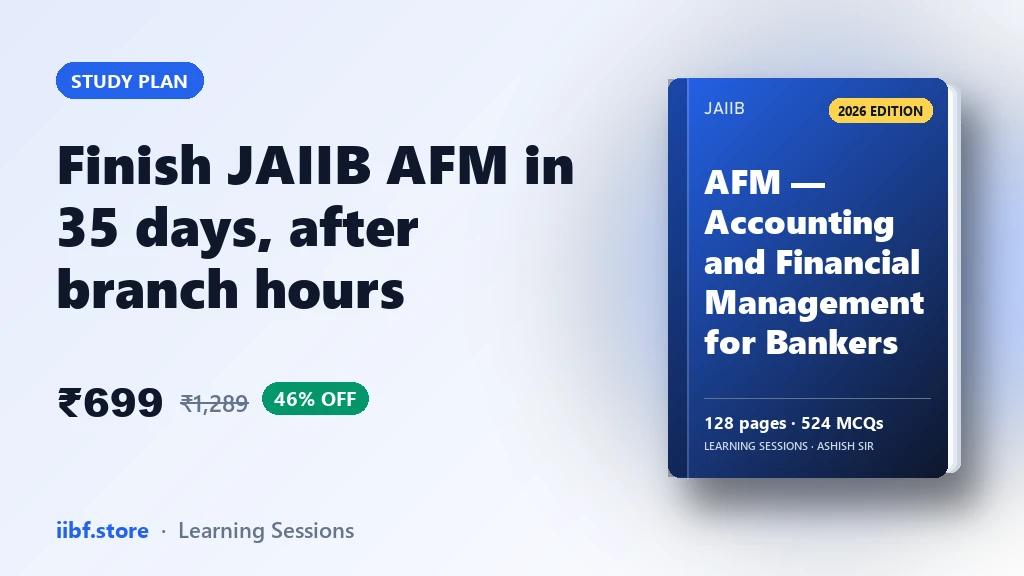
128 pages · 524 MCQs
Learning Sessions · Ashish Sir
107 pages · 445 MCQs
Learning Sessions · Ashish Sir
148 pages · 478 MCQs
Learning Sessions · Ashish Sir
151 pages · 465 MCQs
Learning Sessions · Ashish Sir
148 pages · 375 MCQs
Learning Sessions · Ashish Sir
216 pages · 895 MCQs
Learning Sessions · Ashish Sir
109 pages · 300 MCQs
Learning Sessions · Ashish Sir
104 pages · 360 MCQs
Learning Sessions · Ashish Sir
82 pages · 297 MCQs
Learning Sessions · Ashish Sir
151 pages · 600 MCQs
Learning Sessions · Ashish Sir
98 pages · 282 MCQs
Learning Sessions · Ashish Sir
132 pages · 225 MCQs
Learning Sessions · Ashish Sir
188 pages · 435 MCQs
Learning Sessions · Ashish Sir
117 pages · 236 MCQs
Learning Sessions · Ashish Sir
Learning Sessions · Ashish Sir
118 pages · 299 MCQs
Learning Sessions · Ashish Sir
Learning Sessions · Ashish Sir
Learning Sessions · Ashish Sir
Learning Sessions · Ashish Sir
115 pages · 255 MCQs
Learning Sessions · Ashish Sir
Learning Sessions · Ashish Sir
334 pages · 936 MCQs
Learning Sessions · Ashish Sir
Learning Sessions · Ashish Sir
115 pages · 344 MCQs
Learning Sessions · Ashish Sir
107 pages · 240 MCQs
Learning Sessions · Ashish Sir
90 pages · 150 MCQs
Learning Sessions · Ashish Sir
Learning Sessions · Ashish Sir
Quick quiz on this topic
5 exam-style questions from our free test bank — check yourself before you move on.
Practice this topic
Take a free mock test, download chapter PDFs, or watch a video class — all included on iibf.store.