JAIIB November 2026 Registration Rescheduled to 10 August
Update, 10 August 2026: IIBF has since issued a further notice postponing the 10 August registration start for the JAIIB/DB&F, DRA and BCBF examinations. A revised schedule will be announced on the Institute's website. Registration had not opened as of 10 August 2026 — check iibf.org.in before planning around any date. The paper dates are unchanged; see our JAIIB CAIIB exam dates guide.
If you sat down on 1 August expecting to pay your fee and be done with it, nothing was wrong with your browser. JAIIB November 2026 registration did not open that day. IIBF has issued a notice confirming that the window has been pushed back, and the reason is entirely administrative — a system migration on the institute's portal that left the transaction server unavailable.
The short below carries the announcement. The details, the revised fee slabs and what to do with the extra days are below it.
JAIIB big update for the next exam cycle · Watch on YouTube
What the IIBF notice actually says
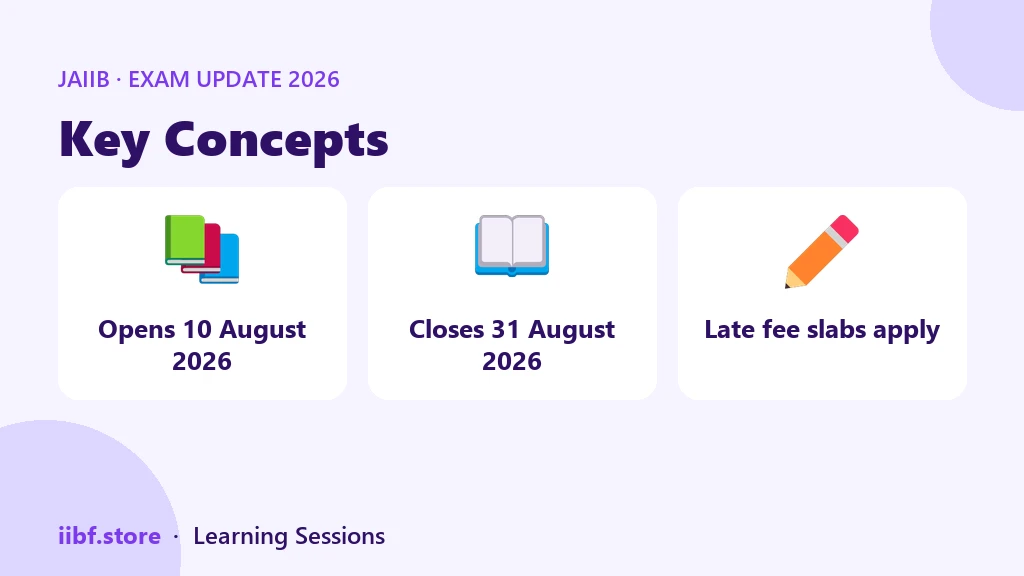
The notice, headed Change in Registration Schedule for JAIIB/DB&F November 2026 Examination, states that registration was scheduled to commence from 01-08-2026, but that due to ongoing system migration it is now rescheduled to 10-08-2026. It confirms that registration will remain open for three weeks, up to 31 August 2026.
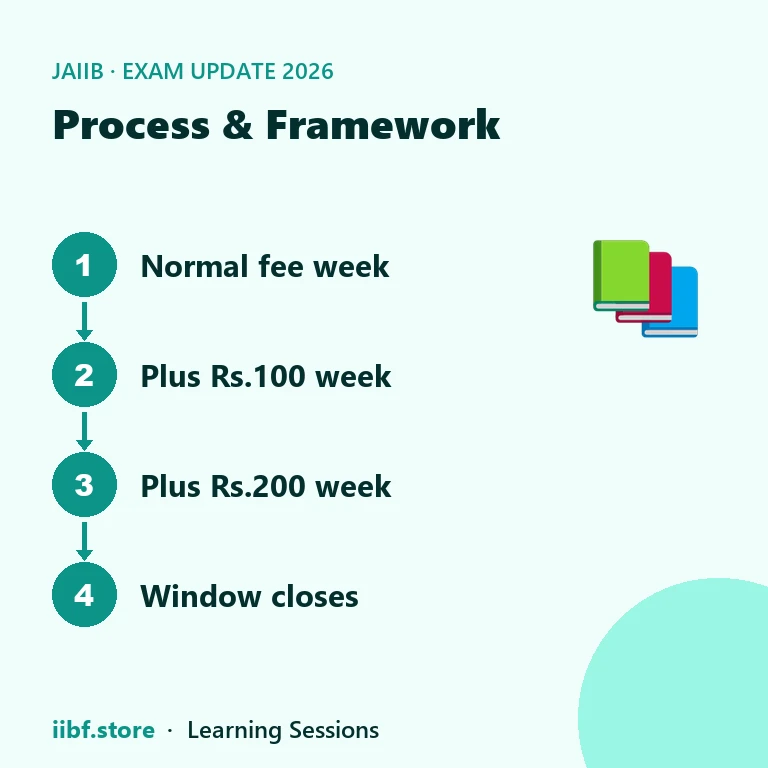
Every slab shifted by exactly nine days. The structure of the window — one week at normal fees, then two successively costlier weeks — is unchanged.
| JAIIB / DB&F Nov 2026 Examination | Original schedule | Revised schedule |
|---|---|---|
| Registration with normal fees | 01-08-2026 to 07-08-2026 | 10-08-2026 to 16-08-2026 |
| Registration with normal fees plus ₹100 | 08-08-2026 to 14-08-2026 | 17-08-2026 to 23-08-2026 |
| Registration with normal fees plus ₹200 | 15-08-2026 to 21-08-2026 | 24-08-2026 to 31-08-2026 |
Read the middle column as a warning rather than a formality. Waiting until the final week of JAIIB November 2026 registration costs an extra ₹200 on top of the normal fee, and there is no reason to donate that money to a deadline.
The exam dates have not moved
This is the part candidates most often get wrong when a notice like this circulates on social media. The notice changes the registration schedule only. It says nothing about postponing the examination itself, and no separate notice shifting the exam has been issued alongside it.
The practical consequence is uncomfortable but simple: you have lost nine days of the registration window, not nine days of preparation time. The gap between the day you pay and the day you sit is now shorter, not longer. Anyone who was planning to start studying "after registering" has just had that plan quietly compressed.
What to do with the days before the window opens
Treat the delay as free preparation time rather than dead time. There is nothing to do on the portal until 10 August, so use the gap on the four papers themselves — Indian Economy & Indian Financial System, Principles & Practices of Banking, Accounting & Financial Management for Bankers, and Retail Banking & Wealth Management.
A sensible use of the window looks like this. Finish one full module of AFM numericals, because that is the paper where marks are won by calculation speed rather than reading. Take one diagnostic mock per paper to find out where you actually stand before the syllabus pressure builds. Keep your documents, photograph and signature files ready in the right format so that the day the portal opens you spend ten minutes on it, not an evening.
A short checklist before 10 August
Log in to your IIBF member profile once and confirm it opens, since the migration touched the portal. Check that your membership is active and your contact details are current, because the examination communications go to whatever is on record. Keep the fee ready on a card or account that will not fail at the payment gateway during a rush. Decide your papers and your exam centre preference in advance so that no choice is made in a hurry on a slow portal.
Then complete your JAIIB November 2026 registration in the first week. Portals under a fresh migration are busiest right after they open and right before they close, and the first slab is also the cheapest one.
While you wait, start on the syllabus properly — the paper-wise material sits on the JAIIB course page, timed practice on our JAIIB mock tests, and a day-by-day schedule on the study planner. Current policy numbers for the economy and banking papers are on the RBI rates page, and more exam updates are collected on our blog. Always confirm dates against the official notice on iibf.org.in before you act on them.
A nine-day plan for the gap
Nine days is not much, but it is enough to change where you start the cycle from. The mistake most candidates make is to treat the wait as a pause and come back to the books on 10 August with nothing gained. Blocked properly, the same nine days are worth roughly twenty focused hours — about one full module.
Spend the first three days on a diagnostic pass. Attempt one timed mock in each of the four papers, mark every question you got right by guessing as though you got it wrong, and write down the three modules where you actually lose marks. Almost everyone discovers the same thing at this stage: the weakness is narrower than it felt, and it is usually concentrated in numericals rather than theory.
Give the next four days to those weak modules alone, one module a day, theory first and then twenty sums. Working capital, ratio analysis and depreciation between them account for a large share of the calculation-heavy questions in AFM, and they reward repetition more than any amount of re-reading. Keep a single sheet of formulas as you go; that sheet becomes your revision material in the last week before the exam.
Use the final two days for admin and consolidation. Log in to the IIBF portal, confirm your profile opens cleanly after the migration, keep your photograph and signature files in the prescribed format, and revise the formula sheet you built. Then complete the JAIIB November 2026 registration formality on the first day of the window and go straight back to the syllabus, without letting the payment become an event that costs you an evening.
One last habit worth adopting from this cycle onwards: check the official notices page yourself rather than relying on forwarded screenshots. Notices like this one are published as a dated PDF on the institute's site, and reading the original takes less time than arguing about a rumour in a study group.
Why was JAIIB November 2026 registration postponed?
IIBF's notice attributes it to ongoing system migration, which left the transaction server on the portal unavailable. It is an administrative delay, not a change in eligibility, syllabus or exam pattern.
Have the examination dates changed as well?
No. The notice revises the registration schedule only and does not postpone the examination. Verify the exam schedule on the IIBF website before making travel or leave plans.
What is the last date to register, and what does it cost?
The window closes on 31 August 2026. Registering between 10 and 16 August attracts normal fees, between 17 and 23 August adds ₹100, and between 24 and 31 August adds ₹200 to the normal fee.
Does the delay affect DB&F candidates too?
Yes. The notice covers the JAIIB / DB&F November 2026 Examination together, so the same revised registration dates and fee slabs apply to both.
Quick quiz on this topic
5 exam-style questions from our free test bank — check yourself before you move on.
Practice this topic
Take a free mock test, download chapter PDFs, or watch a video class — all included on iibf.store.
Keep reading