JAIIB CAIIB Exam Dates 2026: Plan Your Subject Order Around Them
If you were refreshing the IIBF portal on 1 August and found nothing, you were not imagining it. Registration for the November attempt has been moved twice now, and that has left a lot of candidates unsure whether anything else has shifted. The good news is that the JAIIB CAIIB exam dates themselves have not moved at all. They were published in the FY 2026-27 examination schedule and they still stand. What has changed is only the registration window, and that is worth separating clearly in your head, because your study plan should be built on the exam dates, not on the form-filling dates.
JAIIB CAIIB 2026 — exam dates, rules and a last-chance study plan · Watch on YouTube
The exam dates you should be planning around
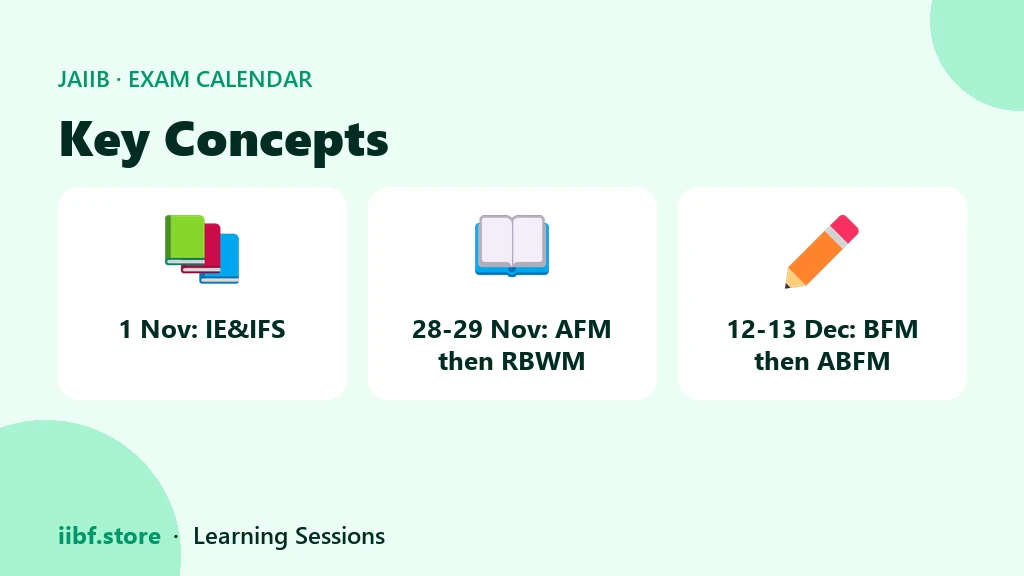
These come straight from the Institute's published examination schedule for May 2026 to January 2027. Note the second row carefully, because this is the one people get wrong: Principles & Practices of Banking is on 22 November, not 2 November. A three-week gap after the first paper is very different from a one-day gap, and it changes everything about how you sequence your preparation.
| Date | Exam | Subject | Gap from previous paper |
|---|---|---|---|
| 01 Nov 2026 | JAIIB | Indian Economy & Indian Financial System | — |
| 22 Nov 2026 | JAIIB | Principles & Practices of Banking | 21 days |
| 28 Nov 2026 | JAIIB | Accounting & Financial Management for Bankers | 6 days |
| 29 Nov 2026 | JAIIB | Retail Banking & Wealth Management | 1 day |
| 06 Dec 2026 | CAIIB | Advanced Bank Management | — |
| 12 Dec 2026 | CAIIB | Bank Financial Management | 6 days |
| 13 Dec 2026 | CAIIB | Advanced Business & Financial Management | 1 day |
| 20 Dec 2026 | CAIIB | Banking Regulations and Business Laws | 7 days |
| 27 Dec 2026 | CAIIB | Elective paper | 7 days |
Two pairs jump out. RBWM sits one day after AFM, and ABFM sits one day after BFM. Those two pairs are the whole planning problem in a nutshell, and we will come back to them.
Where registration actually stands right now
As of 10 August 2026, JAIIB registration has not opened. The sequence so far: the original window was 1–7 August for normal fees. IIBF then issued a notice moving it to 10–16 August because of a system migration, with 17–23 August at normal fees plus ₹100 and 24–31 August at normal fees plus ₹200. A later notice then postponed that 10 August start as well, for JAIIB/DB&F along with the DRA and BCBF exams, and said a fresh schedule would be announced on the Institute's website.
So the practical position is: watch iibf.org.in for the new dates, and do not treat any date circulating on social media as final until the Institute publishes it. CAIIB registration has not been disturbed and is currently scheduled for 1–7 September at normal fees, 8–14 September with ₹100 extra, and 15–21 September with ₹200 extra. We are tracking the JAIIB position separately in our registration reschedule update.
Why the gaps decide your subject order
Most candidates pick a subject order by difficulty, or by whichever book they happen to have open. That is the wrong axis. The right axis is how much time you get between papers, because that is the only revision time you can count on once the exam season starts.
Work it backwards. After IE&IFS on 1 November you get three clear weeks before PPB. That is a real revision block. But after PPB on 22 November you get six days for AFM, and after AFM on 28 November you get a single day for RBWM. One day is not preparation time. It is barely enough to sleep and re-read your own summary sheet.
The conclusion is uncomfortable but simple: RBWM has to be exam-ready before 28 November. If your plan says "I will do Retail Banking at the end", your plan has no time in it. The same logic applies on the CAIIB side, where ABFM on 13 December sits one day after BFM on 12 December. Both of those papers must be finished before 12 December, not sequenced against each other.
A subject order that fits the calendar
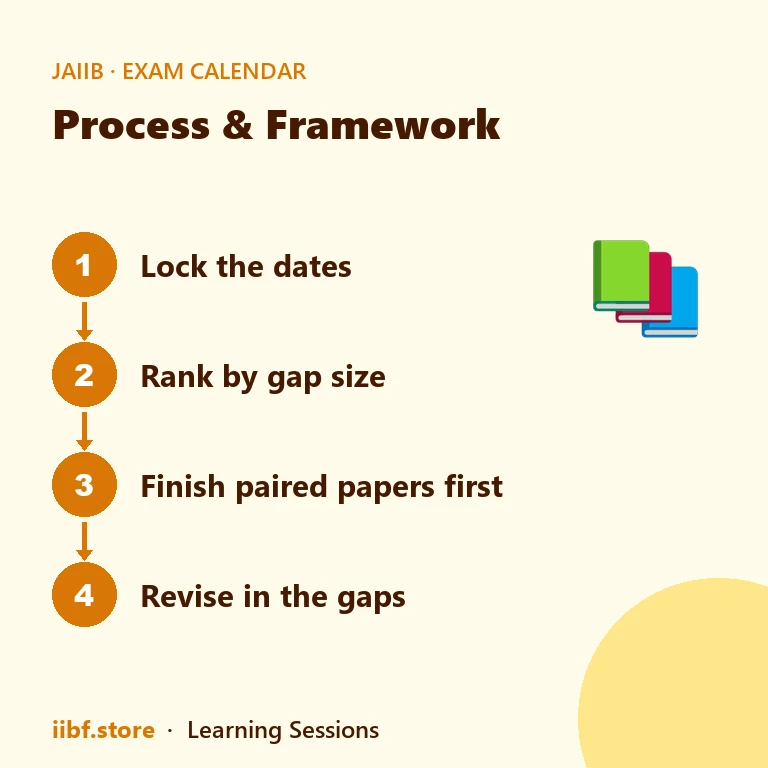
For JAIIB, front-load the two papers that have no recovery time behind them. A workable order is AFM first, then RBWM, then PPB, then IE&IFS. AFM is the heaviest calculation paper and it rewards early, repeated practice, so it earns the first slot. RBWM comes second precisely because it gets no gap of its own. PPB is broad but readable, and the three-week window after 1 November is exactly the kind of block PPB rewards. IE&IFS goes last in the build order but is the first paper you sit, so it gets a dedicated revision sprint in the final ten days before 1 November. The full paper-wise breakdown sits on our JAIIB course page.
For CAIIB, treat BFM and ABFM as a single block finished before 12 December. ABM gets the earliest attention because it is first on 6 December and because its statistics section needs practice rather than reading. BRBL on 20 December and the elective on 27 December each get a clear week of their own, so those are the two you can genuinely leave for the gaps. Our Advanced Bank Management course page maps the module split if you want to break ABM into weekly chunks, and the study planner will lay any of this out against real dates for you.
The rules that fail well-prepared candidates
Knowing the JAIIB CAIIB exam dates is only half of it. Three rules from the Institute's Rules & Syllabus 2026 catch people out every cycle.
An attempt counts when you apply, not when you appear. If you register and then skip the exam, that attempt is gone. You get five attempts or three years from your first registration, whichever comes first. Filling the form "just to keep the option open" is how candidates burn through their window.
The 45-mark rule is not a lower pass mark. The normal pass is 50 out of 100 in each subject. There is a second route: at least 45 in every subject and an aggregate of 50% across all subjects, cleared in a single attempt. Worked example: 46 + 47 + 52 + 55 = 200 out of 400, which is exactly 50%, with nothing below 45, so it passes. But 44 + 60 + 60 + 60 = 224, a much better aggregate, and it fails, because one subject dropped below 45. The floor is absolute.
No negative marking means no blanks. Roughly 100 objective questions, 100 marks, two hours, online only, and wrong answers cost nothing. Leaving a question unanswered is the only guaranteed way to score zero on it. CAIIB additionally uses case studies and some numerical questions where you type the answer rather than pick an option, which is why calculation practice matters more than re-reading theory. Working through a full-length paper on the mock test section is the cheapest way to find out whether your speed matches the two-hour limit. Fees, for reference, are ₹4,000 for a first JAIIB attempt and ₹5,000 for a first CAIIB attempt, with ₹1,300 for each subsequent attempt, plus convenience charges and taxes; the full breakdown sits in our attempts and fees guide.
Build the plan around the calendar, register in the first week once it opens, and keep the two one-day pairs in mind. Candidates who lose this cycle rarely lose it on syllabus. They lose it by discovering the JAIIB CAIIB exam dates too late to reorder anything.
Have the JAIIB CAIIB exam dates changed along with the registration delay?
No. Only the registration window has been affected. The paper dates published in the FY 2026-27 examination schedule — 1, 22, 28 and 29 November for JAIIB and 6, 12, 13, 20 and 27 December for CAIIB — are unchanged.
Is PPB on 2 November or 22 November 2026?
22 November 2026. The Institute's published schedule lists Principles & Practices of Banking on 22 November, three weeks after IE&IFS on 1 November. Plan for the longer gap.
What happens if I register but do not sit the exam?
The attempt is still counted. IIBF counts attempts from the point of application, regardless of whether you appear, and you have five attempts or three years from first registration, whichever expires first.
Which subject should I start with if I am beginning from zero?
AFM for JAIIB and ABM for CAIIB. Both are calculation-heavy, both reward spaced practice rather than last-week reading, and both sit close to a paper that gets no gap of its own.
Quick quiz on this topic
5 exam-style questions from our free test bank — check yourself before you move on.
Practice this topic
Take a free mock test, download chapter PDFs, or watch a video class — all included on iibf.store.
Keep reading