JAIIB PPB Latest Updates 2026: NPA, KFS, DLG, Penal Charges
The single biggest reason candidates lose marks in Paper 2 is not difficulty. It is staleness. They study a rule the way it existed three years ago and answer confidently on a version RBI has already replaced. The JAIIB PPB latest updates that matter for the 2026 attempt cluster around four areas: penal charges, the Key Facts Statement, Default Loss Guarantee in digital lending, and the NPA norms that never stop appearing. Ashish sir walked through all four with MCQs in the session below.
PPB Latest Updates 2026 · RBI New Rules MCQs · Watch on YouTube
Below, each rule is set out with the circular that created it, the date it took effect, and the specific number an examiner can build a question around. Dates and numbers are what separate a guessed answer from a certain one.
Penal charges: the rule that killed penal interest
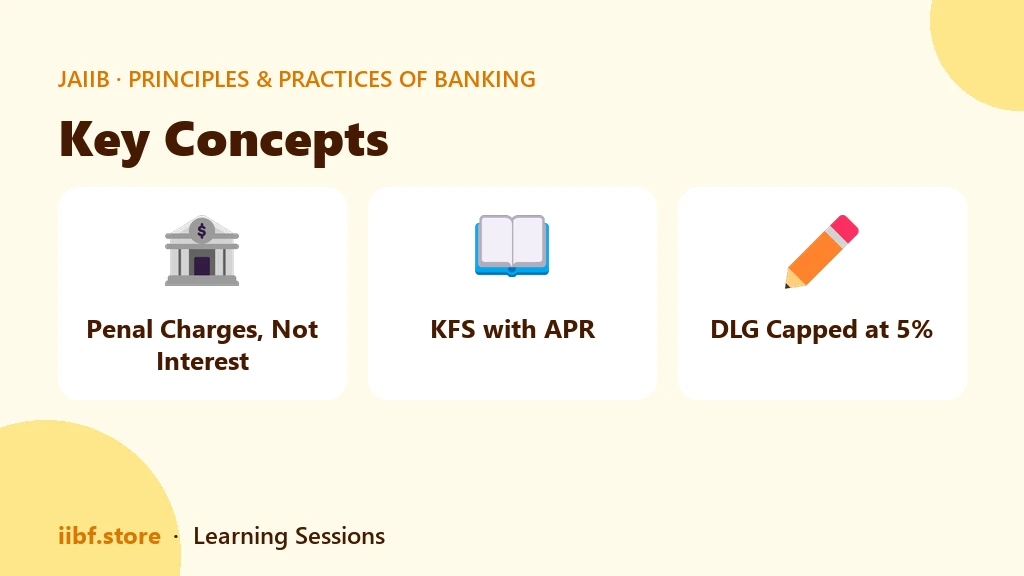
RBI issued Fair Lending Practice - Penal Charges in Loan Accounts on 18 August 2023. The core idea is a change of category, not a change of amount. A penalty for breaching a loan covenant must be levied as a penal charge, a flat amount, and must not be levied as penal interest added to the rate of interest on the advance.
The consequences follow from that one distinction:
- There is no capitalisation of penal charges. No further interest is computed on them.
- Penal charges must be reasonable and proportionate to the actual non-compliance, and the quantum and reason must be disclosed in the loan agreement, in the Key Facts Statement, and on the lender's website under interest rates and service charges.
- For loans to individual borrowers taken for purposes other than business, penal charges must not exceed the penal charges applied to non-individual borrowers for a comparable default.
On timing, the instructions were originally to apply from 1 January 2024 and were then deferred by three months. The operative dates are: fresh loans availed on or after 1 April 2024, and for existing loans, the switch at the next review or renewal date falling on or after 1 April 2024 but not later than 30 June 2024. Examiners like that pair of dates precisely because most candidates remember only the January figure.
Key Facts Statement: one page that binds the bank
RBI harmonised the Key Facts Statement rules through a circular dated 15 April 2024, superseding the earlier scattered requirements for retail lending and digital lending. The KFS applies to all retail and MSME term loans extended by regulated entities, and became mandatory for loans sanctioned on or after 1 October 2024.
Three testable features:
- The KFS carries a unique proposal number and must remain valid for at least three working days for loans with a tenor of seven days or more, and one working day where the tenor is under seven days.
- It must disclose the Annual Percentage Rate (APR), the all-in annual cost of credit including interest and every other charge, plus an amortisation schedule.
- Any fee not disclosed in the KFS cannot be charged at any stage of the loan without the borrower's explicit consent.
Notice how the KFS and the penal charges circular interlock. Penal charges must be disclosed in the KFS, and undisclosed charges cannot be levied. A question that looks like it is about one is often testing the other.
Default Loss Guarantee in digital lending
DLG is the arrangement where a lending service provider or another entity absorbs a slice of the losses on a digital loan portfolio originated through it. RBI first framed guidelines on 8 June 2023 and the concept now sits inside the consolidated digital lending framework.
| Feature | The rule |
|---|---|
| Cap | DLG cover cannot exceed 5 per cent of the amount of that loan portfolio |
| Permitted form | Cash deposit with the RE, fixed deposit with lien marked in favour of the RE, or a bank guarantee |
| Tenor | Not less than the longest tenor of any loan in the portfolio |
| Invocation | Within a maximum overdue period of 120 days, unless repaid earlier |
| Excluded | Credit cards and revolving credit facilities |
| Asset classification | Unaffected by DLG - the RE still classifies as per IRAC norms |
That last row is the trap. Candidates assume a guaranteed loan escapes NPA classification. It does not. DLG changes who bears the loss, not how the account is classified.
NPA norms: the numbers that never change and the one clarification that did
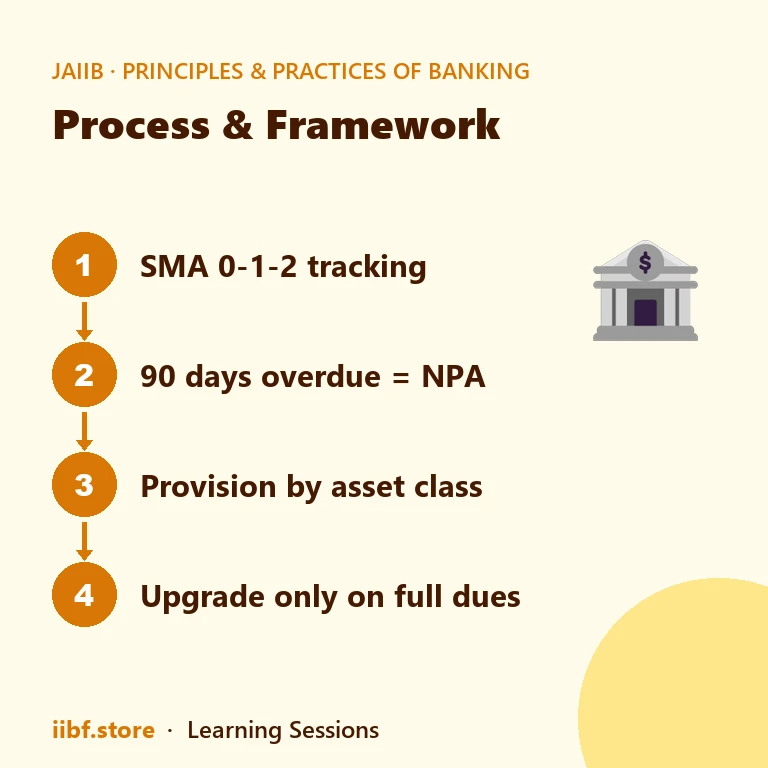
The IRAC core is stable. A term loan becomes non-performing when interest or instalment remains overdue for more than 90 days. A cash credit or overdraft account is NPA when it stays out of order for more than 90 days. For agricultural advances the yardstick is crop seasons: two crop seasons for short duration crops and one crop season for long duration crops.
Before an account turns NPA it passes through Special Mention Account stages: SMA-0 for 1 to 30 days overdue, SMA-1 for 31 to 60 days, and SMA-2 for 61 to 90 days. For cash credit and overdraft accounts, only SMA-1 and SMA-2 apply.
The clarification worth knowing is the one from 12 November 2021. Two points from it recur in exams: classification as SMA and as NPA is a day-end process, so the flag is raised at the close of the calendar day on which the account crosses the threshold; and an account classified as NPA may be upgraded to standard only when the entire arrears of interest and principal are paid, not merely the overdue instalments. RBI's notifications are published at rbi.org.in if you want the originals.
How to convert these JAIIB PPB latest updates into marks
Every one of these rules has a date, a number and a category. Build a single revision sheet with exactly those three columns and nothing else. Most PPB questions on updates are testing one of the three, and prose notes hide them.
Then test yourself rather than reread. Attempt a set of PPB mock tests that mix updates with core theory, because in the real paper an update question arrives without a label warning you. Full topic coverage sits inside the JAIIB course, and if you are running short on days, sequence the revision with a study planner so the update sheet gets revisited in the final week. Current rates and thresholds are tracked on the RBI rates page.
Frequently asked questions
Can a bank still charge penal interest on a defaulted loan?
No. Since the 2023 circular, penalties for non-compliance must be levied as penal charges, a separate amount, and not as penal interest added to the loan's rate of interest. Penal charges are also not capitalised, so no further interest accrues on them.
Which loans require a Key Facts Statement?
All retail and MSME term loans extended by regulated entities, for loans sanctioned on or after 1 October 2024. The KFS must show the APR and an amortisation schedule, carry a unique proposal number, and stay valid for at least three working days where the tenor is seven days or more.
What is the maximum DLG cover permitted?
Five per cent of the amount of that loan portfolio. It must be held as a cash deposit, a lien-marked fixed deposit or a bank guarantee, has to run at least as long as the longest loan in the portfolio, and cannot be used for credit cards or revolving credit.
How many of these updates actually appear in the paper?
Update-based questions are a small but reliable slice of PPB, and they are the easiest marks in the paper because the answer is a fixed date or number rather than a judgement. Treat the JAIIB PPB latest updates sheet as compulsory revision, not optional reading. More free material is on the Learning Sessions blog.
Prefer revising from a printed book?
Chapter-wise books with MCQs after every chapter — minimal pages, complete coverage, delivered anywhere in India. Every book has a free sample to read first.
221 pages · 831 MCQs
Learning Sessions · Ashish Sir
131 pages · 672 MCQs
Learning Sessions · Ashish Sir
128 pages · 524 MCQs
Learning Sessions · Ashish Sir
107 pages · 445 MCQs
Learning Sessions · Ashish Sir
148 pages · 478 MCQs
Learning Sessions · Ashish Sir
151 pages · 465 MCQs
Learning Sessions · Ashish Sir
148 pages · 375 MCQs
Learning Sessions · Ashish Sir
216 pages · 895 MCQs
Learning Sessions · Ashish Sir
109 pages · 300 MCQs
Learning Sessions · Ashish Sir
104 pages · 360 MCQs
Learning Sessions · Ashish Sir
82 pages · 297 MCQs
Learning Sessions · Ashish Sir
151 pages · 600 MCQs
Learning Sessions · Ashish Sir
98 pages · 282 MCQs
Learning Sessions · Ashish Sir
132 pages · 225 MCQs
Learning Sessions · Ashish Sir
188 pages · 435 MCQs
Learning Sessions · Ashish Sir
117 pages · 236 MCQs
Learning Sessions · Ashish Sir
Learning Sessions · Ashish Sir
118 pages · 299 MCQs
Learning Sessions · Ashish Sir
Learning Sessions · Ashish Sir
Learning Sessions · Ashish Sir
Learning Sessions · Ashish Sir
115 pages · 255 MCQs
Learning Sessions · Ashish Sir
Learning Sessions · Ashish Sir
334 pages · 936 MCQs
Learning Sessions · Ashish Sir
Learning Sessions · Ashish Sir
115 pages · 344 MCQs
Learning Sessions · Ashish Sir
107 pages · 240 MCQs
Learning Sessions · Ashish Sir
90 pages · 150 MCQs
Learning Sessions · Ashish Sir
Learning Sessions · Ashish Sir
Quick quiz on this topic
5 exam-style questions from our free test bank — check yourself before you move on.
Practice this topic
Take a free mock test, download chapter PDFs, or watch a video class — all included on iibf.store.
Keep reading