MCLR Formula Change: RBI Draft Directions 2026 Explained
If you learned MCLR from a book printed even two years ago, a large piece of it is about to be out of date. On 12 August 2026 the Reserve Bank released for public comment the Draft Reserve Bank of India (Interest Rates on Loans and Advances) Directions, 2026, and the MCLR formula change inside it is the part that will touch every floating-rate borrower in the country. Ashish sir broke down the practical effect in the video below.
MCLR Formula badal raha hai - New RBI Draft ka asar · Watch on YouTube
One caution before anything else, because it decides how you should answer an exam question on this. This is a draft. RBI invited comments up to 11 September 2026 and has said final directions will be issued separately for each category of regulated entity after the feedback is examined. Until then, the existing MCLR and external benchmark framework remains the law. Write it as a proposal, not as a rule in force.
Why RBI opened this up at all
The announcement came out of the Statement on Developmental and Regulatory Policies dated 5 August 2026. RBI's stated concern is divergence: banks compute MCLR and its components differently, which weakens monetary policy transmission and makes two loans that look identical price differently for reasons the borrower cannot see.
The draft therefore aims at a single principles-based framework covering all regulated entities - commercial banks, NBFCs, all-India financial institutions, regional rural banks and cooperative banks - for both fixed-rate and floating-rate loans, calibrated to the size and complexity of each category.
The MCLR formula change itself
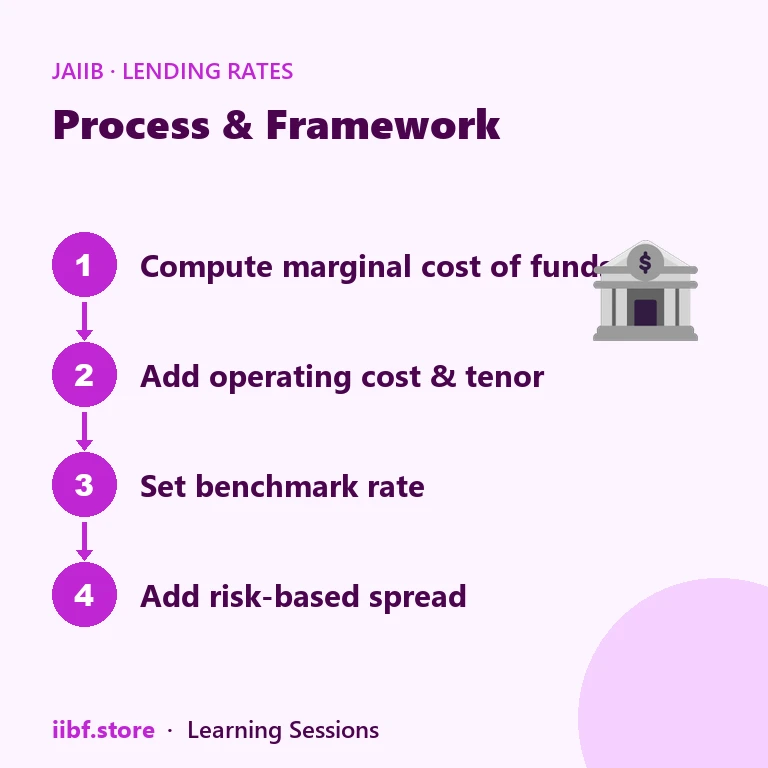
Today the marginal cost of funds is computed from the marginal cost of borrowings and the return on net worth, using rates prevailing at the point of computation. The draft proposes replacing that point-in-time reading with an average.
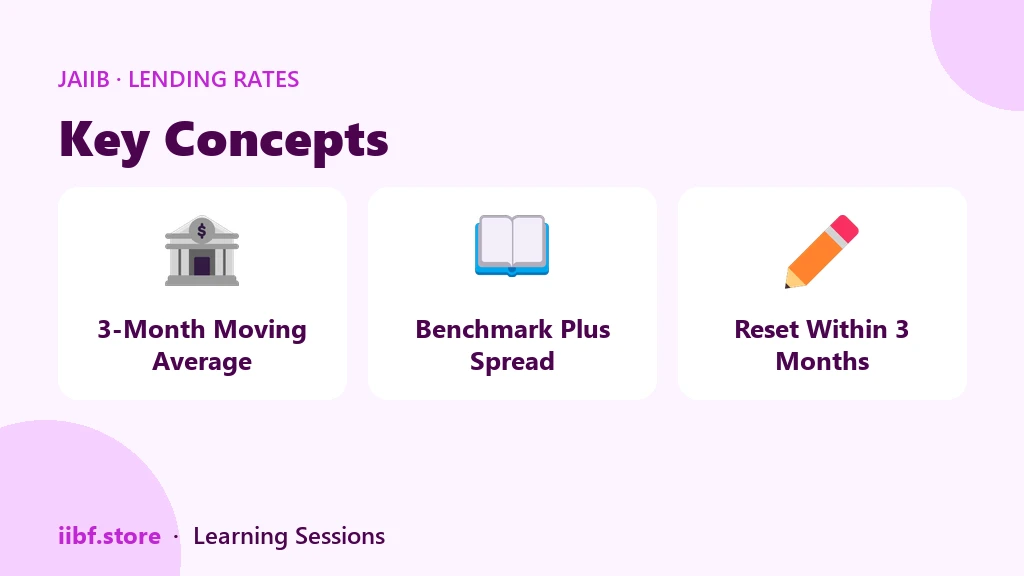
Under the proposal, the marginal cost of funds would be a three-month moving average of the marginal cost of domestic deposits and borrowings. For each month in the trailing three-month window, the bank computes an annualised weighted average interest cost based on the volume of fresh deposits and fresh borrowings raised in that month, and then averages the three.
| Element | Present practice | What the 2026 draft proposes |
|---|---|---|
| Marginal cost of funds | Point-in-time marginal cost | Three-month moving average of fresh domestic deposits and borrowings |
| Rate structure | Benchmark plus spread, defined separately for internal and external benchmarks | One harmonised structure: internal or external benchmark plus a risk-based spread |
| Spread revision | Varies by lender policy | Credit risk premium revised only on a change in the borrower's credit profile |
| Reset frequency | Up to twelve months for MCLR-linked loans | Maximum three months for floating-rate loans, proposed from 1 April 2027 |
| Coverage | Different rules for banks and NBFCs | All regulated entities under one framework |
What a moving average actually does to your EMI
Averaging cuts both ways, and this is the point most commentary gets wrong. When deposit rates fall sharply, a three-month average lags the fall, so lending rates come down more slowly than they would under a point-in-time computation. When deposit rates rise sharply, the same lag protects the borrower, and lending rates climb more slowly.
The net effect is a smoother rate path with fewer abrupt moves in either direction, which is exactly what a bank's asset-liability desk wants. It also means the familiar complaint that lending rates rise fast and fall slowly becomes a question about the averaging window rather than about intent.
The spread, and when a lender can move it
The draft keeps the benchmark-plus-spread architecture but tightens the spread. It is built around a credit risk premium, with optional components for operating cost, term premium and business strategy premium. The disciplining rule is that the credit risk premium should be revised only where there is a change in the borrower's credit profile.
That sentence is the borrower protection in the whole document. A lender would not be able to widen the spread simply because its own margins are under pressure, which is the mechanism that has historically blunted rate cuts before they reached the customer.
The two dates to remember
The draft sets out a phased path. Floating-rate loans would reset within a maximum of three months with effect from 1 April 2027. Existing loans linked to internal or external benchmarks would be migrated into the new framework through a one-time mapping exercise by 1 April 2029.
A long runway like that tells you something about scale. Repricing every floating-rate loan in the banking system is a systems project, not a circular that can take effect next quarter.
How to handle this in JAIIB PPB
Keep two columns in your notes. The left column is the framework in force today: base rate history, MCLR with its tenor premium and its reset of up to twelve months, and the external benchmark regime for retail and MSME floating-rate loans. The right column is the MCLR formula change proposed in August 2026, with the moving average, the three-month reset and the two effective dates.
If a question is silent on timing, answer from the left column, because that is the position in force. If it names the 2026 draft, answer from the right. Candidates lose marks by mixing them. The wider lending-rate chapter, including how MCLR compares with EBLR, is covered in the JAIIB course, and the same material reappears in the credit modules of CAIIB. Practise it under time pressure with mock tests, and keep the current policy rates handy on the RBI rates page. The draft itself is on rbi.org.in.
Frequently asked questions
Has the MCLR formula change already taken effect?
No. It is a draft issued on 12 August 2026 with comments invited up to 11 September 2026. Final directions will be issued separately for each category of regulated entity after RBI reviews the feedback. Until then the existing MCLR and external benchmark rules apply.
Will my EMI fall because of this?
Not directly. The proposal changes how the benchmark is computed and how often it resets, not the level of interest rates. A three-month moving average smooths movement in both directions, so cuts pass through more gradually and so do increases.
Would the external benchmark still be mandatory?
The draft proposes a single structure of an internal or external benchmark plus a risk-based spread, with the framework calibrated by category of regulated entity. Because the final directions will be issued separately for each category, treat the precise obligation for banks and NBFCs as unsettled until they are published.
What should I write if this is asked in the exam?
State that it is a draft dated 12 August 2026, describe the proposed three-month moving average of fresh domestic deposits and borrowings, and give the two dates: a maximum three-month reset from 1 April 2027 and migration of existing loans by 1 April 2029. Then note that the present framework continues until final directions are issued. More updates are posted on the Learning Sessions blog.
Prefer revising from a printed book?
Chapter-wise books with MCQs after every chapter — minimal pages, complete coverage, delivered anywhere in India. Every book has a free sample to read first.
221 pages · 831 MCQs
Learning Sessions · Ashish Sir
131 pages · 672 MCQs
Learning Sessions · Ashish Sir
128 pages · 524 MCQs
Learning Sessions · Ashish Sir
107 pages · 445 MCQs
Learning Sessions · Ashish Sir
148 pages · 478 MCQs
Learning Sessions · Ashish Sir
151 pages · 465 MCQs
Learning Sessions · Ashish Sir
148 pages · 375 MCQs
Learning Sessions · Ashish Sir
216 pages · 895 MCQs
Learning Sessions · Ashish Sir
109 pages · 300 MCQs
Learning Sessions · Ashish Sir
104 pages · 360 MCQs
Learning Sessions · Ashish Sir
82 pages · 297 MCQs
Learning Sessions · Ashish Sir
151 pages · 600 MCQs
Learning Sessions · Ashish Sir
98 pages · 282 MCQs
Learning Sessions · Ashish Sir
132 pages · 225 MCQs
Learning Sessions · Ashish Sir
188 pages · 435 MCQs
Learning Sessions · Ashish Sir
117 pages · 236 MCQs
Learning Sessions · Ashish Sir
Learning Sessions · Ashish Sir
118 pages · 299 MCQs
Learning Sessions · Ashish Sir
Learning Sessions · Ashish Sir
Learning Sessions · Ashish Sir
Learning Sessions · Ashish Sir
115 pages · 255 MCQs
Learning Sessions · Ashish Sir
Learning Sessions · Ashish Sir
334 pages · 936 MCQs
Learning Sessions · Ashish Sir
Learning Sessions · Ashish Sir
115 pages · 344 MCQs
Learning Sessions · Ashish Sir
107 pages · 240 MCQs
Learning Sessions · Ashish Sir
90 pages · 150 MCQs
Learning Sessions · Ashish Sir
Learning Sessions · Ashish Sir
Quick quiz on this topic
5 exam-style questions from our free test bank — check yourself before you move on.
Practice this topic
Take a free mock test, download chapter PDFs, or watch a video class — all included on iibf.store.
Keep reading