Joint Liability Group Lending in Small Finance Banks (2026)
🤝 Joint liability group lending is the backbone of how Small Finance Banks (SFBs) reach borrowers who have no collateral to offer but a strong track record of repaying informal loans on time. If you are preparing for the SFB certification exam, this model deserves close attention because it sits at the intersection of priority sector lending, credit risk management and financial inclusion — three themes examiners return to again and again.
🤝 What Is Joint Liability Group Lending
A Joint Liability Group (JLG) is an informal association of 4 to 10 individuals — typically small farmers, tenant cultivators, landless labourers, artisans or micro-entrepreneurs — who come together to avail bank credit on a group guarantee basis, without conventional collateral security. The defining feature of joint liability group lending is exactly what its name suggests: every member of the group is jointly and severally liable for the repayment of loans taken by any other member. This peer-guarantee structure replaces the physical collateral a bank would otherwise demand, and it is why Small Finance Banks lean on JLGs so heavily to serve the unbanked and underbanked segments described in the principles of lending chapter of the SFB syllabus. Two broad models exist: the NABARD-promoted model, where the bank itself forms, trains and finances the group directly, and the intermediary model, where a Business Correspondent, NGO or Micro Finance Institution facilitates group formation before the bank extends credit. This JLG model is distinct from Self-Help Group (SHG) lending, where members first build a savings corpus before borrowing — JLGs are purely credit-oriented from day one, with no mandatory savings component.
💡 Exam Tip: If a question asks what replaces collateral in JLG lending, the answer is always "mutual/peer guarantee," not a third-party guarantor or margin money.
📋 JLG Formation Rules and Eligibility
Under the standard framework followed by SFBs, a JLG must have a minimum of 4 and a maximum of 10 members. Members should be of similar economic and social status, ideally residing in the same village or locality, so peer monitoring is realistic. A person can be a member of only one JLG at any given time, and close relatives (spouse, parents, children) are generally not permitted to be in the same group, since this dilutes the independence of peer pressure that makes the JLG model work as a risk-mitigation tool. Groups elect a leader who coordinates meetings and loan applications, but the leader has no extra financial liability — the joint and several liability clause applies equally to every member.
Before the first loan disbursement, the bank or facilitating agency conducts a Group Recognition Test and basic financial literacy sessions covering loan utilisation, repayment discipline and the consequences of default. Documentation is deliberately light — usually an inter-se agreement signed by all members, KYC documents, and a simple loan application — which keeps the onboarding cost low enough for banks to profitably serve very small ticket sizes. This lean process is also why priority sector classification under the priority sector advances chapter treats JLG-linked agriculture and micro-enterprise loans favourably.
💰 Loan Limits, Pricing and Repayment in JLG Lending
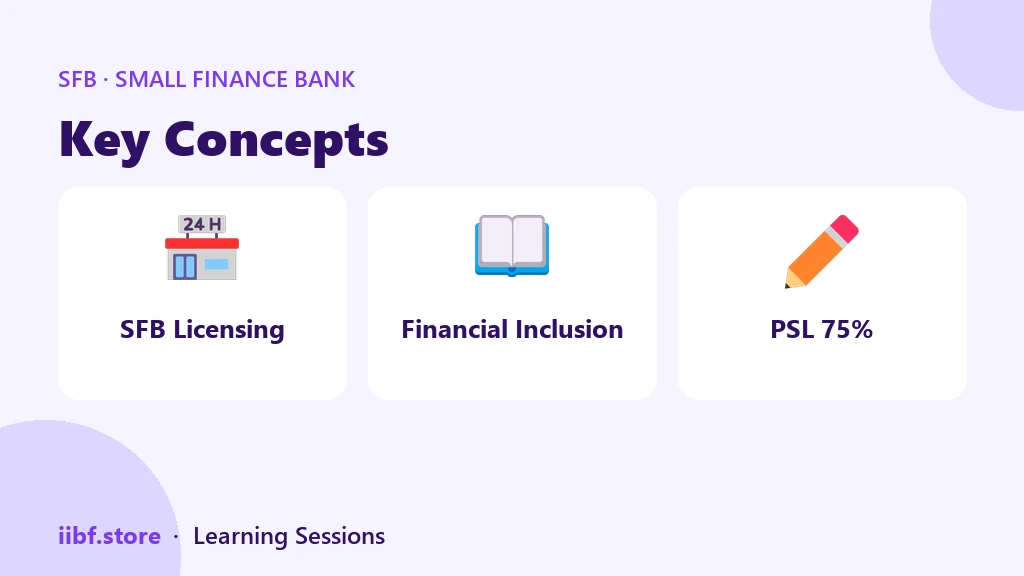
Loan sizes under this JLG lending model are modest by design — typically ranging from a few thousand rupees for a first-time borrower up to a few lakh rupees per member across renewal cycles, depending on the SFB's internal policy and the borrower's repayment history. Interest rates are usually higher than secured retail loans because of the elevated credit risk and higher servicing cost per rupee lent, but SFBs price JLG loans competitively against local moneylenders and informal credit sources — often the real benchmark this product is competing against. Repayment is structured in frequent instalments — weekly, fortnightly or monthly — collected at group meetings, which keeps instalment sizes small and cash-flow-friendly for borrowers with irregular daily or seasonal income.
A first loan cycle is usually small and short-tenure; on satisfactory repayment, the borrower graduates to a larger loan in the next cycle. This graduated-limit approach lets the bank build a credit history for borrowers who previously had none, while containing downside risk. Group meetings also double as a low-cost recovery mechanism, since members reinforce repayment discipline among themselves rather than the bank relying solely on field staff visits.
⚠️ Common Mistake: Candidates often confuse JLG loans with individual collateral-free personal loans. JLG loans are group-guaranteed and group-monitored — an individual loan carries no peer liability at all.
⚠️ Risks and NPA Management in JLG Lending
Despite the peer-guarantee structure, this lending model is not risk-free. Covariate risk is a key concern — because members typically live in the same area and often depend on similar livelihoods (say, the same crop or trade), a local shock such as a drought, flood or market crash can push the entire group into default simultaneously, defeating the purpose of diversification that individual peer pressure normally provides. Free-rider risk is another concern: if monitoring within the group weakens, some members may under-contribute to joint liability while relying on others to cover shortfalls.
SFBs manage this through a mix of measures: capping the loan size per group, staggering disbursement and maturity across members, diversifying group composition across livelihood types where feasible, and closely tracking early-warning indicators like meeting attendance and instalment delays. Portfolio-at-risk beyond 30 or 60 days is monitored group-wise as well as branch-wise, and asset classification and provisioning for JLG loans follow the same RBI income recognition and asset classification norms applicable to all other advances, once a loan turns overdue. Field officer visits, though secondary to peer monitoring, remain essential for early detection of stress before it snowballs into an NPA.
📊 JLG vs SHG vs Individual Micro-Loans
The table below summarises how JLG lending compares with the two other common credit-delivery models used to reach the underbanked segment.
| Feature | JLG Lending | SHG Lending | Individual Micro-Loan |
|---|---|---|---|
| Collateral required | ❌ None (peer guarantee) | ❌ None (group savings-linked) | ✅ Often required |
| Prior savings mandatory | ❌ Not mandatory | ✅ Mandatory before borrowing | ❌ Not applicable |
| Group size | 4–10 members | 10–20 members | Not applicable |
| Joint and several liability | ✅ Yes | ✅ Yes, at group-fund level | ❌ No, sole liability |
| Onboarding speed | ✅ Fast | ❌ Slower (savings build-up phase) | ✅ Fast (if eligible) |
| Typical borrower | Micro-entrepreneur, small farmer | Rural women's collective | Salaried/credit-scored customer |
This comparison is a favourite in featured-snippet style exam questions, so it is worth memorising column by column rather than row by row.
📌 Remember: JLGs need no savings history; SHGs are built around a savings-first culture. That single distinction resolves most exam confusion.
🌱 JLG Lending Within the SFB Business Model
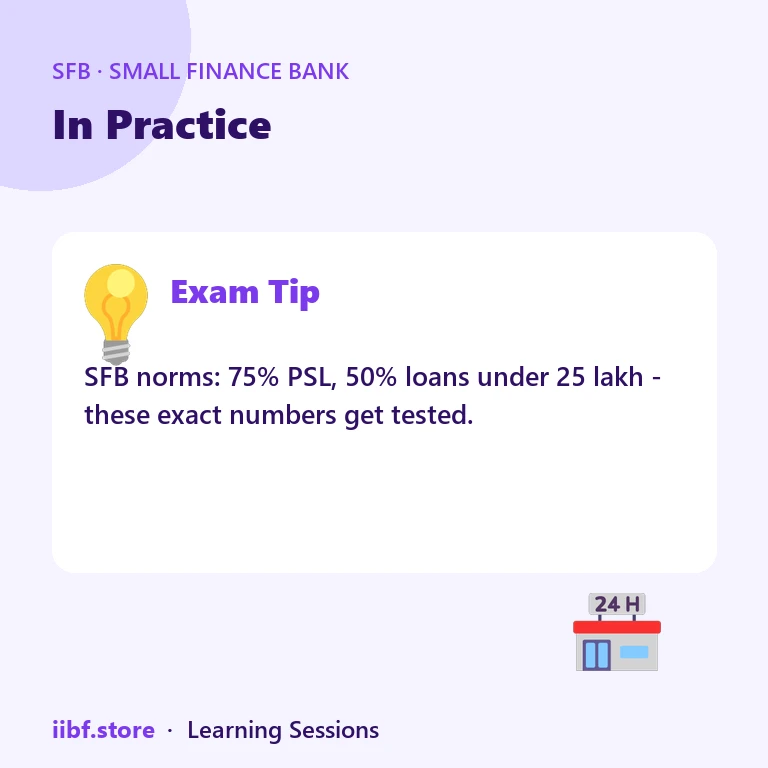
Small Finance Banks were licensed specifically to deepen credit access for small business units, marginal farmers, micro and small industries, and other unorganised-sector entities — and joint liability group lending is one of their primary tools for meeting that mandate at scale. Many SFBs originated as microfinance institutions before converting to banks, so JLG-based lending is often deeply embedded in their legacy operations and staff expertise, even as they diversify into other retail products. This diversification matters for balance-sheet stability, which readers can explore further in our piece on capital adequacy ratio for small finance banks, and in the broader discussion of how SFBs evolve their liability mix in our article on CASA building strategy.
As some SFBs mature and consider scaling up their operations, the question of graduating into a different licence category also comes up — a topic covered in our guide to SFB to universal bank transition. Candidates should also cross-check how JLG lending compares with the broader microfinance ecosystem it grew out of, which we detail separately in our article on microfinance institution lending norms. For a full topic map of this subject, browse every article under the Small Finance Bank tag hub.
🧠 Practice MCQs: Joint Liability Group Lending
Q1. What is the minimum and maximum number of members permitted in a standard Joint Liability Group? (a) 2 and 5 (b) 4 and 10 (c) 10 and 20 (d) 5 and 15
Answer: (b) — A JLG typically has between 4 and 10 members, distinct from the larger 10–20 member size of a Self-Help Group.
Q2. In JLG lending, what replaces conventional collateral security? (a) A third-party guarantor (b) Fixed deposit margin money (c) Mutual/peer guarantee among members (d) A mortgage on group assets
Answer: (c) — The group's joint and several liability substitutes for physical collateral, which is the core design principle of JLG lending.
Q3. Which risk is most distinctive to JLG lending because members share similar livelihoods and geography? (a) Interest rate risk (b) Covariate risk (c) Foreign exchange risk (d) Operational risk
Answer: (b) — Covariate risk arises because a single local shock (drought, flood, market crash) can push most or all group members into default at once.
Q4. Which statement correctly distinguishes a JLG from a Self-Help Group (SHG)? (a) JLGs require prior group savings; SHGs do not (b) SHGs are credit-only from day one; JLGs are not (c) JLGs do not require prior savings; SHGs are built around a savings-first culture (d) There is no meaningful difference between JLG and SHG
Answer: (c) — SHGs mandate a savings build-up phase before lending begins; JLGs are purely credit-oriented and can be financed without a prior savings track record.
Q5. Under the graduated-limit approach used in JLG lending, what typically happens after a member repays the first loan cycle satisfactorily? (a) The group is dissolved (b) The member becomes ineligible for further credit (c) The member usually qualifies for a larger loan in the next cycle (d) The interest rate is doubled
Answer: (c) — Satisfactory repayment in the first cycle builds credit history and typically leads to a larger loan limit in subsequent cycles, a core feature of JLG credit delivery.
Want chapter-wise mock tests with 100+ MCQs? Start practising free →
❓ Frequently Asked Questions
What is the minimum group size for JLG lending?
A Joint Liability Group must have a minimum of 4 members and a maximum of 10 members, all of broadly similar economic and social standing.
Do JLG members need to maintain savings before borrowing?
No. Unlike Self-Help Groups, the JLG model does not require members to build a prior savings corpus — the group can access credit from its very first meeting cycle, subject to basic financial literacy training.
What happens if one member of a JLG defaults?
Because of joint and several liability, the remaining group members are collectively responsible for ensuring the overdue instalment is repaid, which is why peer selection and peer monitoring are central to how JLGs manage credit risk.
Why do Small Finance Banks rely heavily on JLG lending?
SFBs are mandated to deepen credit access for small businesses, marginal farmers and micro-entrepreneurs. The JLG lending model lets them serve this segment profitably without collateral, using low-cost group-based origination and monitoring instead of individual credit appraisal.
🎯 Conclusion: Master JLG Lending for Your SFB Exam
Joint liability group lending is a high-yield topic for the SFB certification exam precisely because it links credit delivery mechanics, risk management and the priority sector mandate into one compact model. Focus on the group-size rule, the absence of collateral and prior savings, the joint and several liability clause, and the covariate-risk concern — these four points cover the vast majority of exam questions on this topic. Put your understanding to the test with a full-length mock covering Small Finance Bank practice questions, or continue structured preparation through the CAIIB course track for allied risk and lending topics.
Prefer revising from a printed book?
Chapter-wise books with MCQs after every chapter — minimal pages, complete coverage, delivered anywhere in India. Every book has a free sample to read first.
Learning Sessions · Ashish Sir
132 pages · 225 MCQs
Learning Sessions · Ashish Sir
188 pages · 435 MCQs
Learning Sessions · Ashish Sir
117 pages · 236 MCQs
Learning Sessions · Ashish Sir
Learning Sessions · Ashish Sir
118 pages · 299 MCQs
Learning Sessions · Ashish Sir
Learning Sessions · Ashish Sir
Learning Sessions · Ashish Sir
115 pages · 255 MCQs
Learning Sessions · Ashish Sir
Learning Sessions · Ashish Sir
334 pages · 936 MCQs
Learning Sessions · Ashish Sir
Learning Sessions · Ashish Sir
115 pages · 344 MCQs
Learning Sessions · Ashish Sir
107 pages · 240 MCQs
Learning Sessions · Ashish Sir
90 pages · 150 MCQs
Learning Sessions · Ashish Sir
Learning Sessions · Ashish Sir
131 pages · 672 MCQs
Learning Sessions · Ashish Sir
221 pages · 831 MCQs
Learning Sessions · Ashish Sir
128 pages · 524 MCQs
Learning Sessions · Ashish Sir
107 pages · 445 MCQs
Learning Sessions · Ashish Sir
148 pages · 478 MCQs
Learning Sessions · Ashish Sir
151 pages · 465 MCQs
Learning Sessions · Ashish Sir
148 pages · 375 MCQs
Learning Sessions · Ashish Sir
216 pages · 895 MCQs
Learning Sessions · Ashish Sir
109 pages · 300 MCQs
Learning Sessions · Ashish Sir
104 pages · 360 MCQs
Learning Sessions · Ashish Sir
82 pages · 297 MCQs
Learning Sessions · Ashish Sir
151 pages · 600 MCQs
Learning Sessions · Ashish Sir
98 pages · 282 MCQs
Learning Sessions · Ashish Sir
Practice this topic
Take a free mock test, download chapter PDFs, or watch a video class — all included on iibf.store.
Keep reading