AML KYC Certification Exam by IIBF: Pattern, Marks and Prep
If you searched for the AML KYC certification exam hoping for a straight answer on eligibility, pattern and passing marks, this is that answer. The IIBF's Certificate Examination in Anti-Money Laundering & Know Your Customer is one of the Institute's most practical standalone certifications, and getting the structure right before you start studying saves weeks of wasted effort. Below is the current exam pattern, syllabus shape and a realistic prep plan.
📋 Eligibility and Purpose of the Certification
The AML KYC certification exam is open to both members and non-members of the Indian Institute of Banking & Finance. There is no banking-employment condition attached: any candidate who has passed the 12th standard examination (or its equivalent) is eligible to register. Candidates who have completed IIBF's Business Correspondent/Business Facilitator (BC/BF) examination also qualify, which makes this certification accessible to junior staff and BC agents who handle onboarding at the last mile.
IIBF designed the course to build depth in a function central to every bank's compliance risk — customer identification, ongoing due diligence and suspicious-activity reporting. Unlike JAIIB or CAIIB, this is a single-paper, subject-specific certificate rather than a multi-paper diploma, suited to fresh recruits and experienced officers alike.
💡 Exam Tip: Because there is no negative marking, attempt every one of the 120 questions — an educated guess is always better than a blank answer.
Banks frequently nominate branch and compliance staff for this exam because it maps directly to day-to-day KYC operations. If your role touches account opening, periodic KYC updation or transaction monitoring, the syllabus reads less like an exam and more like a job manual.
📝 Exam Pattern, Marks and Passing Criteria
The AML KYC certification exam is conducted entirely in online remote-proctored mode — there is no physical test centre requirement. The paper carries 120 objective-type multiple-choice questions for a total of 100 marks, to be completed within a duration of 2 hours. The medium of the examination is English only, so there is no regional-language option for this particular certificate.
The passing criterion is a minimum of 60 marks out of 100 in a single attempt — there is no separate sectional cut-off, so a candidate strong in one syllabus area can offset a weaker one elsewhere in the paper. Crucially, IIBF does not apply negative marking for wrong answers on this exam, which changes exam-day strategy considerably compared to papers that do penalise incorrect attempts.
⚠️ Common Mistake: Candidates often under-prepare the international-standards and legislation sections because they sound "theoretical" — but a meaningful share of the 120 questions draws directly from these chapters, not just from operational KYC procedure.
With roughly one minute per question on average, time pressure is moderate rather than severe, provided you are not stalling on lengthy case-based items. Reading each question fully before selecting an option matters more than raw speed here.
| Exam Parameter | Detail |
|---|---|
| Questions / Marks | 120 MCQs for 100 marks |
| Duration | 2 hours |
| Mode | Online, remote-proctored |
| Medium | English only |
| Passing marks | 60 out of 100 |
| Negative marking | ❌ No |
| Fee (Member) | ₹1,100 — first & every subsequent attempt |
| Fee (Non-member) | ₹1,600 first attempt, ₹1,100 subsequent |
| Attempt cap | ✅ Unlimited re-registration across cycles |
📚 Syllabus Breakdown: What the Certification Covers
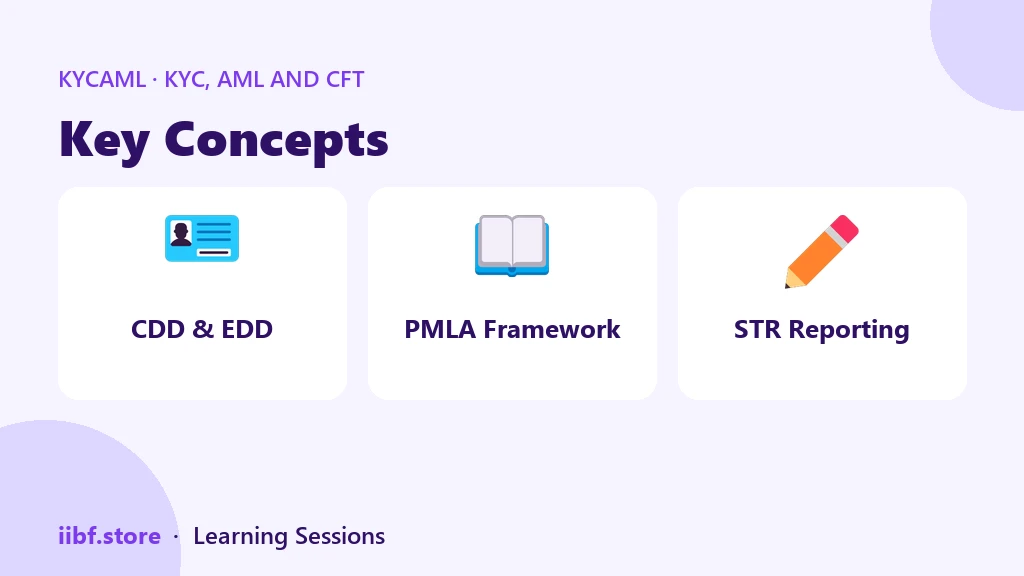
The syllabus for the AML KYC certification exam is organised around how a bank's KYC/AML function is actually structured, not as a loose list of definitions. It opens with the genesis and policy framework of KYC — why the RBI mandated it, and how a bank's board-approved KYC policy is built — before moving into the organisational set-up: who owns KYC/AML risk inside a bank, from branch level up to the designated director and principal officer.
A significant portion is devoted to international guidelines and standards, covering the bodies and frameworks that shape India's own AML/CFT regime, alongside legislation at the national level — principally the Prevention of Money Laundering Act framework as it applies to reporting entities. The syllabus also carries a dedicated segment on AML/CFT legislation across major countries and regions, useful for candidates who work with cross-border accounts or correspondent relationships.
Two operationally heavy areas round out the paper: correspondent banking (due diligence expectations when one bank relies on another's KYC) and the specific documentary and procedural requirements that apply to different customer categories. A closing segment on training and awareness reflects how seriously IIBF treats staff sensitisation as part of an effective AML control environment, not an afterthought.
📌 Remember: This exam rewards candidates who can connect a rule to the reason behind it — memorising a clause without understanding the underlying risk rarely survives an application-based question.
💰 Exam Fees, Schedule and Registration
Registration for the AML KYC certification exam happens through the candidate login on iibf.org.in, where the Institute publishes exact exam dates for each cycle. As a general rule, IIBF schedules this certificate on the 2nd and 4th Saturday of the month and on all Sundays — but always confirm the live calendar on the official site before you lock a date, since slot availability varies month to month.
Fee-wise, IIBF members pay ₹1,100 for both the first attempt and each subsequent attempt. Non-members pay a higher first-attempt fee of ₹1,600, which drops to ₹1,100 for subsequent attempts — effectively the same repeat-attempt cost regardless of membership status. Applicable GST is charged on top of these base fees, and payment is made online at the time of registration.
Because the exam runs on remote proctoring, you will need a stable internet connection, a working webcam and a quiet room for the full two-hour window. Keep your admit card and a valid photo ID ready for the proctoring check before the session opens.
🎯 How to Prepare: A Study Plan for the Certification
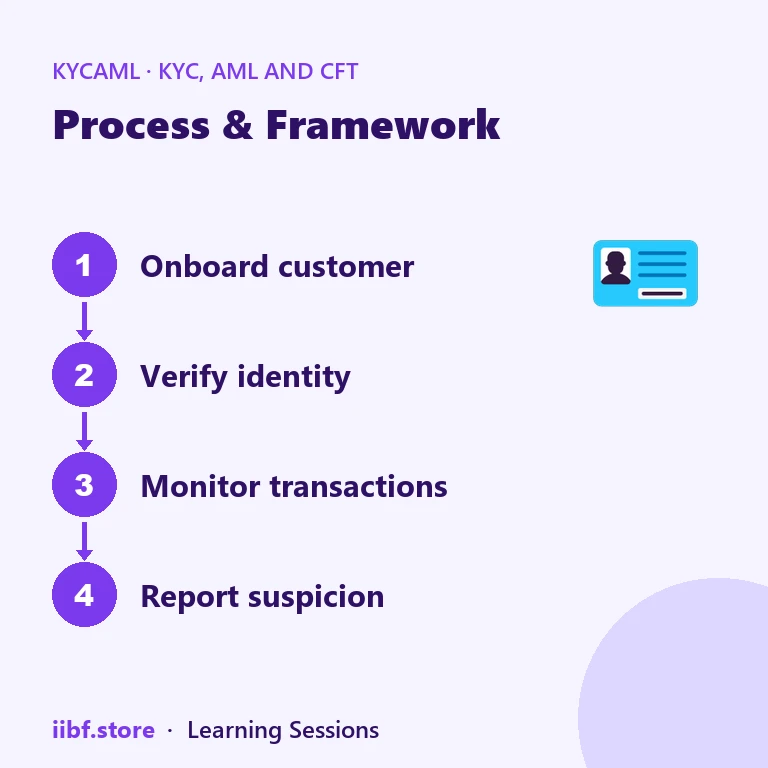
Most candidates clear the AML KYC certification exam comfortably with three to four weeks of focused preparation, provided the plan is structured rather than a single cover-to-cover read of the workbook. Start with the policy-framework and organisational chapters first — they anchor every later topic, since almost every operational rule traces back to why the KYC policy exists and who is accountable for it.
- Week 1: KYC genesis, policy framework and organisational set-up for KYC/AML.
- Week 2: International guidelines/standards and national-level legislation (PMLA framework).
- Week 3: Correspondent banking, customer-category-specific requirements and cross-country AML/CFT legislation.
- Week 4: Training-and-awareness chapter, full mock tests, and targeted revision of weak areas.
Since there is no negative marking, practise under time pressure so guessing on uncertain questions feels natural rather than risky. Chapter-wise mock questions modelled on the real paper are the fastest way to convert workbook reading into exam-ready recall — work through the study chapters below as you progress through each week.
🧠 Practice MCQs: AML KYC Certification Exam
Q1. What is the minimum qualifying mark to pass IIBF's Certificate Examination in AML/KYC? (a) 50 out of 100 (b) 55 out of 100 (c) 60 out of 100 (d) 65 out of 100
Answer: (c) — A candidate must score at least 60 marks out of 100 to pass the AML/KYC certificate exam.
Q2. How many objective-type questions does the AML/KYC certificate paper carry? (a) 90 questions for 90 marks (b) 100 questions for 100 marks (c) 120 questions for 100 marks (d) 150 questions for 150 marks
Answer: (c) — The paper has 120 objective-type multiple-choice questions carrying a total of 100 marks.
Q3. Is there negative marking for wrong answers in the AML/KYC certificate exam? (a) Yes, 0.25 marks are deducted per wrong answer (b) Yes, 0.5 marks are deducted per wrong answer (c) No, there is no negative marking (d) Only in the second attempt
Answer: (c) — IIBF does not apply negative marking on this exam, so candidates should attempt every question.
Q4. Who, besides IIBF members, is eligible to register for the AML/KYC certificate exam? (a) Only serving bank employees (b) Non-members who have passed 12th standard or equivalent, or completed the BC/BF exam (c) Only candidates with a postgraduate degree (d) Only candidates already holding CAIIB
Answer: (b) — Both members and non-members can register, provided they have passed 12th standard (or equivalent) or completed IIBF's BC/BF examination.
Q5. In what mode is the IIBF AML/KYC certificate exam conducted? (a) Offline at designated test centres only (b) Online, remote-proctored (c) Open-book take-home test (d) Oral viva with an examiner panel
Answer: (b) — The examination is held entirely in online mode with remote proctoring; there is no physical test-centre requirement.
Want chapter-wise mock tests with 100+ MCQs? Start practising free →
❓ Frequently Asked Questions
What is the exam fee for the AML KYC certification?
IIBF members pay ₹1,100 for the first attempt and each subsequent attempt. Non-members pay ₹1,600 for the first attempt and ₹1,100 for subsequent attempts, plus applicable GST.
Is the AML/KYC certificate exam conducted in Hindi?
No. The examination is conducted in English only; there is currently no regional-language medium option for this particular certificate.
How many attempts are allowed if I don't clear it the first time?
IIBF does not cap the number of attempts on its rolling certificate exams — you can re-register for a later cycle and pay the subsequent-attempt fee, which is ₹1,100 for both members and non-members.
Does clearing this certification help toward JAIIB or CAIIB?
The AML/KYC certificate is a standalone qualification and is not a prerequisite or credit toward JAIIB or CAIIB, though the subject knowledge overlaps closely with the KYC-AML portions tested in those exams.
Ready to build your prep plan around the real syllabus?
Work chapter by chapter starting with KYC (Know Your Customer) - Genesis & Policy Framework, then International Guidelines & Standards and Legislation at National Level before a full mock. Already past the basics? Revisit officially valid documents for KYC, brush up on CKYC ID, and see how Aadhaar based e-KYC for banks fits the onboarding flow this exam tests. Outside this subject, penal charges on loan accounts run under a separate RBI framework worth knowing. Browse the full stream on the KYC, AML and CFT tag hub, or plan your next step at the JAIIB course page. For the authoritative rules and live exam calendar, cross-check IIBF's official AML/KYC certification page before you register.
Prefer revising from a printed book?
Chapter-wise books with MCQs after every chapter — minimal pages, complete coverage, delivered anywhere in India. Every book has a free sample to read first.
117 pages · 236 MCQs
Learning Sessions · Ashish Sir
132 pages · 225 MCQs
Learning Sessions · Ashish Sir
188 pages · 435 MCQs
Learning Sessions · Ashish Sir
Learning Sessions · Ashish Sir
118 pages · 299 MCQs
Learning Sessions · Ashish Sir
Learning Sessions · Ashish Sir
Learning Sessions · Ashish Sir
Learning Sessions · Ashish Sir
115 pages · 255 MCQs
Learning Sessions · Ashish Sir
Learning Sessions · Ashish Sir
334 pages · 936 MCQs
Learning Sessions · Ashish Sir
Learning Sessions · Ashish Sir
115 pages · 344 MCQs
Learning Sessions · Ashish Sir
107 pages · 240 MCQs
Learning Sessions · Ashish Sir
90 pages · 150 MCQs
Learning Sessions · Ashish Sir
Learning Sessions · Ashish Sir
131 pages · 672 MCQs
Learning Sessions · Ashish Sir
221 pages · 831 MCQs
Learning Sessions · Ashish Sir
128 pages · 524 MCQs
Learning Sessions · Ashish Sir
107 pages · 445 MCQs
Learning Sessions · Ashish Sir
148 pages · 478 MCQs
Learning Sessions · Ashish Sir
151 pages · 465 MCQs
Learning Sessions · Ashish Sir
148 pages · 375 MCQs
Learning Sessions · Ashish Sir
216 pages · 895 MCQs
Learning Sessions · Ashish Sir
109 pages · 300 MCQs
Learning Sessions · Ashish Sir
104 pages · 360 MCQs
Learning Sessions · Ashish Sir
82 pages · 297 MCQs
Learning Sessions · Ashish Sir
151 pages · 600 MCQs
Learning Sessions · Ashish Sir
98 pages · 282 MCQs
Learning Sessions · Ashish Sir
Quick quiz on this topic
5 exam-style questions from our free test bank — check yourself before you move on.
Practice this topic
Take a free mock test, download chapter PDFs, or watch a video class — all included on iibf.store.
Keep reading