FATF Mutual Evaluation of India: IIBF KYC-AML Exam Guide
A FATF mutual evaluation is a peer review in which one country's entire anti-money-laundering and counter-terrorist-financing system is graded against the FATF 40 Recommendations — first on paper, then on whether it actually works. India's most recent round, adopted at the June 2024 FATF Plenary, placed the country in regular follow-up, the least demanding of the post-evaluation categories. For IIBF candidates the examinable core is narrow and predictable: what gets graded, who does the grading, the two separate scorecards used, and how a distant plenary finding ends up changing work at a branch counter.
This guide walks through the process in the order the assessors themselves follow, and flags the three points where candidates most often lose marks.
🌐 What a FATF Mutual Evaluation Actually Grades
The Financial Action Task Force is an inter-governmental standard-setter, not a regulator. It cannot fine a bank or direct RBI. Its leverage is entirely reputational, and it is exercised through the mutual evaluation — a structured peer review carried out by assessors drawn from other member jurisdictions, supported by the FATF Secretariat.
Two things are assessed, and they are assessed separately. Technical compliance asks whether the country's laws, rules and institutional powers match the 40 Recommendations. Effectiveness asks whether the system produces results, measured against 11 Immediate Outcomes. A country can have a flawless statute book and still be rated poorly on effectiveness, which is exactly why the second scorecard was introduced from the fourth round onwards.
The exercise runs over roughly eighteen months. It begins with a scoping call, moves to a written technical-compliance submission by the national authorities, then an on-site visit of two to three weeks during which assessors interview regulators, the financial intelligence unit, investigators, prosecutors, and — importantly for bankers — compliance teams at selected banks and other reporting entities. A draft report is then debated at plenary and adopted with any agreed changes.
The wider architecture behind all of this is covered in the chapter on international guidelines and standards, which is the single most examined chapter in this module.
💡 Exam Tip: FATF issues Recommendations, not law. They bind India only once transposed into domestic instruments such as the PMLA, the PML (Maintenance of Records) Rules and RBI directions. Any option calling FATF a "regulator" or "supervisor" of banks is wrong.
🧭 Who Assessed India and What the 2024 Round Concluded
India is unusual in belonging to three assessment bodies at once: the FATF itself, the Asia/Pacific Group on Money Laundering (APG) and the Eurasian Group (EAG). Its evaluation was therefore a joint exercise, with the report adopted at the FATF Plenary held in June 2024.
The headline result was favourable. India was placed in regular follow-up, a category reserved for countries whose results are broadly strong; the alternative, enhanced follow-up, applies where technical compliance or effectiveness falls short on a significant number of items. Countries in regular follow-up report back to the plenary on a three-year cycle rather than annually.
The assessment recognised a well-developed legal framework, an active financial intelligence unit, and strong use of financial intelligence by investigative agencies. It also identified areas needing work — most prominently the time taken to conclude money-laundering prosecutions, and supervision of designated non-financial businesses and professions and of the non-profit sector, both of which sit outside the banking perimeter.
For a bank, the practical significance is not the grade but the evidence trail. Assessors do not accept a regulator's assurance that customer files are complete; they sample. Where a bank cannot produce dated records on demand, the finding is recorded as an effectiveness weakness. That is precisely why our companion piece on record retention under PMLA matters more than it first appears — retention rules are the audit substrate on which an effectiveness rating rests.
📊 Technical Compliance vs Effectiveness: Two Separate Scorecards
Candidates routinely blur the two scorecards. They use different scales, different evidence, and different remedies. Learn the table below cold; it converts directly into two or three marks in most sittings.
The distinction is not academic. A jurisdiction can amend its statute overnight and lift a technical-compliance rating from Partially Compliant to Largely Compliant at the next follow-up. Moving an effectiveness rating requires years of case data — completed prosecutions, confiscations actually enforced, supervisory action actually taken — which is why effectiveness ratings are revisited only at a full evaluation.
| Feature | Technical Compliance | Effectiveness |
|---|---|---|
| What is graded | The 40 Recommendations — laws, rules, institutional powers | 11 Immediate Outcomes — results actually achieved |
| Rating scale | Compliant / Largely Compliant / Partially Compliant / Non-Compliant | High / Substantial / Moderate / Low level of effectiveness |
| Primary evidence | Statute text, rules, regulator directions | Case data, statistics, on-site interviews |
| Are banks interviewed directly? | ❌ Rarely — largely a desk review of the country's submission | ✅ Yes — compliance teams are sampled during the on-site visit |
| Can a legislative amendment alone fix a poor rating? | Usually yes, at the next follow-up report | No — sustained, demonstrated outcomes are required |
The eleven Immediate Outcomes run from risk understanding and national co-ordination through supervision, preventive measures, transparency of legal persons, financial intelligence, investigation and prosecution, confiscation, terrorist financing, and proliferation-financing sanctions. Preventive measures and supervision are the two that reporting entities feel directly. India's domestic transposition of these obligations is set out chapter-wise under AML-CFT legislation in India.
🏦 How the Findings Reach a Branch Counter
A mutual evaluation finding never arrives at a branch as a FATF document. It arrives as an amended master direction, a revised internal policy, or a new alert scenario in the monitoring system. Understanding that chain is what separates a rote answer from an applied one.
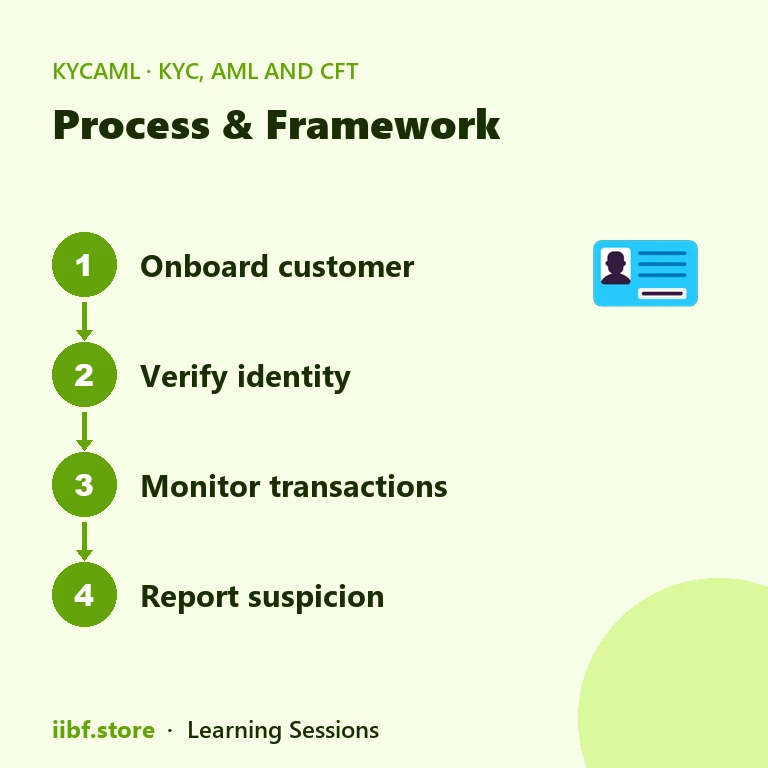
The typical sequence runs: plenary adopts the report → the identified gap is assigned to a domestic authority → the Department of Revenue, RBI or another regulator amends rules or directions → the bank's board-approved KYC-AML policy is revised → branch-level procedures, system parameters and staff training follow. Each step is auditable, and the last one is where evidence most often fails.
Three areas absorb most of the downstream effect. Correspondent banking is scrutinised because cross-border relationships carry the highest concentration of jurisdiction risk — the mechanics of due diligence on a respondent bank are covered in the chapter on correspondent banking. Jurisdictional exposure follows, since assessors test whether a bank actually differentiates its handling of counterparties by country; see country risk. And alert handling is tested end to end, from scenario tuning to the disposition rationale recorded by the analyst, as set out in transaction monitoring and reporting.
⚠️ Common Mistake: Treating an alert closed as "no suspicion" with a blank reason field. In an effectiveness assessment an undocumented closure counts as no analysis at all — the volume of alerts generated proves nothing on its own.
Cyber-enabled fraud now feeds the same pipeline; complaints routed through the national cyber crime reporting portal increasingly become the predicate-offence evidence behind a suspicious transaction report.
⚠️ Follow-Up Status, Grey Listing and the Common Confusion
The most frequently mis-set question on this topic conflates two entirely different FATF processes. A mutual evaluation is a technical peer review applied to every member on a rotating cycle; it always produces a report and a follow-up category. Listing under increased monitoring — the so-called grey list — is a separate political process handled by the International Co-operation Review Group for jurisdictions with strategic deficiencies, and it comes with an agreed action plan and deadlines.
A poor mutual evaluation can trigger referral to that process, but the two are not the same thing, and a country in enhanced follow-up is not thereby grey-listed. The consequences for correspondent relationships and remittance costs are explained in our note on FATF grey listing and Indian banks.
The follow-up categories themselves are worth memorising. Regular follow-up means reporting to plenary roughly every three years. Enhanced follow-up means more frequent reporting and closer scrutiny of remediation. Countries may apply for re-ratings on individual Recommendations once the underlying gap is closed, which is why a country's technical-compliance profile improves between full evaluations without a fresh on-site visit.
Remember: ratings can move in both directions between evaluations, but only technical-compliance ratings are re-rated on application. Effectiveness ratings are revisited only at the next full mutual evaluation, which is the single most useful sentence to carry into the hall on this topic.
For the domestic statutory backdrop — the PMLA, the Rules and the reporting architecture — work through legislation at the national level alongside the global picture in money laundering global measures. Primary texts are worth a look too: the master directions on rbi.org.in and the syllabus published on iibf.org.in are both examinable sources in their own right.

🧠 Practice MCQs: FATF Mutual Evaluation
Q1. Under the FATF methodology, effectiveness is assessed against which of the following? (a) The 40 Recommendations (b) The 9 Special Recommendations (c) 11 Immediate Outcomes (d) The 8 Key Principles
Answer: (c) — Effectiveness is graded against 11 Immediate Outcomes; the 40 Recommendations carry the technical-compliance rating.
Q2. Which rating scale applies to technical compliance? (a) Compliant, Largely Compliant, Partially Compliant, Non-Compliant (b) High, Substantial, Moderate, Low (c) Satisfactory, Needs Improvement, Deficient (d) Green, Amber, Red
Answer: (a) — The four-point C/LC/PC/NC scale is used for technical compliance; High/Substantial/Moderate/Low is the effectiveness scale.
Q3. India's mutual evaluation report adopted in 2024 placed the country in which category? (a) Enhanced follow-up (b) Increased monitoring (c) Blacklist (d) Regular follow-up
Answer: (d) — India was placed in regular follow-up, which requires reporting back to plenary on a three-year cycle.
Q4. Which statement about FATF is correct? (a) It can impose monetary penalties on non-compliant banks (b) It sets standards that bind a country only after domestic transposition (c) It licenses financial intelligence units (d) It supervises correspondent banking relationships directly
Answer: (b) — FATF is a standard-setter; its Recommendations take legal effect in India only through the PMLA, the Rules and regulator directions.
Q5. Placement on the FATF list of jurisdictions under increased monitoring is decided through which mechanism? (a) Automatic downgrade after a mutual evaluation (b) A vote of the Asia/Pacific Group alone (c) The International Co-operation Review Group process (d) A referral by the financial intelligence unit of any member
Answer: (c) — Grey listing runs through the ICRG process with an agreed action plan, and is distinct from the mutual evaluation itself.
Want chapter-wise mock tests with 100+ MCQs? Start practising free →
❓ Frequently Asked Questions
How often does a country undergo a FATF mutual evaluation?
Evaluations run in rounds, with each member assessed roughly once per decade depending on the cycle and the assessment body concerned. Between full evaluations, countries submit follow-up reports and may seek re-ratings on individual Recommendations.
Does a poor mutual evaluation automatically mean grey listing?
No. A weak result may lead to referral to the International Co-operation Review Group, but listing under increased monitoring is a separate decision with its own criteria and an agreed action plan. Enhanced follow-up is not the same as grey listing.
Are individual banks interviewed during an evaluation?
Yes. Assessors sample reporting entities during the on-site visit and interview compliance officers about risk assessment, due diligence, alert handling and record keeping. Documentation quality, not policy wording, drives the effectiveness finding.
How much of this topic appears in the IIBF paper?
The international-standards chapter reliably yields several questions, typically on the FATF structure, the two ratings scales and the difference between evaluation and listing. Details of the exam pattern are covered in our guide to the AML KYC certification exam.
🎯 Key Takeaways and Next Step
Keep four anchors in mind: FATF sets standards and does not regulate banks; technical compliance and effectiveness are graded on separate scales; India's 2024 report placed it in regular follow-up; and grey listing is an ICRG decision, not an automatic consequence of a weak evaluation. Everything else on this topic is elaboration.
Read the rest of the module in our KYC, AML and CFT article hub, then test yourself — take a free chapter-wise mock test and find out which of the eleven Immediate Outcomes you can actually explain under time pressure.
Prefer revising from a printed book?
Chapter-wise books with MCQs after every chapter — minimal pages, complete coverage, delivered anywhere in India. Every book has a free sample to read first.
117 pages · 236 MCQs
Learning Sessions · Ashish Sir
132 pages · 225 MCQs
Learning Sessions · Ashish Sir
188 pages · 435 MCQs
Learning Sessions · Ashish Sir
Learning Sessions · Ashish Sir
118 pages · 299 MCQs
Learning Sessions · Ashish Sir
Learning Sessions · Ashish Sir
Learning Sessions · Ashish Sir
Learning Sessions · Ashish Sir
115 pages · 255 MCQs
Learning Sessions · Ashish Sir
Learning Sessions · Ashish Sir
334 pages · 936 MCQs
Learning Sessions · Ashish Sir
Learning Sessions · Ashish Sir
115 pages · 344 MCQs
Learning Sessions · Ashish Sir
107 pages · 240 MCQs
Learning Sessions · Ashish Sir
90 pages · 150 MCQs
Learning Sessions · Ashish Sir
Learning Sessions · Ashish Sir
131 pages · 672 MCQs
Learning Sessions · Ashish Sir
221 pages · 831 MCQs
Learning Sessions · Ashish Sir
128 pages · 524 MCQs
Learning Sessions · Ashish Sir
107 pages · 445 MCQs
Learning Sessions · Ashish Sir
148 pages · 478 MCQs
Learning Sessions · Ashish Sir
151 pages · 465 MCQs
Learning Sessions · Ashish Sir
148 pages · 375 MCQs
Learning Sessions · Ashish Sir
216 pages · 895 MCQs
Learning Sessions · Ashish Sir
109 pages · 300 MCQs
Learning Sessions · Ashish Sir
104 pages · 360 MCQs
Learning Sessions · Ashish Sir
82 pages · 297 MCQs
Learning Sessions · Ashish Sir
151 pages · 600 MCQs
Learning Sessions · Ashish Sir
98 pages · 282 MCQs
Learning Sessions · Ashish Sir
Quick quiz on this topic
5 exam-style questions from our free test bank — check yourself before you move on.
Practice this topic
Take a free mock test, download chapter PDFs, or watch a video class — all included on iibf.store.
Keep reading