CAIIB BRBL Guide to legal risk in banking: sources and controls
Legal risk in banking is the risk that a bank's rights against a borrower, guarantor or counterparty turn out to be unenforceable, defective or costlier to enforce than assumed at the time of sanction. For CAIIB candidates, legal risk in banking is not an abstract compliance topic — it is the reason a fully secured advance can end up as a total write-off after five years of litigation. The money was lent correctly, the security existed, the borrower was genuine; but a document was not stamped, a charge was registered late, or the suit was filed after the period allowed by law. This guide covers the sources of legal risk, how Basel and the RBI treat it, the role of legal audit of title documents, and the controls the examiner expects you to name.
⚖️ What Legal Risk in Banking Actually Covers
Legal risk is the risk of loss arising from the bank's contracts, security interests, statutory obligations or conduct being challenged, set aside or found unenforceable. It is wider than "litigation risk". A bank can carry heavy legal risk without a single case pending — for example, where thousands of loan files use a clause that has been read down by courts, or where documentation was executed by a person who did not have authority to bind the borrower.
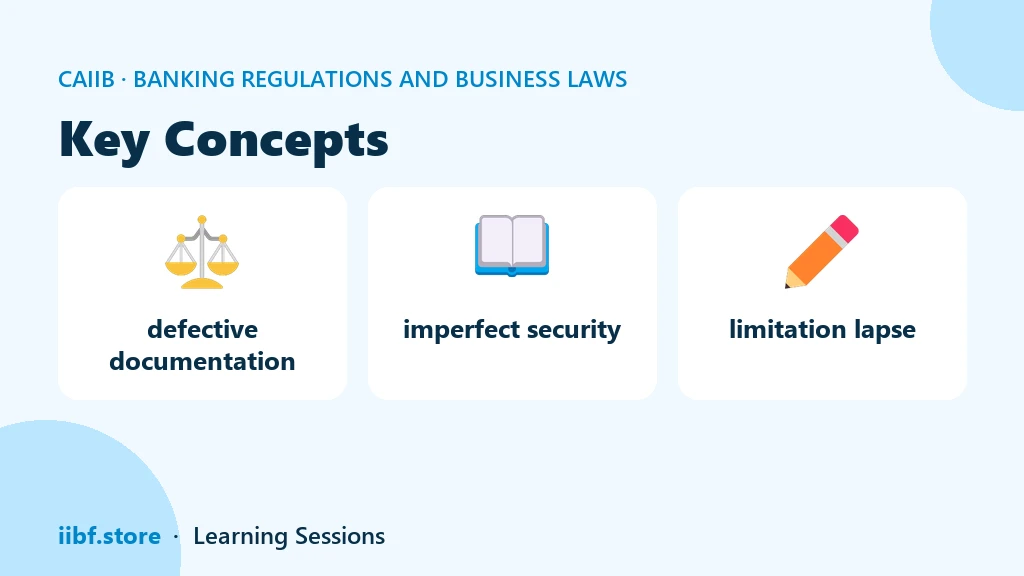
It is useful to separate three strands. The first is transactional legal risk: defective documentation, imperfect security, want of capacity or authority. The second is statutory and regulatory legal risk: breach of the Banking Regulation Act 1949, RBI directions, or the wide body of consumer, labour and data obligations that now apply to banks. The third is conduct and liability risk: wrongful dishonour of a cheque, wrongful sale of a security, mis-selling of a third-party product, or a deficiency in service that becomes compensable.
Because the exam draws heavily on statutory structure, revise the legal framework of regulation of banks alongside this topic — most regulatory legal risk is simply the mirror image of a provision the bank failed to observe. Note also that legal risk is not credit risk. Credit risk is the borrower's inability to pay; legal risk is the bank's inability to recover from a borrower who could have paid. The two compound: a weak borrower plus a defective mortgage is where banks actually lose money.
📄 The Main Sources of Legal Risk in a Loan Account
Defective documentation. Wrong borrower description, blanks left unfilled, undated or unstamped instruments, missing schedules of property, and documents executed before sanction terms were finalised. An inadequately stamped document is generally inadmissible in evidence until the deficiency and penalty are made good, which converts a straightforward recovery suit into an expensive detour.
Imperfect or unenforceable security. Title defects, prior undisclosed encumbrances, a second charge taken without the first chargeholder's no-objection, property not falling within the schedule, or a charge over a company's assets not registered with the Registrar of Companies within the period allowed by Section 77 of the Companies Act 2013. An unregistered charge is not taken into account by the liquidator or other creditors in winding up — the debt survives, the priority does not.
Lapse of limitation. Every debt has a prescribed period within which the bank must sue. Where no suit, acknowledgement of debt or part payment intervenes, the remedy is extinguished even though the loan is genuine. This is the most avoidable of all legal losses and the most common in branch audit findings.
Want of capacity or authority. Borrowing by a company beyond the powers conferred by its board or shareholders, execution by a partner outside the implied authority of the firm, minors, or an attorney acting under a power that had already been revoked.
Regulatory breach. Exposure norms, restrictions on advances, and conduct requirements — the areas covered in regulation of banking business — carry penalty and reputational consequences even where no borrower is involved.
| Source of legal risk | Typical trigger at branch level | Primary control | Usually curable after default? |
|---|---|---|---|
| Defective documentation | Blanks, wrong name, unstamped or undated instrument | Bank-approved standard formats plus maker-checker at disbursal | ❌ |
| Imperfect security | Charge not registered in time; undisclosed prior encumbrance | Search report, title opinion, charge-registration tracker | ❌ |
| Limitation lapse | No acknowledgement obtained before the period runs out | Diarised balance confirmation and revival letters | ❌ |
| Want of authority | Borrowing beyond board or shareholder authority | Vetting of resolutions and constitution documents | ✅ |
💡 Exam Tip: When a question describes a genuine loan that the bank cannot recover, look first for a documentation, registration or limitation defect — not for a credit weakness. That is the examiner's signature for a legal risk question.
Guarantee documentation deserves separate attention, because a discharged surety is a silent loss; the principles are set out in our note on the contract of indemnity and guarantee for bankers. Cheque-related liability is a second everyday source, covered in the article on Section 138 NI Act cheque dishonour.
🏛️ Basel and RBI Treatment: Legal Risk Sits Inside Operational Risk
Under the Basel framework, operational risk is defined as the risk of loss resulting from inadequate or failed internal processes, people and systems, or from external events. That definition includes legal risk but excludes strategic and reputational risk. This single sentence is among the most frequently examined lines in the whole operational risk syllabus, and the exclusion is where candidates lose the mark.
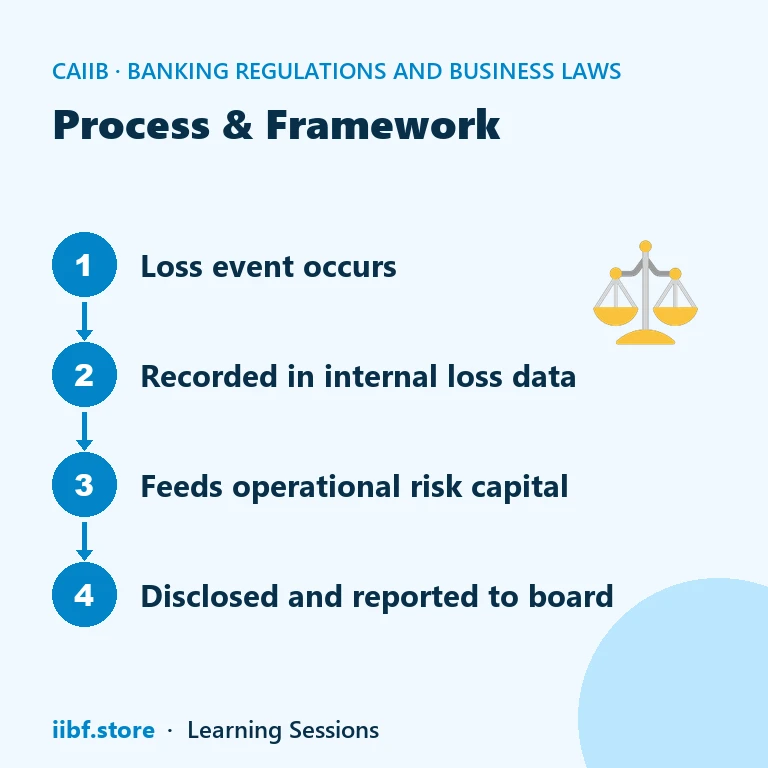
Legal risk in this context is read broadly: exposure to fines, penalties and punitive damages from supervisory actions, as well as private settlements. So a penalty imposed by the regulator, a consumer forum award, or a settlement paid to close a class of customer complaints is an operational risk loss event and must flow into the bank's internal loss data.
Capital treatment has moved away from bank-specific modelling. The Basel III finalisation replaced the advanced measurement approach with a standardised approach driven by a business indicator and the bank's own historical operational loss experience, so that a bank with a poor loss record carries more capital. The RBI has issued its own master direction on minimum capital requirements for operational risk implementing this approach for Indian banks; because the phase-in dates have been revised more than once, check the current RBI master direction rather than relying on a remembered date. The practical consequence is simple and testable: legal losses are no longer just a legal department problem, because recorded litigation and penalty losses raise regulatory capital for years afterwards.
Supervisory expectations reinforce this. Banks must disclose contingent liabilities in respect of claims not acknowledged as debts, provide for probable litigation outflows in line with accounting standards, and report material legal proceedings to the board. Candidates should also connect this to the supervisory architecture studied under control over organisation of banks questions, where the RBI's powers of inspection and penalty are the enforcement end of the same chain.
⚠️ Common Mistake: Writing that operational risk "includes legal, strategic and reputational risk". It includes legal risk only. Strategic and reputational risk are expressly outside the Basel definition and are handled under Pillar 2.
🔍 Legal Audit of Title Documents and the Standard Control Set
The single most effective control against transactional legal risk is legal audit of title documents — an independent re-examination, by a lawyer other than the one who gave the original opinion, of the title deeds and security documents actually held in the branch. The RBI's fraud-risk framework requires banks to subject large-value loan accounts to periodic legal audit of title documents, and to re-verify the documents at defined intervals during the currency of the loan. Thresholds and periodicity have been revised over time, so quote the requirement qualitatively in the exam unless you have checked the current master direction.
Legal audit works because it tests the file that exists, not the file that was supposed to exist. It routinely catches photocopies passed off as originals, deeds released to the borrower and never returned, a mortgage created over a property different from the one valued, and encumbrance certificates that stop short of the date of deposit.
The standard control set that follows from this is worth memorising as a list: pre-sanction search and title investigation from a panel advocate; use of bank-approved standard documents with no manual alterations; correct stamping and, where required, registration; timely registration of charges and a central tracker for filing deadlines; custody of original documents in fire-proof storage with dual control; a documents-due register for renewals, revival letters and balance confirmations; periodic legal audit; a panel of advocates with performance review; and a litigation MIS placed before the board.
Banks lose cases for a short and repetitive list of reasons: the officer who signed the documents could not be produced as a witness; the acknowledgement was obtained after the period had run; the notice went to a stale address; the demand notice quantified an amount the account statement did not support; or the enforcement action was taken without following the procedure the statute prescribes, as discussed in the article on SARFAESI Act enforcement of security interest. Legal risk also travels into newer products — receivable-based structures of the kind described in supply chain finance for banks depend entirely on the validity of the underlying assignment.
📌 Remember: Legal risk is controlled by process, not by argument. A diarised revival letter costs nothing; the same debt lost to limitation is a hundred per cent loss with no recovery route left.
🧠 Practice MCQs: Legal Risk in Banking
Q1. Under the Basel framework, legal risk is treated as: (a) a sub-set of market risk (b) a component of operational risk (c) an independent Pillar 1 risk category (d) a part of strategic risk
Answer: (b) — The Basel definition of operational risk expressly includes legal risk.
Q2. A charge created by a company in favour of a bank is not registered with the Registrar of Companies within the period allowed. The most likely consequence is: (a) the charge becomes void against the company itself (b) the underlying debt is extinguished (c) the directors are automatically disqualified (d) the charge is not taken into account by the liquidator or other creditors in a winding up
Answer: (d) — The debt remains payable, but the bank loses the benefit of its security priority against the liquidator and other creditors.
Q3. The primary purpose of a legal audit of title documents is to: (a) confirm that the documents actually held are genuine, complete and enforceable (b) value the property for insurance cover (c) compute the drawing power on the account (d) assign an internal credit rating to the borrower
Answer: (a) — Legal audit independently re-verifies the documents on record, and is not a valuation or rating exercise.
Q4. A bank's debt becomes time-barred when: (a) the account is classified as an NPA (b) the security is sold (c) the prescribed limitation period expires without a suit, a valid acknowledgement or a part payment (d) the guarantor dies
Answer: (c) — Classification as NPA has no effect on limitation; only a suit, acknowledgement or part payment preserves the remedy.
Q5. The Basel definition of operational risk includes legal risk but expressly excludes: (a) internal fraud losses (b) strategic and reputational risk (c) losses from system failure (d) damage to physical assets
Answer: (b) — Strategic and reputational risk are outside the Basel operational risk definition.
Want chapter-wise mock tests with 100+ MCQs? Start practising free →
Frequently Asked Questions
Is legal risk the same as compliance risk?
They overlap but are not identical. Compliance risk is the risk of breaching a specific regulatory requirement. Legal risk is broader and includes contractual defects, unenforceable security and litigation exposure that may involve no regulatory breach at all.
Why is legal risk placed under operational risk rather than credit risk?
Because the loss originates in the bank's own processes, people or systems — a defective document, a missed registration, an incorrect notice — rather than in the borrower's inability to pay. Basel therefore folds it into the operational risk definition.
Who should carry out a legal audit of title documents?
An advocate independent of the one who issued the original title opinion, so that the re-verification is genuinely a second pair of eyes. Large borrowal accounts are subjected to it periodically under the RBI's fraud-risk framework.
How much of this topic is asked in the CAIIB BRBL paper?
Legal risk appears as scenario-based questions rather than as a standalone chapter — typically a case where a genuine loan cannot be recovered because of a documentation, registration or limitation defect. Practise applied questions rather than memorising definitions alone.
Conclusion. Legal risk is the quiet loss line in a bank's balance sheet: it never shows up at sanction, and it is almost never curable once the defect matures. Learn the five sources, the Basel classification, and the control set built around documentation discipline and legal audit, and most exam questions on this topic answer themselves. Continue with more subject notes on the banking regulations and business laws tag hub, and take the full paper-wise practice set in our CAIIB course.
Source and further reading: Reserve Bank of India and the Indian Institute of Banking & Finance.
Quick quiz on this topic
5 exam-style questions from our free test bank — check yourself before you move on.
Practice this topic
Take a free mock test, download chapter PDFs, or watch a video class — all included on iibf.store.
Keep reading