Margining and Clearing Corporation Risk: CCP Rules for IIBF RFS
Every exchange-traded equity, derivative or currency trade in India is settled through a clearing corporation, and margining and clearing corporation risk is the framework that stops one member's failure from becoming everybody's loss. For the IIBF Risk in Financial Services paper, this topic pulls together novation, initial margin, exposure margin, mark-to-market margin, peak margin norms and the default waterfall. Bank treasuries, custodians and broking subsidiaries deal with these numbers every single day. This guide explains how a central counterparty (CCP) absorbs counterparty exposure, how each margin layer is built and collected, and what actually happens on the day a clearing member cannot pay.
🏦 Novation: How a Clearing Corporation Becomes Everyone's Counterparty
A clearing corporation is a central counterparty that interposes itself between the two sides of a trade. The legal mechanism is novation: the original bilateral contract between buyer and seller is extinguished and replaced by two fresh contracts, one between the buyer and the CCP, and one between the seller and the CCP. The CCP becomes the buyer to every seller and the seller to every buyer. From that instant, neither trading party has any credit exposure to the other; both have exposure only to the clearing corporation.
This is a genuine transformation of risk, not its elimination. Diffuse bilateral counterparty risk is converted into concentrated exposure to one institution that must be over-engineered to survive. That is why a CCP is required to run a formal risk framework, hold pre-funded financial resources, and stress test itself continuously — the same discipline you study in the credit risk management framework chapter, applied to an institution that cannot be allowed to fail.
Access is tiered. Clearing members face the CCP directly; trading members and clients face the CCP through a clearing member. Each layer is separately margined, and client collateral must be segregated and identifiable so that a defaulting member's clients can be ported or their assets returned. In India, clearing corporations of stock exchanges are regulated by SEBI, while the CCP for government securities, forex and rupee interest rate derivatives operates under the Reserve Bank's oversight. Both are expected to observe the CPMI–IOSCO Principles for Financial Market Infrastructures, which set the global benchmark for CCP governance, credit and liquidity resources, margin methodology and default management.
📌 Remember: Novation does not make risk disappear — it re-routes and concentrates it. The CCP's own risk management, not the trade itself, becomes the thing that must be supervised.
📊 The Margin Stack: Initial, Exposure and Mark-to-Market
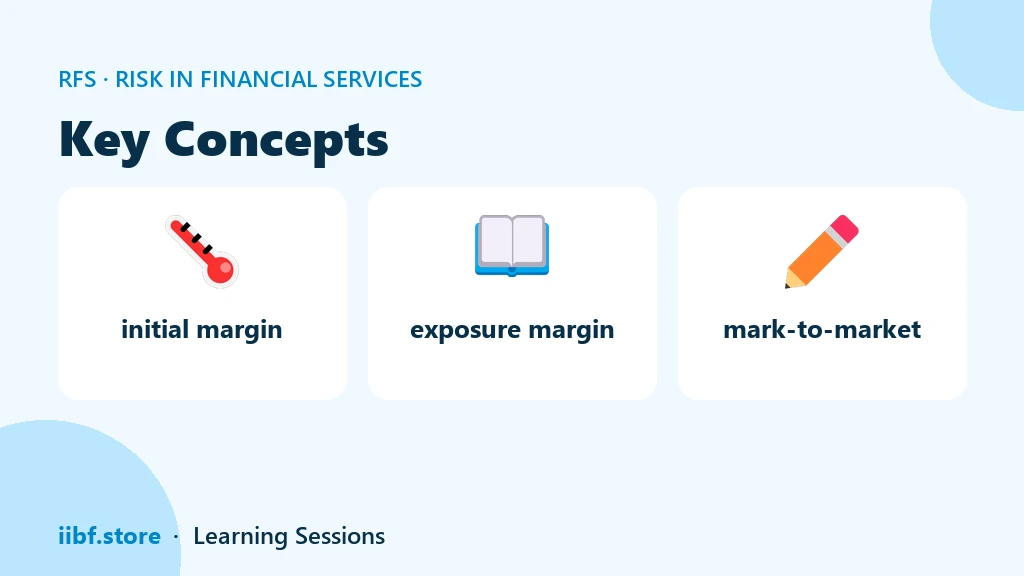
Margin is the CCP's first and largest line of defence, and it is deliberately layered. Initial margin is forward-looking: it is sized to cover the loss the CCP could suffer while closing out a defaulter's portfolio over an assumed margin period of risk, at a high confidence level. Indian equity derivatives have long used a SPAN-type portfolio risk model that revalues positions across a grid of price and volatility scenarios and takes the worst-case loss; the cash segment uses a VaR-based margin calibrated at a high confidence level, with tighter parameters for less liquid scrips. Because these parameters are recalibrated periodically by SEBI and the clearing corporations, always confirm the current percentages from the latest circular rather than memorising an old figure.
On top of initial margin sit buffers for tail moves that a VaR model will under-capture: extreme loss margin in the cash segment and exposure margin in derivatives. Then comes mark-to-market margin, which is backward-looking — it collects the notional loss already accrued on open positions so that unrealised losses are not allowed to build up. Additional or special margins, calendar spread margins and delivery margins are levied situationally, for example around physical settlement of stock derivatives or unusual volatility in a single scrip. The interaction between price volatility and margin levels is the same VaR intuition covered in the market risk chapter.
| Margin layer | What it covers | Broad basis | Collected upfront from client? |
|---|---|---|---|
| Initial margin (SPAN / VaR) | Close-out loss over the margin period of risk | Portfolio scenario model at high confidence level | ✅ Yes |
| Extreme loss / exposure margin | Tail moves beyond the VaR estimate | Percentage of value or volatility multiple | ✅ Yes |
| Mark-to-market margin | Loss already accrued on open positions | Difference between trade price and closing price | ❌ No — settled after the close |
| Additional / special margin | Scrip-specific or event-driven volatility | Levied by the CCP on a case basis | ✅ Yes |
| Core SGF contribution | Mutualised loss after a default | Stress-test-driven corpus, member share | ❌ No — member-level, not trade-level |
⏱️ Peak Margin Norms and Upfront Collection by Brokers
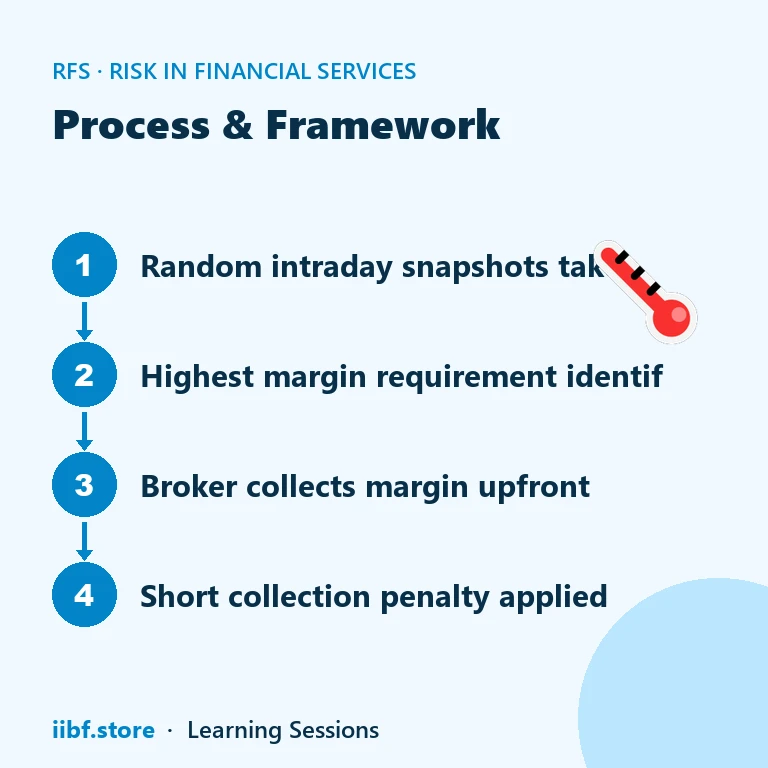
For years, brokers could fund a client's intraday exposure and square up before the day ended, so end-of-day margin files understated the true risk that had been carried. The peak margin framework closed that gap. The clearing corporation takes several random snapshots of client positions during the trading day; the highest margin requirement across those snapshots becomes the peak margin obligation, and the broker must have collected margin against it. Reporting is done against the higher of the end-of-day requirement and the peak requirement, and short collection or non-collection attracts a graded penalty.
The practical effect is that intraday leverage from brokers is now tightly capped, and margin must be available before the position is taken, not after it moves against the client. Collateral can be cash or approved securities pledged through the depository margin-pledge mechanism, with a haircut, and there are limits on how much of the requirement may be met with non-cash collateral. Client funds and securities have also been progressively ring-fenced — including daily upstreaming of client cash to the clearing corporation in permitted forms — so that a broker cannot recycle one client's money to fund another's exposure.
⚠️ Common Mistake: Candidates often equate peak margin with the end-of-day margin. It is the highest margin requirement captured across the day's random snapshots — a client who built and squared a large position by lunch still owes peak margin for that day.
This upfront discipline is essentially conduct regulation as much as prudential regulation, and it sits close to the mis-selling and suitability themes discussed in conduct risk in financial services. Where a bank sponsors or owns a broking arm, the group must monitor both the prudential margin numbers and the client-treatment obligations that ride on them.
🛡️ Default Waterfall and the Core Settlement Guarantee Fund
If margins prove insufficient, the CCP falls back on a pre-agreed, publicly disclosed sequence of resources known as the default waterfall. The order matters enormously in the exam. First, the defaulting member's own resources are consumed: its margins, collateral, deposits and its contribution to the core settlement guarantee fund (core SGF). Only after the defaulter's money is exhausted does the clearing corporation apply its own pre-funded contribution — its skin in the game — which is deliberately placed ahead of surviving members' money so that the CCP's incentives stay aligned with prudent margining.
Next comes the mutualised layer: the core SGF contributions of non-defaulting members, followed by the remaining capital of the clearing corporation and any insurance or additional assessments permitted by the rules. The size of the core SGF, the minimum required corpus, is not arbitrary — it is derived from stress tests calibrated so that the CCP can withstand the default of its largest exposure or, for the most systemically important CCPs, of two large participants under extreme but plausible market conditions. Corpus adequacy is reviewed periodically and topped up when stress losses rise.
Because the corpus is stress-driven, the methodology overlaps directly with bank-side scenario work; if you want the parallel from the capital planning side, read stress testing in banks. The same design question also connects to concentration risk in bank lending: a CCP with a few dominant clearing members faces exactly the concentration problem a lender faces with a few dominant borrowers, and it manages it with position limits, higher margins on concentrated books and member exposure caps.
🌐 Why CCPs Are Systemically Important for Banks
A clearing corporation is a single point through which an entire market's settlement obligations pass. If it stops functioning, trading stops with it — which is why CCPs are treated as critical financial market infrastructure and supervised far more intensively than an ordinary intermediary. Banks are exposed to them in several ways at once: as clearing members posting margin, as custodians of client collateral, as settlement banks holding the CCP's funds, and as contributors to the settlement guarantee fund.
Capital rules reflect that. Trade exposures to a qualifying CCP attract a concessional risk weight far below what an equivalent bilateral exposure would carry, while exposures to a non-qualifying CCP are penalised heavily. A separate capital charge applies to a bank's default fund contributions, because that money is genuinely at risk of mutualisation. This asymmetry is the regulatory nudge that pushed standardised derivatives, including many credit products covered in the credit derivatives chapter, from bilateral markets onto central clearing after the global financial crisis.
💡 Exam Tip: If a question asks what a bank gains from clearing through a qualifying CCP, the answer set is multilateral netting, daily margining, a mutualised default fund and materially lower capital on trade exposures — not the removal of counterparty risk.
The residual risks are real. Margin is procyclical: models tighten sharply in a shock, and simultaneous margin calls across members can drain liquidity precisely when funding is hardest to raise. Members must therefore hold liquid assets against potential margin calls, treat intraday liquidity as a managed resource, and understand how quickly rulebook changes can alter their obligations — the horizon-scanning discipline explained in regulatory risk in banks.

🎯 Key Takeaways and Study Plan
Get four things right and most questions on margining and clearing corporation risk fall into place: novation makes the CCP the counterparty to both sides; the margin stack runs from forward-looking initial margin through tail buffers to backward-looking mark-to-market; peak margin norms force upfront collection against the day's highest intraday requirement; and the default waterfall consumes the defaulter's money first, then the CCP's skin in the game, then mutualised resources. Everything else — collateral haircuts, position limits, stress-tested corpus sizing, concessional capital for qualifying CCPs — hangs off those four ideas.
Build the recall with short, repeated drills rather than one long reading. Work through the related chapters in the risk in financial services tag hub, then test yourself under time pressure. Start with a chapter-wise mock on iibf.store practice tests, and if you are preparing the wider risk syllabus alongside, map your revision to the CAIIB course plan so the market risk and credit risk modules reinforce each other.
🧠 Practice MCQs: Margining and Clearing Corporation Risk
Q1. Novation by a clearing corporation means that — (a) the CCP becomes the buyer to every seller and the seller to every buyer (b) the CCP guarantees a minimum profit to clearing members (c) the original trade is cancelled and re-executed on the exchange (d) the buyer and seller settle bilaterally while the CCP only maintains records
Answer: (a) — Novation replaces the bilateral contract with two contracts against the CCP, so each party faces only the clearing corporation.
Q2. A client's peak margin obligation for a trading day is determined by — (a) the end-of-day open position only (b) the simple average of intraday positions (c) the highest margin requirement across the clearing corporation's random intraday snapshots (d) the position held at the market opening
Answer: (c) — Random intraday snapshots capture the day's maximum requirement, preventing brokers from funding intraday leverage that vanishes by the close.
Q3. In the default waterfall, which resource is applied immediately after the defaulting member's margins and collateral? (a) Non-defaulting members' core SGF contributions (b) The defaulting member's own contribution to the core SGF (c) The clearing corporation's skin in the game (d) Insurance proceeds arranged by the exchange
Answer: (b) — The defaulter's entire pool of resources, including its SGF contribution, is exhausted before the CCP's own capital or any mutualised money is touched.
Q4. Which margin settles a loss that has already accrued rather than buffering a future close-out loss? (a) Initial margin (b) Extreme loss margin (c) Exposure margin (d) Mark-to-market margin
Answer: (d) — Mark-to-market margin collects the difference between the trade price and the closing price, so accrued losses are not allowed to accumulate.
Q5. Under Basel-based capital norms, a bank's trade exposures to a qualifying central counterparty attract — (a) a zero risk weight (b) the same risk weight as an unsecured corporate exposure (c) a low concessional risk weight (d) a punitive risk weight higher than a bilateral trade
Answer: (c) — Trade exposures to a qualifying CCP get a concessional low risk weight; default fund contributions carry a separate capital charge, and non-qualifying CCPs are treated much more harshly.
Want chapter-wise mock tests with 100+ MCQs? Start practising free →
❓ Frequently Asked Questions
Is initial margin the same as mark-to-market margin?
No. Initial margin is forward-looking and is meant to cover the loss the clearing corporation could suffer while liquidating a defaulter's portfolio. Mark-to-market margin is backward-looking and settles the loss that has already accrued on open positions since the trade or the previous close.
Why is the clearing corporation's own contribution placed before members' money in the waterfall?
Placing the CCP's pre-funded skin in the game ahead of non-defaulting members' contributions aligns incentives. The CCP loses its own capital before it mutualises losses, so it has a direct interest in setting margins and membership standards conservatively.
Does central clearing remove counterparty risk for a bank?
It removes bilateral counterparty risk but replaces it with exposure to the CCP, plus liquidity risk from margin calls and the risk of loss mutualisation through the default fund. That is why banks still hold capital against CCP trade exposures and default fund contributions.
How much detail on margin percentages does the RFS exam expect?
Concepts and sequence matter more than exact numbers. Know what each margin covers, which margins must be collected upfront, how peak margin is measured, and the order of the default waterfall. Because SEBI and the clearing corporations revise parameters periodically, verify any specific percentage against the latest circular before relying on it.
Source and further reading: SEBI and the Indian Institute of Banking & Finance.
Practice this topic
Take a free mock test, download chapter PDFs, or watch a video class — all included on iibf.store.
Keep reading