Stress Testing in Banks: Scenarios, Severity and ICAAP
A bank that only measures risk under normal conditions is measuring the easy half of the problem. Stress testing in banks is the discipline of asking what happens when conditions stop being normal — when GDP contracts, when the yield curve shifts 250 basis points, when the three largest borrower groups default in the same quarter. For IIBF Risk Management candidates, this is one of the most reliably examined areas because it cuts across credit, market, liquidity and capital planning in a single framework.
Examiners rarely ask for definitions alone. They ask which technique suits which question, how severity is calibrated, who owns the scenario, and where the output finally lands. This article walks the full chain — from shock design to board table — with the vocabulary the paper expects.
🧭 What Stress Testing in Banks Really Tests
A stress test is a forward-looking assessment of the impact of exceptional but plausible adverse events on a bank's earnings, asset quality, liquidity and capital. It is deliberately not a forecast. A forecast asks "what is most likely"; a stress test asks "what would hurt, and could we survive it".
Three properties separate a genuine stress test from a routine sensitivity report:
- Severity beyond experience. The shock should sit in the tail, not in the ordinary volatility band that Value at Risk already captures.
- Plausibility. A shock nobody can explain economically gets dismissed by the board and produces no management action.
- Actionability. Every run must end in a decision — capital, limits, provisioning, funding or pricing.
The relationship with VaR is a favourite exam hook. VaR quantifies loss at a confidence level under assumed distributions; it says nothing about the shape of the loss beyond that cut-off, and it degrades badly when correlations break. Stress testing is the complement that probes exactly that region — which is why the chapter on Value at Risk and the stress-testing material are almost always taught back to back. Read them as one unit: model-based measurement plus judgement-based challenge.
The broader framing — risk identification, measurement, monitoring and control as a continuous cycle — is set out in Risks and Risk Management in Banks, and stress testing sits squarely in the "control" leg of that cycle.
💡 Exam Tip: If a question contrasts VaR with stress testing, the discriminator is almost always probability. VaR attaches a confidence level to a loss; a stress scenario usually carries no assigned probability at all.
🧪 Sensitivity Tests vs Scenario Tests
The first classification every candidate must hold is sensitivity versus scenario. They answer different questions and are graded differently in the exam.
Sensitivity analysis
A sensitivity test moves one risk factor by a defined amount and holds everything else constant. Shift the entire yield curve up by 200 bps and read the change in economic value of equity. Depreciate the rupee by 10% and read the revaluation impact on the net open position. Raise the probability of default of a single rating grade by one notch and read the provisioning gap.
Sensitivity tests are cheap, fast, easy to repeat monthly, and easy to explain. Their weakness is that they are economically incoherent — in the real world a 200 bps rate shock does not arrive without credit spreads, deposit behaviour and collateral values also moving.
Scenario analysis
A scenario test moves a coherent bundle of factors together according to a narrative: a slowdown drives GDP down, unemployment up, corporate cash flows down, property prices down, and policy rates in whichever direction the story supports. Because the factors move jointly, second-order effects appear that no single-factor test can produce.
Scenario work is where the analyst adds value, and where the exam sets its harder questions. The technique is closely related to the loss-estimation approach described in scenario analysis in operational risk, where expert workshops replace statistical fitting because loss data is thin.
Single-factor vs integrated tests
The second classification is single-factor versus integrated. A single-factor test isolates one risk type — say, a credit shock only. An integrated stress test runs the same macro narrative through credit, market and liquidity books simultaneously and adds up the impact on capital. Integration is what surfaces the compounding problem: rating downgrades raise risk weights while mark-to-market losses erode the capital those weights are measured against, and both happen while deposit outflows force asset sales at distressed prices.
🌪️ Historical, Hypothetical and Reverse Stress Tests
Scenarios are sourced in three ways, and the exam expects you to know the trade-off of each.
Historical scenarios replay an actual episode — the 2008 global financial crisis, the 2013 taper-driven rupee and bond sell-off, the 2020 pandemic shutdown. Their great advantage is credibility: nobody can call the shock implausible because it happened. Their weakness is that the balance sheet, product mix and counterparties of the bank today may bear little resemblance to the portfolio that suffered then.
Hypothetical scenarios are constructed by economists and risk managers to capture vulnerabilities the historical record has not yet tested — a concentrated exposure to one infrastructure sector, a new digital deposit base with untested behavioural stickiness, or a climate-transition shock to a carbon-heavy loan book. They are forward-looking but attract the challenge "why this severity and not another".
Reverse stress testing inverts the whole exercise. Instead of starting with a shock and computing the loss, it starts with the failure outcome — capital falling below the regulatory minimum, or the bank being unable to meet obligations — and works backwards to identify the combinations of events that would produce it. Its value is diagnostic: it exposes the specific concentrations and dependencies on which the business model actually rests, which a menu of standard scenarios may never touch.
⚠️ Common Mistake: Candidates describe reverse stress testing as "a more severe stress test". It is not a severity setting — it is a reversed direction of analysis. The endpoint is fixed and the scenario is the unknown being solved for.
Severity calibration is the quiet skill underneath all three. A useful discipline is to define a graded ladder — mild, moderate, severe — anchored to observable history, so that the severe case is defensibly worse than anything in the recent record without becoming a doomsday fantasy that management dismisses. Different risk types also need different clocks: a market shock is calibrated over days, a credit-cycle scenario over eight to twelve quarters, and a liquidity stress over an overnight-to-30-day survival horizon.
📊 Translating Shocks Into PD, LGD, NII, MTM and CRAR
A scenario narrative is worthless until it becomes numbers on the balance sheet. This translation layer is where most marks are won.
- Credit: macro variables feed satellite models that push up probability of default and loss given default. Downgrades raise risk-weighted assets under the standardised approach; higher expected loss raises provisions, which hit the profit and loss account and therefore retained earnings. Both effects squeeze the capital ratio from opposite ends. The underlying mechanics are set out in the Credit Risk chapter.
- Market: rate and spread shocks produce mark-to-market losses on the trading book and AFS portfolio, and a change in economic value of equity on the banking book. The capital consequence is covered in Capital Allocation Against Market Risk.
- Earnings: net interest income compresses when deposits reprice faster than assets, or when the reference index on assets and the funding index diverge — the mechanism explained under basis risk in banking.
- Liquidity: outflow rates on deposits and undrawn commitments are stressed, haircuts on collateral are widened, and the survival horizon is recomputed — the trigger set that activates the contingency funding plan for banks.
The following illustrative table shows how a single macro narrative cascades through a hypothetical bank. The figures are teaching illustrations, not regulatory thresholds.
| Impact channel | Mild | Moderate | Severe | Hits capital directly? |
|---|---|---|---|---|
| Average portfolio PD | +15% | +45% | +90% | ✅ via RWA and provisions |
| LGD on secured book | +3 pp | +8 pp | +15 pp | ✅ via expected loss |
| Net interest income | -4% | -11% | -20% | ✅ via retained earnings |
| MTM on AFS/trading book | -1% | -4% | -9% | ✅ via revaluation reserve |
| 30-day deposit outflow | +2 pp | +6 pp | +12 pp | ❌ liquidity, not capital |
| Resulting CRAR movement | -30 bps | -110 bps | -260 bps | ✅ the headline output |
📌 Remember: A stress test result is a path, not a point. The board wants the quarter-by-quarter capital trajectory and the lowest point it touches, because the trough is what determines whether a capital raise is needed and when.
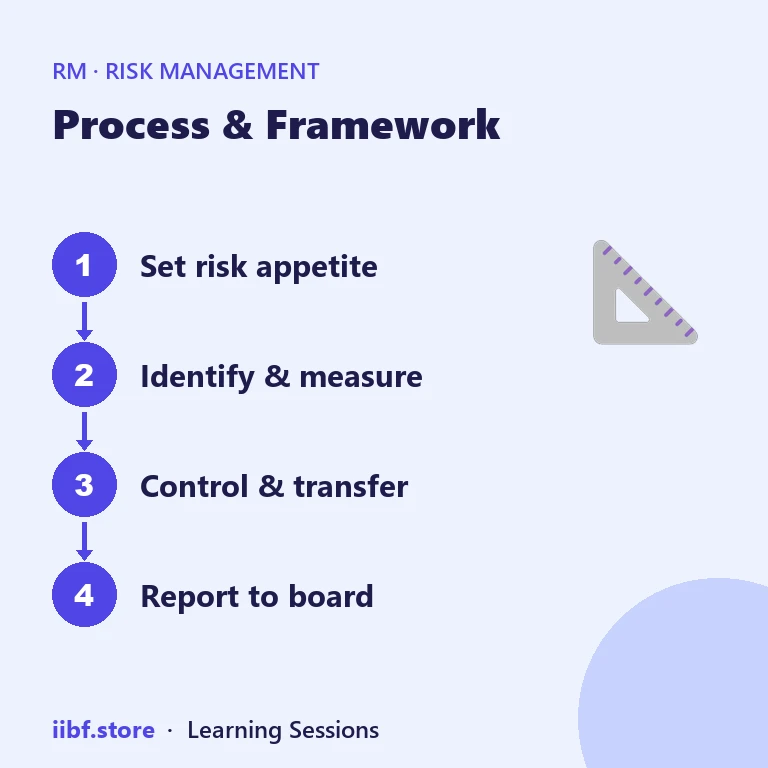
🏛️ Governance, ICAAP Linkage and Management Actions
Stress testing in banks fails most often not on modelling but on governance. A technically elegant run that nobody owns, challenges or acts on adds no resilience.
Who owns what
- Board: approves the stress-testing policy, the risk appetite it defends, and the capital plan that follows from the results.
- Risk management committee / ALCO: approves scenarios and severity, challenges assumptions, and signs off management actions.
- Risk function: designs and runs scenarios, maintains models, and reports results independently of the business lines.
- Business units: supply portfolio data and behavioural assumptions, and own the mitigation actions in their books.
- Internal audit / independent validation: tests data lineage, model assumptions and whether prior actions were actually executed.
The ICAAP connection
Stress testing is the analytical engine of the Internal Capital Adequacy Assessment Process. Pillar 1 sets minimum capital for credit, market and operational risk on standard rules. ICAAP asks whether that minimum, plus buffers, is enough for this bank's actual risk profile — including concentration, interest rate risk in the banking book, and strategic risk that Pillar 1 does not price. The stressed capital trajectory is the evidence base for the answer, and the gap between the stressed trough and the regulatory floor is what sizes the internal capital buffer and the capital plan's timing.
Results must also survive the supervisory conversation, which is one reason the framework has to be re-examined whenever rules change — the horizon-scanning habit described under regulatory risk in banks belongs inside the scenario design process, not beside it.
Management actions
Every reported result should carry a credible action set: slowing growth in stressed sectors, tightening sanction criteria, reducing single-borrower and sectoral concentration, hedging duration, lengthening funding tenor, raising collateral standards, conserving capital by adjusting dividends, or triggering the contingency funding plan. Actions assumed in the model must be ones the bank could realistically execute in the stressed environment — assuming an equity raise in the middle of a systemic crisis is exactly the kind of assumption supervisors reject.
Frequency should match volatility: full integrated runs at least annually with the ICAAP cycle, liquidity stress far more often, and ad-hoc runs whenever a shock is developing. Wider study material across the paper is collected on the Risk Management article hub, and current policy numbers can be checked against the RBI rates reference before you quote any figure in an answer.
🧠 Practice MCQs: Stress Testing and Scenario Design
Q1. A bank shifts the entire yield curve up by 200 bps and holds all other risk factors constant. This is best described as: (a) an integrated stress test (b) a sensitivity analysis (c) a reverse stress test (d) a historical scenario
Answer: (b) — Moving a single risk factor while holding everything else constant is the defining feature of sensitivity analysis.
Q2. Reverse stress testing is best described as an exercise that: (a) applies the most severe historical shock available (b) reverses a hedge to measure gross exposure (c) starts from a defined failure outcome and identifies scenarios that would cause it (d) reruns last year's scenario on this year's balance sheet
Answer: (c) — Reverse stress testing fixes the failure endpoint and solves backwards for the event combinations that produce it.
Q3. The main limitation of using a historical scenario such as a past crisis episode is that: (a) it lacks economic coherence between factors (b) regulators do not accept historical data (c) it cannot be quantified (d) the current portfolio and business mix may differ materially from the period replayed
Answer: (d) — Historical scenarios are credible but may not capture today's concentrations, products or counterparties.
Q4. Under a severe credit scenario, the capital ratio is squeezed from two directions primarily because: (a) risk weights fall while provisions fall (b) rating downgrades raise risk-weighted assets while higher provisions reduce retained earnings (c) deposits are reclassified as capital (d) operational risk charges are recalculated monthly
Answer: (b) — The denominator rises with RWA while the numerator falls through provisioning charges to profit.
Q5. In the ICAAP, the primary role of stress test results is to: (a) replace Pillar 1 minimum capital requirements (b) set the daily VaR limit for the trading desk (c) provide the evidence base for internal capital buffers and the capital plan (d) determine the statutory liquidity ratio
Answer: (c) — Stress results size the internal buffer above Pillar 1 and drive the timing of the capital plan.
Want chapter-wise mock tests with 100+ MCQs? Start practising free →
❓ Frequently Asked Questions
Is stress testing the same as scenario analysis?
No. Scenario analysis is one technique within stress testing. The broader discipline also includes single-factor sensitivity tests and reverse stress tests, each answering a different question.
How severe should a stress scenario be?
Severe but plausible. A practical benchmark is that the severe case should be worse than anything in the bank's recent experience while still being explainable by an economic narrative the board will accept and act on.
How often should a bank run stress tests?
Integrated capital stress tests are typically run at least annually alongside the ICAAP cycle. Liquidity stress tests are run much more frequently, and ad-hoc runs are triggered whenever a material shock or emerging risk appears.
Which exam papers cover this topic?
It appears in the IIBF Certificate in Risk Management and recurs in CAIIB's BFM paper through interest rate risk, liquidity and capital adequacy questions. Preparing both together saves considerable revision time.
🎯 Final Word
Treat stress testing in banks as one continuous chain — narrative, calibration, translation into PD, LGD, NII, MTM and CRAR, then governance and action. Questions in the paper almost always test one link of that chain, so knowing where each technique sits is worth more than memorising definitions. Practise the numeric translation until the direction of every impact is automatic, then work the governance layer until you can name the owner of each step.
Ready to test yourself under exam conditions? Work through the risk chapters and mocks on the CAIIB course page, then attempt a timed set at iibf.store mock tests.
Practice this topic
Take a free mock test, download chapter PDFs, or watch a video class — all included on iibf.store.
Keep reading