Regulatory Risk in Banks: Horizon Scanning, Impact and Mitigation (IIBF RFS)
For most bank officers, "risk" means credit defaults or a bad trading position. But regulatory risk in banks is different — it is the risk that a change in law, regulation or supervisory expectation forces you to redesign products, hold more capital, or rework systems before you are ready. Unlike a market shock, it rarely arrives without warning: RBI publishes draft directions, discussion papers and consultation drafts months ahead. The banks that read those signals early adjust cheaply. The ones that wait for the final gazette notification end up retrofitting core systems under deadline pressure, and pay for it twice — once in project cost, once in supervisory trust.
📊 Regulatory Risk vs Compliance Risk: Why the Distinction Matters
Candidates routinely blur regulatory risk with compliance risk, and examiners test the line between them. Compliance risk is backward-looking: it is the risk of penalty or loss from failing to follow rules that already exist — a KYC lapse, a delayed regulatory return, a breach of an exposure ceiling already in force. Regulatory risk is forward-looking: it is the risk that the rulebook itself changes, and your business model, pricing or capital plan becomes non-compliant or uneconomic the moment a new direction takes effect.
A bank can have a spotless compliance record and still carry high regulatory risk — think of a lender whose entire book depends on an unsecured-lending risk weight that RBI is known to be reviewing, or a co-lending arrangement structured around a supervisory interpretation that has not been formally tested. The Basel Committee's supervisory guidance treats this forward-looking exposure as part of the wider risk governance mandate, not a compliance checklist item, which is why RFS candidates should study it alongside the Credit Risk Management Framework rather than treating it as a standalone topic.
💡 Exam Tip: If a question describes a bank reacting to a rule that already exists, tag it compliance risk. If it describes a bank positioning ahead of a rule that has only been proposed or drafted, tag it regulatory risk.
🔭 Horizon Scanning: Reading Draft Directions Before They Bite
Horizon scanning is the formal process by which a bank's regulatory affairs or compliance function tracks consultation papers, draft directions, discussion papers and speeches from RBI, the Basel Committee and other regulators, and translates them into an internal watchlist before they become binding. A mature horizon-scanning function does three things: it maintains a live register of pending regulatory changes with expected effective dates, it assigns an owner in each business line to assess exposure, and it feeds a short impact note to the risk committee well before the comment period on a draft closes.
This is where regulatory risk in banks becomes a genuine early-warning discipline rather than a legal-affairs footnote. A draft direction on expected credit loss provisioning, for instance, signals a shift that touches credit risk models, pricing and disclosure long before the final direction is notified — which is exactly why horizon scanning has to sit next to the bank's Credit Risk Models and Portfolio Credit Risk functions, not sit isolated in a legal team. Banks that skip formal horizon scanning tend to discover a rule change only when the final circular lands — by which point the implementation clock has already started and negotiating room with the supervisor is gone.
⚠️ Common Mistake: Treating a consultation paper as noise until it becomes a final direction. By the time a direction is notified, the implementation window is already running — the horizon-scanning value was in the draft stage.
💰 Impact Assessment: Capital, Products and Pricing
Once a draft or new direction is identified, the next discipline is impact assessment — quantifying what the change actually does to the bank before it is forced to react. Three areas are almost always in scope. Capital: does the change alter risk weights, provisioning norms or capital buffers, and by how much does that move the CRAR? Products: does an existing product become non-compliant, need repricing, or need withdrawal? Pricing: does a change in funding cost, capital charge or fee-cap regulation compress the margin on a product line that was assumed profitable?
Good impact assessment is quantitative, not a one-line memo. It runs the proposed rule through the same stress-testing and portfolio tools used for credit risk work, comparing the pre- and post-change position across products, and it flags which committees need to sign off before implementation begins. The table below summarises how a mature impact-assessment process differs from an ad hoc one.
| Impact Assessment Practice | Ad Hoc Approach | Mature Governance |
|---|---|---|
| Trigger point | Final circular only | Draft / consultation stage ✅ |
| Capital impact quantified | ❌ Estimated late | ✅ Modelled before effective date |
| Product repricing reviewed | ❌ Reactive | ✅ Scenario-tested in advance |
| Ownership assigned | ❌ Unclear | ✅ Named business owner per change |
| Board / risk committee visibility | ❌ After the fact | ✅ Tracked on a live register |
This is also where regulatory risk in banks intersects with market and credit risk measurement directly: a change to the standardised approach for market risk capital, for example, needs the same kind of scenario work covered under Market Risk, applied specifically to the incoming rule rather than to day-to-day trading exposure — the same discipline candidates study under market risk measurement in banks. A regulatory change that tightens sector caps can equally reshape how concentration risk in bank lending is measured and limited, so impact assessment for one often triggers a review of the other.
🏗️ Implementation Governance and the Cost of Retrofitting Late
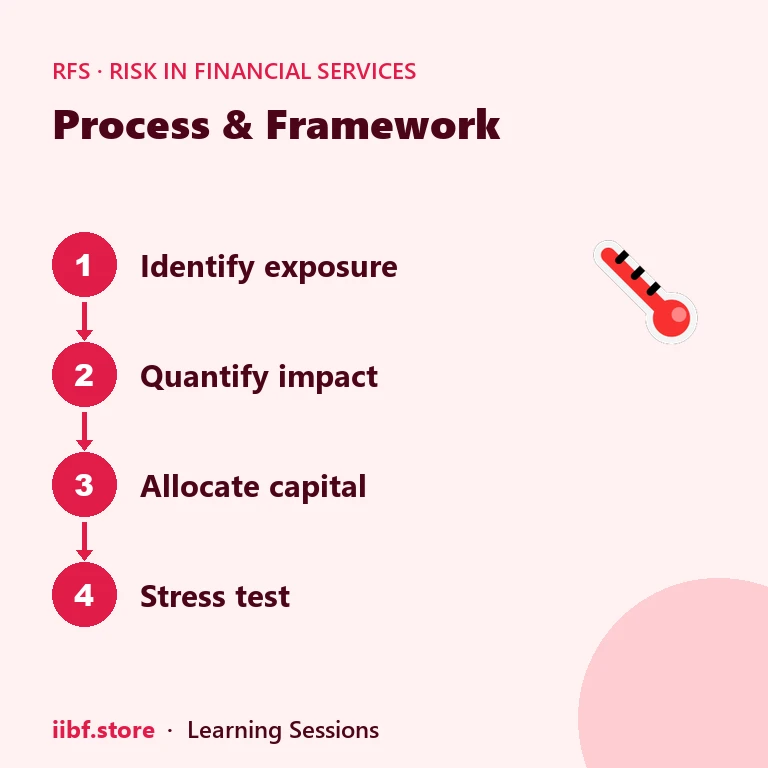
Identifying and assessing a regulatory change is only half the job — the bank still has to implement it, and this is where regulatory risk most often turns into real financial loss. Implementation project governance means treating a regulatory change like any other major IT and process project: a named sponsor, a defined scope, a testing plan, a parallel-run period where feasible, and a go-live date built backward from the regulatory effective date with buffer for slippage.
Banks that fold regulatory implementation into business-as-usual sprint capacity, instead of ring-fencing a dedicated project, consistently underestimate the work. Core banking and loan-origination systems were rarely built with the next rule change in mind, so a provisioning-methodology change or a new disclosure format often means touching data lineage across several systems, not just a configuration flag. Retrofitting this late — after the effective date has already passed — costs far more than building it into the roadmap early, because it now competes with emergency remediation, manual workarounds, and the risk of a supervisory finding for late compliance stacked on top of the original implementation cost.
📌 Remember: The cost of a regulatory change is not the change itself — it is the gap between the effective date and the date the bank's systems are actually ready. Horizon scanning exists to shrink that gap.
⚖️ Enforcement Action and the Feedback Loop to Capital and Reputation
When implementation genuinely fails — a bank stays non-compliant past the effective date, or a supervisory inspection finds the impact assessment was never done properly — regulatory risk crystallises as enforcement risk. Under the Banking Regulation Act, 1949, RBI can levy monetary penalties, issue directions restricting specific business activity, or in serious cases curtail a bank's ability to expand a product line until remediation is verified. These are published on the RBI website and picked up by rating agencies and the market almost immediately.
The feedback loop back into capital and reputation is direct. A monetary penalty is a P&L hit, but the bigger cost is usually indirect: heightened supervisory scrutiny that slows every subsequent approval, a reputational dent that raises funding cost at the margin, and — where the underlying breach touched capital adequacy — a direct reduction in the CRAR buffer the bank can rely on. This is precisely why RFS treats regulatory risk as a first-order risk category and not an administrative afterthought: an unmanaged regulatory risk today is tomorrow's operational-risk loss event and reputational-risk headline in one. For the authoritative, always-current source on enforcement actions, directions and penalties, refer to rbi.org.in rather than any secondary summary. Sustained regulatory breaches also feed the operational-risk loss database, and the same tail-loss modelling used in scenario analysis in operational risk is what banks now use to size the capital held against a future enforcement event.
🎯 Bringing It Together for the RFS Exam
Regulatory risk in banks sits at the intersection of governance, credit and market risk measurement, and project discipline — which is exactly how IIBF's RFS paper tests it: expect scenario questions that ask you to separate a compliance breach from a forward-looking regulatory exposure, and to trace how a delayed implementation turns into an enforcement and capital problem. Revisit the Credit Rating System and Obligor and Borrower Risk chapters alongside this topic, since impact assessments almost always route through them. Regulatory risk also feeds board-level planning, which is why it pairs naturally with strategic risk in financial services on your revision list. For the wider risk syllabus, browse every article under the Risk in Financial Services tag hub, and when you are ready to test recall, attempt a timed RFS mock test to see how these scenario questions actually get framed.
🧠 Practice MCQs: Regulatory Risk in Banks
Q1. Regulatory risk in banks is best described as the risk that: (a) an existing regulation is breached through operational error (b) a change in law, regulation or supervisory expectation makes current practice non-compliant or uneconomic (c) a borrower defaults on a regulatory loan (d) interest rates move against a fixed-rate book
Answer: (b) — Regulatory risk is forward-looking exposure to changes in the rulebook, distinct from compliance risk, which concerns breaches of existing rules.
Q2. Horizon scanning in the context of regulatory risk primarily involves: (a) reviewing past compliance breaches (b) tracking consultation papers and draft directions to assess future exposure (c) auditing customer KYC records (d) calculating value at risk on the trading book
Answer: (b) — Horizon scanning tracks draft directions, discussion papers and consultation papers before they become binding, giving the bank lead time to assess impact.
Q3. A bank discovers a proposed rule will raise risk weights on a lending product it sells heavily. The FIRST step in a mature process is to: (a) wait for the final circular before doing anything (b) quantify the capital and pricing impact under the draft rule (c) immediately withdraw the product (d) file a compliance breach report
Answer: (b) — Impact assessment on capital, products and pricing should begin at the draft stage, well before the rule is finalised or an effective date is set.
Q4. The main financial danger of retrofitting systems for a regulatory change AFTER the effective date has passed is that: (a) the change becomes voluntary (b) the bank can request an extension without cost (c) remediation competes with emergency workarounds and may draw a supervisory finding on top of the original cost (d) no additional cost is incurred since the rule was already known
Answer: (c) — Late retrofitting is more expensive because it is done under deadline pressure, alongside manual workarounds, and can attract a separate supervisory finding for delayed compliance.
Q5. Under the Banking Regulation Act, 1949, RBI's enforcement action against a bank for a sustained regulatory breach can include: (a) only a private advisory letter with no public record (b) monetary penalties and directions restricting specific business activity (c) automatic license cancellation in every case (d) no action unless a criminal complaint is filed
Answer: (b) — RBI can levy monetary penalties and issue directions curtailing specific activities; these are published and affect market and rating-agency perception, feeding back into reputation and funding cost.
Want chapter-wise mock tests with 100+ MCQs? Start practising free →
What is the difference between regulatory risk and compliance risk in banks?
Compliance risk is the risk of penalty or loss from breaching a rule that already applies to the bank today. Regulatory risk is forward-looking: the risk that a proposed or upcoming change in law, regulation or supervisory expectation will make current products, pricing or capital planning non-compliant or uneconomic once it takes effect.
Why is horizon scanning important for managing regulatory risk in banks?
Horizon scanning tracks consultation papers, draft directions and regulatory speeches before they become final rules, giving the bank lead time to assess impact and plan implementation. Without it, a bank only reacts once the final circular is notified, by which point the implementation timeline has already started.
What does impact assessment cover when a new regulation is proposed?
A proper impact assessment quantifies how the proposed change affects capital adequacy, existing products, and pricing — typically by modelling the pre- and post-change position and routing the findings to the relevant risk and business committees before the rule is finalised.
How does poor regulatory risk management lead to enforcement action?
If a bank fails to implement a regulatory change by its effective date, or an inspection finds the impact assessment and implementation governance were inadequate, RBI can levy monetary penalties or issue directions restricting business activity under the Banking Regulation Act, 1949, which in turn affects capital, supervisory standing and reputation.
Practice this topic
Take a free mock test, download chapter PDFs, or watch a video class — all included on iibf.store.
Keep reading