Bank Treasury: mark to market valuation of derivatives explained
Mark to market valuation of derivatives is the daily discipline that tells a bank what its swap, forward and option book is actually worth today, not what it was booked at on trade date. In a bank treasury, mark to market valuation of derivatives replaces the trade-date price with the current exit price every single day, so an overnight rate move on a single unhedged position shows up in the profit and loss account immediately. For JAIIB and CAIIB candidates, this topic sits at the junction of three syllabus areas: instrument mechanics, valuation mathematics and risk reporting. Examiners like it because it lets them test whether you understand fair value as a process, not just as a definition.
This guide walks through what revaluation measures, how each major instrument is priced off a discount curve, why credit adjustments are layered on top, and how the resulting number drives margin calls, exposure limits and provisioning on client positions.
📉 What Mark to Market Valuation of Derivatives Measures
Fair value is the price at which a position could be closed out with a willing counterparty in an orderly transaction on the reporting date. Revaluation replaces the historical trade price with that current exit price and routes the difference to the profit and loss account or to a reserve, depending on the classification of the deal. Trading positions are revalued and the change is recognised immediately; positions designated as hedges follow the accounting treatment of the underlying, so the gain or loss is deferred or matched rather than taken straight to income.
The contrast to understand is accrual versus fair value. Under accrual accounting, only the interest that has economically arisen during the period is recognised, spread evenly over the life of the contract. Under fair value accounting, the entire remaining life of the contract is repriced every day, so a rate move at the far end of the curve hits today's books even though no cash has changed hands. That is why a bank can report a large derivative loss in a quarter in which every payment was received on time.
A second distinction is realised versus unrealised. Revaluation produces an unrealised figure; it becomes realised only on termination, assignment or maturity. Both are real for risk purposes. Before you can price anything you need a firm grip on how the underlying markets quote, which the chapter on the derivative market covers in detail, and on how dealing desks are organised inside an integrated treasury.
💡 Exam Tip: If a question says "no cash flow has occurred yet", the answer usually involves an unrealised revaluation entry, not a realised gain. Read the wording of the option carefully.
🧮 Valuing Forwards, Swaps and Options Off the Curve
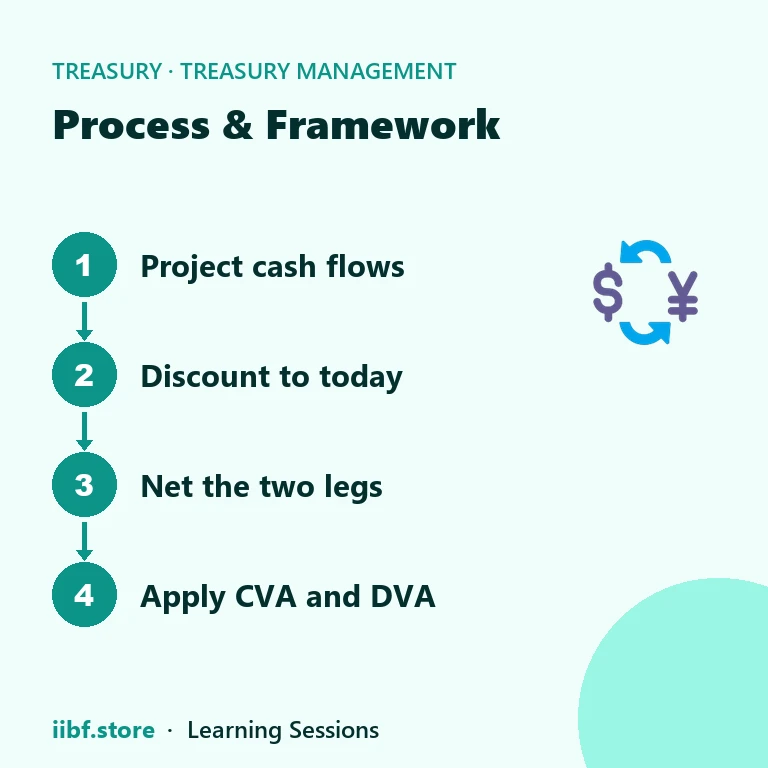
Every derivative valuation reduces to the same three steps: project the future cash flows, discount them to today, and net the two legs. What changes from instrument to instrument is only how the projection is made.
An outright foreign exchange forward is valued by comparing the contracted rate with the forward rate ruling today for the same remaining maturity, and discounting that difference back. If you bought dollars forward at a rate below today's comparable forward rate, the contract carries a positive fair value. An interest rate swap is valued by projecting the floating leg off the forward rates implied by the current swap curve, projecting the fixed leg off the contracted coupon, discounting both legs, and taking the difference. A cross-currency swap adds one more layer, because the two legs sit on two different discount curves and the resulting foreign currency value must be converted at the spot rate; the basis spread between the two currencies is itself a priced input.
The discount curve is therefore the single most important input, and building it correctly demands the same bootstrapping and duration logic taught for fixed income securities, duration and convexity. Candidates preparing the risk paper should also revise the yield curve and term structure of interest rates, because a parallel shift and a steepening produce very different revaluation results on the same swap.
| Instrument | Main valuation input | Daily revaluation in trading book | Usually collateralised |
|---|---|---|---|
| FX forward | Spot rate plus forward points for residual tenor | ✅ | ❌ |
| Interest rate swap | Domestic swap or overnight index curve | ✅ | ✅ |
| Cross-currency swap | Two discount curves plus currency basis and spot | ✅ | ✅ |
| Exchange-traded futures | Exchange settlement price | ✅ | ✅ |
| Client currency option | Volatility surface plus forward and discount curve | ✅ | ❌ |
Structures sold to companies, such as currency swaps for corporate hedging, are valued exactly the same way; only the client-facing spread differs.
📊 The CVA and DVA Overlay on Fair Value
A curve-based price assumes both parties always pay. They do not. The credit valuation adjustment, or CVA, reduces the fair value of a position that is in the bank's favour to reflect the chance that the counterparty defaults before the contract matures. It is conceptually the expected loss on the derivative exposure: the profile of expected positive exposure over the life of the deal, multiplied by the counterparty's default probability and by loss given default. Because the exposure profile itself depends on future rates, CVA is a hybrid of market risk and credit risk, and Basel norms as adopted by RBI require capital to be held for the volatility of CVA, not merely for default itself.
The debit valuation adjustment, or DVA, is the mirror image: it recognises that the bank's own credit standing affects what a counterparty would pay to take over the bank's obligations. DVA produces the counter-intuitive result that a deterioration in the bank's own credit can create an accounting gain, which is why many supervisors filter DVA gains out of regulatory capital.
Legal documentation directly reduces the credit overlay. Close-out netting collapses many contracts into a single net amount on default, and a credit support annex requires collateral to be posted as exposure builds, so the residual exposure driving CVA is much smaller. That is why the ISDA master agreement in treasury is treated as a risk-mitigation tool and not merely as paperwork. Similar documentation logic runs through market conventions such as FEDAI rules for forex dealings, which fix value dates and cancellation charges for rupee forward contracts.
⚠️ Common Mistake: CVA is not a provision on an overdue amount. It is an adjustment to the fair value of a live, performing contract, computed on expected future exposure.
🔔 Margin Calls, Credit Equivalent and Client Exposure
Once a revaluation number exists, it drives cash and limits. On exchange-traded and centrally cleared positions, variation margin settles the change in fair value in cash, usually daily, while initial margin is held against the potential move between the last settlement and close-out of a defaulted member. In bilateral deals, a credit support annex performs the same function contractually, with thresholds and minimum transfer amounts deciding when a call is actually made.
For credit limit and capital purposes, current fair value alone understates the risk, because rates can move further tomorrow. Supervisory approaches therefore build a credit equivalent amount out of two parts: the current replacement cost, which is the positive fair value of the contract, and an add-on for potential future exposure that scales with residual maturity and the volatility of the underlying. Negative fair values are floored at zero, since a bank that owes money on a contract has no credit exposure on it. Candidates should confirm the current add-on factors and any netting recognition from the latest RBI master direction, as these have been revised over successive Basel updates.
The same number is what the corporate client sees. A hedge that has moved against the client shows as a mark to market loss on its statement, and where that loss is unsettled and overdue, prudential norms require the bank to treat the receivable as a credit exposure and to provide for it. Unhedged foreign currency exposure of borrowers attracts incremental provisioning and capital under a separate RBI framework, so a client that has left a large exposure open increases the bank's own requirement. Positions in the underlying market itself are covered in the chapter on the foreign exchange market.
📌 Remember: Replacement cost uses the positive fair value only. A contract with a negative fair value contributes nothing to the credit equivalent amount, though it still consumes market risk limits.
🧠 Practice MCQs: Mark to Market Valuation
Q1. Under fair value accounting, a change in the market value of a trading derivative is recognised: (a) only on maturity (b) immediately in the profit and loss account (c) only when cash settles (d) evenly over the residual life
Answer: (b) — Trading positions are revalued and the resulting unrealised gain or loss is taken to income at once.
Q2. In valuing an interest rate swap, the floating leg cash flows are typically projected using: (a) the contracted fixed coupon (b) the spot exchange rate (c) forward rates implied by the current swap curve (d) the historical average of past resets
Answer: (c) — Forward rates implied by today's curve give the projected floating payments, which are then discounted.
Q3. The credit valuation adjustment on a derivative essentially reflects: (a) expected loss from counterparty default over the life of the contract (b) the bank's own funding cost (c) the brokerage payable on the trade (d) the statutory reserve requirement
Answer: (a) — CVA combines the expected positive exposure profile with default probability and loss given default.
Q4. In computing the credit equivalent amount of a derivative, a contract with a negative fair value contributes a replacement cost of: (a) the absolute value of the loss (b) half the notional (c) the full notional (d) zero
Answer: (d) — Replacement cost is floored at zero, because the bank owes money and therefore has no credit exposure on that contract.
Q5. Variation margin on a cleared derivative position is best described as: (a) a one-time deposit fixed at inception (b) cash settlement of the daily change in fair value (c) a fee for clearing services (d) a penalty for late confirmation
Answer: (b) — Variation margin settles the day's revaluation movement in cash, while initial margin covers potential future moves.
Want chapter-wise mock tests with 100+ MCQs? Start practising free →

❓ Frequently Asked Questions
Is mark to market valuation of derivatives the same as realising a profit?
No. Revaluation produces an unrealised figure that reverses if rates move back. The gain or loss becomes realised only when the contract is terminated, assigned or allowed to mature.
Why do banks apply CVA if the counterparty has not defaulted?
Because fair value is an exit price. Any buyer of the position would demand compensation for the possibility of future default, so that expected loss is deducted from the curve-based value of a live, performing contract.
Does a credit support annex remove counterparty risk completely?
No. Collateral posted against exposure reduces it substantially, but thresholds, minimum transfer amounts and the gap between the last call and actual close-out leave a residual exposure that still carries capital.
What happens when a corporate client's hedge shows a large loss?
The bank calls for settlement or collateral under the terms of the deal. If the amount remains unpaid, the receivable is treated as a credit exposure and provided for under the applicable prudential norms.
Treat revaluation as a chain rather than a formula: curve, cash flows, discounting, credit overlay, then limits and provisioning. If you can explain why a swap that has generated no cash yet can still produce a reported loss, and why that loss is scaled down by netting and collateral, you can answer most questions the paper throws at you. Browse more notes on the treasury management tag hub, revise the scope and function of treasury management, and then lock the concepts in with the full CAIIB course and mock tests.
Source and further reading: FIMMDA and the Indian Institute of Banking & Finance.
Practice this topic
Take a free mock test, download chapter PDFs, or watch a video class — all included on iibf.store.