MCLR vs EBLR: What Actually Changes for the Borrower

Somebody asks the MCLR vs EBLR question in almost every JAIIB batch, and it always arrives in the same shape: if both are just benchmarks for pricing a floating rate loan, why did the Reserve Bank need two of them? The honest answer is that the first one did not do the job it was built to do. MCLR vs EBLR is not really a fight between two formulas. It is the story of the RBI giving up on internally computed benchmarks for retail lending and pushing banks onto a rate that no bank can quietly manage in its own favour.
MCLR vs EBLR · Watch on YouTube
Why an internally computed benchmark stopped working
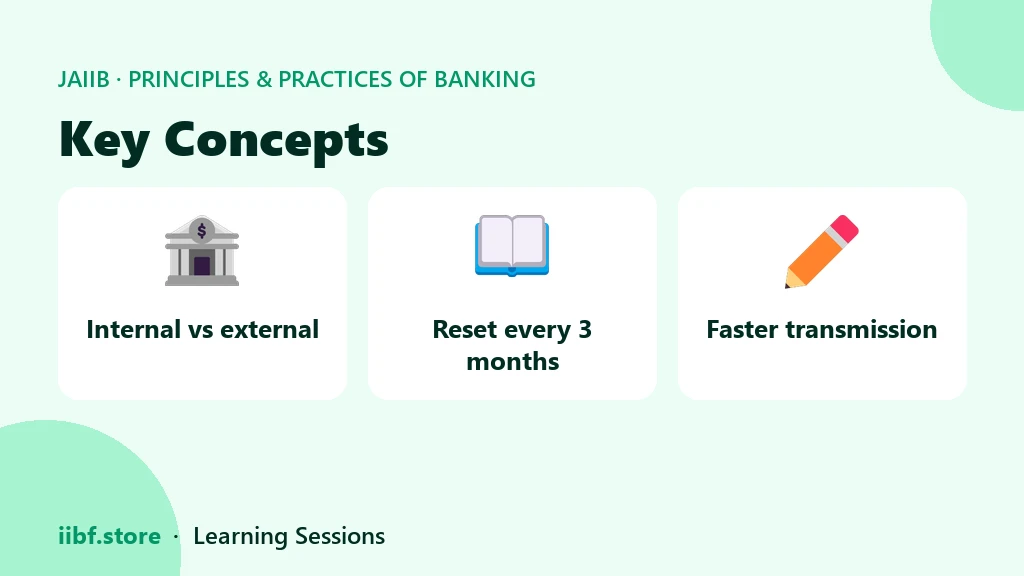
Under the MCLR system a bank works out its own lending rate floor from its own cost data. That sounds fair until you notice the incentive it creates. When the policy rate falls, a bank that is slow to reprice its deposits can honestly report that its cost of funds has barely moved, and therefore its MCLR barely moves either. When the policy rate rises, the same arithmetic is far quicker to catch up. Borrowers noticed. So did the regulator.
The RBI set up an Internal Study Group to examine exactly this. Its report, published in October 2017 for public comment, concluded that internal benchmarks such as the Base Rate and the MCLR had not delivered effective transmission of monetary policy, and recommended a time-bound switch to an external benchmark. Two years later that recommendation became a circular, and the whole MCLR vs EBLR distinction was born.
How MCLR is actually built
MCLR stands for marginal cost of funds based lending rate, and the word that carries the weight is marginal. The bank is not costing its entire deposit book. It is costing the next rupee it would have to raise. Four components go into the number:
- Marginal cost of funds. A weighted figure made of the marginal cost of borrowings at 92 per cent and the return on net worth at 8 per cent. The 8 per cent weight is not arbitrary - it mirrors the minimum Tier 1 capital requirement.
- Negative carry on the CRR. Balances a bank parks with the RBI to meet the cash reserve ratio earn nothing, so the funding cost of that idle slice has to be recovered somewhere.
- Operating costs. The cost of actually running the lending business, excluding anything already recovered through service charges.
- Tenor premium. A uniform, borrower-agnostic premium for the longer commitment period. This is why a bank publishes MCLR for overnight, one month, three months, six months and one year tenors.
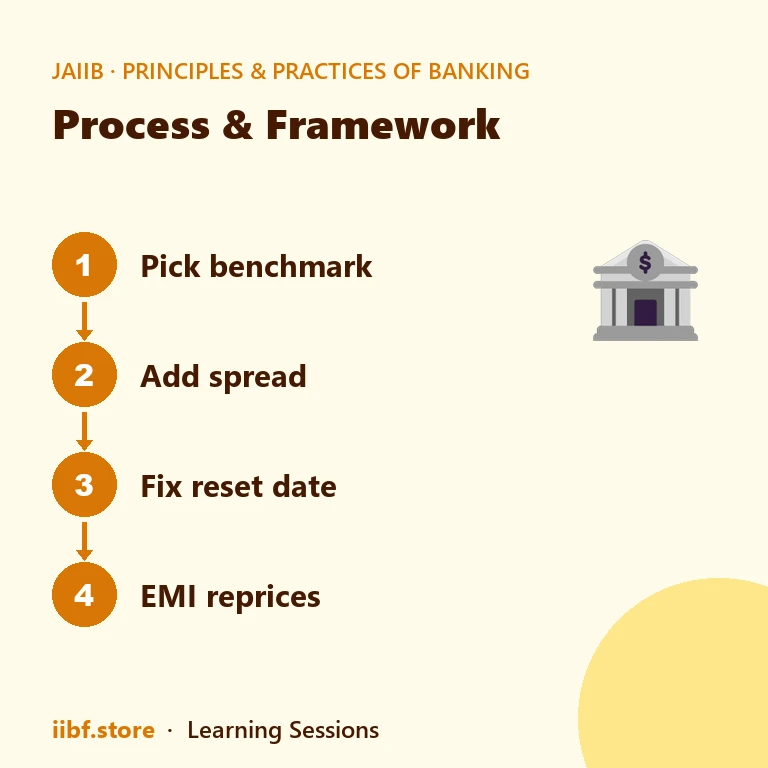
The lending rate is then the applicable MCLR plus a spread. Crucially, an MCLR-linked loan does not reprice the day the MCLR changes. It reprices on its pre-agreed reset date, which can be as far out as one year.
How EBLR is actually built
The external benchmark based lending framework came in through RBI circular DBR.DIR.BC.No.14/13.03.00/2019-20 dated 4 September 2019, effective for new floating rate personal or retail loans and floating rate loans to micro and small enterprises sanctioned from 1 October 2019. It was extended to medium enterprises from 1 April 2020. Banks must anchor those loans to one of four permitted benchmarks:
- the RBI policy repo rate;
- the Government of India three-month Treasury Bill yield published by FBIL;
- the Government of India six-month Treasury Bill yield published by FBIL; or
- any other benchmark market interest rate published by FBIL.
On top of that sits the spread, and the spread is where the discipline lives. A bank is free to decide it at sanction, but afterwards the credit risk premium may change only when the borrower's credit assessment undergoes a substantial change, and the other components of the spread - operating cost and the like - may be altered only once in three years. The benchmark itself must be reset at least once in three months. You can check the live policy rates any time on our RBI rates reference page.
MCLR vs EBLR side by side
| Feature | MCLR | EBLR |
|---|---|---|
| Introduced | 1 April 2016 | 1 October 2019 |
| Nature of benchmark | Internal - computed by the bank | External - repo rate or FBIL-published T-Bill yield |
| Who can see the inputs | Only the bank | Anyone, published publicly |
| Maximum reset interval | Up to one year | At least once in three months |
| Spread discipline | Bank policy | Credit risk premium only on substantial credit change; other components once in three years |
| Mandatory for | Floating rate rupee loans sanctioned from 1 April 2016 | New floating rate retail and MSE loans from 1 October 2019; medium enterprises from 1 April 2020 |
| Transmission speed | Slow and asymmetric | Fast and symmetric |
The same loan under both systems
Take two borrowers with identical credit profiles. As at 31 July 2026 the policy repo rate stood at 5.25 per cent, so assume the first borrower is on repo plus a spread of 2.75 per cent, giving an EBLR of 8.00 per cent. The second borrower sat down a few years earlier and took a one-year MCLR loan; assume the bank's one-year MCLR is 8.90 per cent and the spread is 0.10 per cent, so the rate is 9.00 per cent with an annual reset every April.
Now the RBI cuts the repo rate by 50 basis points in September. The first borrower's benchmark falls to 4.75 per cent and the rate falls to 7.50 per cent at the next quarterly reset - by December at the latest, whatever the bank thinks about it. The second borrower gets nothing until April, and even then only if the bank's own marginal cost of funds has actually fallen. That gap, spread over a twenty-year home loan, is the entire practical content of the MCLR vs EBLR debate.
Note the symmetry point that examiners like. A repo hike reaches the EBLR borrower just as fast. External benchmarking is not a discount scheme; it is a transparency scheme, and it cuts both ways.
What the exam actually asks
The MCLR vs EBLR area is a reliable source of one or two questions in JAIIB Principles and Practices of Banking, and it resurfaces in CAIIB when transmission and asset-liability management come up. The traps are consistent:
- The 92:8 weighting inside the marginal cost of funds is asked directly. Do not confuse the 8 per cent return-on-net-worth weight with any capital adequacy ratio figure.
- EBLR reset is "at least once in three months", not "every three months". A bank may reset faster.
- The three-year rule applies to the non-credit-risk components of the spread, not to the credit risk premium.
- Base Rate and MCLR are both internal benchmarks. Only the fourth generation - which we cover in the lending rate history piece on the blog - moved outside the bank.
Practise these as MCQs rather than notes; the distinctions only stick once you have got two of them wrong. Our chapter tests carry the full question bank for this module, and if you are building a study schedule around the December attempt, the study planner will sequence it for you. The primary source is worth ten minutes of your time as well - the circular sits on the RBI website and is unusually readable.
Frequently asked questions
Is MCLR abolished?
No. MCLR continues for loan categories outside the external benchmark mandate and for older loans that were never migrated. What changed is that new floating rate retail and MSME loans must be linked to an external benchmark, so MCLR no longer prices the bulk of new retail lending.
Can a bank change my EBLR spread whenever it likes?
No. The credit risk premium can change only if your credit assessment undergoes a substantial change, and the other components of the spread can be altered only once in three years. The benchmark itself moves freely - that is the part the bank does not control.
Which is cheaper, MCLR or EBLR?
Neither is inherently cheaper. In a falling rate cycle EBLR passes the cut on faster; in a rising cycle it passes the hike on faster too. The real difference in the MCLR vs EBLR comparison is speed and transparency, not level.
Can an existing MCLR borrower switch to EBLR?
Yes. Banks offer a switch to the external benchmark, usually on payment of an administrative or switching charge and subject to the bank's board-approved policy. Compare the effective all-in rate after the switch, not just the headline benchmark.
Quick quiz on this topic
5 exam-style questions from our free test bank — check yourself before you move on.
Practice this topic
Take a free mock test, download chapter PDFs, or watch a video class — all included on iibf.store.
Keep reading