MFI to SFB Transition 2026: Small Finance Bank Guide
The MFI to SFB transition is the single most important structural story in Indian financial inclusion, and it is a favourite theme in the IIBF Small Finance Bank certification. Most of India's small finance banks did not start life as banks at all — they were microfinance institutions (MFIs) that lent tiny, uncollateralised loans to joint-liability groups of women. When the RBI opened a licensing window for small finance banks, several of the largest MFIs applied, converted, and became fully regulated banks. Understanding what actually changes when a lender crosses that bridge — in funding, regulation, capital and culture — is essential for the 2026 exam, and this guide breaks it down section by section.
At its core, the transition converts an asset-only lender into a full-scope deposit-taking bank. That sounds like an upgrade, and commercially it often is, but it imposes a heavy new rulebook and forces a business model built for lending to suddenly master the art of gathering deposits.
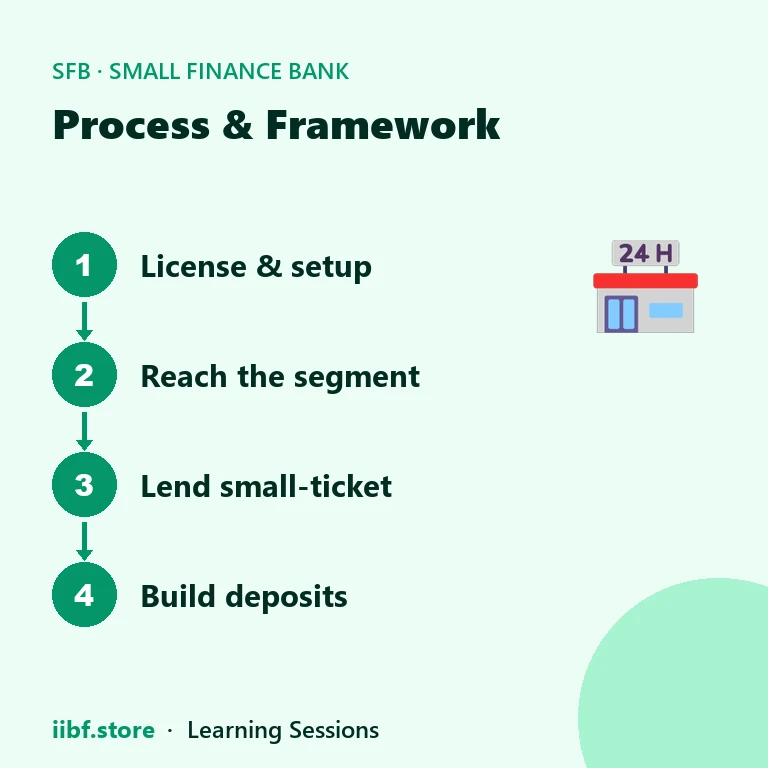
Why MFIs Chose to Become Small Finance Banks
An NBFC-MFI is fundamentally starved of cheap, stable funding. It borrows from banks and markets at wholesale rates and on-lends, so its cost of funds is high and its liability side is fragile. Converting into a small finance bank unlocks three prizes:
- Access to public deposits — especially low-cost current and savings accounts (CASA), which can dramatically cut the cost of funds over time.
- A stronger, more diversified liability profile — retail deposits are stickier than wholesale borrowings.
- A wider product suite and brand legitimacy — the ability to offer savings, fixed deposits, remittances and third-party products under a trusted "bank" label.
The trade-off is regulation. The moment the licence is granted, the entity falls under the full weight of the Banking Regulation Act, must maintain the cash reserve ratio (CRR) and statutory liquidity ratio (SLR), and answers to RBI supervision with far greater intensity than any NBFC ever did.
The Deposit Franchise Challenge: Building CASA
The hardest part of the MFI to SFB transition is not lending — the loan book already exists — it is learning to attract deposits. A brand-new bank has no CASA base, so it typically launches with headline-grabbing savings and fixed-deposit rates to buy its way into customers' wallets. This is expensive and squeezes margins in the early years.
Over time, the winning small finance banks convert their existing borrowers into savers, open feature-rich branches in semi-urban catchments, and use digital onboarding to gather granular retail deposits. Building a durable CASA franchise is a multi-year grind, and examiners often ask candidates to explain why the cost-to-income ratio spikes immediately after conversion before improving.
New Regulatory Obligations After Conversion
Once licensed, a small finance bank must satisfy a demanding set of prudential conditions. The 2026-relevant highlights that candidates should memorise are:
- Minimum paid-up capital of ₹200 crore, with a minimum capital-to-risk-weighted-assets ratio (CRAR) of 15% — higher than a universal bank because of the riskier, thinner-file customer base.
- Priority sector lending (PSL) of 75% of adjusted net bank credit, versus 40% for universal banks.
- A concentration rule: at least 50% of the loan portfolio must comprise loans and advances of up to ₹25 lakh, keeping the bank focused on small-ticket, financial-inclusion lending.
- CRR and SLR maintenance, listing obligations within three years of reaching net worth thresholds, and full RBI reporting.
These conditions are set out in RBI's operating guidelines for small finance banks, available on rbi.org.in. For candidates who also sit universal-banking papers, contrast these with the norms covered in our JAIIB course to see how much tighter the SFB regime is. You can track prevailing CRR, SLR and repo levels on our RBI rates page.
Governance, Culture and the People Shift
Beyond ratios, the transition demands a cultural transformation. An MFI runs on field officers and group meetings; a bank needs treasury, compliance, risk, internal audit and a board with banking experience. The organisation must build an ALCO, a robust KYC and AML machine, and a governance structure that satisfies fit-and-proper norms. Many transition pains — technology migration to core banking, staff retraining, and integrating a deposit culture with a lending culture — are behavioural, not financial.
Examiners like to probe this human dimension, so be ready to discuss why some conversions stumbled on governance and technology even when the underlying loan book was healthy. Stay current on licensing news via our IIBF news updates and reinforce definitions with the banking terms matching game.
Frequently Asked Questions

Related study material
Go deeper with the full chapter notes and the complete article hub for this subject:
Why did microfinance institutions want a small finance bank licence?
Chiefly to access low-cost public deposits, especially CASA, which lowers their cost of funds and diversifies a fragile, wholesale-dependent liability side. The licence also brings a broader product suite and the credibility of operating as a regulated bank.
What is the minimum capital and CRAR for a small finance bank?
A small finance bank needs minimum paid-up capital of ₹200 crore and must maintain a CRAR of at least 15%, higher than a universal bank because its financial-inclusion customer base carries thinner credit files and higher risk.
How much priority sector lending must an SFB do?
Small finance banks must direct 75% of adjusted net bank credit to priority sectors, nearly double the 40% required of universal banks, and at least 50% of the loan book must be individual loans of up to ₹25 lakh.
What is the biggest operational challenge after conversion?
Building a low-cost deposit franchise from zero. A former MFI has a ready loan book but no CASA base, so it must offer competitive rates and invest heavily in branches, technology and staff to gather granular retail deposits before margins recover.
Conclusion: Cement the Transition Story for Your Exam
The MFI to SFB transition ties together funding economics, RBI licensing conditions, priority-sector rules and organisational change — exactly the cross-cutting themes IIBF loves to test. Learn the four regulatory anchors (₹200 crore capital, 15% CRAR, 75% PSL, 50% small-ticket rule) and the CASA-building narrative, and you will handle any question the paper throws. Put it into practice now with a Small Finance Bank mock test on iibf.store.
Practice this topic
Take a free mock test, download chapter PDFs, or watch a video class — all included on iibf.store.
Keep reading