Small Finance Bank Target Segment: The Key to the IIBF SFB Exam
Understanding the Small Finance Bank target segment is the single most important idea for anyone preparing for the IIBF Small Finance Bank (SFB) examination. The Small Finance Bank target segment defines who these banks are licensed to serve, why the Reserve Bank of India created the category in 2015, and how nearly every operational, lending, and compliance rule in the syllabus flows from that mandate. Unlike a universal bank that can chase any customer, an SFB is a differentiated bank built to reach the financially excluded and underserved. If you internalise that one principle, Modules B and C of the SFB course stop being a list of disconnected topics and become a single, coherent story about serving small borrowers well.
This guide walks through the regulatory purpose, the customer segments an SFB must prioritise, the way its balance sheet is engineered around those customers, and the compliance guardrails the examiner expects you to know. Throughout, the focus stays practical and exam-accurate so you can answer both direct recall questions and the applied, scenario-style questions IIBF increasingly favours.
Why the RBI created the Small Finance Bank category
The Reserve Bank of India issued the Guidelines for Licensing of Small Finance Banks in the Private Sector in November 2015, and the first SFBs began operations in 2016 and 2017. The stated objective was financial inclusion: providing savings vehicles and supplying credit to small business units, small and marginal farmers, micro and small industries, and other unorganised-sector entities. Many of the earliest licensees were converted microfinance institutions (MFIs) and non-banking finance companies that already had deep last-mile reach in rural and semi-urban India but lacked a deposit franchise.
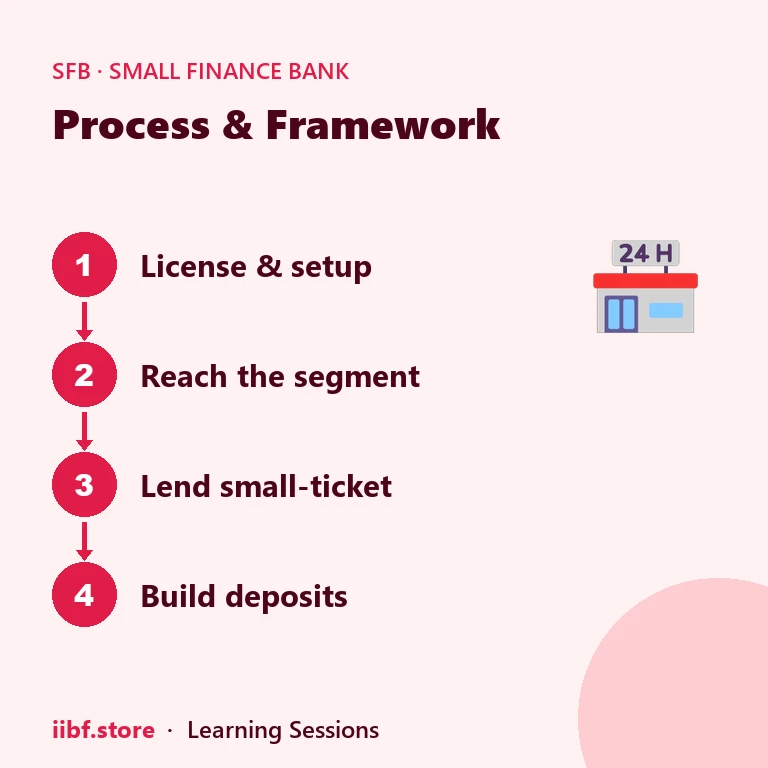
An SFB is a full-fledged bank in a legal sense: it accepts deposits, offers a savings and current account book, and is governed by the Banking Regulation Act, 1949 and RBI directions. What makes it "differentiated" is the scope restriction. It cannot lend large ticket sizes at will, and a defined majority of its loan book must reach priority sectors and small borrowers. This is precisely why the Small Finance Bank target segment is not a marketing phrase but a licensing condition. The examiner expects you to connect the segment to the two headline requirements the RBI attaches to it: a high floor for priority-sector lending and a cap on how much of the portfolio can sit in large loans. Understanding this "why" makes the numbers in the next section easy to remember rather than rote. For a deeper treatment of how these loans are actually booked, the course chapter on Priority Sector Advances is essential reading.
Who exactly is the Small Finance Bank target segment
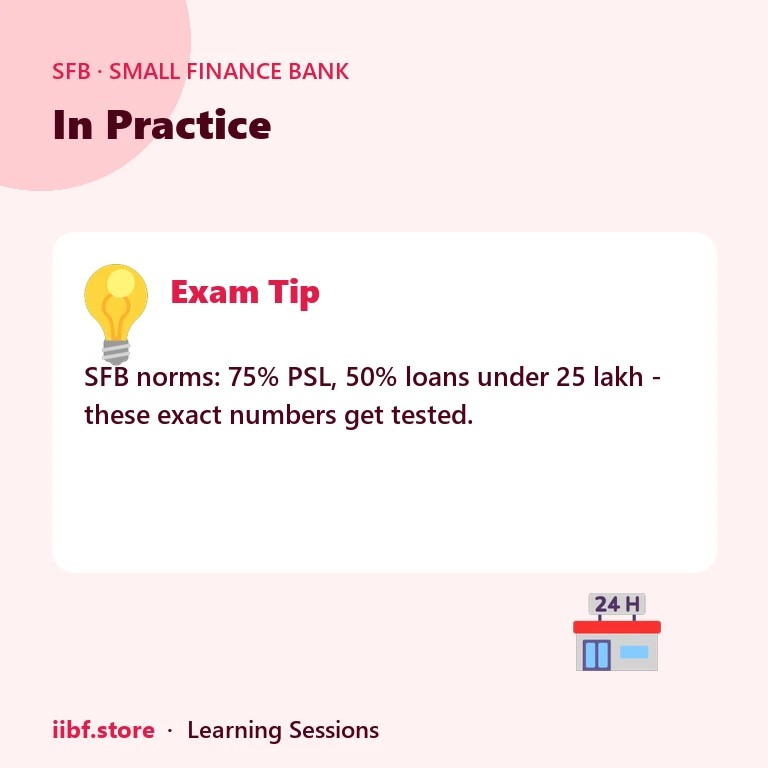
The customer base an SFB is licensed to serve is deliberately specific. It centres on small and marginal farmers, micro and small enterprises, small business units, low-income households, and unorganised-sector workers who have historically been outside the formal credit system. Two structural rules make this concrete and are heavily examinable. First, an SFB must extend at least 75% of its Adjusted Net Bank Credit (ANBC) to the sectors eligible for classification as priority-sector lending under RBI norms — double the 40% floor that applies to universal commercial banks. Second, at least 50% of the loan portfolio should consist of loans and advances of up to a defined small ticket size (traditionally framed around the Rs 25 lakh mark) to serve the small-borrower base, a condition the RBI reviews as the sector matures.
Because the segment skews toward first-time and thin-file borrowers, relationship banking matters more here than in a metro branch. Field officers know their customers personally, group-lending discipline substitutes for formal collateral, and repeat lending rewards good repayment behaviour. The SFB syllabus reflects this through its treatment of the banker-customer relationship and day-to-day account handling. Reviewing the chapter on the Banker's Special Relationship alongside Maintenance of Accounts shows how the target segment shapes even routine operational choices. You can test your grasp of these segment-specific rules on the IIBF SFB practice tests before exam day.
How the target segment shapes an SFB's balance sheet
Once you know who the customer is, the balance-sheet strategy becomes predictable — and that is exactly the logic IIBF questions test. On the asset side, the book is dominated by small-ticket, priority-sector loans: microfinance-style group loans, individual micro-enterprise loans, small agricultural advances, affordable housing, and loans against gold. Ticket sizes are small, yields are relatively high, and the portfolio is granular, which spreads risk across thousands of tiny exposures rather than a few large ones.
The harder challenge sits on the liability side. Newly licensed SFBs, especially those converted from MFIs, began life with almost no low-cost current and savings account (CASA) deposits, so they leaned on comparatively expensive term deposits and borrowings. Building a stable, low-cost deposit base is therefore the defining strategic project of every SFB, and the examiner may frame this as a cost-of-funds or net-interest-margin question. The table below summarises the key contrasts between an SFB and a universal commercial bank that you should be able to reproduce.
| Parameter | Small Finance Bank | Universal Commercial Bank |
|---|---|---|
| Priority-sector lending floor (of ANBC) | 75% | 40% |
| Small-ticket loans in portfolio | At least 50% up to a small defined limit | No such requirement |
| Minimum paid-up capital at licensing | Rs 200 crore | Rs 500 crore (new universal banks) |
| Typical starting CASA base | Very low; must be built | Established and large |
| Core customer | Small/marginal farmers, micro & small enterprises | Broad, all segments |
| Governing framework | Banking Regulation Act, 1949 + SFB guidelines | Banking Regulation Act, 1949 |
Note that the capital and threshold figures above are drawn from the RBI's licensing guidelines and are reviewed periodically; in the exam, if you are unsure of an exact current number, describe the requirement qualitatively rather than guessing. The operational mechanics behind this balance sheet are covered in the chapter on Operations of Banks.
Compliance and risk guardrails around the segment
Serving thin-file, cash-heavy customers raises the compliance stakes, so the SFB syllabus devotes real weight to Know Your Customer (KYC) and Anti-Money Laundering (AML) discipline. An SFB must follow the same RBI Master Direction on KYC as any other bank: risk-based customer due diligence, acceptance of Officially Valid Documents, periodic updation of KYC, and monitoring for suspicious transactions with reporting to the Financial Intelligence Unit. For a segment where many customers are onboarded through simplified or video-based processes, getting these controls right is both a regulatory duty and an exam favourite.
On the credit side, the principles of sound lending — safety, liquidity, profitability, purpose, and diversification — apply with extra force because the borrowers are vulnerable to local income shocks. Documentation, correct creation of charges, and disciplined recovery keep the granular book healthy. Candidates should study the chapters on KYC and AML and the Principles of Lending together, because the examiner often links a compliance failure to a downstream credit loss in scenario questions. For authoritative primary-source detail, the RBI's own official website (rbi.org.in) carries the SFB licensing guidelines and KYC Master Direction referenced throughout this syllabus. You can browse more SFB study material through the Small Finance Bank blog tag hub and revise related topics on the IIBF blog.
Frequently asked questions
What is the Small Finance Bank target segment?
It is the group of customers an SFB is licensed to serve on a priority basis: small and marginal farmers, micro and small enterprises, small business units, low-income households, and unorganised-sector workers who have limited access to formal banking. This mandate is enforced through RBI conditions such as a 75% priority-sector-lending floor.
Why must a Small Finance Bank lend 75% to priority sectors?
The 75% of Adjusted Net Bank Credit requirement — versus 40% for universal banks — is the RBI's way of guaranteeing that SFBs stay focused on financial inclusion rather than drifting toward large corporate lending. It directly ties the bank's assets to its licensed target segment.
How is an SFB different from a regular commercial bank?
An SFB is a differentiated bank with scope restrictions: a higher priority-sector floor, a majority of small-ticket loans, a lower minimum paid-up capital of Rs 200 crore at licensing, and a customer base centred on small borrowers. A universal bank has no such lending restrictions and serves all segments.
Why is CASA building so important for Small Finance Banks?
Most SFBs, especially former MFIs, started with little or no low-cost current and savings account deposits and relied on costly term funding. Growing a stable CASA base lowers the cost of funds and protects the net interest margin, making it the central strategic priority for the sector.
Conclusion and next step
The Small Finance Bank target segment is the thread that ties the entire SFB syllabus together: the RBI's inclusion mandate defines the customer, the customer defines the 75% PSL floor and small-ticket asset book, and that book in turn drives the CASA-building and KYC/AML priorities that fill Modules B and C. Master the segment first, and every downstream rule becomes far easier to recall under exam pressure. Ready to test yourself? Attempt a full-length IIBF Small Finance Bank mock test now, then reinforce weak areas with quick revision on the SFB match game and the latest RBI rates reference.
Practice this topic
Take a free mock test, download chapter PDFs, or watch a video class — all included on iibf.store.
Keep reading