Micro Enterprise Lending by Small Finance Banks: Appraisal and Collections (IIBF SFB)
For loan officers writing the IIBF Small Finance Bank exam, micro enterprise lending by small finance banks is the paper's most practical topic — because it is the business SFBs were licensed to do. Most micro entrepreneurs, from a roadside welding unit to a tailoring shop, keep no audited books. Appraisal has to run on cash flow, not on a balance sheet, and recovery has to run on doorstep contact, not on cheque bounces alone. This article walks through how SFBs assess informal borrowers, size the ticket, structure it as collateral-free credit under CGTMSE, and manage field collections through the loan's life.
📊 Cash-Flow Based Appraisal for Informal Borrowers
A micro enterprise borrower rarely has three years of CA-audited financials. Appraisal therefore shifts from ratio analysis to a direct estimate of household-cum-business cash flow — what actually comes in and goes out each month, and how much of that surplus can safely service an EMI. Field officers reconstruct this picture from bank statement turnover, GST returns where the unit is registered, purchase and sales vouchers, and simple stock and cash-book estimates taken during a unit visit.
Where formal proof is thin, SFBs rely on surrogate income proof: electricity and water bills as a proxy for scale of operation, rent receipts, supplier ledgers, local market inquiry, and — increasingly — the digital footprint of UPI or POS receipts. This is the same discipline covered under principles of lending, applied to borrowers who fall outside conventional credit-bureau depth. A candidate must remember that surrogate assessment is a substitute for documentation, not for due diligence — KYC, Udyam registration where applicable, and site verification remain mandatory regardless of ticket size.
The banker-customer relationship formed at this appraisal stage also shapes future underwriting — repeat borrowers with a clean repayment record graduate to larger, faster-approved tickets on the strength of internal transaction history rather than fresh paperwork. This progressive-trust model is discussed further under banker customer relationship in small finance banks, and it is central to why cash-flow lending scales profitably for SFBs despite thin formal documentation.
💡 Exam Tip: Cash-flow appraisal does not waive KYC or end-use verification — it only replaces the balance sheet as the primary underwriting input. Questions testing this distinction are common.
💰 Ticket Sizes and Loan Structuring for Micro Units
Ticket sizing for micro enterprise loans is deliberately small and short-cycle at entry, then steps up with proven repayment behaviour. First loans are typically modest working-capital tickets sized to a few weeks or months of the borrower's cash cycle rather than to asset value, with tenor matched to the seasonality of the trade — a festive-season trader needs a different repayment schedule than a year-round kirana shop.
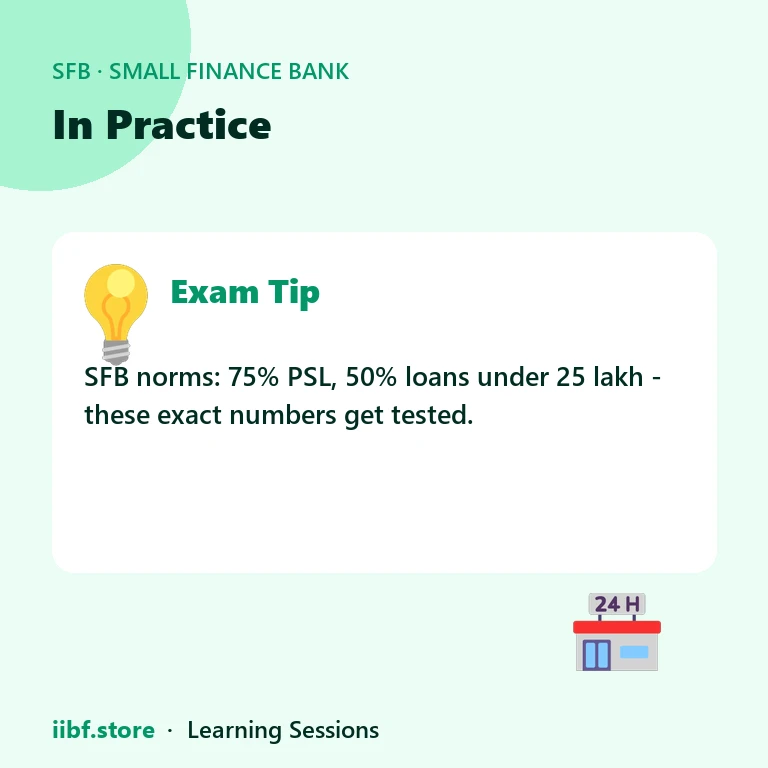
This small-ticket bias is not incidental — it reflects a core SFB licensing condition. RBI's small finance bank licensing guidelines require that at least half of an SFB's loan portfolio consist of loans and advances up to a prescribed small-ticket threshold, keeping the book anchored to the underserved micro segment the licence was designed to reach. That structural requirement, covered in small finance bank licensing, is why SFBs cannot simply chase larger, easier-to-underwrite MSE accounts and drift away from the micro segment.
Micro enterprise lending also counts heavily toward priority sector lending obligations. Loans to units meeting the revised MSME investment and turnover thresholds for the micro category qualify under the priority sector, and correct classification at sanction — captured in the loan documentation under priority sector advances — feeds directly into the bank's PSL compliance reporting. Getting the ticket size and classification right at origination avoids costly reclassification later.
🤝 Collateral-Free MSE Lending and the CGTMSE Safety Net
Per RBI's lending guidelines, banks, including SFBs, are directed not to insist on collateral security for micro and small enterprise loans up to a prescribed threshold, relying instead on the borrower's cash flow and character. This is what makes micro enterprise lending viable at scale for a first-time borrower who owns no mortgageable property. Where the bank wants credit-risk cover on such unsecured exposure, it can enrol the loan under the Credit Guarantee Fund Trust for Micro and Small Enterprises (CGTMSE) — a trust set up jointly by the Government of India and SIDBI — which guarantees a substantial share of default on eligible collateral-free MSE credit, for a guarantee fee charged to the borrower or absorbed by the lender.
Loan agreements for CGTMSE-backed accounts still require standard documentation and, where movable assets like machinery or stock are hypothecated as primary security, the appropriate charge is created — reinforcing why different modes of charges remains exam-relevant even in a "collateral-free" product; CGTMSE removes the need for third-party collateral or a guarantor, not for a charge on the primary asset the loan finances.
| Loan Band | Typical Collateral | CGTMSE Eligible | Primary Underwriting Basis |
|---|---|---|---|
| Small ticket micro loans (first cycle) | None | ✅ Yes | Cash flow + surrogate proof |
| Repeat micro enterprise loans (higher cycle) | None | ✅ Yes | Internal repayment history |
| Larger collateral-free MSE loans | None (guarantee-backed) | ✅ Yes | Cash flow + GST/bank statements |
| Large enterprise term loans beyond MSE limits | Mortgage/hypothecation | ❌ No | Audited financials |
⚠️ Common Mistake: Candidates often assume "collateral-free" means "guarantee-free" too. CGTMSE cover is a credit-risk mitigant for the lender, not proof that the loan carries no security interest at all where a charge on financed assets exists.
🚶 Field Collections, Monitoring and NPA Management
Because most micro enterprise borrowers transact in cash and operate outside formal payment rails, collection is field-driven rather than purely centralised. Relationship officers or collection executives visit the unit on a fixed cycle — often weekly or monthly, aligned to the borrower's cash flow — to collect instalments, verify that the business is still trading, and catch early stress signals like a shuttered shop or falling footfall well before an account turns delinquent.
Digital collection is steadily displacing pure cash pickup: QR-code and UPI-linked repayment has cut cash-handling risk for field staff and given SFBs a real-time view of collection status. This shift rides on the same infrastructure discussed under digital banking in rural india, where UPI penetration into semi-urban and rural micro-enterprise clusters has made doorstep digital collection operationally realistic even for very small tickets. Field officers who once carried cash bags now increasingly carry a collection app.
Asset classification for a micro enterprise loan follows the same IRAC norms as any other advance — an account overdue for a specified period slips to the non-performing category and drives provisioning, irrespective of ticket size. Because tickets are small and numbers large, SFBs track a portfolio-level "collection efficiency" ratio rather than chasing every account individually, and route genuinely stressed but viable units toward restructuring instead of straight recovery. Operational conduct of these accounts — from account opening to the way transactions are posted and monitored — sits within operations of banks and maintenance of accounts, both worth revising alongside this topic.
📌 Remember: Field visit frequency for micro loans is a risk-management tool, not just a recovery tool — early physical contact catches stress before it becomes an NPA.
🎯 Conclusion: Tying Appraisal to Collections
Micro enterprise lending by small finance banks works only when appraisal and collections are designed as one continuous discipline — cash-flow assessment at entry, a right-sized collateral-free ticket backed by CGTMSE where needed, and disciplined field contact through the loan tenor. For the SFB paper, expect scenario questions that combine all three: given a borrower profile, pick the correct surrogate documents, the appropriate ticket band, and the right collection approach. Reinforce this chapter alongside the broader financial inclusion role of small finance banks, since micro enterprise credit is the clearest expression of that mandate — see financial inclusion role of small finance banks for the fuller picture. Browse the small finance bank tag hub for more chapter-linked articles on this paper.
🧠 Practice MCQs: Micro Enterprise Lending by Small Finance Banks
Q1. In cash-flow based appraisal of an informal micro enterprise borrower, which of the following is used as surrogate income proof? (a) Audited balance sheet (b) Electricity bill and bank statement turnover (c) Credit rating agency report (d) Board resolution
Answer: (b) — Informal borrowers lack audited books, so utility bills and account turnover substitute as surrogate income evidence.
Q2. RBI's small finance bank licensing framework requires the loan portfolio to maintain what minimum share in small-ticket loans? (a) At least 25% of loans up to a prescribed small-ticket size (b) At least 50% of loans up to a prescribed small-ticket size (c) No minimum share is prescribed (d) 100% of the book must be micro loans
Answer: (b) — RBI's SFB licensing conditions require at least half the loan portfolio to consist of loans up to a prescribed small-ticket threshold.
Q3. What is the primary function of CGTMSE cover on a collateral-free MSE loan? (a) It waives KYC requirements (b) It guarantees a share of the lender's loss on eligible default (c) It fixes the rate of interest (d) It replaces the need for a loan agreement
Answer: (b) — CGTMSE guarantees a portion of the credit loss to the lender on eligible collateral-free MSE exposure; it does not waive documentation or KYC.
Q4. "Collateral-free" MSE lending means: (a) No security interest of any kind ever exists on the loan (b) No third-party collateral or guarantor is insisted upon, though a charge on financed assets may still exist (c) The loan cannot be classified as NPA (d) The borrower need not repay if the business fails
Answer: (b) — Collateral-free means the bank does not insist on third-party collateral or a guarantor; a charge on hypothecated stock or machinery financed by the loan can still exist.
Q5. Why have SFBs increasingly shifted field collections toward UPI/QR-based repayment? (a) RBI has banned cash collection for MSE loans (b) It reduces cash-handling risk for field staff and gives real-time collection visibility (c) It is mandatory under CGTMSE rules (d) It replaces the need for field visits entirely
Answer: (b) — Digital collection lowers cash-handling risk and improves real-time tracking, though field contact for monitoring stress signals continues alongside it.
Want chapter-wise mock tests with 100+ MCQs? Start practising free →
What makes micro enterprise lending by small finance banks different from regular MSE lending by universal banks?
The core difference is scale and appraisal method — SFBs are structurally required to keep a large share of their portfolio in small-ticket loans and lean more heavily on cash-flow and surrogate income assessment because a bigger proportion of their borrowers are first-time, informally documented entrepreneurs.
Is collateral ever required for a micro enterprise loan at a small finance bank?
Not as a rule for eligible small-ticket MSE loans, in line with RBI's collateral-free lending mandate, though the bank may still hypothecate the stock or machinery the loan finances and can use CGTMSE cover to guard against default risk.
What documents commonly substitute for a balance sheet when assessing an informal micro borrower?
GST returns where applicable, bank statement turnover, utility bills, supplier and sales records, and increasingly UPI or POS transaction history are used as surrogate income proof in place of audited financials.
How does field collection differ for micro enterprise loans compared to salaried-segment retail loans?
Micro enterprise collections rely more on doorstep contact and, increasingly, digital repayment tools like QR/UPI, because borrowers often transact in cash and do not have the standing instructions or auto-debit setups common to salaried retail loans.
Practice this topic
Take a free mock test, download chapter PDFs, or watch a video class — all included on iibf.store.
Keep reading