MSME Certificate Exam Book: A Tour of All 15 Modules
You finish the day at the branch, the last customer has left, the cash is tallied, and you still have a certificate paper waiting at home. The syllabus looks endless, the PDFs on your phone are scattered, and you have no idea where to begin. If that is you, this walk-through of the MSME certificate exam book is meant to take away one thing: the confusion about what you are actually supposed to study.
The Certificate Course on MSME is a practical paper. It asks how an enterprise is defined, which schemes help it, how a loan is appraised, how receivables are financed, and what you do when an account turns sick. A banker who handles MSME accounts daily already knows part of this. The rest has to be organised, and that is where a good structure saves weeks.
Below, we open the book and look at how it is built, what one chapter feels like, and how to use it in short late-night sessions. Even if you never buy it, the method in this article will work with any material you already have.
Why a clear structure matters more than more material
Most tired candidates do not fail for lack of material. They fail because they study in a random order, revise nothing, and meet the question paper for the first time in the exam hall. A structure fixes three problems at once.
- You know where you stand. With 15 units listed, you can tick off progress instead of feeling vaguely behind.
- You can study in small pieces. A 30-minute slot is enough for one topic when topics are separated cleanly.
- You can revise. Revision is only possible when you can point to a page and say, this is what I will repeat on Sunday.
So before comparing any book, ask one question: can I see the whole syllabus on one page, and can I finish a part of it in one sitting? Keep that test in mind as we go through the layout.
The 15 modules, one by one
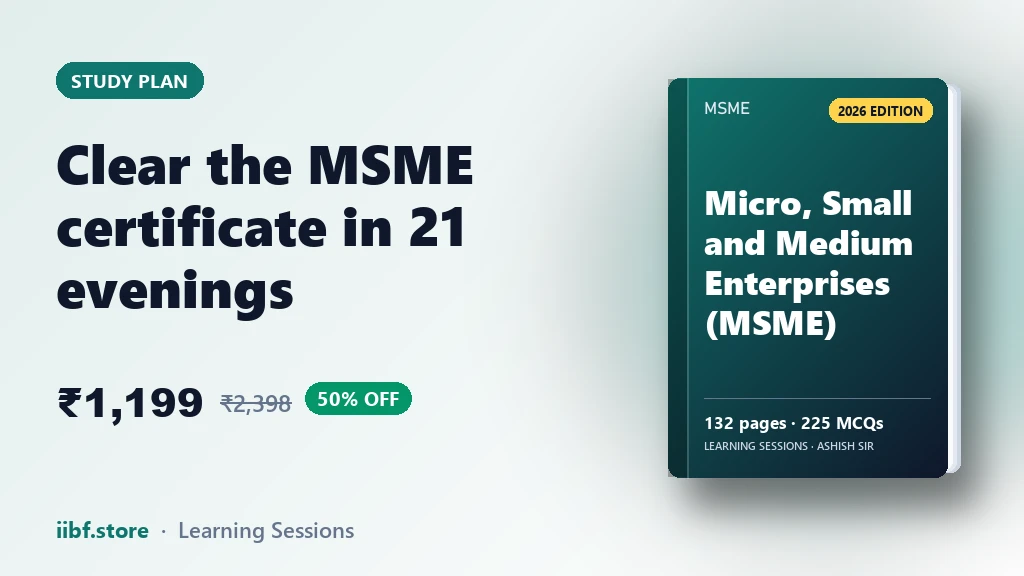
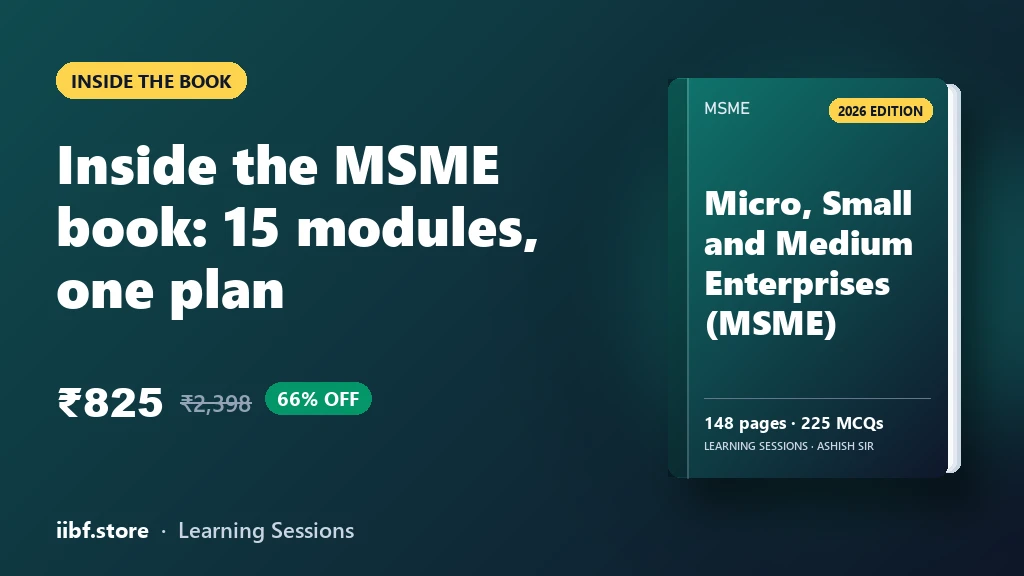
The MSME certificate exam book is a 2026 edition of 148 pages with 15 chapters, one for each unit of the course. The book calls its parts Modules, and each module carries a single chapter. That is a deliberate design: one unit, one chapter, one study sitting.
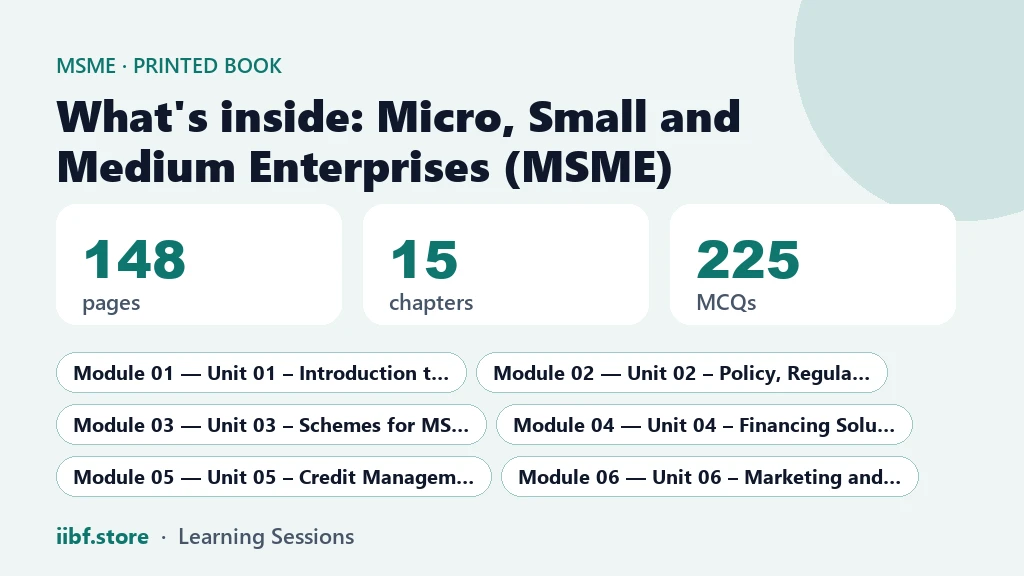
Here is the full map, grouped the way a working banker would think about it.
Foundations: what an MSME is and who regulates it
- Module 01: Introduction to MSMEs
- Module 02: Policy, Regulatory, Legal and Compliance Framework
- Module 03: Schemes for MSME Development
The banker's core: finance, credit and receivables
- Module 04: Financing Solutions and Access to Finance
- Module 05: Credit Management and Lending
- Module 10: Receivable Management and TReDS
Running the enterprise: marketing, people and clusters
- Module 06: Marketing and Sales
- Module 07: Human Resource Management
- Module 08: Clusters and Cluster Development
Digital, compliance and problem accounts
- Module 09: Digital Onboarding of MSMEs
- Module 11: Compliance and Ethics
- Module 12: Operational Challenges and Solutions
- Module 14: Detection of Sickness and Rehabilitation
Application and the road ahead
- Module 13: Case Studies and Real-world Application
- Module 15: Emerging Issues, Trends and Opportunities
Notice how the grouping already suggests a study order. If your daily work is lending, Modules 04, 05 and 14 will feel familiar and can be done fast. The legal and scheme modules at the start usually need slower, more careful reading.
What one chapter looks like
Every chapter follows the same rhythm, and that sameness is a feature. After the first chapter you stop wondering how to read and simply read.
- Concise notes. The unit is boiled down to what an examinee needs, not a full textbook. You read this once, slowly, with a pencil.
- Key points. A short list you can scan in a couple of minutes. This is your revision layer: the night before a mock, you read only these.
- MCQs. Practice questions at the end of the chapter. Across the book there are 225 of them.
The sequence matters. Read the notes, close the book, try to recall five points, and only then check the key points. Then attempt the questions. Wrong answers send you back to a specific paragraph rather than to the whole syllabus.
A realistic evening with Module 05
Say you pick Credit Management and Lending on a weeknight. You have 45 minutes. Spend 25 on the notes, 5 on the key points, and 15 on the chapter questions. Mark every question you got wrong or guessed. On the weekend, return only to those marks. That is a complete, honest study loop, and it needs no more than the book and a pen.
The extras: case studies and mega tests
Besides the 15 chapters, the book carries two practice blocks that change how you prepare in the last weeks.
| Part | Size | Use it for |
|---|---|---|
| Chapters with notes and key points | 15 modules, 148 pages | First read and fast revision |
| Chapter MCQs | 225 questions | Checking each unit right after you read it |
| Case Studies | 40 case studies, 160 questions | Applying theory to a situation, the way a banker is tested |
| Mega Tests | 5 tests, 500 questions | Full-length timed practice before the exam |
Case studies deserve special attention. A scheme or a ratio is easy to recall in isolation, but a paragraph describing a small manufacturer with a delayed receivable forces you to choose among options. The 40 case studies, with 160 questions between them, give you that practice. The five mega tests then give you the stamina: 500 questions in total, to be attempted with a clock running.
A four-step plan to use the book
This plan assumes you work full time and can give roughly an hour on weekdays and a longer block on weekends. Adjust the pace to your own exam date, which you should confirm on the official IIBF website for the upcoming exam cycle.
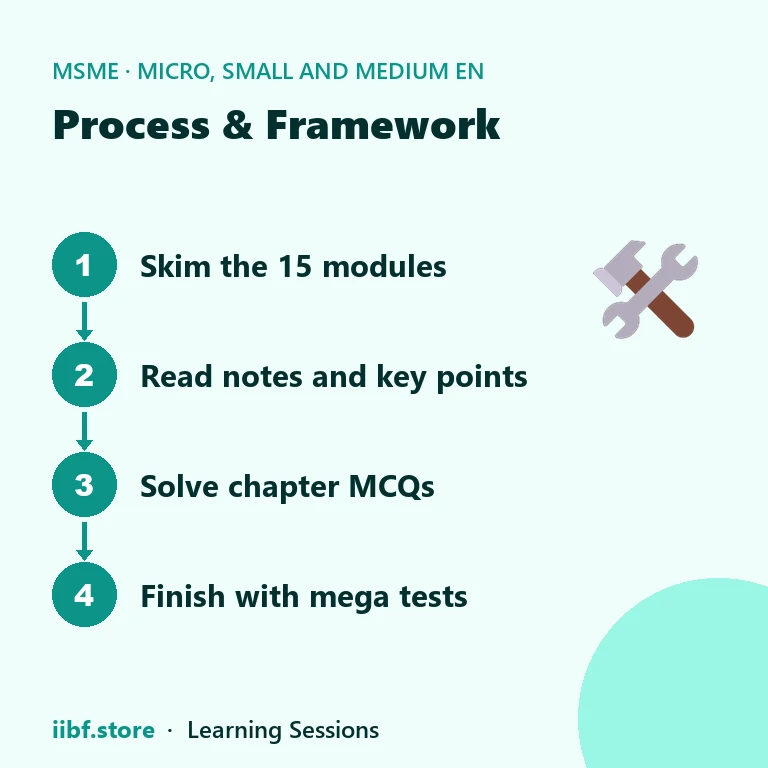
- Skim all 15 modules in one sitting. Do not try to learn. Just read the headings and key points so the paper stops feeling unknown.
- Read one module per sitting. Notes, then key points. Familiar modules go quickly; keep extra time for schemes, the legal framework and TReDS.
- Solve that module's MCQs immediately. Note your wrong answers, and re-read only those paragraphs.
- Finish with case studies and mega tests. Attempt the case studies after the chapters, then use the mega tests as timed rehearsals in the final stretch.
If you want extra drill beyond the book, the free mock tests and the free study material on the same site are useful companions, and they cost nothing to try.
Who gets the most out of this book
A book like this suits some candidates better than others, so here is a straight answer.
- Bankers new to MSME work who need the whole picture, from definitions to rehabilitation, in a form they can finish.
- Experienced lenders who know the credit side but feel unsure about schemes, clusters, HR and marketing modules.
- Candidates who prefer paper. If you retain more with a pen in hand than with a phone screen, a printed MSME certificate exam book fits that habit.
- Anyone short on time who needs a compact route rather than a shelf of reference volumes.
One honest limit: a book alone will not give you exam-hall speed. Pair it with timed mock practice, and check the official course material for anything the current cycle changes. For the current price, which may change, see the book page, where it is listed at ₹825 against an MRP of ₹2,398. You can also browse the other titles at iibf.store/books.
Final word
Fifteen modules, one chapter each, notes then key points then questions, followed by case studies and mega tests: that is the shape of the book, and it is a shape you can fit into a tired weeknight. Whether you use this MSME certificate exam book or your own material, copy the method: skim first, one unit per sitting, questions straight after reading, timed tests at the end. Small, steady evenings clear this paper. For more preparation guides, keep an eye on the iibf.store blog.
Frequently asked questions
How many pages and chapters does the book have?
The 2026 edition runs to 148 pages and 15 chapters, one chapter for each of the 15 modules.
How many practice questions are included?
There are 225 chapter MCQs, plus 40 case studies carrying 160 questions and 5 mega tests carrying 500 questions.
Can I see a sample before I order?
Yes. The book page offers a free sample so you can judge the style of the notes and questions before deciding.
Is the book enough on its own?
It gives you a structured route through the whole course, but exam-hall speed comes from timed practice, so pair it with mock tests and check the official IIBF site for the current syllabus and schedule.
Prefer revising from a printed book?
Chapter-wise books with MCQs after every chapter — minimal pages, complete coverage, delivered anywhere in India. Every book has a free sample to read first.



Practice this topic
Take a free mock test, download chapter PDFs, or watch a video class — all included on iibf.store.