PCCFM Study Plan for Working Bankers: 3 Weeks, 15 Chapters
It is 9:30 pm. The branch closed late, the cash did not tally until the last minute, and you still have the certificate you promised yourself you would attempt. You open the syllabus for cyber crime and fraud management and it looks like a wall: hackers, cards, laws, institutions, taxation. Where do you even begin?
This article gives you a simple PCCFM study plan that assumes you are tired, busy and have maybe 60 to 90 minutes on weekdays. You do not need to buy anything to use the method. If it helps, we also show how one printed book fits into it.
Why a PCCFM study plan beats "I will read when free"
Prevention of Cyber Crimes and Fraud Management is a certificate paper where candidates often underestimate the volume. It is not hard like a numerical paper, but it is wide. You meet technical terms, payment channels, legal provisions and institution names in the same sitting, and they blur together if you read without a schedule.
A fixed plan solves three problems for a working banker:
- Decision fatigue. After a full day you should not be deciding what to study. The plan decides.
- Uneven coverage. Without a plan, people read the interesting early chapters twice and never reach the laws and institutions at the end.
- No feedback. Reading feels like progress; only questions tell you whether it stuck.
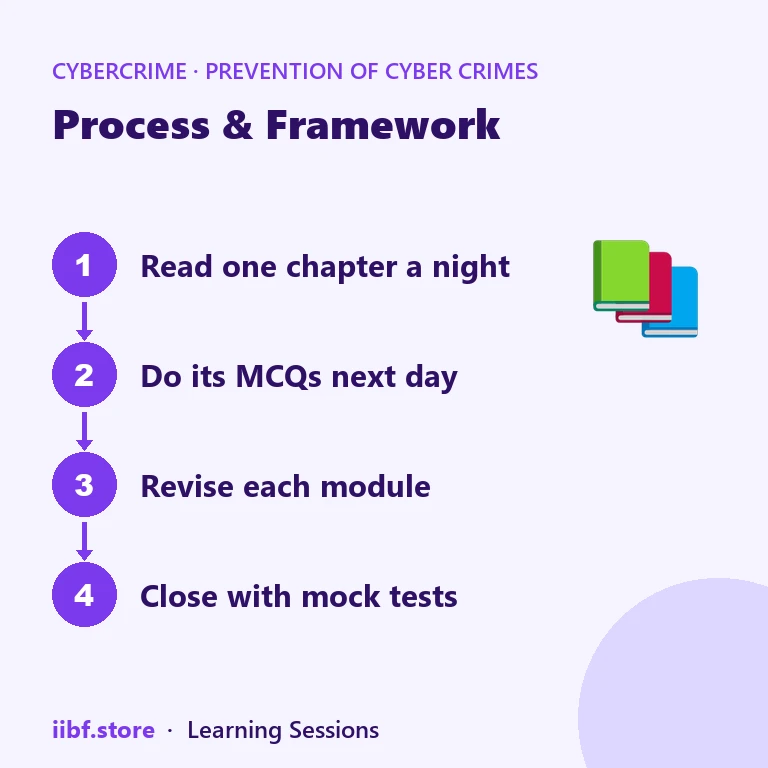
So the rule of this plan is simple: one chapter of reading, then questions on that chapter, then move on. Always keep the next day's chapter name written on a sticky note on your desk or phone.
How the paper is organised: four modules, 15 chapters
Before you plan days, know the shape of the material. The PCCFM book from iibf.store follows four modules:
Module A: Cyber Crimes Overview (5 chapters)
- Introduction to Cyber Crime - Concepts and Techniques
- Channels of Cyber Crimes
- Modus Operandi of Cyber Crimes
- Digital Vulnerabilities
- Computer Hackers
Module B: Fraud Management (2 chapters)
- Computer Fraud Protection
- Incident Management of Cyber Crimes
Module C: Electronic Transactions (3 chapters)
- Online Transactions
- Global Payment Processing
- Electronic Card Frauds
Module D: Cyber Laws and Regulatory Compliance (5 chapters)
- Cyber Laws in India
- Electronic Transactions and Taxation Issues
- Human Traits
- Regulatory Compliance
- National and International Institutions
Notice something useful. Modules A and C are about how crimes happen and how money moves, which you already half-know from branch work. Modules B and D are about response, law and institutions, which feel dry and need more repetition. Your plan should give the dry parts more revision time, not less.
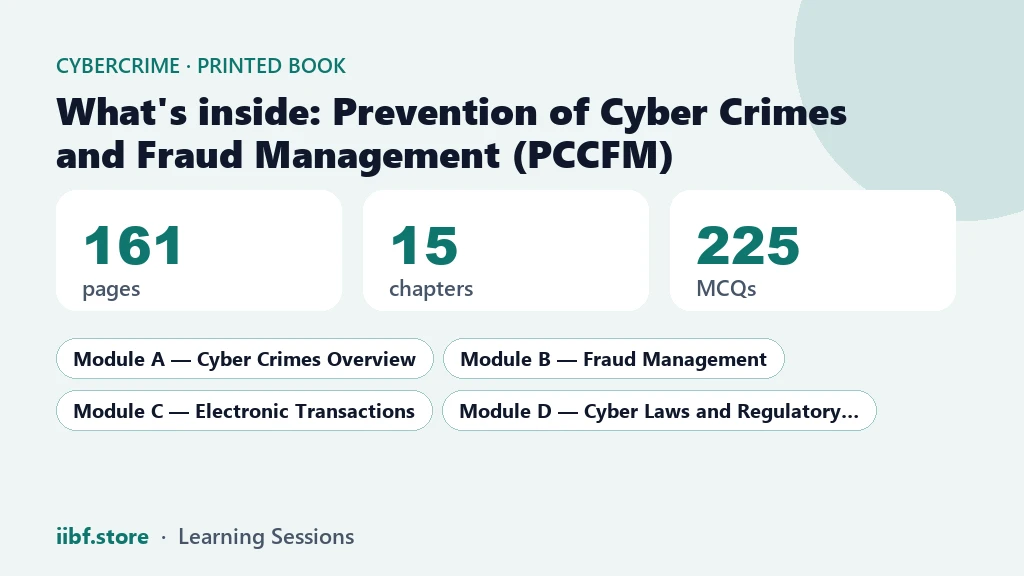
The book itself is compact: 161 pages, 15 chapters and 225 questions in total. Spread evenly, that is roughly 15 questions a chapter, which is a sensible daily practice load after a tired day. It also lists 20 case studies (80 questions) and 5 mega tests (500 questions) as extras, which we use at the end of the plan.
The three-week PCCFM study plan, day by day
Here is the plan in a table. It assumes 21 days with one lighter day each week. If you have only two weeks, merge two chapters per day on the days marked light; if you have a month, simply double the revision days.
| Days | Read | Questions to attempt |
|---|---|---|
| Day 1-3 | Module A: chapters 1 to 3 (concepts, channels, modus operandi), one chapter a night | The end-of-chapter MCQs of that chapter, next evening before reading the new one |
| Day 4-5 | Module A: Digital Vulnerabilities, Computer Hackers | MCQs of both chapters, then a mixed recap of all five Module A chapters |
| Day 6-7 | Module B: Computer Fraud Protection, Incident Management | MCQs of both chapters. Day 7 is light: revise only wrong answers |
| Day 8-10 | Module C: Online Transactions, Global Payment Processing, Electronic Card Frauds | MCQs of each chapter, one chapter a night |
| Day 11 | Light day: revise Modules A, B and C notes | Re-attempt only the questions you got wrong so far |
| Day 12-14 | Module D: Cyber Laws in India, Electronic Transactions and Taxation Issues, Human Traits | MCQs of each chapter; make a one-page list of laws and sections |
| Day 15-16 | Module D: Regulatory Compliance, National and International Institutions | MCQs of both chapters; make a one-page list of institutions |
| Day 17-18 | Revision of Modules D and B (the dry modules) | Case studies: attempt the questions, read the explanations |
| Day 19-21 | Weak chapters only | One mega test each on days 19 and 20, a full review on day 21 |
Weekdays: read for 40 minutes, then 20 minutes of questions on the previous chapter. Weekends: stretch to two hours and do the revision blocks. That is the whole PCCFM study plan; the rest is discipline.
How to use MCQs so they actually teach you
Most candidates treat questions as a test. Use them as a teaching tool instead.
- Attempt first, then read. After finishing a chapter the next evening, try its questions from memory before opening the text again. The gaps you find are exactly what to re-read.
- Keep a wrong-answer list. Write the question number and the one-line reason you were wrong. On light days, review only this list.
- Do not memorise options. Memorising A, B, C, D patterns gives a false score. Ask why the other three options are wrong.
- Time the last tests. The mega tests are where you practise speed. Sit them in one go without checking the book.
If you want extra practice beyond any book, the free mock tests at iibf.store/tests and the downloadable PDFs at iibf.store/free-material cost nothing and are a good way to check your plan is working.
Where a printed book helps, and where it does not
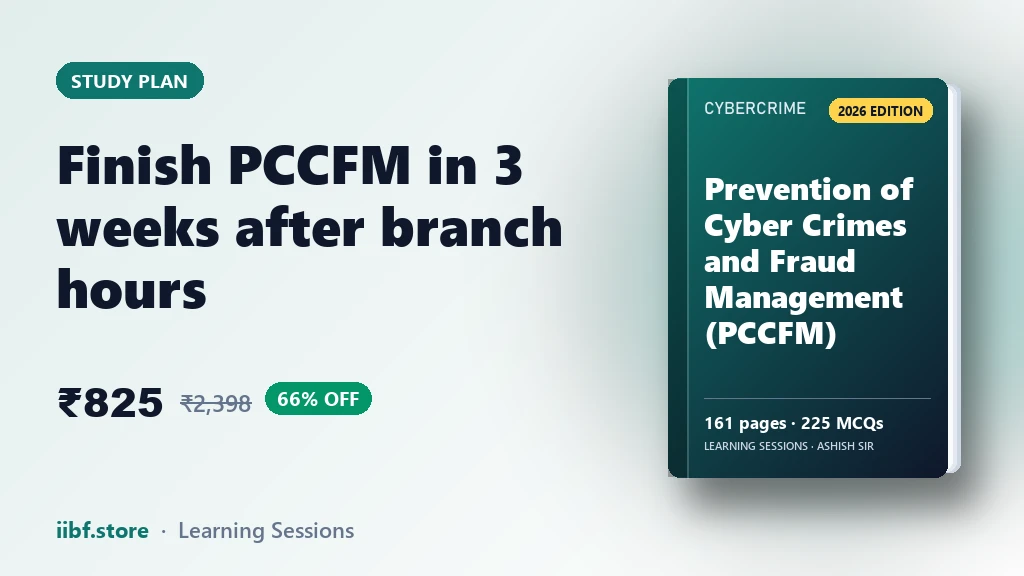
A printed book is useful if you commute, study in short bursts, or lose focus on a phone screen. You can underline, flag pages and carry one thing instead of ten tabs. The Prevention of Cyber Crimes and Fraud Management book is priced at ₹825 against an MRP of ₹2,398 at the time of writing; prices may change, so the book page is always the current source. There is also a free sample you can read before deciding.
One honest limit: a book alone will not give you exam-hall speed. Reading builds understanding, but timed questions build the habit of picking the right answer under pressure. That is why the plan above ends with mega tests and why we point you to free mocks as well. Also keep an eye on the official syllabus and announcements at the IIBF website, since the schedule for the upcoming exam cycle is published there and nowhere else is authoritative.
Small habits that keep you on schedule
- Study at the same hour. A fixed slot beats a heroic weekend that never happens.
- Link concepts to your branch. When you read about card frauds or incident management, recall a real case from your counter or your bank's alerts. Memory sticks to things you have seen.
- Never skip the next-day question session. If you miss a reading day, move the plan by a day rather than dropping the questions.
- Protect sleep. Studying until 1 am does not beat 60 sharp minutes at 9 pm.
More preparation guides for other papers are on the iibf.store blog, and the full range of titles is at iibf.store/books.
Your first step tonight
Open the first chapter, Introduction to Cyber Crime - Concepts and Techniques, and read it with a pencil. That is all for day one. Follow the PCCFM study plan for three weeks, keep a short wrong-answer list, finish with the mega tests, and you will walk into the exam knowing every module at least twice. If you want the compact 15-chapter text to carry along, the PCCFM printed book is one option; the method works with any good material.
Frequently asked questions
Can I finish PCCFM in two weeks while working full time?
It is possible if you merge two short chapters on light days and study about two hours on weekends. Three weeks is more comfortable and leaves room for the mega tests, so prefer it if your exam date allows.
How many MCQs should I do daily?
The book has 225 questions across 15 chapters, so around 15 per chapter on average. Doing one chapter's set each evening is a manageable load, with the 80 case-study questions and 500 mega-test questions kept for the final week.
Is the book enough, or do I need more material?
The book covers all four modules and 15 chapters with practice questions. For exam-hall speed, add timed mock tests, such as the free ones on iibf.store/tests. Always check the official IIBF website for the current syllabus and exam schedule.
Can I read a sample before buying?
Yes, the book page offers a free sample. Prices can change, so check the book page for the current price and offer.
Prefer revising from a printed book?
Chapter-wise books with MCQs after every chapter — minimal pages, complete coverage, delivered anywhere in India. Every book has a free sample to read first.










Practice this topic
Take a free mock test, download chapter PDFs, or watch a video class — all included on iibf.store.