Inside the CCP exam preparation book: 5 modules, 29 chapters
It is 9:40 pm. You have closed the branch, finished the day's sanction notes, travelled home, and now a credit syllabus is staring at you. Principles of lending, RAROC, working capital, charges, stressed assets, IBC, fraud risk. It feels endless, and you are not sure where to even begin. If you are preparing for the Certified Credit Professional certificate, this is a very common starting point, and the real problem is rarely intelligence. It is the lack of a clear map.
So this article is a guided tour. We will open a CCP exam preparation book page by page, in words: how it is organised, what a single chapter looks like, and what else sits alongside the chapters. You will be able to picture yourself using it before you decide anything. Even if you never buy it, the sections below give you a way to break a big credit syllabus into small, finishable pieces.
Why a map matters more than more hours
Working bankers rarely fail a certification because they studied too little in total. They fail because their hours were scattered. One evening goes to financial statements, the next to a random circular, and by the third week nothing connects. Credit is a subject where the topics lean on each other. You cannot assess working capital sensibly without understanding financial statements, and you cannot understand monitoring and stressed assets without knowing what was appraised and documented in the first place.
That is why the first job of any CCP exam preparation book is order. The sequence should follow the life of a loan: why we lend, how we appraise, how we structure facilities, how we document, and what we do when things go wrong. If the book follows that arc, your late-night sessions start to feel like one continuous story rather than 29 unrelated lectures.
Three questions to ask of any study material
- Can I see the whole syllabus on one page, grouped into a handful of blocks?
- Is each chapter short enough to finish in a single weeknight sitting?
- Does every chapter end with questions, so I know straight away whether it stuck?
Keep these three questions handy. We will use them as we walk through the book.
How the book is organised: five modules, 29 chapters
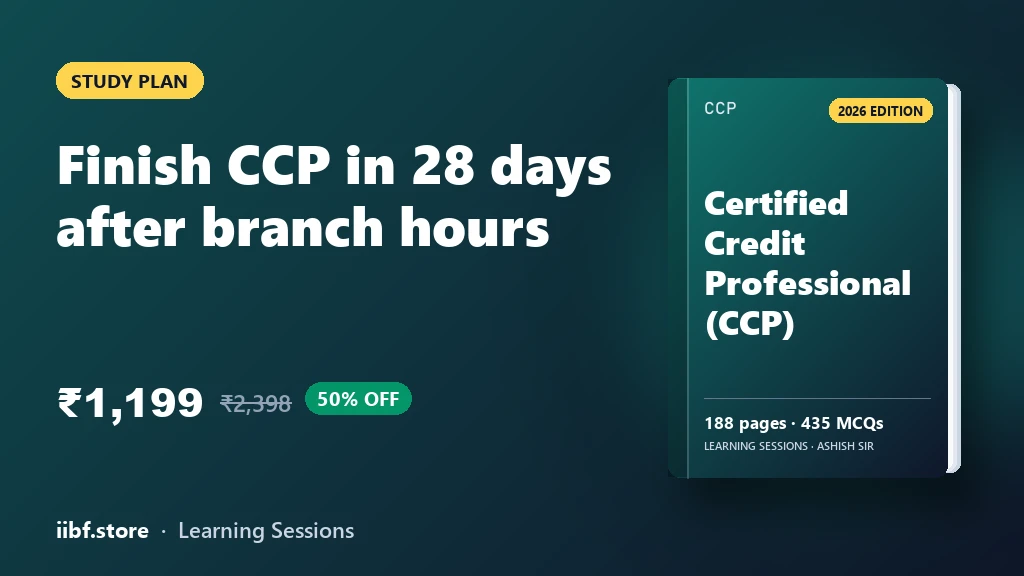
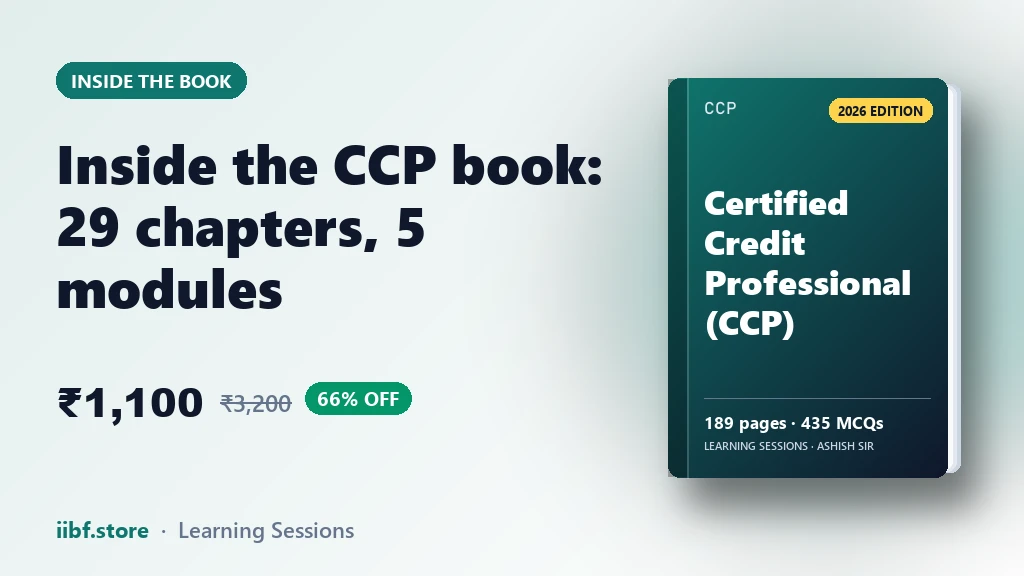
The Certified Credit Professional printed book runs to 189 pages in the 2026 edition and is split into five modules holding 29 chapters in all. Here is the structure, exactly as the book lays it out.
Module A: Introduction and overview of credit
Eight chapters set the foundation: Principles of Lending, Credit Policy, Types of Borrowers and Types of Credit Facilities, Credit Delivery, Credit Appraisal, Credit Rating, Capital Adequacy, and the Importance and Application of RAROC. If you already sit on a credit desk, you may know half of this by instinct. The value here is putting the right vocabulary on what you do daily, because exam questions use that vocabulary.
Module B: Credit appraisal and risk assessment
Four chapters, and arguably the analytical heart of the paper: Analysis of Financial Statements, Non-Financial Risk Analysis and Macroeconomic Factors, Project Appraisal, and Credit Risk Analytics and Credit Scoring Models. Expect numbers here, so this module deserves your freshest evenings, not the end of a tired day.
Module C: Working capital and non-fund based facilities
Only two chapters, Working Capital Assessment and Non-Fund Based Credit Facilities, but both are bread and butter for branch and corporate credit staff. Short module, high practical payoff.
Module D: Specialised areas of credit
Eight chapters that widen your lens: Export Finance, Priority Sector Lending, Retail Loans, Forward Exposure Limit and Pre-settlement Risk, Structured Finance Options, Alternative Sources of Funding, Digital Finance and P2P Lending via Fintech, and Green Finance. Many bankers are strong in one or two of these and thin in the rest, so this is where a structured read pays off.
Module E: Documentation, credit monitoring and stressed assets
Seven chapters close the loan lifecycle: Documentation, Types of Charges, Credit Monitoring, Resolution of Stressed Assets, Fair Practices Code on Lender's Liability, the Insolvency and Bankruptcy Code, 2016, and Fraud Risk Management in Credit.
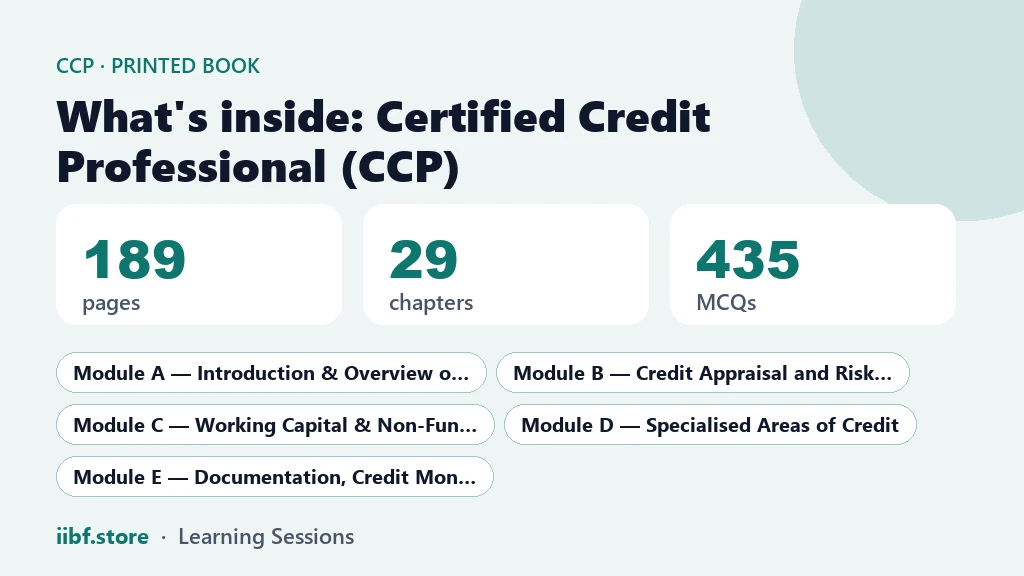
| Module | Theme | Chapters |
|---|---|---|
| A | Introduction and overview of credit | 8 |
| B | Credit appraisal and risk assessment | 4 |
| C | Working capital and non-fund based facilities | 2 |
| D | Specialised areas of credit | 8 |
| E | Documentation, monitoring and stressed assets | 7 |
Notice the shape: 8, 4, 2, 8 and 7. Modules are not equal in size, which tells you something useful about planning. A two-chapter module can be finished in a weekend. An eight-chapter module needs a week or more of evenings.
What one chapter looks like
Structure is only half the story. The other half is what happens when you open a single chapter on a tired Tuesday. In this book each chapter follows a repeating pattern: concise notes first, then key points, then MCQs to test what you just read.
Picture the chapter on Credit Appraisal. You read the notes, which are trimmed to what the certification expects rather than a textbook's full discussion. Then you reach the key points, a short block you can revisit in the last week without re-reading everything. Finally you attempt the MCQs and check yourself immediately, while the material is still warm in your head.
This note, key point, question loop matters for a simple reason. Reading feels productive but proves nothing. Questions are the only honest feedback you get in a printed book. A fixed pattern also removes decision fatigue: you never have to wonder what to do next, you simply follow the same three steps for each of the 29 chapters.
The extras beyond the chapters
Alongside the 29 chapters, the book carries 435 questions in total, plus two extras that change how you practise.
- 60 case studies (240 questions). Credit exams love scenarios: a borrower, some financials, a facility request, and questions that ask what you would do. Case studies train you to read a situation, pick out the facts that matter, and decide. They are slower than plain MCQs, so schedule them for a weekend morning, not a weeknight.
- 5 mega tests (500 questions). These pull together all five modules so you can check yourself across the whole syllabus. Use them late in your preparation, once you have finished the chapters, to find the modules that still leak marks.
A fair word on limits: a printed book gives you notes and questions, but it cannot give you the speed of a timed exam hall. For that, pair it with free timed practice. You can start with the free mock tests on iibf.store and use the book to fix the topics those tests expose.
A four-step method for using the book on a work-week schedule
Here is a method that suits a full-time banker, and it works whichever CCP exam preparation book you choose. The four steps below are also in the picture that follows.
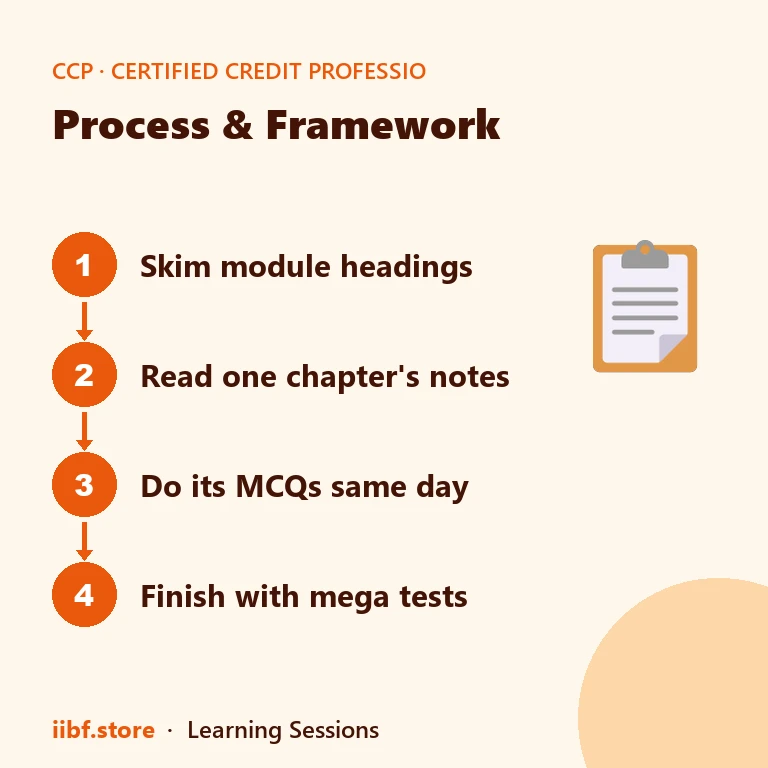
- Skim the module headings first. Spend 30 minutes just reading the five module names and the 29 chapter titles. Mark the ones you already handle at work and the ones that sound unfamiliar. This is your personal map.
- Read one chapter's notes per sitting. One chapter, not three. On a weeknight, 45 to 60 minutes is realistic. Stop when the chapter ends, even if you have energy left. Consistency beats heroic Sundays.
- Do that chapter's MCQs the same day. Do not postpone the questions. Note every wrong answer in a small notebook with a one-line reason. That notebook becomes your revision sheet.
- Finish with case studies and mega tests. After all five modules, move to the 60 case studies and then the 5 mega tests. Treat the mega tests as rehearsals and review every wrong answer before the next one.
A rough pacing idea
With 29 chapters, one chapter per working evening finishes the reading in about six weeks if you also take weekends partly off. Add two further weeks for case studies and mega tests. Adjust to your own load: a month-end closing week will eat your evenings, so build slack into the plan rather than pretending it will not happen.
Free material that works alongside the book
You do not need to spend a rupee to improve your preparation today. The free PDFs on iibf.store are good for revising a topic quickly, and the iibf.store blog carries explainers on many banking topics. Use them to patch gaps, then lean on the book for the structured pass through the syllabus.
For official information, always rely on the Institute itself. The upcoming exam cycle, eligibility and the syllabus are published by the Indian Institute of Banking and Finance, and you should check there before you plan your dates. Rules and schedules change, so treat the official site as the final word.
Who gets the most out of this book
After walking through it, here is an honest view of who benefits most from this kind of CCP exam preparation book.
- Branch and credit-desk staff who want a single ordered path. If you handle loans daily but never saw the theory in sequence, the module order gives you that sequence.
- People who study best on paper. A printed book means no screen glare at midnight and no notifications pulling you away.
- Candidates who learn by testing themselves. With 435 questions, 60 case studies and 5 mega tests, there is plenty to practise on.
- Bankers moving towards credit roles who need the whole picture, from appraisal to stressed-asset resolution, not just their current corner of it.
It may not be the right fit if you want live classes with a teacher explaining every step, or if you prefer to study only on a phone. In that case, start with the free material and tests, and consider the book later as a revision companion.
Price and how to look at it before you decide
The book is listed at ₹1,100 against an MRP of ₹3,200, which the store shows as 66 percent off. Prices may change, so the CCP book page is always the current reference. There is a free sample you can read first, which is the best way to judge whether the writing style suits you. If the sample feels clear on a tired evening, that is a good sign. If it does not, you have lost nothing. You can also compare it with the other titles on the iibf.store books page.
Bringing it together
A syllabus feels endless when it is a blur, and manageable when it is five modules and 29 chapters. Whichever material you pick, the principles hold: see the whole map, study one chapter at a time, test yourself the same day, and keep case studies and mega tests for the final stretch. A well-organised CCP exam preparation book makes that routine easy, but the routine itself is what clears the exam. Start tonight with the module headings, and let the chapters follow.
Frequently asked questions
How many chapters and questions does the book have?
The 2026 edition has 189 pages and 29 chapters in five modules, with 435 questions. It also includes 60 case studies carrying 240 questions and 5 mega tests carrying 500 questions.
Can I read a sample before ordering?
Yes. The book page offers a free sample so you can check the writing style and layout before you decide. Prices may change, so confirm the current price on the book page.
Is a book alone enough to clear the exam?
A book gives you structured notes and practice, but exam-hall speed comes from timed practice. Pair it with the free mock tests and check the official IIBF website for the upcoming exam cycle and syllabus.
Which module should I start with?
Start with Module A for the foundation, then move to Module B, where appraisal and numbers sit. If you already work in credit, skim A quickly and spend more time on the modules you handle least at your branch.
Prefer revising from a printed book?
Chapter-wise books with MCQs after every chapter — minimal pages, complete coverage, delivered anywhere in India. Every book has a free sample to read first.




Quick quiz on this topic
5 exam-style questions from our free test bank — check yourself before you move on.
Practice this topic
Take a free mock test, download chapter PDFs, or watch a video class — all included on iibf.store.