DIBF Study Plan for Working Bankers: 70 Days, One Chapter a Day
It is 9:40 pm. The branch closed late, the cash did not tally till the last minute, and you have just opened the Diploma in International Banking and Finance syllabus again. Three papers, thirty-two modules between them, topics from Basel norms to maritime fraud. The mind says: not tonight. If this sounds familiar, you need a DIBF study plan that fits a tired person, not an ideal student with free evenings.
This article gives you exactly that. It is a 70-day schedule, built around one chapter a day, that works whether or not you ever buy a book. Take the table, take the method, and adjust the days to your own branch rhythm.
Why most DIBF preparation stalls in week two
Working bankers rarely fail because they cannot understand the content. They stall because of three very ordinary things.
- No fixed order. You read a bit of Basel today, a bit of letters of credit tomorrow, and after ten days nothing feels complete.
- No feedback. You read, feel you know it, and discover only in a mock that you did not.
- Sessions that are too big. A plan that demands four hours daily collapses on the first overtime day, and then guilt does the rest.
The fix is boring but it works: a fixed order, a small daily unit, and a quick self-test after each unit. That is the whole logic of the schedule below.
What a tired mind can actually do
After a full branch day, expect about 60 to 90 focused minutes on weekdays and perhaps two to three hours on a weekend morning. Plan for that, not for your best day. A plan you can follow on your worst day is the only plan that finishes.
The one-chapter-a-day method
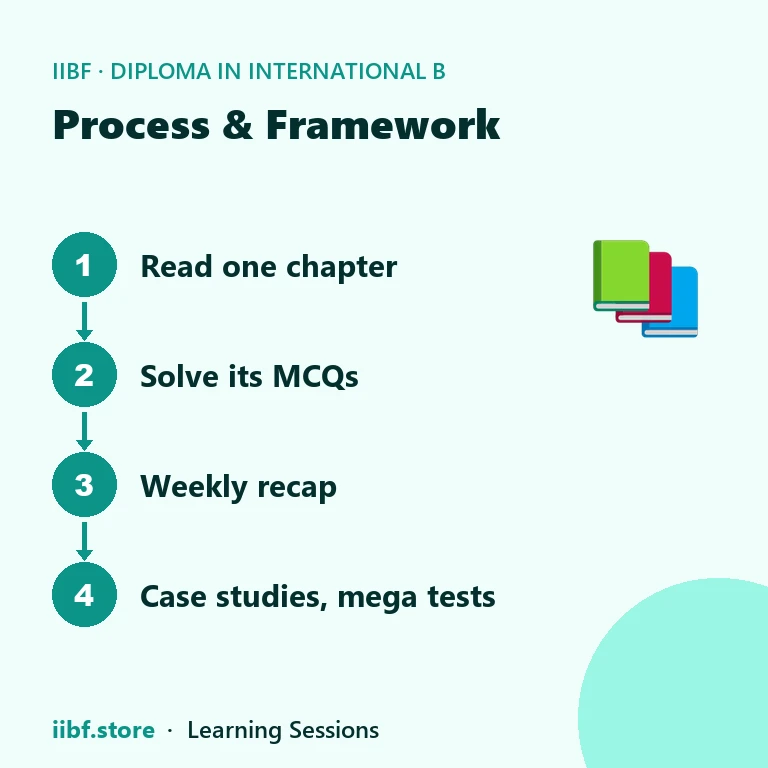
Every unit of study follows the same short loop. Keep it identical each day so that you do not spend willpower deciding how to start.
- Skim the chapter heading and sub-headings first (5 minutes). You are building a mental map before you read.
- Read the chapter once, properly (40 to 50 minutes). Mark only definitions, lists, limits and formulae. Do not highlight whole pages.
- Close the book and attempt the end-of-chapter MCQs (20 to 25 minutes). Do it without peeking.
- Review every wrong answer (10 minutes). Write the correct point in one line in a notebook. That notebook becomes your last-week revision material.
On the weekend, do a recap: re-attempt the questions you got wrong during the week, and read your one-line notes aloud. This takes less than an hour and is the single habit that keeps knowledge from leaking away.
Paper 2 and Paper 3 contain legal and structured-finance content that can feel dry. The loop is the same, but give those chapters a second skim the next morning, even if it is only ten minutes on the commute.
What the printed book gives you for this plan
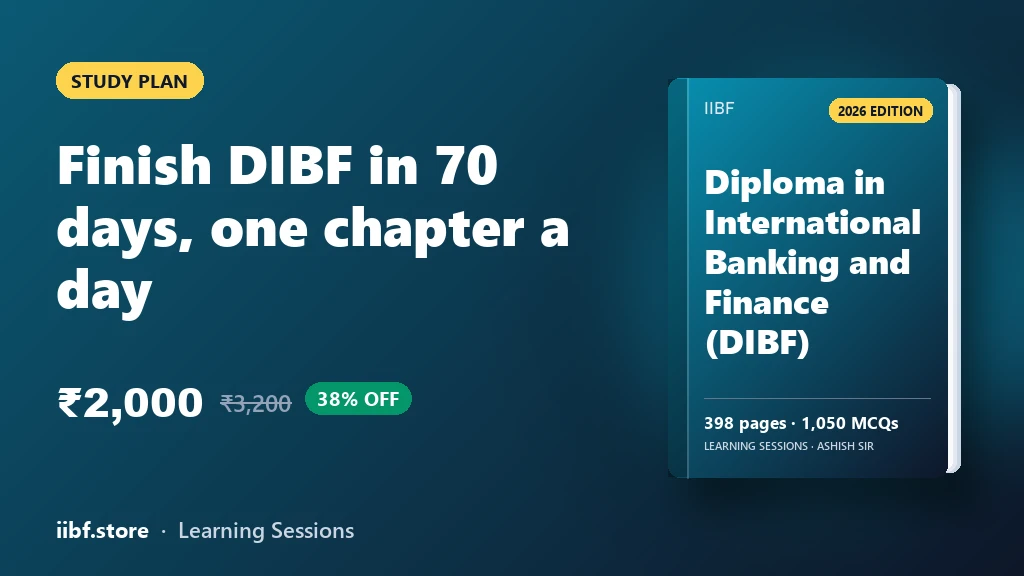
A plan needs material with a clear order and built-in questions. The Diploma in International Banking and Finance (DIBF) book is a 2026 edition of 398 pages, split into three volumes (Papers 1, 2 and 3), with 70 chapters and 1,050 practice questions. That works out to roughly 15 questions per chapter on average, which suits the 20 to 25 minute self-test slot in the loop above.
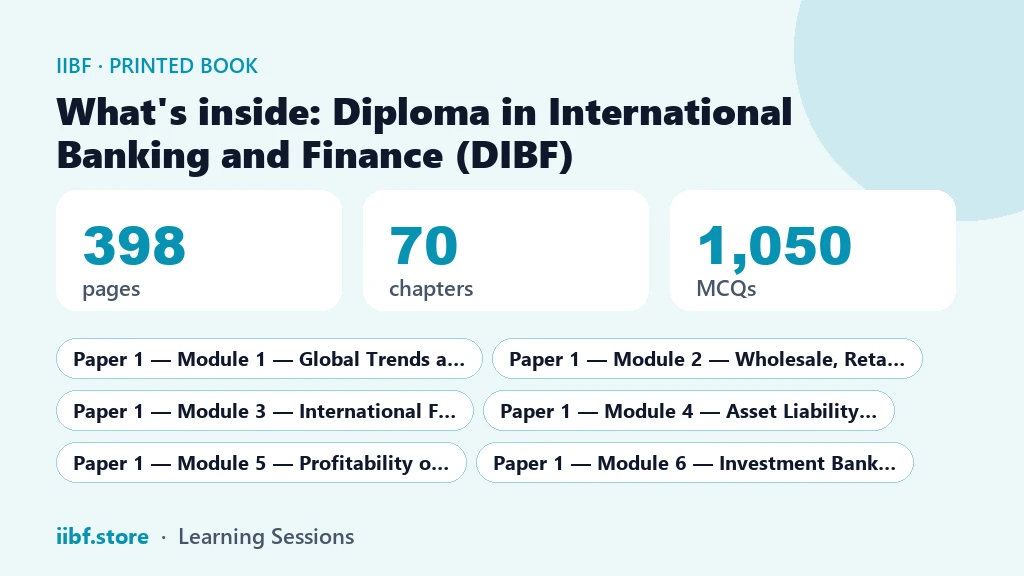
The chapters follow the paper and module structure: 25 chapters in Paper 1, 22 in Paper 2 and 23 in Paper 3. Beyond the chapter questions, the book also lists 130 case studies (520 questions) and 15 mega tests (1,500 questions), which we will use in the final days of the schedule.
Prices may change, so the book page is always the current source for price and availability. At the time of writing it is listed at ₹2,000 against an MRP of ₹3,200.
The 70-day DIBF study plan, day by day
Here is the schedule. It assumes six study days a week and treats the day numbers as study days, not calendar days, so a missed Tuesday simply shifts everything by one. The MCQ column is approximate, based on the average of about 15 questions per chapter.
| Days | What to read | Chapters | MCQs (approx.) |
|---|---|---|---|
| 1 to 6 | Paper 1, Modules 1 to 3: global trends, wholesale and retail banking, financial centres, OBUs and SEZs | 5 | 75 |
| 7 to 12 | Paper 1, Modules 4 to 7: asset liability management, profitability, investment banking, correspondent banking and SWIFT | 6 | 90 |
| 13 to 18 | Paper 1, Modules 8 to 10: IMF, World Bank, BIS, WTO, treasury, forex calculations, FEMA | 7 | 105 |
| 19 to 25 | Paper 1, Module 11: letters of credit, UCP 600, URC 522, URR 725, buyers' and suppliers' credit | 7 | 105 |
| 26 to 30 | Paper 2, Module 1: regulatory architecture, Basel framework, capital adequacy, LCR and NSFR | 5 | 75 |
| 31 to 35 | Paper 2, Modules 2 and 3: international law, jurisdiction, exchange controls, loan agreements and covenants | 7 | 105 |
| 36 to 40 | Paper 2, Modules 4 to 6: country risk, counterparty risk, debt management, IMF and World Bank in crises | 5 | 75 |
| 41 to 45 | Paper 2, Modules 7 to 11: AML laws, maritime frauds, competitiveness, accounting standards, arbitration | 5 | 75 |
| 46 to 50 | Paper 3, Modules 1 and 2: lending to MNCs, credit monitoring, rating agencies, global capital markets | 6 | 90 |
| 51 to 55 | Paper 3, Modules 3 and 4: ECBs, FCNR(B), international bond market, bond pricing and yield | 6 | 90 |
| 56 to 60 | Paper 3, Modules 5 to 7: RUF and NIF, syndicated loans, project and infrastructure finance | 6 | 90 |
| 61 to 65 | Paper 3, Modules 8 to 10: corporate treasury, derivatives, FPI, FDI, EXIM Bank | 5 | 75 |
| 66 to 70 | Revision: your wrong-answer notebook, case studies, then mega tests | All | Case studies and mega tests |
Notice that some days in the table carry more than one chapter, for example Days 13 to 18 hold seven chapters in six days. On those days the chapters are short or closely related, so read the two together and do a combined MCQ round. If a day feels heavy, move one chapter to the weekend; do not skip it.
Where to be slower
Three clusters deserve extra patience. First, the letters of credit block in Paper 1, because the ICC rules (UCP 600, URC 522, URR 725) are precise and the questions test exact wording. Second, the Basel and liquidity chapters in Paper 2, where ratios and definitions must be exact. Third, bond pricing and yield in Paper 3, which involve calculation. Give each of these one extra evening in your calendar; the buffer days at the end of each paper exist for that.
The last five days: case studies and mega tests
By Day 65 you will have read everything once and tested every chapter in small doses. The final stretch converts that into exam readiness.
- Day 66: go through your wrong-answer notebook end to end. This is your highest-value revision, because every line in it is something you personally got wrong.
- Day 67: work through a set of the case studies. They train you to read a scenario, pick out the relevant facts and answer several questions from it.
- Days 68 to 70: attempt mega tests under timed conditions, then spend as long reviewing as you spent attempting.
The mega tests matter because exam-hall speed is a separate skill from knowing the content. A book alone will not build that speed for you. Pair it with timed practice, and add the free mock tests at iibf.store/tests for extra variety.
How to adapt this DIBF study plan to your life
No schedule survives contact with a month-end closing. Here is how to bend it without breaking it.
If you have only 45 minutes on weekdays
Stretch the plan to roughly 100 days. Read on weekdays, do the MCQs for that chapter on the following morning, and use Sundays for recap. Slower is fine; stopping is not.
If you are sitting only one paper this time
Use the same loop and the same table, but run only that paper's block of days, then finish with its own revision. The chapter lists above show which modules belong to which paper, so you can cut the schedule cleanly. Always confirm which papers you are eligible for and when they are held on the official site, www.iibf.org.in, as schedules and rules are updated there for the upcoming exam cycle.
If you fall behind
Do not try to double up for a week. Drop the lowest-value day of the next block, such as a long weekend recap, and keep the daily loop intact. Consistency across seventy days beats intensity across ten.
Free resources to use alongside
You can get a good deal of practice without spending anything. The free PDFs at iibf.store/free-material are useful for quick revision, and the wider catalogue at iibf.store/books shows the other certificate books if you plan a second paper later. If you want to read the actual layout and language of the DIBF book before deciding, open the DIBF book page and read the free sample.
Putting it together
A DIBF study plan does not need to be clever. It needs a fixed order, a daily unit small enough to survive a bad day, and a quick self-test after every chapter so that you find your gaps early. Seventy chapters in seventy study days, a weekly recap, and a final week of case studies and mega tests will take you through all three papers without demanding a life you do not have.
Start tonight with Chapter 1 of Paper 1, even if it is only the skim. The first day is the hardest, and the plan only has to be better than the one you did not have yesterday.
Frequently asked questions
Can I really finish DIBF preparation in 70 days while working full time?
For many bankers, yes, if you can give 60 to 90 minutes on weekdays and a longer block on weekends. The plan is one chapter per study day. If your branch hours are heavy, stretch it to about 100 days rather than cramming.
Should I study the three papers in order?
The plan follows the book order, Paper 1 then Paper 2 then Paper 3, because the foundations in Paper 1 (treasury, letters of credit, FEMA) are used again later. If you are sitting only one paper, simply run that paper's block of days.
How many MCQs should I attempt each day?
All the questions at the end of the chapter you just read, which averages about 15 per chapter in this book. Attempt them without looking at the text, then review every wrong answer the same day.
Is the book alone enough to pass?
No book can promise that. It gives you the order, the content and the questions, but you also need timed practice. Use the mega tests and the free mock tests to build exam-hall speed, and check the official IIBF site for the latest exam details.
Prefer revising from a printed book?
Chapter-wise books with MCQs after every chapter — minimal pages, complete coverage, delivered anywhere in India. Every book has a free sample to read first.












Practice this topic
Take a free mock test, download chapter PDFs, or watch a video class — all included on iibf.store.