CCFE Study Plan: 8 Weeks While Working Full Time at a Bank
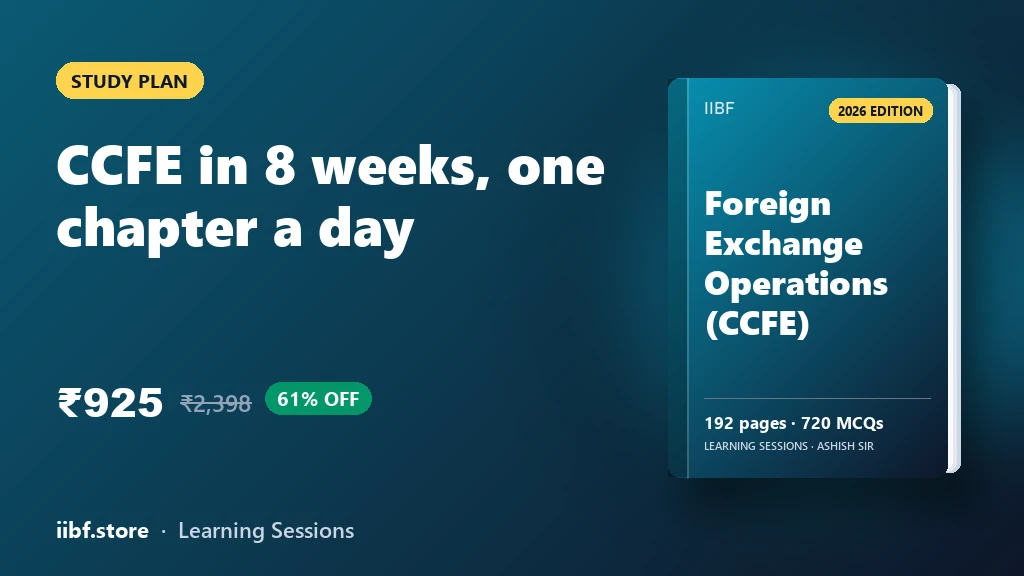
It is 9:40 pm. The branch closed late, the commute was long, and the Foreign Exchange syllabus is still sitting there: FEMA, FEDAI rules, letters of credit, UCP 600, export finance, Foreign Trade Policy. You have told yourself you will start on Sunday for the third Sunday in a row. If that sounds familiar, you do not need more motivation. You need a CCFE study plan small enough to survive a tiring week.
This article gives you exactly that, whether or not you ever buy a book from us. We will first look at why forex papers frustrate people who work full time, then build a day-wise schedule around the six modules of the syllabus, and then show how practice questions fit in. The plan assumes about 60 to 90 minutes on weekdays and a longer block on weekends. Adjust it, but keep its shape.
Why forex feels harder than other IIBF certificates
Most certificate papers are heavy on definitions. Foreign Exchange Operations is different: it mixes four kinds of knowledge, and each needs a different way of studying.
- Calculation: quotations, spreads, cross rates, forward premium and discount.
- Regulation: FEMA rules for individuals and entities, which change in detail as RBI issues updates.
- Rule books: UCP 600, URC 522, URDG 758, ISBP and Incoterms, where one word in a clause changes the answer.
- Policy: Foreign Trade Policy 2023, DGFT, export obligations and how they interact with FEMA.
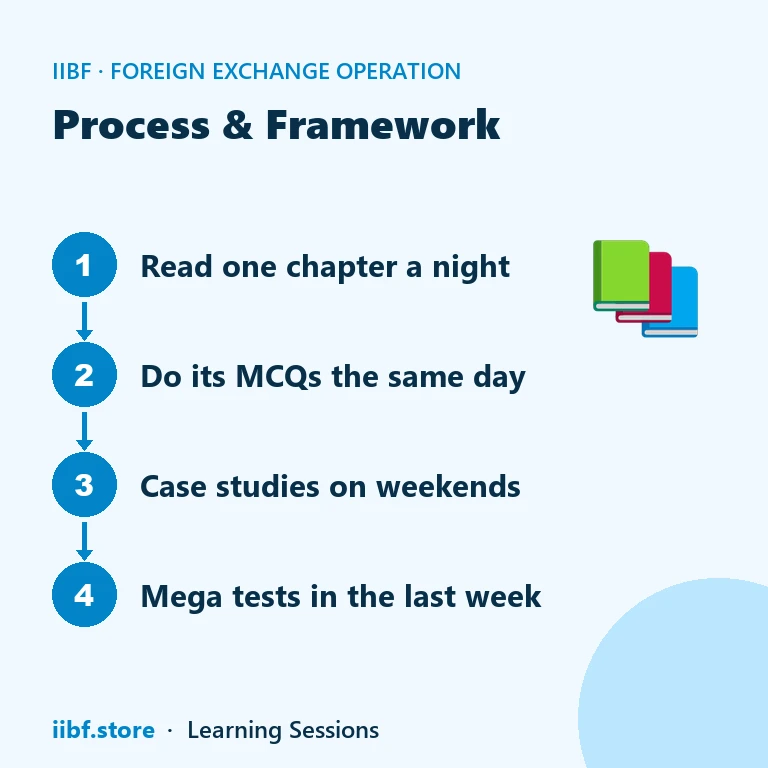
If you try to read all of this like a novel, you will forget the first module by the time you reach the fourth. The fix is not more hours. It is a fixed order, small daily chunks and immediate recall practice. That is the whole logic behind this CCFE study plan.
Three rules before you start
First, one chapter per day is the unit, not one hour. Some chapters take 40 minutes, some take 90. Second, never read a new chapter before you have attempted questions on the previous one. Third, keep a single notebook of mistakes. Forex errors repeat: confusing bid with offer, mixing up D/P and D/A, forgetting which party bears risk under which Incoterm.
The syllabus in six modules, in the order that works
The order matters more than people think, because later modules lean on earlier ones. Quotations and forward contracts in Module 1 are needed again when you study export bills and finance. FEMA basics in Modules 2 and 3 are needed again when you reach the combined FTP and FEMA cases at the end. So do not skip around.
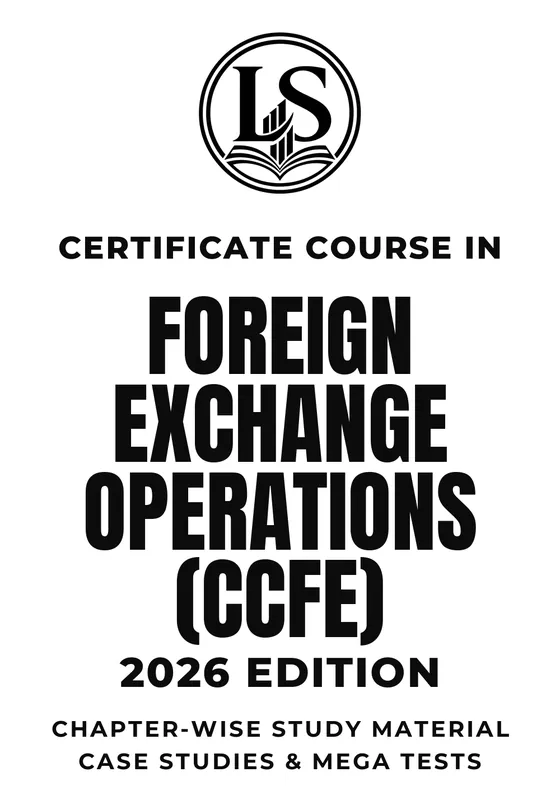
The Foreign Exchange Operations (CCFE) book follows this order. It has 192 pages in 48 chapters, split into six modules:
- Module 1: FEDAI role and rules, exchange rates, risk management and code of conduct (7 chapters)
- Module 2: FEMA requirements for resident and non-resident individuals (8 chapters)
- Module 3: FEMA requirements for resident and non-resident entities (11 chapters)
- Module 4: Documentary credits and standby credits (12 chapters)
- Module 5: Export finance (5 chapters)
- Module 6: Foreign Trade Policy 2023 (5 chapters)
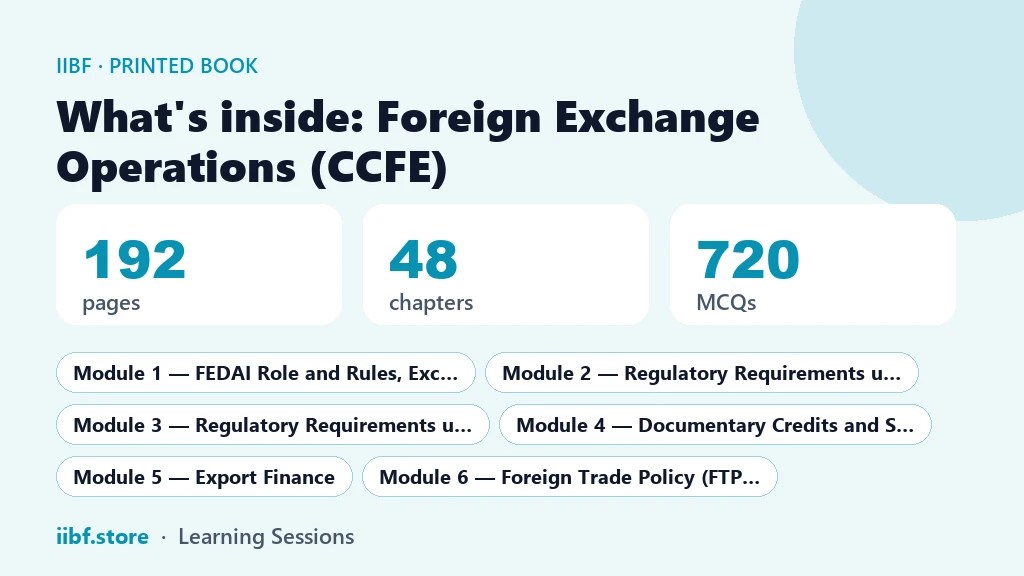
Alongside the chapters, the book carries 80 case studies (320 questions) and 5 mega tests (500 questions). Those extras are what we use in the final week of the schedule below.
How to study each chapter in 60 to 90 minutes
This is the daily routine. It works with any material, so even if you use your own notes, copy the method.
- 15 minutes: skim the chapter headings and the first line of each section. Know where you are going.
- 35 to 45 minutes: read the chapter properly. Underline only rules, limits, parties and sequences.
- 20 to 30 minutes: attempt that chapter's MCQs without looking back. Mark every wrong answer in your mistake notebook with the reason.
The recall step is not optional. Reading feels productive but fades quickly; answering questions is what moves a rule into memory. With 720 questions and 48 chapters, you get roughly 15 questions per chapter if you spread them evenly, which is about the right size for a tired evening.
For extra practice that costs nothing, use the free mock tests and the free study material on the site.
The day-wise CCFE study plan
Here is the schedule. It runs 48 study days, one chapter per day, followed by a revision block. If you study six days a week, that is about eight weeks in all. Keep one full day off; a rested brain retains more than a burnt-out one.
| Days | What to read | MCQs |
|---|---|---|
| 1 to 7 | Module 1: forex basics, RBI, AD banks and FEDAI, quotations, customer rates, spot and forward, forward contracts, conduct and controls | about 105 |
| 8 to 15 | Module 2: FEMA residence, LRS, personal remittances, resident foreign-currency accounts, overseas assets, NRE, NRO and FCNR(B), NRI investments | about 120 |
| 16 to 26 | Module 3: imports, services, IDPMS, trade credit, ECB, exports, EDPMS, export advances, ODI, FDI and FPI, liaison, branch and project offices | about 165 |
| 27 to 38 | Module 4: trade documents, documentary credits, UCP 600, document examination, discrepancies, eUCP, collections, standbys, URDG 758, URBPO and DOCDEX, Incoterms | about 180 |
| 39 to 43 | Module 5: packing credit, PCFC, post-shipment finance, factoring and forfaiting, ECGC | about 75 |
| 44 to 48 | Module 6: FTP 2023, restricted and prohibited trade, Advance Authorisation and EPCG, deemed exports, combined FTP and FEMA cases | about 75 |
| 49 to 56 | Revision: mistake notebook, 80 case studies, then 5 mega tests | 320 case questions plus 500 mega test questions |
How to adapt this to your week
- Weekday evenings: one chapter, as above. If a chapter is long, split it across two nights and do its MCQs on the second.
- Saturday: a catch-up chapter or a repeat of that week's mistake notebook entries.
- Sunday: rest, or a light 30-minute scan of the week's headings.
- Month-end and audit weeks: do not abandon the plan. Drop to the minimum: read the chapter, attempt only 8 to 10 questions, and move on. A thin day beats a missed day.
Where to spend extra time
Not all 48 chapters deserve equal effort. Module 4 is the largest, with 12 chapters, and it is where careless reading costs marks. Spend your longest evenings on the UCP 600 examination framework, discrepancies and refusal notices, and the difference between URC, URDG and standby rules. These are the places where two options look almost identical.
Module 1 deserves care for a different reason: the calculations. Do not just read how a cross rate is derived. Work two or three examples on paper each time, in the same format. By the second week it will feel mechanical, and mechanical is exactly what you want in an exam hall.
For Modules 2 and 3, regulations are the risk. Learn the structure first (who is allowed, what purpose, which route, what documents) before you try to memorise limits. Limits and conditions are revised by the regulator from time to time, so always cross-check the current position on the official IIBF website and RBI circulars before the exam. Any book, including ours, is a snapshot of one edition.
Using the book without letting it become a shelf ornament
A printed book has one real advantage for a working banker: it does not buzz with notifications. You can read the CCFE book on the train, at lunch or in bed, and highlight in the margins. The 2026 edition is priced at ₹925 against an MRP of ₹2,398, a 61 percent discount. Prices may change, so the book page always shows the current figure, and there is a free sample you can read first.
One honest limit: a book alone will not give you exam-hall speed. Reading and chapter MCQs build understanding, but speed comes from timed practice. That is why the plan ends with the mega tests, and why we suggest you also browse the full books list only if you genuinely need a companion paper. Do not buy more than you can finish.
Your first three nights
Do not wait for a perfect Monday. Tonight, read the opening chapter on forex basics and participants, and attempt its questions. Tomorrow, move to the chapter on RBI, Authorised Dealers and FEDAI. On the third night, start quotations. After three nights, you will have momentum, a mistake notebook with real entries, and proof that the CCFE study plan fits your life. Check the upcoming exam cycle and registration details on the official site, then work backwards from that date and stretch or compress the eight weeks as needed.
Frequently asked questions
Can I finish CCFE in less than eight weeks?
Yes, if you can give two chapters a day, but only if you still attempt questions after each one. Compressing the reading is fine. Skipping practice is not. Work backwards from the exam date published on the official IIBF website.
What should I do if I miss a few days?
Do not try to double up every night. Shift the whole schedule forward by the days you lost, and protect the revision block at the end. Missing a week is recoverable; abandoning the plan is what actually hurts.
Is the book enough, or do I need mock tests too?
The book covers all six modules, chapter questions, 80 case studies and 5 mega tests. Still, add free timed practice from the mock tests page in your last two weeks so that exam timing does not surprise you.
How current are the FEMA and policy details?
The book is the 2026 edition, but rules can change after printing. Always verify limits and procedures against the latest RBI and IIBF notifications before you sit the exam.
Prefer revising from a printed book?
Chapter-wise books with MCQs after every chapter — minimal pages, complete coverage, delivered anywhere in India. Every book has a free sample to read first.







Practice this topic
Take a free mock test, download chapter PDFs, or watch a video class — all included on iibf.store.