MSME NPA Recovery: SARFAESI, OTS, Lok Adalat, DRT & IBC Routes
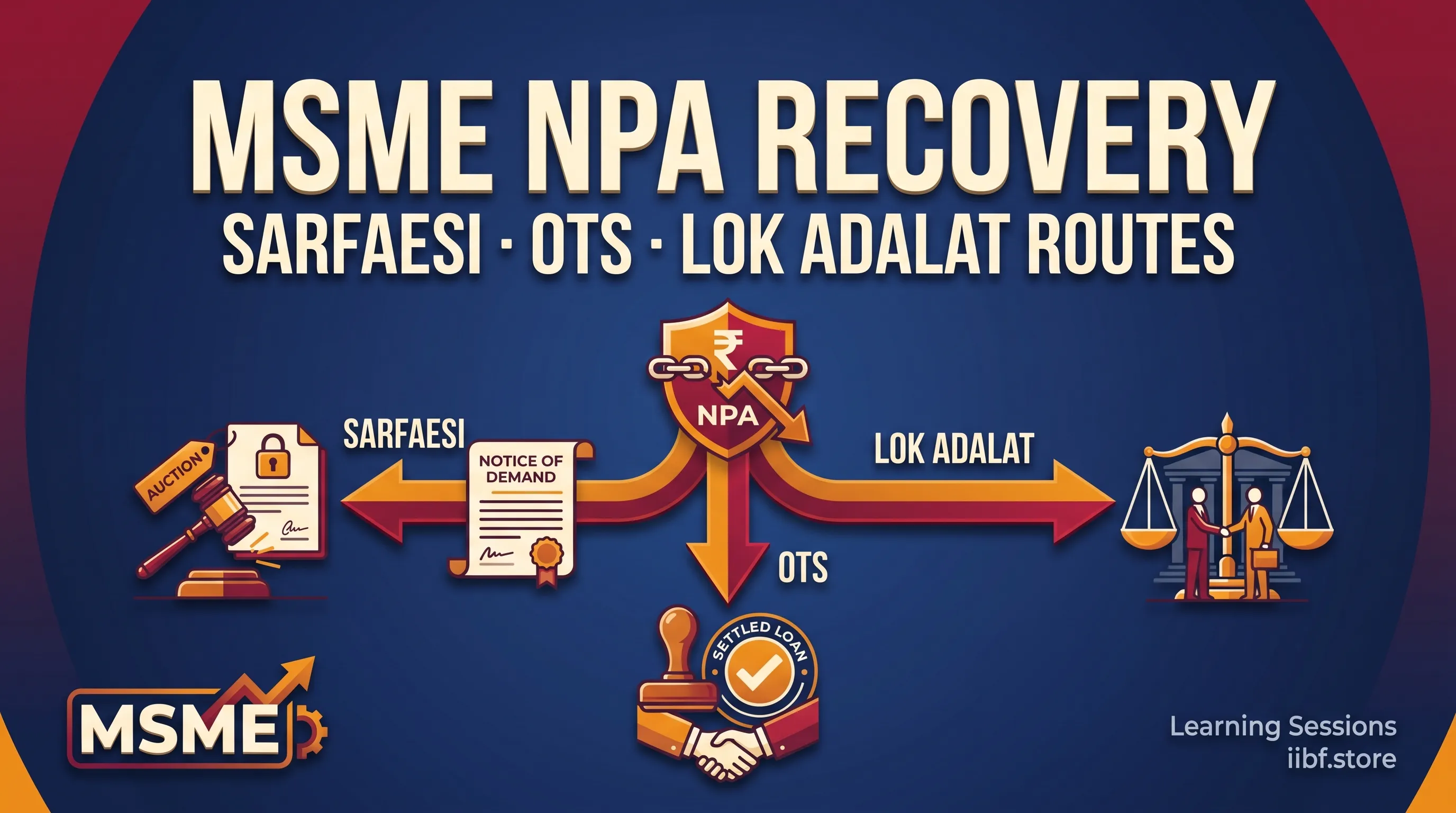
MSME NPA recovery is the moment every branch banker dreads and no project report ever models for: the small-enterprise borrower has stopped paying, the hypothecated stock has quietly shrunk, and the pressure to "find a solution" is suddenly very real. Recovering a non-performing MSME loan is a discipline of its own. The borrower rarely has deep pockets, the security may be thin, and the difference between a clean settlement and a full write-off often comes down to choosing the right legal route at the right time.
This guide walks through all five MSME NPA recovery routes — SARFAESI, One-Time Settlement (OTS), Lok Adalat, DRT and IBC — in plain working-banker language. You will learn which route fits which situation, the realistic timeline and cost of each, the branch-level tactics that actually move recoveries, and precisely how this high-yield topic surfaces in the IIBF Certificate Course on MSME. If you are preparing for the exam, bookmark the full Certificate Course on MSME hub alongside this article.
Key takeaways
- An MSME loan turns NPA when interest or principal is overdue beyond 90 days under RBI's IRAC norms.
- SARFAESI is the bank-driven first line for secured loans; OTS is the fastest negotiated exit; Lok Adalat suits small, co-operative cases.
- DRT/DRAT handles contested mid-size claims, and IBC is reserved for larger corporate borrowers with multiple creditors.
- The right route depends on ticket size, security, borrower intent and whether default is genuine or wilful.
- Early action at the SMA stage often prevents the NPA in the first place — recovery starts before the account ever slips.
When does an MSME loan become an NPA?
Before any recovery route opens, the account must actually be classified as non-performing. Under RBI's Income Recognition and Asset Classification (IRAC) framework, an MSME loan is treated as a Non-Performing Asset in the following situations:
- Interest and/or a principal instalment remains overdue for more than 90 days on a term loan.
- A cash-credit or overdraft account stays out-of-order for more than 90 days — meaning the outstanding balance has exceeded the sanctioned limit, there have been no credits for 90 days, or credits are insufficient to cover the interest debited.
- Bills purchased and discounted remain overdue for more than 90 days.
RBI has also issued separate classification and provisioning criteria for restructured and standard-restructured MSME accounts, each with its own timelines. These nuances change periodically, so always verify against the latest IRAC master direction rather than relying on memory.
Once an account is NPA-classified, the recovery officer's first task is diagnostic, not legal: read the borrower's real situation, estimate the realisable value of any security, and only then pick the route most likely to maximise recovery and minimise time.
SARFAESI Act, 2002 — the first-line tool for secured loans
The SARFAESI Act is usually the opening move in MSME NPA recovery when the loan is backed by hypothecation or mortgage and the bank can take possession of an asset and sell it — without first going to court.
When to use it: the loan is secured, and the borrower holds assets the bank can realistically take over and liquidate.
The process, step by step:
- The bank issues a Section 13(2) notice — a 60-day demand for repayment of the entire outstanding.
- If the borrower does not pay, the bank takes symbolic or physical possession of the secured asset under Section 13(4).
- The asset is sold through public auction or private treaty at a reserve price.
- The borrower may appeal to the Debt Recovery Tribunal under Section 17.
A typical SARFAESI action runs 6 to 18 months from notice to recovery. Its strength is that it is bank-driven and needs no court order to begin. Its limits: it does not apply to unsecured loans or to agricultural land, Section 17 appeals can stretch the timeline, and distressed-sale realisations often fall below book value.
One-Time Settlement (OTS) — the negotiated exit
For many small enterprises, the cleanest MSME NPA recovery is a negotiated one. OTS is the route when the borrower faces genuine difficulty — not wilful default — and can raise a lump sum that, while short of the full dues, beats the cost and delay of litigation.
How it works:
- The branch or recovery officer evaluates the borrower's settlement offer.
- The offer is benchmarked against the outstanding, the realisable value of security, and the time-cost of every other route.
- An authorised committee — typically at Regional, Zonal or Head Office level depending on the size of the haircut — approves the settlement.
- A settlement deed is signed, payment is received, the loan is closed and the charge is satisfied.
OTS usually concludes in 2 to 4 months. It delivers fast, certain recovery, frees up provisions, and can even repair the banker-borrower relationship. The trade-off is the haircut, which commonly lands anywhere between 20% and 60%, and the heightened RBI scrutiny on settlements to guard against moral-hazard signalling. For a deeper view of how the same borrower's credit was assessed at the start, our MSME Credit Assessment field guide closes the lending-to-recovery loop nicely.
Lok Adalat — the small-ticket fast track
Lok Adalats are the most under-rated tool in MSME NPA recovery for genuinely small accounts. They offer a conciliatory, low-cost forum where a settlement, once recorded, carries the force of a civil court decree.
When to use it: small loan amounts — typically up to around ₹20 lakh for bank/DRT Lok Adalats, and potentially higher for State Legal Services Authority Lok Adalats — where the borrower is willing to engage.
The flow is short:
- The bank or borrower refers the matter to a Lok Adalat organised by the State/District Legal Services Authority or a specialised bank Lok Adalat.
- A panel of conciliators helps the parties reach a mutually acceptable settlement.
- The settled amount is paid and the loan is closed.
- The Lok Adalat award has the force of a civil decree and is non-appealable.
Most matters settle within 1 to 3 months of referral. The advantages are speed, finality and near-zero cost; the constraints are that the borrower must co-operate, ticket sizes are limited, and some haircut is still likely.
DRT and DRAT — the contested route
When a borrower digs in, the Debt Recovery Tribunal becomes the workhorse of MSME NPA recovery. It is a specialised forum built for bank claims and is faster than an ordinary civil court, though still far from instant.
When to use it: the claim is above ₹20 lakh, the borrower contests it, security enforcement is complicated, or a Section 17 appeal has blocked a SARFAESI action.
- The bank files an Original Application (OA) with the relevant DRT.
- The DRT issues notices, takes evidence and passes a recovery order — the Recovery Certificate.
- A recovery officer attached to the DRT executes the certificate by attaching and selling the debtor's properties.
- Appeals lie to the DRAT (Debt Recovery Appellate Tribunal).
Realistically, a DRT matter takes 18 to 36 months. The recovery officer wields wide powers, but time, cost and the borrower's litigation tactics can all stretch the process.
Insolvency and Bankruptcy Code, 2016 — the corporate route
The IBC is the heavy-artillery option, suited to corporate MSME borrowers rather than tiny proprietorships. It applies when a private limited company or LLP has a substantial default, multiple creditors, and an amount above the prescribed minimum threshold (recently set at around ₹1 crore — always confirm the figure against the current IBC notification).
- The bank files an application with the NCLT as a Financial Creditor under Section 7.
- The NCLT admits the application, typically within 14 days.
- The Corporate Insolvency Resolution Process (CIRP) begins and an Insolvency Professional is appointed.
- A Committee of Creditors (CoC) is formed and resolution plans are invited.
- CIRP is meant to conclude within 180 days, extendable to 270 days, and up to 330 days in specified cases with NCLT approval.
- If no plan is approved, the company moves to liquidation under a defined waterfall.
The IBC offers a time-bound, market-driven outcome and a liquidation waterfall that protects financial creditors better than older frameworks. But process costs are high and recoveries can fall well below claim values, which is exactly why it is reserved for larger corporates.
MSME NPA recovery routes compared
Use the table below as a quick at-a-glance map before you commit to a route. Treat the amounts and timelines as broad working ranges that move with the latest RBI and government notifications.
| Route | Best for | Typical timeline | Cost / haircut |
|---|---|---|---|
| SARFAESI | Secured loans with realisable assets | 6-18 months | Low cost; distressed-sale shortfall |
| OTS | Genuine difficulty, co-operative borrower | 2-4 months | Haircut often 20-60% |
| Lok Adalat | Small tickets (up to ~₹20 lakh) | 1-3 months | Free/low cost; some haircut |
| DRT / DRAT | Contested claims above ₹20 lakh | 18-36 months | Moderate-high; litigation cost |
| IBC | Corporate borrowers, multiple creditors | 180-330 days (CIRP) | High process cost |
Picking the right route — a practical decision matrix
Theory is easy; the judgement call at the branch is harder. Here is the working logic most recovery officers apply when sequencing MSME NPA recovery:
- Small MSME (₹5-20 lakh), secured, co-operative: attempt OTS first, fall back to Lok Adalat if the settlement stalls.
- Medium MSME (₹20 lakh-₹1 crore), secured, contested: start with SARFAESI; move to DRT if a Section 17 appeal blocks enforcement.
- Large MSME (₹1 crore+), corporate: use SARFAESI for individual asset recovery, and IBC for full corporate resolution where multiple creditors are involved.
- Unsecured loan: try OTS first, then suit-based civil recovery or Lok Adalat.
- Wilful defaulter: combine SARFAESI with criminal action for cheating or fraud and list the borrower on the RBI wilful-defaulter database.
Tip: Where the loan is CGTMSE-covered, the guarantee can change the entire calculus — but invocation has strict timelines. Read our CGTMSE guarantee scheme explainer before you choose a settlement that might forfeit the cover.
Branch-side recovery tactics that actually work
The legal route is only half the story. The recoveries that succeed almost always share the same operational habits:
- Intervene early. The day an account slips to SMA-1 (overdue 31-60 days), the recovery officer should already be visiting or calling. By SMA-2 (61-90 days) the conversation shifts to salvage talks. Once it is NPA, the options narrow sharply.
- Document everything. Every call, visit and written communication builds the case file that wins the day if the matter ever reaches a DRT.
- Diagnose intent honestly. A genuinely struggling borrower needs an OTS; a wilful defaulter needs SARFAESI plus a criminal complaint. Misreading this wastes months.
- Protect CGTMSE cover. Where the loan is guarantee-backed, invocation deadlines are unforgiving — miss them and the cover lapses.
- Co-ordinate with consortium lenders. Multiple-bank exposure demands inter-bank alignment, especially for IBC filings and large SARFAESI actions.
How to study MSME NPA recovery for the IIBF exam
This chapter is a reliable scorer in the Certificate Course on MSME, with roughly 6 to 10 questions per paper. A focused three-step plan covers it comfortably:
- Lock the numbers first. Commit the 90-day NPA rule, SARFAESI's 60-day Section 13(2) notice, the ₹20 lakh DRT threshold and the 180/270/330-day IBC timeline to memory — these are the most frequently tested figures.
- Map route to scenario. Practise reading a one-line borrower profile and instantly naming the best route. The exam loves application-style questions over rote definitions.
- Drill, then revise. Reinforce recall with a free MSME mock test and sharpen the section-and-timeline memory with the MSME matching games. For wider context on schemes that feed into the same syllabus, the Small and Medium Enterprises in India module and our MUDRA loan working guide are worth a read.
Common mistakes to avoid
- Treating SARFAESI as universal. It simply does not apply to unsecured loans or agricultural land — reaching for it there wastes time.
- Approving an OTS without committee authority. The haircut size dictates the approval level; skipping it invites audit and compliance trouble.
- Confusing SMA with NPA. SMA is an early-warning stage, not a recovery trigger — but it is the best window to prevent the NPA entirely.
- Filing IBC for a tiny proprietorship. The Code is built for corporates above the threshold; for small firms the cost outweighs the recovery.
- Letting a CGTMSE claim lapse. Choosing a settlement that forgoes enforcement can quietly forfeit a valid guarantee.
Frequently asked questions
When does an MSME loan officially become an NPA?
An MSME loan is classified as a Non-Performing Asset when interest or a principal instalment stays overdue beyond 90 days, or when a cash-credit/overdraft account remains out-of-order for more than 90 days. The 90-day benchmark flows from RBI's IRAC norms. Restructured accounts follow separate criteria, so confirm against the latest IRAC master direction.
Can a single MSME loan be pursued through both SARFAESI and DRT?
Yes, but usually in sequence rather than in parallel. Banks typically run SARFAESI first because it is faster and needs no court. If a Section 17 appeal stalls it or the security realisation is only partial, the residual deficit can then be pursued through the DRT.
What is the difference between SMA-0, SMA-1 and SMA-2?
SMA stands for Special Mention Account, an early-warning stage before NPA classification. SMA-0 means dues are overdue up to 30 days, SMA-1 covers 31-60 days, and SMA-2 covers 61-90 days. Banks are expected to act at SMA-1 and SMA-2 — follow-up, additional security or restructuring — to stop the slide into NPA.
Is a Lok Adalat award appealable?
No. A Lok Adalat award is final and non-appealable, and it carries the force of a civil court decree. This finality is exactly why Lok Adalats are so popular for small-ticket MSME recovery — the matter closes cleanly without years of appeals.
What happens to the CGTMSE guarantee if the bank opts for OTS instead of SARFAESI?
CGTMSE generally expects the bank to have exhausted available recovery routes before invoking the guarantee. An OTS in which the bank voluntarily settles for a partial amount usually does not trigger a CGTMSE claim for the written-off balance, because the bank chose to settle rather than enforce. Always check the current CGTMSE invocation circular for operational specifics.
Which recovery route is fastest for a small MSME loan?
For a small, co-operative borrower, a One-Time Settlement is usually quickest, often closing in 2 to 4 months. A Lok Adalat is a strong second option for small tickets, settling in 1 to 3 months with a non-appealable award. Both far outpace DRT or IBC for modest amounts.
Final word
MSME NPA recovery is part craft and part regulatory discipline. Master the five routes — SARFAESI, OTS, Lok Adalat, DRT and IBC — and learn to match each to the borrower in front of you, and you equip yourself for both the IIBF MSME exam and the daily reality of branch recovery. Start early, read the borrower honestly, and let the numbers guide the route. For the authoritative source on definitions and circulars, refer to the Indian Institute of Banking & Finance, and explore every free guide for this paper in the MSME blog library.
Related Guides
📚 Free Learning Sessions resources — connect & crack your exam
- 📝 Free mock tests — chapter-wise, exam-pattern, with instant solutions
- 🎮 Matching games — gamified revision of key terms & concepts
- 📄 Study notes & PDFs — downloadable chapter material
- 🎥 Video classes on YouTube — subscribe to @learningsessions
💬 Want the full course? WhatsApp your course name to 8360944207 and our team will set you up.
📱 Study on the go — get our iOS & Android app at iibf.store/app.
Prefer revising from a printed book?
Chapter-wise books with MCQs after every chapter — minimal pages, complete coverage, delivered anywhere in India. Every book has a free sample to read first.
132 pages · 225 MCQs
Learning Sessions · Ashish Sir
188 pages · 435 MCQs
Learning Sessions · Ashish Sir
117 pages · 236 MCQs
Learning Sessions · Ashish Sir
Learning Sessions · Ashish Sir
118 pages · 299 MCQs
Learning Sessions · Ashish Sir
Learning Sessions · Ashish Sir
Learning Sessions · Ashish Sir
Learning Sessions · Ashish Sir
115 pages · 255 MCQs
Learning Sessions · Ashish Sir
Learning Sessions · Ashish Sir
334 pages · 936 MCQs
Learning Sessions · Ashish Sir
Learning Sessions · Ashish Sir
115 pages · 344 MCQs
Learning Sessions · Ashish Sir
107 pages · 240 MCQs
Learning Sessions · Ashish Sir
90 pages · 150 MCQs
Learning Sessions · Ashish Sir
Learning Sessions · Ashish Sir
131 pages · 672 MCQs
Learning Sessions · Ashish Sir
221 pages · 831 MCQs
Learning Sessions · Ashish Sir
128 pages · 524 MCQs
Learning Sessions · Ashish Sir
107 pages · 445 MCQs
Learning Sessions · Ashish Sir
148 pages · 478 MCQs
Learning Sessions · Ashish Sir
151 pages · 465 MCQs
Learning Sessions · Ashish Sir
148 pages · 375 MCQs
Learning Sessions · Ashish Sir
216 pages · 895 MCQs
Learning Sessions · Ashish Sir
109 pages · 300 MCQs
Learning Sessions · Ashish Sir
104 pages · 360 MCQs
Learning Sessions · Ashish Sir
82 pages · 297 MCQs
Learning Sessions · Ashish Sir
151 pages · 600 MCQs
Learning Sessions · Ashish Sir
98 pages · 282 MCQs
Learning Sessions · Ashish Sir
Practice this topic
Take a free mock test, download chapter PDFs, or watch a video class — all included on iibf.store.