MUDRA Loan Scheme: Shishu, Kishore, Tarun Banker's Guide
The MUDRA loan scheme is the single product a branch officer is asked about more than almost any other, and yet it is the one most of us explain badly under pressure. A first-time entrepreneur walks in with a hand-written quotation for a sewing machine or a tea cart, asks whether a Mudra loan is possible, and suddenly you are trying to recall whether Shishu needs collateral and where the Tarun ceiling sits this year. This guide is written to fix that — a clear, practical walk-through of the scheme the way you would actually use it at the counter, and the way it shows up in the IIBF MSME certificate exam.
MUDRA stands for Micro Units Development and Refinance Agency. It is the Government of India's flagship vehicle for funding non-corporate, non-farm small and micro enterprises, and it remains one of the highest-volume retail credit products in any public-sector or private bank branch in India. Understanding the three tiers and the underwriting logic behind them is therefore not just exam preparation — it is a daily job skill.
Key takeaways
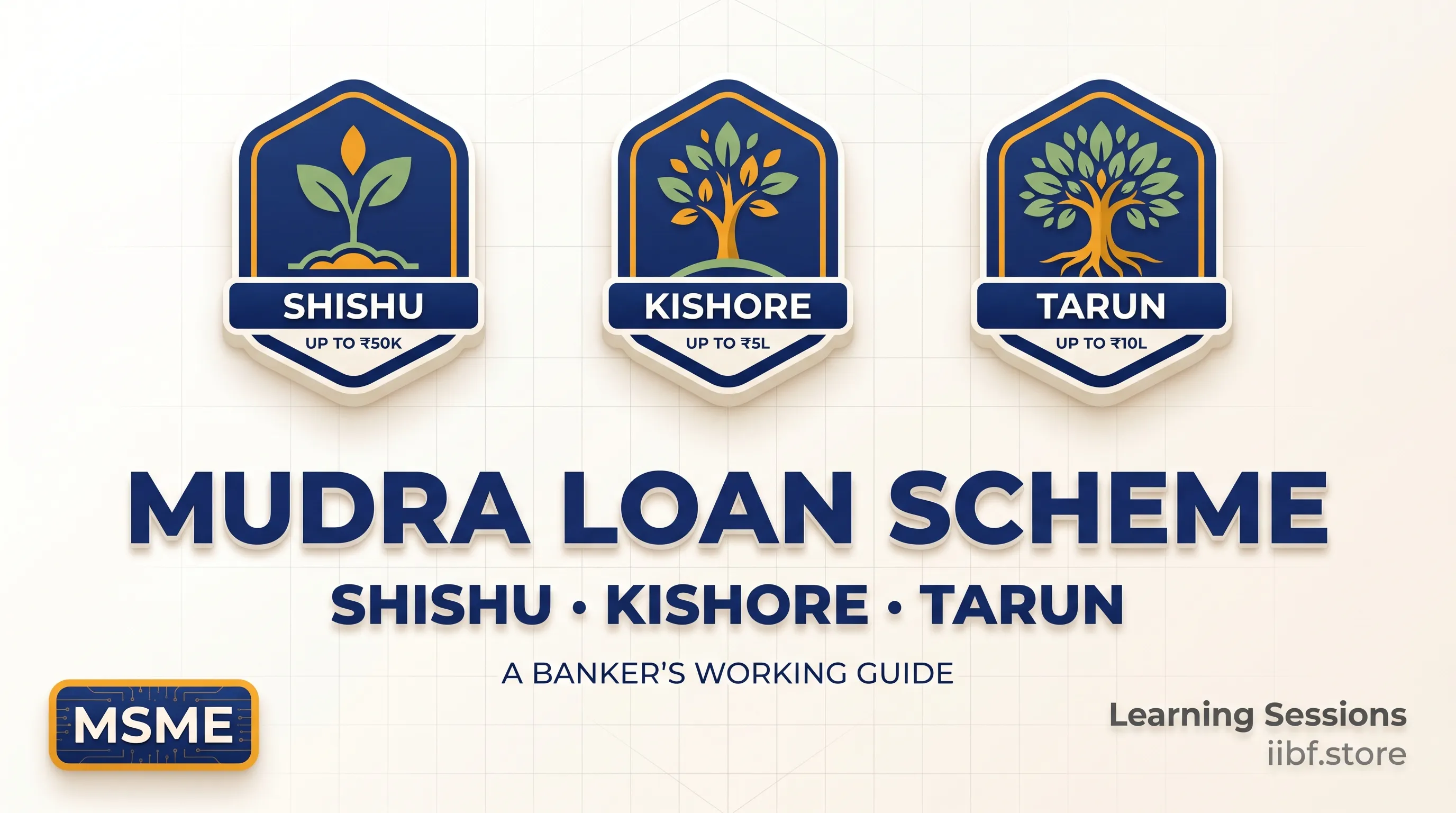
- Three tiers by loan size: Shishu (up to ₹50,000), Kishore (above ₹50,000 to ₹5 lakh), Tarun (above ₹5 lakh to ₹10 lakh).
- The MUDRA loan scheme is collateral-free — the lender is protected by the CGFMU guarantee, not by land or gold.
- End-use must be income-generating: no agriculture (use KCC) and no pure consumption.
- Udyam registration is the most valuable document you can get a borrower to complete before applying.
- For exam-specific limits, always confirm against the latest released IIBF notification and the current RBI / Mudra circular.
The three tiers of the MUDRA loan scheme — Shishu, Kishore, Tarun
The elegance of the MUDRA loan scheme lies in its tiering. Instead of one large scheme with a tangle of conditions, the facility is split by loan quantum, and each tier maps to a genuine stage in a micro-enterprise's life cycle. The names themselves carry the logic.
- Shishu (literally "infant") — loans up to ₹50,000. This is first-step funding for a brand-new micro entrepreneur: a vegetable vendor buying a cart, a tailor picking up a second-hand sewing machine, a paanwala stocking up before the festive rush. No collateral, minimal documentation, the smallest of the small.
- Kishore (literally "adolescent") — loans above ₹50,000 and up to ₹5 lakh. This is the customer who started small a year or two ago and now needs working capital to expand — a textile printer adding a second machine, a kirana scaling toward wholesale, a beauty parlour moving from home to a rented shop.
- Tarun (literally "youth") — loans above ₹5 lakh and up to ₹10 lakh. This is the established small unit ready for a serious capital purchase: a small manufacturer buying a lathe, a press upgrading to digital printing, a food-processing entrepreneur installing a packaging line.
A further sub-category, often referred to as Tarun Plus, was introduced to support repeat borrowers who have already cleared a Tarun loan, raising the ceiling above ₹10 lakh. Availability and operational guidelines vary by lending bank, so treat the upper limit as something to verify against the latest RBI / Mudra circular and your own bank's product master before you quote it to a customer.
Who actually qualifies for a MUDRA loan
One reason the MUDRA loan scheme is so popular at the counter is that its eligibility test is broader than most schemes. The core conditions are straightforward.
- The applicant is an Indian citizen running a non-farm, non-corporate income-generating activity — manufacturing, processing, trading or services in the micro and small space.
- There is a viable business proposal. Even at Shishu, the borrower should be able to say what the loan will buy and how it will repay itself.
- There is no major default record with any bank or NBFC. A clean credit bureau report is ideal; minor blemishes can sometimes be accommodated at the Shishu level.
- The borrower is broadly within the working-age band banks accept (commonly 18 upwards), with some lenders stretching the upper age for repeat customers.
Two end-use exclusions matter. The MUDRA loan scheme is not meant for agricultural activity — a Kisan Credit Card (KCC) is the correct product there — and it is not meant for purely consumption purposes. A salaried walk-in who wants a Mudra loan to "try a side business" needs a clear, document-backed plan, not just an idea, before you take the file forward.
Collateral, interest rate and repayment under the MUDRA loan scheme
Three operational items trip up branch officers more than anything else, so it is worth fixing them firmly in memory.
Collateral. MUDRA loans are collateral-free. The lender is protected not by land, gold or third-party security but by a credit guarantee — the CGFMU (Credit Guarantee Fund for Micro Units), administered by NCGTC. The fund covers the lender against default up to a defined ceiling, and that backstop is precisely what makes lending at the bottom of the pyramid commercially workable.
Interest rate. MUDRA is fundamentally a refinance mechanism: your bank lends from its own funds at its own rate, and MUDRA refinances. Effective rates to the end borrower are typically benchmarked to the bank's external benchmark lending rate (EBLR) plus a spread, with the spread kept in check by regulatory guidance. The exact numbers move with monetary policy, so keep the live RBI rates page open when you are computing an EMI at the counter rather than quoting a figure from memory.
Repayment. Loans are usually structured as term loans with a moratorium option. Smaller Shishu loans often run for a few years; Kishore and Tarun facilities can run longer, broadly in line with the useful life of the asset financed. Working-capital components can be set up as cash-credit limits that are reviewed and renewed each year.
MUDRA tiers at a glance
The table below summarises the three tiers of the MUDRA loan scheme. Treat the documentation column as the typical minimum — individual banks may ask for a little more.
| Tier | Loan size | Typical borrower | Usual documentation |
|---|---|---|---|
| Shishu | Up to ₹50,000 | Brand-new micro unit; first asset purchase | KYC, photos, quotation, basic business proof |
| Kishore | Above ₹50,000 to ₹5 lakh | Growing unit needing working capital | Above + short project report, ITRs, statements |
| Tarun | Above ₹5 lakh to ₹10 lakh | Established unit; major capital purchase | Fuller project report, financials, GST returns |
| Tarun Plus | Above ₹10 lakh (repeat borrowers) | Proven borrower scaling up further | Full appraisal; confirm limit with current circular |
The documentation bundle, tier by tier
Documentation depth scales with the tier, and knowing exactly what to ask for means you stop sending borrowers home to "come back tomorrow". For a Shishu loan you can usually sanction on a remarkably light file:
- KYC of the borrower — Aadhaar, PAN and address proof.
- Two passport-size photographs.
- Quotation or proforma invoice for the asset being financed.
- Last six months' bank statement, where an account already exists.
- Business identity proof — an Udyam Registration Certificate, Gumasta or shop-and-establishment licence, or an equivalent local authority registration.
For Kishore, add a brief one- to two-page project report, income-tax returns for two to three years where available, and bank statements covering about twelve months. For Tarun, expect a fuller project report, audited financials where applicable, GST returns for the last year or so, and a sharper assessment of debt-service capacity.
Branch tip: Udyam registration is the most useful single document any MUDRA customer can hold. It is free, takes only minutes on the official Udyam portal, and it unlocks a range of other government schemes alongside Mudra. Make registering it the first thing every walk-in borrower does.
A simple branch workflow for sanctioning a Mudra loan
If you want a repeatable approach — whether you are a new officer or revising for the exam — this five-step sequence keeps you out of trouble.
- Classify the request by quantum first. The ticket size tells you the tier, the tier tells you the documentation depth and the appraisal rigour you owe the file.
- Test the activity, not just the person. Confirm the business is non-farm, non-corporate and genuinely income-generating, and that the proposed loan repays itself from that activity.
- Build the file to the tier. Collect the documentation bundle above; push Udyam registration before anything else.
- Price and structure correctly. Apply the bank's EBLR-linked rate, choose a tenor that respects the asset's useful life, and add a moratorium only where cash flows justify it.
- Disburse against the invoice and monitor early. For asset purchases, pay the vendor directly, file the delivery proof, and watch the first three EMIs closely.
Common mistakes and appraisal traps
You will not get exam questions on these, but you will lose sleep over them if a portfolio turns sour. Internalise all three.
- Sanctioning a Shishu and forgetting it. Repayment behaviour in the first ninety days is the best single predictor of long-term performance. A missed second EMI is an early-warning signal — call the borrower, understand why, and act before it becomes an NPA. Small tickets are exactly the ones officers neglect, which is precisely why those portfolios degrade.
- Falling for the "shifted Kishore". A customer who could not justify ₹6 lakh often returns asking for ₹4.99 lakh, sitting right at the upper edge of Kishore. That is not coincidence; it is gaming the threshold. Underwrite the merit, not the round number — if the proposal does not support ₹5 lakh, it does not support ₹4.99 lakh either.
- Skipping end-use verification. Tarun loans for machinery must be disbursed directly to the vendor against an invoice, never credited to the borrower's current account. Cutting this corner is the single biggest cause of Mudra-loan fraud at branch level. Keep the vendor payment trail and the delivery acknowledgement in the file.
CGFMU vs CGTMSE, and how MUDRA is tested in the IIBF MSME exam
One distinction earns marks in the exam and clarity at the desk: the guarantee fund behind each scheme. The MUDRA loan scheme is backed by CGFMU (for micro units), whereas standard MSME term loans and working-capital facilities up to the prescribed ceiling are backed by CGTMSE. Mixing the two is a classic test trap.
If you are sitting the IIBF Certificate Course on MSME, the MUDRA loan scheme is one of the most repeatedly tested topics. Questions tend to cluster around a few themes:
- Tier-wise loan ceilings — the Shishu, Kishore and Tarun cut-offs are staples.
- CGFMU versus CGTMSE — which guarantee fund backs which scheme.
- End-use restrictions — no agriculture, no consumption.
- How MUDRA interacts with schemes such as Stand-Up India and PMEGP.
- Documentation and the broad regulatory framework under RBI's master directions.
To prepare efficiently, work through the Certificate Course on MSME hub, then drill the Small and Medium Enterprises in India module where the credit schemes sit. Lock concepts in with a timed MSME mock test after each chapter, and use the scheme-matching game to memorise which fund pairs with which scheme. You can browse every MSME guide in one place too.
It also helps to read MUDRA alongside the schemes it is often confused with. Our walk-throughs of CGTMSE Guarantee Scheme Explained — When Banks Use It Instead of MUDRA and the Stand-Up India — Scheme for SC/ST and Women Entrepreneurs draw the boundaries cleanly, while MSME Classification Revised — Micro, Small, Medium Thresholds Explained grounds the whole topic. For the official position on any limit, always cross-check the regulator at iibf.org.in.
Frequently asked questions
What is the MUDRA loan scheme in simple terms?
The MUDRA loan scheme is a Government of India programme that provides collateral-free loans to non-farm, non-corporate micro and small enterprises. Lending is delivered through banks and other institutions and is split into three tiers — Shishu, Kishore and Tarun — based on the loan amount. The lender is protected by the CGFMU credit guarantee rather than by physical security.
What are the Shishu, Kishore and Tarun limits?
Shishu covers loans up to ₹50,000, Kishore covers above ₹50,000 up to ₹5 lakh, and Tarun covers above ₹5 lakh up to ₹10 lakh. A Tarun Plus sub-category extends the ceiling further for repeat borrowers. Because limits can be revised, confirm the current figure against the latest RBI / Mudra circular before quoting it.
Is collateral required for a MUDRA loan?
No. The MUDRA loan scheme is collateral-free across all three tiers. Instead of taking land, gold or third-party security, the lender relies on the CGFMU (Credit Guarantee Fund for Micro Units) administered by NCGTC, which covers default up to a defined ceiling. That guarantee is what makes the scheme viable at the bottom of the lending pyramid.
Can a salaried employee get a MUDRA loan for a side business?
Yes, provided the side business is a genuine income-generating activity such as manufacturing, trading or services. The borrower should produce a viable business plan, an Udyam registration in the new venture's name, and evidence that repayment does not depend solely on their salary. Banks scrutinise such proposals more closely, but they are valid under the scheme.
What is the difference between MUDRA and CGTMSE?
They are different things that often appear together. MUDRA is a lending scheme for micro units, guaranteed by CGFMU, whereas CGTMSE is a credit-guarantee scheme that covers collateral-free MSME loans up to a prescribed limit. In short, MUDRA is the loan product; CGTMSE is a guarantee cover used for a broader set of MSME facilities. Confusing the two funds is a frequent exam error.
Can a borrower take more than one MUDRA loan?
Sequentially, yes — a Shishu borrower can graduate to Kishore once the first loan is fully repaid and the business has shown viability. Parallel MUDRA loans for the same activity are not permitted, and a borrower can ordinarily hold only one active Mudra exposure across the banking system at a time. Credit-bureau checks will flag any attempt at double-dipping.
Final word
The MUDRA loan scheme is not complicated: three tiers, one guarantee fund, a light documentation bundle and a strong underlying purpose — getting capital into the hands of India's smallest entrepreneurs without forcing them to pledge security they do not have. The exam rewards whoever has internalised the tier limits, the eligibility logic and the CGFMU-versus-CGTMSE distinction; the job rewards whoever refuses to sanction and forget. Spend one focused evening on the MSME chapter covering MUDRA, take a mock test, and revisit this guide next month — that quiet repetition is exactly what turns a scheme you can look up into one you simply know.
Related Guides
📚 Free Learning Sessions resources — connect & crack your exam
- 📝 Free mock tests — chapter-wise, exam-pattern, with instant solutions
- 🎮 Matching games — gamified revision of key terms & concepts
- 📄 Study notes & PDFs — downloadable chapter material
- 🎥 Video classes on YouTube — subscribe to @learningsessions
💬 Want the full course? WhatsApp your course name to 8360944207 and our team will set you up.
📱 Study on the go — get our iOS & Android app at iibf.store/app.
Prefer revising from a printed book?
Chapter-wise books with MCQs after every chapter — minimal pages, complete coverage, delivered anywhere in India. Every book has a free sample to read first.
132 pages · 225 MCQs
Learning Sessions · Ashish Sir
188 pages · 435 MCQs
Learning Sessions · Ashish Sir
117 pages · 236 MCQs
Learning Sessions · Ashish Sir
Learning Sessions · Ashish Sir
118 pages · 299 MCQs
Learning Sessions · Ashish Sir
Learning Sessions · Ashish Sir
Learning Sessions · Ashish Sir
Learning Sessions · Ashish Sir
115 pages · 255 MCQs
Learning Sessions · Ashish Sir
Learning Sessions · Ashish Sir
334 pages · 936 MCQs
Learning Sessions · Ashish Sir
Learning Sessions · Ashish Sir
115 pages · 344 MCQs
Learning Sessions · Ashish Sir
107 pages · 240 MCQs
Learning Sessions · Ashish Sir
90 pages · 150 MCQs
Learning Sessions · Ashish Sir
Learning Sessions · Ashish Sir
131 pages · 672 MCQs
Learning Sessions · Ashish Sir
221 pages · 831 MCQs
Learning Sessions · Ashish Sir
128 pages · 524 MCQs
Learning Sessions · Ashish Sir
107 pages · 445 MCQs
Learning Sessions · Ashish Sir
148 pages · 478 MCQs
Learning Sessions · Ashish Sir
151 pages · 465 MCQs
Learning Sessions · Ashish Sir
148 pages · 375 MCQs
Learning Sessions · Ashish Sir
216 pages · 895 MCQs
Learning Sessions · Ashish Sir
109 pages · 300 MCQs
Learning Sessions · Ashish Sir
104 pages · 360 MCQs
Learning Sessions · Ashish Sir
82 pages · 297 MCQs
Learning Sessions · Ashish Sir
151 pages · 600 MCQs
Learning Sessions · Ashish Sir
98 pages · 282 MCQs
Learning Sessions · Ashish Sir
Practice this topic
Take a free mock test, download chapter PDFs, or watch a video class — all included on iibf.store.