How neo banks in India work: Models, Rules and Revenue
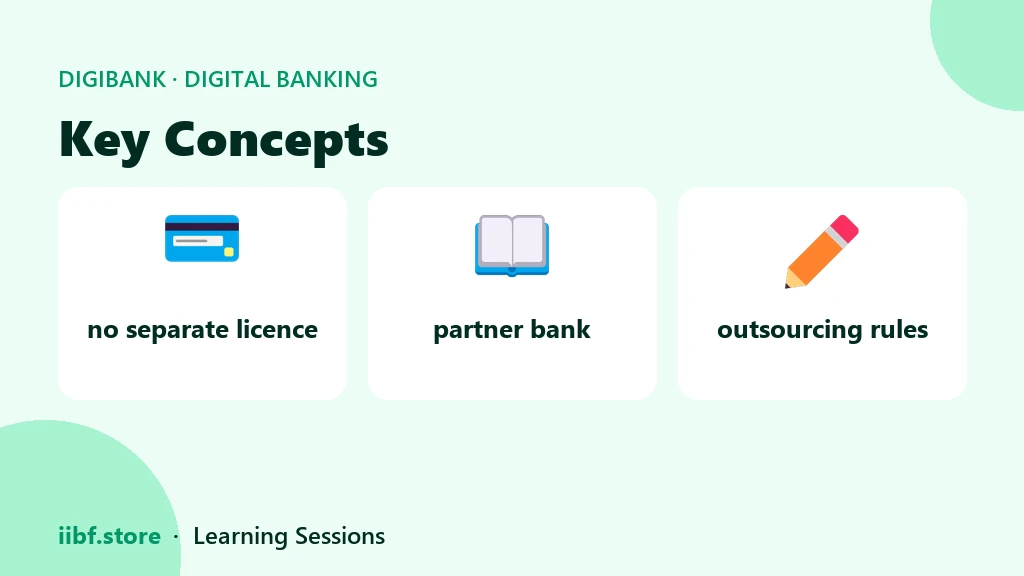
Neo banks in India are digital-first financial platforms that look and feel like a bank on your phone, but do not hold a banking licence of their own. Every rupee a customer deposits through such an app actually sits with a licensed scheduled commercial bank, a small finance bank or a licensed prepaid instrument issuer sitting behind the interface. For JAIIB and CAIIB candidates studying neo banks in India, this single distinction — customer-facing brand versus licence-holding entity — is the whole examinable core of the topic, and it is where most candidates lose marks.
The Reserve Bank of India has never issued a standalone "digital bank" licence. Consequently, the entire neo bank industry runs on a partnership architecture governed by outsourcing, KYC, prepaid payment instrument and digital lending rules rather than by any dedicated neo banking regulation. This article explains the models, the revenue engine, the regulatory boundaries, and how neo banks differ from payments banks and Digital Banking Units — exactly the angles IIBF examiners favour.
🏦 What Neo Banks in India Are and How the Model Works
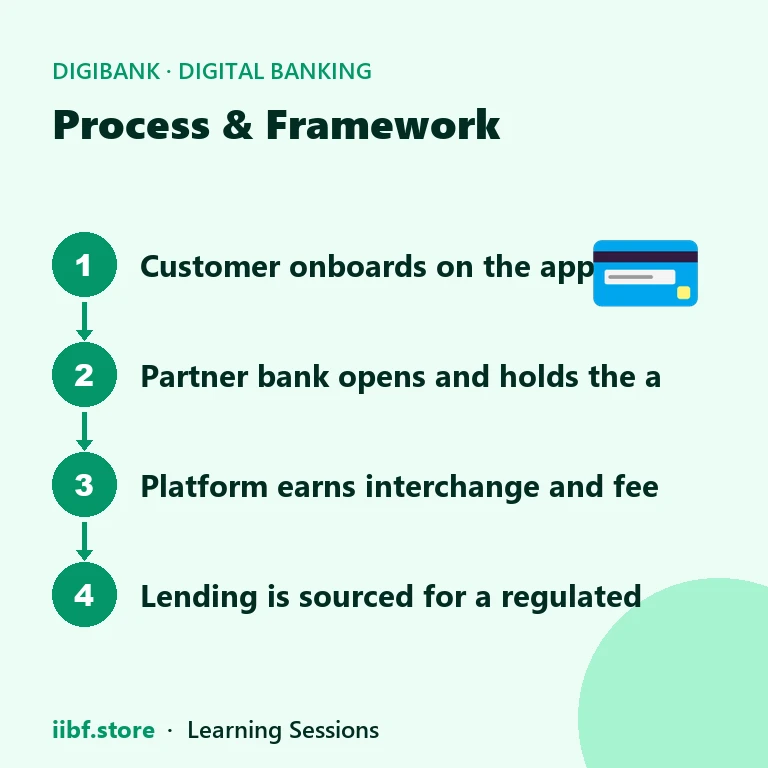
A neo bank is a technology company that builds the customer experience layer — onboarding, app, dashboards, spend analytics, invoicing, expense cards — and rents the regulated capability from a partner bank. The partner bank holds the deposit, appears on the account statement, owns the KYC record, bears the regulatory liability, and is answerable to RBI. The neo bank is, in supervisory language, an outsourced service provider or a business correspondent-style channel, not a bank.
Three broad structures exist in practice. The first is the partner-bank current/savings account model, where the neo bank distributes a partner bank's account and earns a share of interchange and cross-sell income. The second is the prepaid payment instrument model, where the front end issues a wallet or prepaid card either under the partner's PPI licence or its own; the rules here flow directly from the PPI framework, and understanding prepaid payment instruments in India is essential before you can answer any neo bank question. The third is the B2B or banking-as-a-service model, where the platform sells embedded accounts, payouts and reconciliation APIs to marketplaces and payroll firms.
None of these three lets the platform create money, accept a deposit in its own name, or pay interest out of its own balance sheet. The chapter on the overview of digital banking in your syllabus frames this correctly: digital delivery changes the channel, not the licence. A neo bank is a channel innovation layered on an existing balance sheet.
💡 Exam Tip: If a question asks "who is the deposit liability of a neo bank customer owed by?", the answer is always the partner bank — never the neo bank platform.
📜 Why India Has No Standalone Digital Bank Licence
Several jurisdictions — Singapore, Hong Kong, the United Kingdom and South Korea among them — created a distinct digital-only bank licence with a lower entry capital requirement and a restricted initial phase. India deliberately did not. A NITI Aayog discussion paper in 2021 proposed a licensing and regulatory regime for digital banks, suggesting a staged licence with a restricted operating period before full-scale authorisation. It remained a proposal; RBI did not convert it into a licensing window.
The regulator's reasoning, as reflected in its public communication, rests on three pillars. First, India's universal banking licence is already technology-neutral — nothing prevents a licensed bank from operating entirely digitally, so a separate licence solves a problem that does not exist. Second, deposit-taking without branch-based supervision raises resolution and depositor-protection questions in a market with very large retail participation. Third, RBI preferred to strengthen the existing perimeter — outsourcing directions, IT governance, KYC and digital lending rules — rather than open a new category of deposit taker.
The practical consequence for candidates is that no Indian neo bank can call itself a bank in its brand promise or advertising. RBI has repeatedly cautioned entities against using the word "bank" in a manner that misleads the public, since Section 7 of the Banking Regulation Act, 1949 restricts the use of the word "bank", "banker" or "banking" by unlicensed entities. That statutory hook is a favourite one-mark question.
⚠️ Common Mistake: Candidates write that neo banks are "regulated by RBI". They are not directly licensed or regulated as banks — they are supervised indirectly through the compliance obligations RBI imposes on their partner banks.
💰 Revenue Model and Target Segments of Neo Banking Platforms
Because the platform earns no net interest margin on deposits it cannot hold, revenue must come from fee pools. The largest single stream is interchange sharing on debit and prepaid card spends, split with the issuing partner under a commercial agreement. The second is lending distribution income — sourcing fees, service fees or a share of yield when the platform originates personal loans, MSME credit or credit-line products for a partner bank or NBFC, subject to the digital lending framework that requires all disbursals and repayments to flow directly between the borrower's account and the regulated entity's account.
Beyond that sit subscription plans for premium tiers, SaaS fees for the accounting, GST-reconciliation, payroll and vendor-payout tools bundled with a business account, foreign exchange and remittance mark-ups on cross-border collections for freelancers and exporters, and float-linked arrangements where the partner bank shares part of the economic benefit of stable balances. Understanding how card acceptance economics feed this pool is easier once you have worked through the chapter on POS and point-of-sale acquiring.
Target segments are chosen precisely because incumbent banks serve them poorly. Freelancers and gig workers need multi-currency collections and instant invoicing. MSMEs and early-stage companies need current accounts opened without branch visits, plus expense cards with spend controls. Teenagers and young earners need a supervised card and pocket-money controls, typically delivered through a PPI rather than a full savings account. Blue-collar payroll users need low-cost accounts with wage advances. Each of these segments has a distinct compliance profile, which is why co-branding and buy now pay later regulation in India matters so much to their unit economics.
⚖️ Neo Banks vs Payments Banks vs DBUs vs Universal Banks
The comparison table below is the single most exam-relevant summary of this topic. Read the "own RBI licence" column first — it separates a regulated deposit taker from a distribution layer.
| Feature | Neo bank platform | Payments bank | Small finance bank | Digital Banking Unit |
|---|---|---|---|---|
| Holds its own RBI banking licence | ❌ No | ✅ Yes (differentiated) | ✅ Yes (differentiated) | ❌ No — it is a unit of a licensed bank |
| Can accept deposits in its own name | ❌ No | ✅ Yes, subject to the per-customer balance ceiling | ✅ Yes, no special ceiling | ✅ Yes, as the parent bank |
| Can lend from its own balance sheet | ❌ No | ❌ No | ✅ Yes, with priority-sector obligations | ✅ Yes, as the parent bank |
| Physical presence requirement | ❌ None — app only | ✅ Yes, prescribed outlet norms apply | ✅ Yes, branch norms apply | ✅ Yes — a fixed-point brick-and-mortar outlet |
| Deposit insurance cover for the customer | ✅ Yes, but through the partner bank | ✅ Yes, directly | ✅ Yes, directly | ✅ Yes, directly |
| Primary regulatory anchor | Outsourcing, KYC, PPI and digital lending rules | Payments bank licensing guidelines | SFB licensing guidelines | RBI DBU establishment guidelines |
Note the asymmetry the table exposes. A payments bank is a licensed but restricted bank — it may take deposits up to the prescribed per-customer ceiling and must invest the bulk of them in government securities and bank deposits, but it cannot lend. A neo bank is the opposite: it can arrange lending as a distributor, yet cannot hold a single rupee of deposit. A Digital Banking Unit is neither — it is a specified fixed-point outlet of an already-licensed bank, created to deliver digital products with a physical touchpoint, and it is covered in the Retail Banking digital banking class material.
🛡️ Regulatory Constraints, Risks and the Outlook
The binding constraints on neo banks in India come from four directions. PPI rules restrict what a wallet may do — loading from credit lines is not permitted, full-KYC and small PPI categories carry different balance and loading limits, and interoperability obligations apply; always check the current PPI Master Direction for the exact figures, since RBI revises them. Co-branding rules require the licensed issuer to remain the visible, accountable party on the card and to retain control over customer grievance redressal, marketing content and data. Outsourcing and IT governance directions make the partner bank responsible for the platform's controls, audit rights, business continuity and data localisation. Digital lending rules insist that money moves directly between borrower and regulated entity, with a Key Fact Statement, all-inclusive annual percentage rate disclosure and a defined cooling-off period.
The risks follow logically. There is concentration risk: a platform whose entire customer base rides on one partner bank can be wiped out by a single supervisory action against that bank. There is compliance transmission risk, where lax onboarding at the front end lands as a KYC breach on the partner's books. There is cyber and data risk, since the app holds transaction data and credentials — which is why partner banks increasingly demand the platform integrate with their monitoring stack, a theme covered in our note on the security operations centre in banks. Finally there is revenue fragility: interchange caps, the zero-MDR regime on UPI, and RBI's restrictions on credit-line-funded wallets have each removed a revenue line at short notice.
The outlook is consolidation rather than collapse. Stronger platforms are converting into regulated entities themselves — acquiring NBFC licences, becoming business correspondents, or being absorbed by banks that want the technology stack. Weaker ones are retreating into pure SaaS. Candidates tracking this space should also follow how NPCI role in digital payments shapes the rails these platforms depend on, and revise the mobile banking chapter alongside this topic.
📌 Remember: Neo bank = front end without a licence. Payments bank = licence without lending. Digital Banking Unit = licensed bank's physical digital outlet. Get these three separations right and most objective questions on the topic collapse into one line.
🧠 Practice MCQs: Neo Banks in India
Q1. In the Indian neo banking model, the deposit accepted from a customer is a liability of which entity? (a) The neo bank platform (b) The partner licensed bank (c) NPCI (d) The card network
Answer: (b) — The neo bank is only a front end; the licensed partner bank holds the deposit and carries the liability.
Q2. Which statement about a standalone digital bank licence in India is correct? (a) RBI issued it in 2021 (b) It is granted only to foreign banks (c) It is available to payments banks on conversion (d) RBI has not created a separate digital bank licence category
Answer: (d) — A NITI Aayog paper proposed such a regime, but RBI has not opened a digital-bank licensing window.
Q3. Which section of the Banking Regulation Act, 1949 restricts the use of the word "bank" by unlicensed entities? (a) Section 7 (b) Section 21 (c) Section 35A (d) Section 45
Answer: (a) — Section 7 governs the use of the words "bank", "banker" and "banking" in a company's name and business.
Q4. Which of the following is NOT a revenue stream for a neo banking platform? (a) Interchange sharing on card spends (b) SaaS subscription fees from MSME customers (c) Net interest margin earned on its own deposit book (d) Lending distribution and sourcing fees
Answer: (c) — It holds no deposits of its own, so it can earn no net interest margin on a deposit book.
Q5. A Digital Banking Unit differs from a neo bank primarily because a DBU (a) is licensed separately by SEBI (b) is a fixed-point outlet of an already-licensed bank (c) cannot accept deposits (d) is prohibited from offering digital products
Answer: (b) — A DBU is a specified brick-and-mortar outlet set up by a licensed bank to deliver digital banking products.
Want chapter-wise mock tests with 100+ MCQs? Start practising free →
❓ Frequently Asked Questions
Are neo banks safe for depositors in India?
The money sits with a licensed partner bank, so it enjoys the same deposit insurance cover as any other account with that bank, subject to the prevailing DICGC limit. The operational risk lies with the platform's service continuity, not with the safety of the deposit itself.
Can a neo bank in India give loans directly?
No. It can source, underwrite-assist and service loans for a partner bank or NBFC, but disbursement and repayment must flow directly between the borrower and the regulated lender under RBI's digital lending framework.
How is a neo bank different from a payments bank?
A payments bank holds a differentiated RBI banking licence, may accept deposits up to a prescribed per-customer ceiling and cannot lend. A neo bank holds no licence at all, cannot accept deposits, but may distribute credit products as a partner.
Which IIBF papers cover this topic?
It appears in the digital banking and retail banking modules of the IIBF certification syllabus and in the technology-related sections of JAIIB and CAIIB. Browse the full digital banking article hub for related revision notes.
🎯 Conclusion and Next Step
Neo banks are best understood as an unbundling of the bank's customer interface from its balance sheet. The interface competes on speed, design and workflow; the balance sheet, the licence and the accountability stay with the regulated partner. That is why every examinable rule about these platforms is borrowed from somewhere else — the PPI Master Direction, the outsourcing directions, the KYC Master Direction and the digital lending framework — and why no single "neo bank regulation" exists to memorise. Revise the boundaries, not the brand names.
Ready to test yourself on this module? Take a chapter-wise digital banking mock on our free test series, or work through the structured syllabus in the CAIIB course to lock the concepts in before exam day.
Source and further reading: NPCI and the Indian Institute of Banking & Finance.
Quick quiz on this topic
5 exam-style questions from our free test bank — check yourself before you move on.
Practice this topic
Take a free mock test, download chapter PDFs, or watch a video class — all included on iibf.store.
Keep reading