Net Owned Fund for NBFCs: RBI NOF Rules and Minimums (2026)
The Net Owned Fund for NBFCs is the single most important number the Reserve Bank of India looks at before it lets a company operate as a non-banking financial company. It is the regulatory floor of genuine, loss-absorbing capital that every NBFC must hold. If your Net Owned Fund for NBFCs slips below the prescribed minimum, the RBI can refuse or cancel your Certificate of Registration outright. For anyone preparing for the IIBF NBFC certification, understanding how NOF is defined, calculated and phased in under the current rules is non-negotiable exam territory — and it links directly to almost every other topic in the syllabus, from deposit rules to capital adequacy.
This guide breaks down the statutory definition under the RBI Act, the exact calculation method, the category-wise minimums that apply in 2026, and the glide path that is quietly raising the bar for thousands of registered NBFCs. Work through it once and the numbers will stick.
📘 What Net Owned Fund Actually Means
Net Owned Fund (NOF) is a statutory concept defined in Section 45-IA of the Reserve Bank of India Act, 1934. It is the yardstick the RBI uses to decide whether a company has enough of its own skin in the game to be registered and to keep operating as an NBFC. Crucially, NOF is not the same as paid-up capital or net worth — it is a narrower, more conservative figure designed to strip out capital that has been recycled within a group.
The starting point is the "owned fund." Owned fund equals paid-up equity capital plus preference shares compulsorily convertible into equity, plus free reserves, share premium and capital reserves, minus accumulated losses, deferred revenue expenditure, book value of intangible assets and any other losses shown as an asset. From this owned fund, the regulator deducts investments made in shares of, and loans or advances to, subsidiaries and group companies to the extent they exceed ten percent of the owned fund. What remains is the Net Owned Fund. Because it screens out intra-group exposure, NOF gives the RBI a clean view of the capital that is truly available to absorb losses. This concept sits at the heart of the regulatory requirements and compliance module.
💡 Exam Tip: Remember the sequence — start with owned fund, then deduct the excess (over 10%) of investment in group companies. Many candidates wrongly equate NOF with net worth; the group-company deduction is exactly what makes NOF stricter.
🧮 How NOF Is Calculated Step by Step
Calculating NOF is a two-stage arithmetic exercise, and the IIBF loves to test it with a small numerical. Stage one builds the owned fund. Add up paid-up equity capital, compulsorily convertible preference shares, free reserves (general reserve, statutory reserve under Section 45-IC), securities premium and capital reserves arising from cash surpluses. Then subtract the "erosion" items: accumulated losses, deferred revenue expenditure, and intangible assets such as goodwill and preliminary expenses.
Stage two converts owned fund into NOF. Total up the NBFC's investments in shares of subsidiaries, companies in the same group and other NBFCs, plus the book value of debentures, bonds, outstanding loans and advances (including hire purchase and lease finance) made to and deposits with subsidiaries and group companies. Whatever portion of this total exceeds ten percent of the owned fund is deducted. For example, if owned fund is ₹40 crore and group exposure is ₹6 crore, the 10% threshold is ₹4 crore, so ₹2 crore is deducted, giving an NOF of ₹38 crore. The statutory reserve transfer under Section 45-IC — where every NBFC must move at least 20% of net profit to a reserve fund before declaring a dividend — steadily strengthens free reserves and therefore owned fund over time. Understanding where this capital comes from ties into the sources of finance a finance company relies on.
⚠️ Common Mistake: Only the amount exceeding 10% of owned fund is deducted — not the whole group exposure. Deducting the entire investment is the classic trap answer in the option list.
📊 Minimum NOF Requirements by NBFC Category
Different categories of NBFC face different NOF floors, reflecting the risk they carry. A plain investment and credit company sits at one end; a large infrastructure finance company or mortgage guarantee company sits at the other. The table below captures the position applicable in 2026 after the Scale Based Regulation reforms took effect.
| NBFC Category | Minimum NOF (2026) | Public Deposits Allowed? |
|---|---|---|
| NBFC-ICC (Investment & Credit Company) | ₹10 crore (glide path) | Only if rated & deposit-taking |
| NBFC-MFI (Microfinance) | ₹10 crore (₹5 cr in NE region) | ✘ No |
| NBFC-Factor | ₹10 crore (glide path) | ✘ No |
| NBFC-P2P Lending Platform | ₹2 crore | ✘ No |
| NBFC-Account Aggregator | ₹2 crore | ✘ No |
| Infrastructure Finance Company (IFC) | ₹300 crore | ✔ If registered to |
| Mortgage Guarantee Company (MGC) | ₹100 crore | ✘ No |
Note that a Core Investment Company (CIC) becomes systemically important and requires registration once its asset size reaches ₹100 crore with access to public funds. The category-by-category logic mirrors the layered risk approach explained in our guide to NBFC vs bank differences, where capital expectations rise with the systemic footprint of the institution.
🚦 The Glide Path Raising the Bar to ₹10 Crore
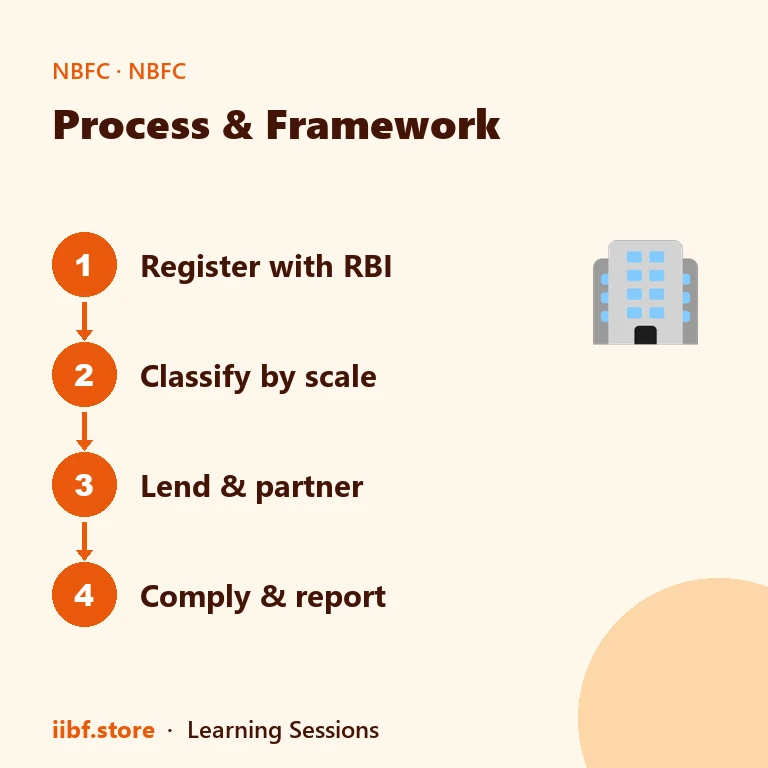
Until 2022 the baseline NOF for a new NBFC-ICC was just ₹2 crore. Under the Scale Based Regulation framework, the RBI decided that ₹2 crore was too thin for institutions increasingly interconnected with the banking system, and raised the minimum to ₹10 crore for the three most common categories — ICC, MFI and Factor. To avoid forcing sudden capital raises, the regulator laid out a phased "glide path": existing NBFCs must reach ₹5 crore by 31 March 2025 and the full ₹10 crore by 31 March 2027. New applicants, however, must show ₹10 crore from day one.
This staged increase is genuinely consequential. An NBFC that fails to hit each milestone risks its registration being cancelled, so treasury and capital planning teams have had to build the increase into their funding calendars — a discipline that overlaps with how banks plan liquidity and capital, covered in our note on treasury operations in banks. It also interacts with the tighter supervisory tools the RBI now deploys, including the PCA framework for NBFCs, where a capital shortfall can trigger corrective action.
📝 Remember: ₹2 crore → ₹5 crore by March 2025 → ₹10 crore by March 2027. NBFC-P2P and Account Aggregators are exempt and stay at ₹2 crore. This timeline is a favourite one-mark question.
🔍 Why NOF Matters and How It Is Tested
NOF is not a one-time registration hurdle — it is a continuing obligation. The RBI monitors NOF alongside the capital-to-risk weighted assets ratio (CRAR), and a breach of the minimum NOF is one of the fastest routes to cancellation of a Certificate of Registration under Section 45-IA(6). For deposit-taking NBFCs, NOF also caps how much public deposit can be mobilised, linking the concept directly to depositor protection. A healthy NOF signals that the company can absorb credit and liquidity shocks without endangering the funds it holds.
For the exam, expect a blend of theory and a numerical. You should be able to state the defining section, list the additions and deductions for owned fund, apply the 10% group-exposure rule, and recall the category minimums and the glide-path dates. NOF questions frequently sit next to questions on the NBFC liquidity risk management framework, because both measure a finance company's resilience. Reinforce the topic by reading how NBFCs fit into the wider Indian financial system, and browse related explainers on the NBFC blog hub. When you are ready, put the numbers to the test with a full mock on iibf.store tests or work through the structured CAIIB course for deeper regulatory context.

🧠 Practice MCQs: Net Owned Fund for NBFCs
Q1. Net Owned Fund for NBFCs is defined under which section of the RBI Act, 1934? (a) Section 45-IB (b) Section 45-IC (c) Section 45-IA (d) Section 45-Q
Answer: (c) — Section 45-IA governs the requirement of registration and the minimum Net Owned Fund for NBFCs.
Q2. While computing NOF, investments in group companies are deducted only to the extent they exceed what percentage of owned fund? (a) 5% (b) 10% (c) 15% (d) 25%
Answer: (b) — Only the portion of group-company investment and loans exceeding 10% of owned fund is deducted from owned fund.
Q3. Under Scale Based Regulation, the minimum NOF for a new NBFC-ICC must reach what amount by 31 March 2027? (a) ₹2 crore (b) ₹5 crore (c) ₹10 crore (d) ₹20 crore
Answer: (c) — The glide path takes NBFC-ICC, MFI and Factor to ₹10 crore by 31 March 2027.
Q4. Which of the following NBFC categories continues to have a minimum NOF of only ₹2 crore? (a) NBFC-MFI (b) NBFC-Factor (c) NBFC-P2P (d) Infrastructure Finance Company
Answer: (c) — NBFC-P2P and Account Aggregators are exempt from the increase and remain at ₹2 crore.
Q5. An NBFC has owned fund of ₹50 crore and total group-company exposure of ₹8 crore. What is its Net Owned Fund? (a) ₹42 crore (b) ₹47 crore (c) ₹48 crore (d) ₹50 crore
Answer: (b) — 10% of ₹50 crore is ₹5 crore; the excess of ₹3 crore is deducted, giving NOF of ₹47 crore.
Want chapter-wise mock tests with 100+ MCQs? Start practising free
❓ Frequently Asked Questions
Authoritative reference: see the latest guidelines on the Reserve Bank of India website and the IIBF syllabus portal.
Is Net Owned Fund the same as net worth?
No. Net worth includes all reserves and surplus, but NOF is stricter — it deducts intangible assets, accumulated losses and the excess of group-company investments over 10% of owned fund, giving a more conservative measure of loss-absorbing capital.
What happens if an NBFC's NOF falls below the minimum?
The RBI can reject a registration application or cancel an existing Certificate of Registration under Section 45-IA(6). The company must restore NOF within the timeline the regulator allows or exit NBFC operations.
Do NBFC-P2P platforms need ₹10 crore NOF?
No. NBFC-P2P lending platforms and Account Aggregators are exempt from the higher requirement and continue to need a minimum NOF of ₹2 crore.
Does the statutory reserve under Section 45-IC affect NOF?
Yes, indirectly. Transferring at least 20% of net profit to the statutory reserve each year increases free reserves, which raises owned fund and therefore strengthens Net Owned Fund over time.
Mastering NOF gives you a reliable one-to-two marks and a foundation for the rest of the NBFC regulatory syllabus. Lock in the definition, the 10% rule and the glide-path dates, then test yourself with a timed mock on iibf.store tests and build broader command of the framework through the CAIIB course.
Prefer revising from a printed book?
Chapter-wise books with MCQs after every chapter — minimal pages, complete coverage, delivered anywhere in India. Every book has a free sample to read first.






























Practice this topic
Take a free mock test, download chapter PDFs, or watch a video class — all included on iibf.store.