PCA Framework for NBFCs: RBI's Trigger Points (2026)
Every NBFC-paper candidate eventually meets a question on the PCA Framework for NBFCs — the Reserve Bank of India's Prompt Corrective Action mechanism that lets the regulator step in the moment a non-banking financial company's capital or asset quality starts slipping. Notified on 14 December 2021 and effective from 1 October 2022, this framework brought NBFCs into a supervisory regime long used for banks, but with its own set of trigger points, layers, and corrective actions. This article walks through the parameters RBI tracks, the three risk threshold levels, the mandatory and discretionary actions that follow a breach, and how the NBFC version compares with the bank PCA framework — everything the exam typically probes.
🚨 What Is the PCA Framework for NBFCs?
The PCA Framework for NBFCs is a rule-based supervisory tool designed to trigger timely corrective action before a stressed NBFC turns into a systemic problem. Rather than waiting for a full-blown crisis, RBI monitors specific financial ratios every quarter and imposes graded restrictions the moment an NBFC crosses a defined risk threshold. The framework applies from the financial position of an NBFC as on or after 31 March 2022, with the first supervisory actions kicking in from 1 October 2022.
Coverage extends to all deposit-taking NBFCs (NBFC-D, excluding government companies) and to non-deposit-taking NBFCs classified in the Middle Layer and Upper Layer under the Nbfcs Types And Roles classification scheme. Base Layer NBFCs that neither accept nor intend to accept public funds, government-owned NBFCs, Primary Dealers, and Housing Finance Companies are explicitly kept outside this framework, since HFCs and PDs already sit under their own supervisory arrangements.
💡 Exam Tip: PCA for NBFCs does NOT cover Base Layer NBFCs without public funds, Housing Finance Companies, Primary Dealers, or government NBFCs — a favourite distractor in MCQs.
📊 The Three Risk Parameters and Threshold Levels
For NBFC-D and NBFC-ND entities, RBI tracks three indicators: the Capital to Risk-weighted Assets Ratio (CRAR), the Tier I Capital Ratio, and the Net NPA (NNPA) Ratio. Core Investment Companies (CICs) are assessed differently — through Adjusted Net Worth to Aggregate Risk Weighted Assets, a Leverage Ratio, and NNPA — reflecting their distinct group-holding business model discussed under Regulatory Requirements Compliance.
Each parameter carries three graded breach levels. On the capital side, against a regulatory minimum CRAR of 15%, Threshold 1 is breached once CRAR falls below 15% but stays above 12%; Threshold 2 covers a fall to between 12% and 9%; and Threshold 3 is any CRAR reading below 9%. The Tier I Capital Ratio is tracked on a parallel breach structure, since NBFC capital adequacy is judged on both an overall and a core-capital basis. On the asset-quality side, an NNPA ratio of 6% to under 9% breaches Threshold 1, 9% to under 12% breaches Threshold 2, and 12% or above breaches Threshold 3.
| Parameter | Threshold 1 | Threshold 2 | Threshold 3 |
|---|---|---|---|
| CRAR | <15% but >12% | <12% but >9% | <9% |
| NNPA Ratio | 6% to <9% | 9% to <12% | >=12% |
| Supervisory response | Mandatory actions begin | Adds branch expansion curbs | Severe, may include resolution |
| Applies during PCA | ✅ Yes | ✅ Yes | ✅ Yes |
Tracking these ratios over successive quarters is essentially a trend-monitoring exercise, and the same statistical logic candidates study under time series analysis in banking — spotting a deteriorating trend before it becomes a full threshold breach — is exactly what RBI's off-site surveillance teams do with NBFC CRAR and NNPA data every quarter.
⛔ Mandatory and Discretionary Corrective Actions
Once an NBFC breaches Threshold 1, certain actions become mandatory: restrictions on dividend distribution and remittance of profits, and a requirement that promoters or shareholders infuse fresh equity to bring leverage back within limits. These are non-negotiable the moment the trigger is hit, regardless of the NBFC's own explanation for the slippage.
⚠️ Common Mistake: Students often assume PCA restrictions apply only after Threshold 3. In reality, dividend restriction and mandatory equity infusion already apply at Threshold 1 — the very first breach.
At Threshold 2, RBI adds restrictions on branch expansion on top of the Threshold 1 actions, slowing the NBFC's ability to grow its footprint while its capital position is repaired. At Threshold 3, the response becomes far more severe: alongside continuing the earlier restrictions, RBI can invoke discretionary actions, including resolution of the NBFC through amalgamation, reconstruction, or splitting, and tighter curbs on management compensation and further credit expansion. These discretionary options mirror the tone of the Recent Rbi Initiatives pushing NBFCs toward stronger board-level accountability rather than just capital top-ups.
📌 Remember: Threshold 1 = dividend curb + equity infusion. Threshold 2 = adds branch expansion restriction. Threshold 3 = severe, discretionary, up to resolution.
🔓 Exit From PCA and Why the Framework Matters
An NBFC does not remain under PCA indefinitely. Exit is considered only after the entity demonstrates sustained improvement — its CRAR, Tier I ratio, and NNPA must move back within the normal range across consecutive review cycles, with the Board formally certifying the turnaround before RBI lifts the restrictions. This mirrors the exit discipline used for banks under the equivalent PCA framework, where a one-quarter improvement is not enough; regulators look for a durable, board-verified correction.
The framework matters because NBFCs today intermediate a large share of retail and MSME credit, and a stressed NBFC left unchecked can trigger contagion across mutual funds, banks, and depositors who hold its paper. By tying supervisory response directly to measurable ratios rather than discretion alone, PCA gives RBI a transparent, rule-based lever — consistent with the broader supervisory architecture candidates study under Indian Financial System An Overview. It also gives depositors, bondholders, and co-lending bank partners an early public signal about which NBFCs are under enhanced supervision.
🏦 PCA Framework for NBFCs vs PCA for Banks
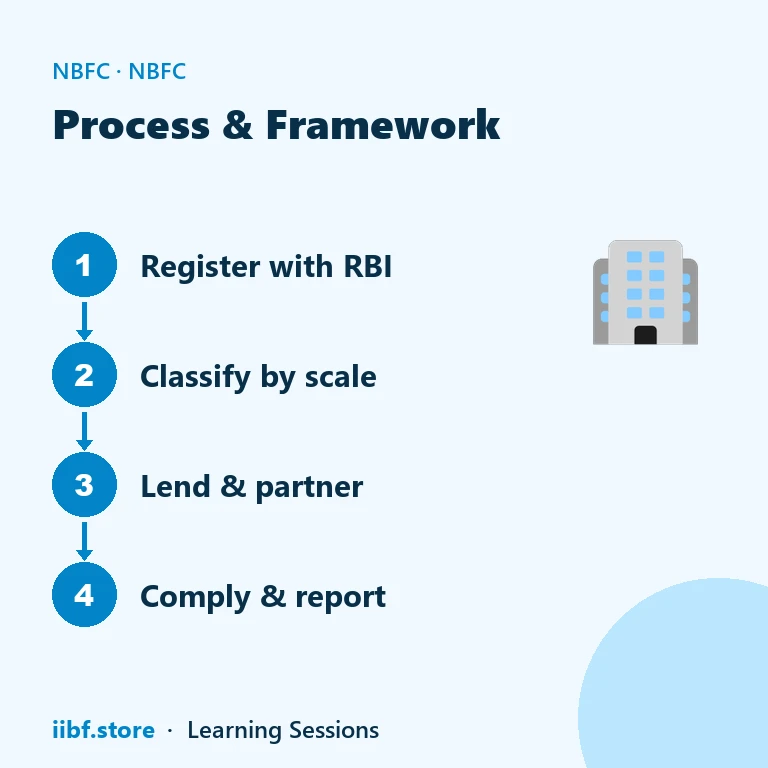
Both frameworks share the same philosophy — graded, rule-based intervention triggered by capital and asset-quality ratios — but the specifics differ because NBFCs and banks carry different risk profiles. Understanding these contrasts is easier once you have internalised the broader set of NBFC vs Bank differences, since PCA for banks additionally tracks Return on Assets and applies to all commercial banks uniformly, whereas the NBFC version is layer-specific and exempts Base Layer entities without public funds.
Capital adequacy discipline under NBFC-PCA also has to be read alongside the NBFC Liquidity Risk Management Framework, because a capital breach and a liquidity mismatch often surface together — an NBFC forced to shrink its balance sheet under PCA restrictions can simultaneously face ALM bucket gaps. Similarly, the mandatory equity-infusion requirement under Threshold 1 connects directly to NBFC corporate governance norms, since it is the Board and promoters, not just management, who are accountable for arranging fresh capital once RBI issues the direction.
🧠 Practice MCQs: PCA Framework for NBFCs
Q1. When did the PCA Framework for NBFCs come into effect, based on financial position as of March 31, 2022? (a) January 1, 2022 (b) October 1, 2022 (c) April 1, 2023 (d) December 14, 2021
Answer: (b) — RBI notified the framework on 14 December 2021, but it became effective from 1 October 2022, based on the NBFC's financial position as on or after 31 March 2022.
Q2. Which three parameters does RBI track under the PCA Framework for deposit-taking and non-deposit-taking NBFCs (excluding CICs)? (a) CRAR, Tier I Capital Ratio and Net NPA Ratio (b) Leverage Ratio, ROA and Liquidity Coverage Ratio (c) Gross NPA, Provision Coverage Ratio and CRAR (d) Net Worth, ALM gap and Tier II Capital
Answer: (a) — CRAR, Tier I Capital Ratio and NNPA Ratio are the three tracked indicators for NBFC-D and NBFC-ND entities; CICs are assessed on a different set of ratios.
Q3. A Net NPA (NNPA) ratio between 6% and 9% breaches which risk threshold level under the NBFC PCA Framework? (a) No breach (b) Threshold 2 (c) Threshold 1 (d) Threshold 3
Answer: (c) — An NNPA ratio of 6% up to 9% constitutes a breach of Risk Threshold 1, the first and mildest level of supervisory intervention.
Q4. Which corrective action is mandatory the moment an NBFC breaches the first risk threshold under PCA? (a) Winding up of the NBFC (b) Removal of the CEO (c) Merger with a bank (d) Restriction on dividend distribution and profit remittance
Answer: (d) — Restriction on dividend distribution and profit remittance, along with mandatory promoter/shareholder equity infusion, applies from the very first threshold breach.
Q5. Which of these entities is explicitly excluded from the RBI's PCA Framework for NBFCs? (a) NBFC-ND-SI in the Upper Layer (b) Housing Finance Companies (c) All deposit-taking NBFCs (d) Middle Layer NBFCs accepting public funds
Answer: (b) — Housing Finance Companies, along with Primary Dealers, government NBFCs, and Base Layer NBFCs without public funds, are excluded from this PCA framework.
Want chapter-wise mock tests with 100+ MCQs? Start practising free →
❓ Frequently Asked Questions
What is the objective of RBI's PCA Framework for NBFCs?
It enables RBI to intervene at an appropriate time and requires the NBFC to initiate and implement remedial measures promptly, restoring its financial health before stress escalates into insolvency.
Which NBFCs are exempt from the PCA Framework?
Base Layer NBFCs not accepting or intending to accept public funds, government-owned NBFCs, Primary Dealers, and Housing Finance Companies are excluded from this framework.
Can an NBFC exit the PCA framework once placed under it?
Yes, but only after its capital and asset-quality ratios move back within normal limits on a sustained basis across consecutive review cycles, with Board-level confirmation of the improvement.
How is the PCA framework different for Core Investment Companies?
Instead of CRAR and Tier I Capital Ratio, CICs are assessed on Adjusted Net Worth to Aggregate Risk Weighted Assets and a Leverage Ratio, alongside the same NNPA Ratio used for other NBFCs.
The PCA Framework for NBFCs converts abstract capital and asset-quality worries into a transparent, quarter-by-quarter trigger system, and exam questions reward candidates who remember the exact threshold bands rather than just the broad concept. Revisit the comparison table above, keep the three parameters and their breach levels straight, and browse more NBFC exam topics or check the official RBI circulars for the latest updates. Ready to test yourself? Attempt a full mock series on iibf.store/tests and lock in these trigger points before exam day.
Prefer revising from a printed book?
Chapter-wise books with MCQs after every chapter — minimal pages, complete coverage, delivered anywhere in India. Every book has a free sample to read first.
115 pages · 255 MCQs
Learning Sessions · Ashish Sir
132 pages · 225 MCQs
Learning Sessions · Ashish Sir
188 pages · 435 MCQs
Learning Sessions · Ashish Sir
117 pages · 236 MCQs
Learning Sessions · Ashish Sir
Learning Sessions · Ashish Sir
118 pages · 299 MCQs
Learning Sessions · Ashish Sir
Learning Sessions · Ashish Sir
Learning Sessions · Ashish Sir
Learning Sessions · Ashish Sir
Learning Sessions · Ashish Sir
334 pages · 936 MCQs
Learning Sessions · Ashish Sir
Learning Sessions · Ashish Sir
115 pages · 344 MCQs
Learning Sessions · Ashish Sir
107 pages · 240 MCQs
Learning Sessions · Ashish Sir
90 pages · 150 MCQs
Learning Sessions · Ashish Sir
Learning Sessions · Ashish Sir
131 pages · 672 MCQs
Learning Sessions · Ashish Sir
221 pages · 831 MCQs
Learning Sessions · Ashish Sir
128 pages · 524 MCQs
Learning Sessions · Ashish Sir
107 pages · 445 MCQs
Learning Sessions · Ashish Sir
148 pages · 478 MCQs
Learning Sessions · Ashish Sir
151 pages · 465 MCQs
Learning Sessions · Ashish Sir
148 pages · 375 MCQs
Learning Sessions · Ashish Sir
216 pages · 895 MCQs
Learning Sessions · Ashish Sir
109 pages · 300 MCQs
Learning Sessions · Ashish Sir
104 pages · 360 MCQs
Learning Sessions · Ashish Sir
82 pages · 297 MCQs
Learning Sessions · Ashish Sir
151 pages · 600 MCQs
Learning Sessions · Ashish Sir
98 pages · 282 MCQs
Learning Sessions · Ashish Sir
Practice this topic
Take a free mock test, download chapter PDFs, or watch a video class — all included on iibf.store.